
Software Architecture Design Patterns Guide

Table of Contents
Let's talk about software architecture design patterns. The best way to think about them is as proven, reusable blueprints for building software. They're not specific pieces of code, but rather high-level strategies for tackling common development problems. They dictate how a system's big pieces fit together, talk to each other, and what each part is responsible for.
What Are Software Architecture Design Patterns?

Forget the dry, technical definitions for a moment. Picture yourself as an architect designing a building. You wouldn't use the same plan for a cozy single-family home as you would for a massive hospital. Each building has wildly different needs for things like traffic flow, scalability, and specialized rooms. Software works the exact same way.
Software architecture patterns give you that foundational structure, just like a building's blueprint. They are conceptual tools and flexible frameworks that shape your most important decisions, not rigid instructions you copy and paste. Picking the right one from the start is what makes the difference between a system that's predictable and stable, and one that crumbles under pressure.
The Purpose of Architectural Patterns
At their heart, these patterns exist to tame complexity and help us avoid repeating common mistakes. As any application grows, so does the risk of it turning into a "big ball of mud"—that dreaded state where everything is so tangled that one small change over here breaks three unrelated things over there. Patterns bring order to that potential chaos.
They also create a shared language for the team. When a developer says they're using a "microservices" approach, everyone else on the team instantly gets the picture: a system made of small, independent services. This common vocabulary is a massive time-saver, streamlining communication and getting everyone on the same page about the fundamental design.
So, why bother? Here are some of the biggest wins:
- Improved Scalability: Patterns like microservices are built for growth, letting you scale up individual parts of the system without touching the rest.
- Enhanced Maintainability: A clear, well-defined structure makes it so much easier for developers to find their way around, fix bugs, and add new features down the line.
- Increased Reusability: Good patterns encourage you to build modular components that can be repurposed in other parts of the app, or even in totally different projects.
- Faster Development: By starting with a proven solution to a known problem, your team can stop reinventing the wheel and get straight to building the features that make your product unique.
By leaning on these established blueprints, we're essentially standing on the shoulders of giants—building on the collective knowledge of the entire software engineering community. This approach is all about minimizing risk and creating a strong foundation that can bend and adapt as requirements change, without needing a complete teardown.
A Foundation for Success
Ultimately, choosing a software architecture pattern is one of the most crucial decisions you'll make when kicking off a new project. It has a ripple effect on everything that follows, from your development speed and team structure to your app's long-term performance and its ability to evolve.
It’s the strategic fork in the road that leads to either a smooth development journey or a constant, uphill battle against complexity you created yourself.
The Journey From Code to Architecture

To really get why software architecture design patterns are so important today, you have to rewind the clock. Picture the early days of software development, back when a lot of programs were just a tangled, chaotic mess of code. In the 1950s and 60s, most software was what we now call a monolith—a single, massive block where every piece was deeply intertwined with every other piece.
It was a house of cards. Trying to make one small change could set off a chain reaction of failures across the entire system. There wasn't much in the way of formal structure, and the idea of building software from modular, reusable parts was still a far-off dream. This "big ball of mud" approach was fine for simple programs, but as software grew more ambitious, the complexity—and the spectacular failures—skyrocketed. It became painfully clear that we needed a better way to build things.
The Dawn of Structured Thinking
The tide started to turn in the 1960s. A few pioneers began introducing ideas that would eventually become the foundation of modern software engineering. The term "software architecture" itself first popped up in a publication in 1968, signaling a major shift in thinking. We were moving from simply writing code to strategically designing systems. If you're curious about this era, you can take a deeper journey through software architecture history on dev.to.
This period was all about bringing order to the chaos. A few powerful concepts started to take root:
- Modularity: The simple but brilliant idea of breaking a huge program into smaller, self-contained, and more manageable modules.
- Encapsulation: The practice of bundling data together with the functions that work on it, effectively hiding the messy details from the rest of the system.
- Object-Oriented Programming (OOP): A new way of thinking that organized software around "objects" instead of just disconnected functions and logic.
These weren't just abstract theories; they were practical solutions to very real problems. They gave developers a way to tame complexity, work together more effectively, and build software that was much easier to fix and update.
By introducing structure, developers could finally start thinking about their systems from a higher level. Instead of being lost in a sea of code, they could focus on how well-defined components should talk to each other.
From Principles to Patterns
This evolution in thought set the stage for what we now know as formal software architecture patterns, which really came into their own in the 1990s. Decades of trial-and-error wisdom were finally distilled into repeatable blueprints. These weren't just academic rules; they were battle-tested strategies for solving common problems and avoiding common failures.
This backstory is so important because it shows that patterns are a direct answer to the real-world pain of unstructured development. They represent a shared understanding of what actually works. Think of it this way: just as agile methodologies brought structure to project management, architecture patterns brought structure to the code itself. The way teams are built, as detailed in our guide to agile methodology roles and responsibilities, often reflects this need for organized collaboration.
When you understand this history, you stop seeing patterns as restrictive rules. Instead, you see them for what they are: powerful frameworks that provide the clarity and stability needed to build ambitious, scalable, and resilient software. They are the maps that guide us through the complexity.
Exploring Core Architectural Patterns
Alright, let's get into the blueprints. You can't build a solid application without understanding the common software architecture design patterns. These are essentially the time-tested strategies that smart people before us figured out to solve recurring problems.
Think of it like this: you wouldn't use the same blueprint for a skyscraper as you would for a single-family home. Each architectural pattern offers a different way to structure your code, with its own distinct advantages and disadvantages. The trick is knowing which one to pick for the job at hand, especially when you need to move fast.
Let's break down the big ones you'll run into.
The Monolithic Pattern
The monolithic pattern is the old-school, traditional way of building things. Picture a single, massive, self-contained building where every department—from the front desk to the back office—is under one roof. In software terms, this means your user interface, business logic, and database access are all bundled together in one big codebase and deployed as a single unit.
For a new project, this is often the fastest way to get started. Everything is in one place, which makes development straightforward. You can code, test, and launch without the headache of managing communication between a bunch of moving parts.
But that simplicity can come back to bite you as your application grows.
- Scaling Headaches: If just one feature gets a ton of traffic, you have to scale up the entire application. That’s like adding another floor to the whole building just because the mailroom is busy. It's inefficient and costly.
- Technology Lock-in: You're pretty much stuck with the tech you chose at the very beginning. Want to try a new, better programming language for one part of the app? Good luck. It's a massive undertaking.
- Slow Deployments: Even a tiny change means you have to test and redeploy the whole system. This makes updates slow, risky, and a real pain.
Don't get me wrong, the monolith is often the perfect choice for small projects, proofs-of-concept, and MVPs where speed and simplicity are what matter most.
The Layered (N-Tier) Pattern
The layered pattern, sometimes called N-Tier architecture, introduces a simple but powerful idea: separation of concerns. Think of it like a layer cake. Each layer has a specific job and only talks to the layers directly above and below it.
A classic setup is the three-tier structure:
- Presentation Layer: This is the top of the cake—the frosting and decorations. It’s the user interface and everything the user sees and interacts with.
- Business Logic Layer: This is the spongy, delicious cake part. It contains all the core rules and logic of your application, processing what the user does.
- Data Layer: This is the base layer, responsible for talking to the database to store and retrieve information.
This separation makes your system far more organized than a standard monolith. Different developers can work on different layers at the same time without tripping over each other. The catch? If all the layers are still deployed as a single unit, you haven't fully escaped the monolithic world. Plus, making requests travel through all those layers can add a little performance overhead.
The Microservices Pattern
Now, microservices take that idea of separation and run with it. Forget one big building; imagine a sprawling corporate campus with lots of smaller, specialized buildings. Each building—or service—is an expert at one thing. You've got one for user authentication, another for product inventory, a third for processing payments, and so on.
The beauty here is that each of these services is developed, deployed, and scaled completely independently. If your payment service gets slammed during a Black Friday sale, you just scale that one service without touching anything else. Teams can even use different technologies for different services, picking the best tool for each specific job.
The whole point of microservices is to build one big system out of many small, independent services that talk to each other through well-defined APIs. This is how giants like Netflix and Amazon achieve incredible speed and scale.
Of course, this flexibility comes with its own set of challenges. Juggling dozens or even hundreds of services is a huge operational lift. You need top-notch automation, monitoring, and a different mindset to keep it all running smoothly.
The Model-View-Controller (MVC) Pattern
While some might call MVC more of a design pattern than a full-blown architectural one, its impact on how we structure applications—especially for the web—is undeniable. Its popularity is no accident; while patterns started in object-oriented programming, it's estimated that over 80% of enterprise software projects now use at least one architectural pattern. The MVC pattern alone is found in more than 60% of web applications, largely because it's baked into so many popular frameworks. You can discover more insights about the history of software architecture and its patterns to see how this approach evolved.
MVC cleanly splits an application into three interconnected parts:
- Model: This is the brain. It manages the application's data and business rules and has no idea what the user interface looks like.
- View: This is the face. It takes the data from the Model and presents it to the user. It’s what you see on the screen.
- Controller: This is the traffic cop. It takes input from the user, tells the Model what to do, and then tells the View which information to display.
This separation of duties is fantastic for keeping your code organized. It makes the application much easier to test and maintain over time.
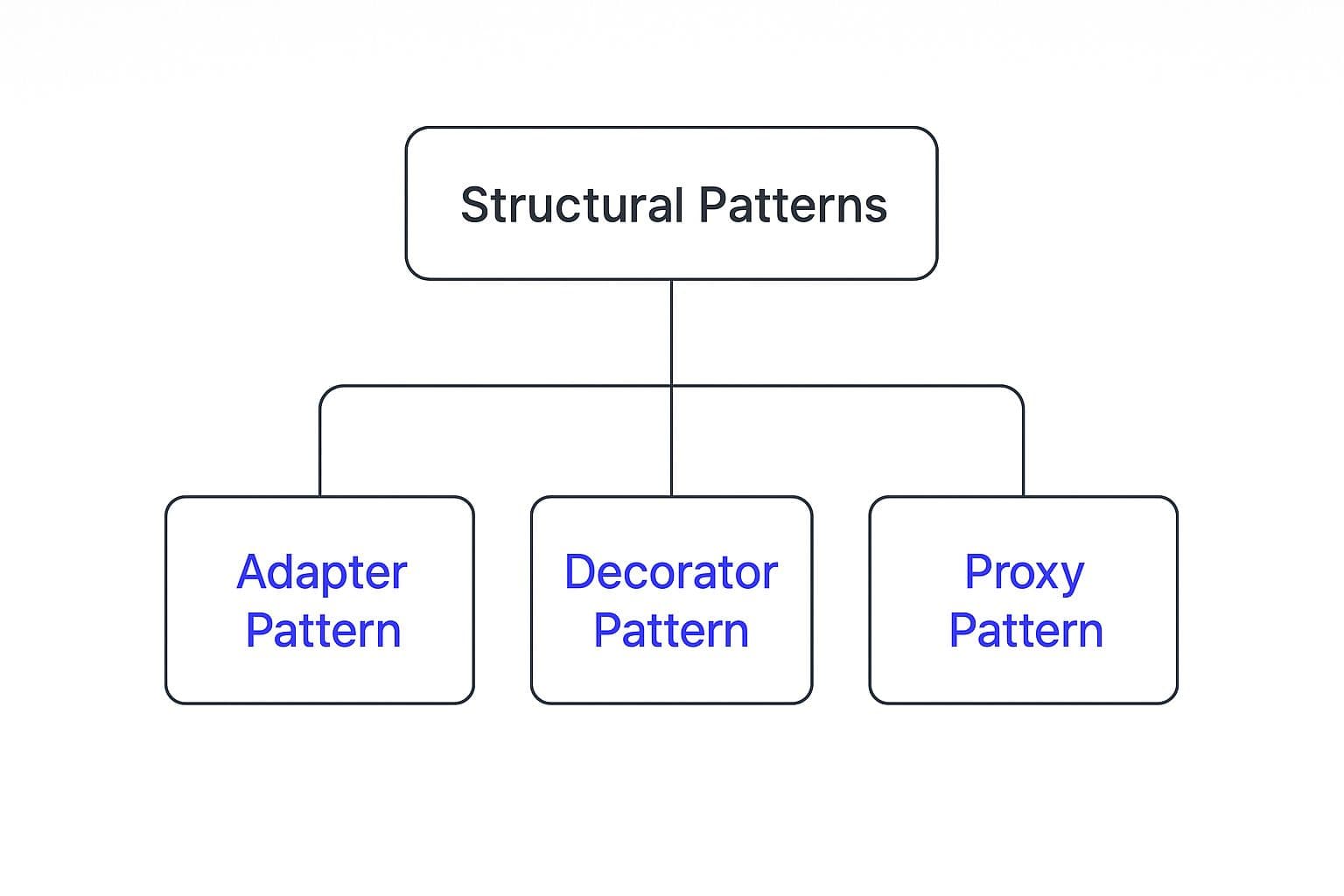
This diagram shows how different patterns fit into a larger hierarchy. Some, like the Adapter and Proxy shown here, are considered structural patterns that solve problems at the code level, while others define the entire system's structure.
The Event-Driven Pattern
Finally, we have the event-driven architecture. This pattern is all about decoupling. Think of a busy newsroom. Instead of reporters running around and telling each other every little update, they post their stories to a central bulletin board. Editors and other departments can then subscribe to the topics that interest them and react when a new story is posted.
In this architecture, a service "publishes" an event—like "UserCreated" or "OrderPlaced"—to a central message broker. Other services that care about that event are "listening" for it and can kick off their own processes in response.
This gives you some powerful advantages:
- Extreme Decoupling: Services don't even need to know that other services exist. They just need to know about the central event broker.
- Asynchronous Workflows: When a user places an order, you can fire off the "OrderPlaced" event and immediately return a confirmation. The shipping, inventory, and notification services can all do their work in the background without making the user wait.
- High Resilience: If one of the services that subscribes to an event is down, the others can keep on working just fine. The show goes on.
This pattern is a perfect fit for complex, distributed systems that need to be incredibly scalable and resilient, like modern e-commerce backends or IoT platforms. The trade-off? It can be harder to trace a single request from start to finish, which can make debugging a bit of a detective story.
Architectural Patterns At a Glance
Feeling a bit overwhelmed? That’s normal. To help you sort through these options, here’s a quick-glance table that boils each pattern down to its essence. This should give you a starting point for figuring out which approach might be the best fit for your project's goals.
| Pattern | Key Strength | Main Weakness | Best For |
|---|---|---|---|
| Monolithic | Simplicity and speed of initial development | Difficult to scale, maintain, and update over time | MVPs, small projects, and proofs-of-concept. |
| Layered (N-Tier) | Good organization and separation of concerns | Can still be monolithic; potential performance overhead | Applications requiring logical separation but not full distribution. |
| Microservices | Maximum flexibility, scalability, and resilience | High operational complexity and management overhead | Large, complex systems with independent, scalable components. |
| Event-Driven | Extreme decoupling and asynchronous processing | Harder to debug and trace system-wide workflows | Systems needing high resilience and real-time responsiveness. |
Remember, this is just a high-level guide. The "best" pattern is always relative to your specific needs, team skills, and long-term vision. The key is to make a conscious, informed decision rather than just falling into a default structure.
How to Choose the Right Architectural Pattern

Getting a handle on the different software architecture design patterns is one thing, but the real work starts when you have to pick one. This isn't just a technical choice; it's a strategic one that can make or break your project. The key is to look past the industry hype and take an honest look at your project's specific needs.
There’s no magic bullet or single "best" pattern. What works for a tech giant like Amazon could completely sink a nimble startup. It’s all about finding the right fit. Let's walk through a practical framework for weighing the crucial factors so you can make a decision that paves the way for success, not headaches.
Evaluate Your Team and Budget
First things first, look at the people you have. What’s their expertise? How big is the team? For a small crew of generalists, a simple monolith is often a godsend. With everything in one place, they can get their heads around the codebase quickly and start shipping features almost immediately.
On the other hand, jumping into a microservices architecture requires a team with some serious specialized skills in things like containerization, service discovery, and the nuances of distributed systems. If your team doesn't have that background, you'll spend more time wrangling the architecture than actually building your product, which can burn through your budget and timeline before you even get off the ground.
And speaking of budget, that's just as critical.
- Monolithic: This approach is typically cheaper to get started. You need less complex infrastructure and fewer specialized tools, which keeps those initial bills down.
- Microservices: The upfront cost can be steep. This pattern often requires a more powerful hosting setup, sophisticated monitoring tools, and potentially higher DevOps salaries to manage all the moving parts.
Think of it this way: are you building one highly efficient food truck or launching an entire chain of specialized restaurants? The single food truck is way cheaper and easier to get running, making it the perfect way to test your recipes.
Align with Your Business Goals
Next up, how does your architecture choice line up with your business goals? Specifically, how fast do you need to get to market? For most startups and new product launches, speed is everything. The main objective is to launch a Minimum Viable Product (MVP) and start collecting real user feedback as soon as possible.
When it comes to speed, a monolithic architecture is almost always the champion. Its inherent simplicity in development, testing, and deployment means a small team can build and launch with incredible velocity.
This lines up perfectly with the principles of agile development, where the focus is on rapid iteration. If your goal is to have an MVP in users' hands within a few weeks, a complex, distributed system is probably massive overkill. It just adds a layer of operational drag that will slow you down. You can see how this philosophy works in practice by learning more about the agile product development process, which is all about delivering value quickly.
Consider Scalability and Domain Complexity
While speed is king for an MVP, you can't completely ignore the future. What kind of growth are you expecting? If you're bracing for explosive growth, especially where one feature might get hammered with traffic while others stay quiet, microservices could be the smarter long-term play. Imagine an e-commerce site during a flash sale: the payment service is getting slammed, but the product review feature is seeing normal traffic.
Here's where you have to balance today's speed against tomorrow's flexibility.
- Simple Domain: If your business logic is fairly straightforward and isn't likely to get massively complicated, a monolith or layered architecture will probably serve you well for a good long while.
- Complex Domain: For applications with distinct, complicated business areas—think banking or logistics—microservices let you dedicate a focused, independent service to each part.
An honest assessment here is vital. A classic blunder is over-engineering for a level of scale that never materializes. Often, a well-designed "modular monolith" strikes the perfect balance, giving you the initial speed you need with the option to peel off services later if and when you truly need to. Choosing the right software architecture design patterns from day one is really about finding that sweet spot between today's needs and tomorrow's possibilities.
The Enduring Legacy of the Gang of Four
If high-level architectural patterns are the city plan for your software, then design patterns are the proven blueprints for the individual buildings. These are the classic, time-tested solutions to the common problems we face every single day when we write code. And their story starts with a landmark book that gave developers a shared language for the first time.
Back in 1994, a book titled Design Patterns: Elements of Reusable Object-Oriented Software hit the shelves and changed everything. Its authors—Erich Gamma, Richard Helm, Ralph Johnson, and John Vlissides—quickly became known as the Gang of Four (GoF). They introduced 23 foundational patterns that have since become a cornerstone of software engineering.
A Common Language for Developers
Before the GoF book, developers were essentially solving the same problems over and over, but in isolation. One team's clever way of handling object creation was a total mystery to another. Without a shared vocabulary, it was impossible to discuss these solutions efficiently. This led to a lot of wasted time and effort, with engineers constantly reinventing the wheel.
The Gang of Four didn't invent these patterns out of thin air. Instead, they did something even more valuable: they observed, documented, and gave names to the solutions that expert programmers were already using. Suddenly, a developer could say, "Let's use a Singleton for the logger," and the entire team knew exactly what that meant. No more long-winded explanations. This kind of clear, concise communication is invaluable, especially in fast-moving projects. For more on how this helps deliver products faster, take a look at our guide to agile development best practices.
This shared language took hold in a big way. Today, surveys show that over 90% of professional developers are familiar with the GoF patterns, and the original book has sold more than 500,000 copies. It truly established a common tongue for the industry. You can read the full history of these influential design patterns to see just how deep their roots go.
More Than Just History
It's tempting to look at something from 1994 and think of it as ancient history. But these patterns are anything but obsolete. They are woven into the very fabric of the modern software and frameworks you rely on.
- The Factory Pattern: When your framework magically hands you a fully configured object without you needing to use the new keyword and pass in a bunch of dependencies, that's a Factory pattern at work.
- The Observer Pattern: How does a user interface automatically refresh when data changes in the background? That's the Observer pattern, creating a clean communication channel between the data (the subject) and the UI elements (the observers).
- The Singleton Pattern: This pattern guarantees you only ever have one instance of a particular class. It's a perfect fit for managing a single, shared resource like a database connection or a settings manager.
Mastering these core concepts isn't about memorizing theories for an exam. It's about understanding the fundamental building blocks that connect high-level architectural decisions to the practical, line-by-line code that brings your application to life.
These patterns are decades of hard-won experience, distilled into reusable solutions for creating flexible and maintainable software. They form the critical bridge between your grand architectural vision and the code that makes it all happen. Knowing them doesn't just make you a better programmer—it makes you a better problem-solver.
Answering Your Top Questions About Architecture
As you get your hands dirty with software architecture, you're bound to run into a few head-scratchers. These concepts can feel a bit theoretical at first, and the real magic happens when you understand how to apply them to actual projects. Let's tackle some of the most common questions to clear up the fog and get you building with confidence.
These are the things teams often ask when the architecture talk begins.
What's the Real Difference Between Architectural and Design Patterns?
This is a classic question, but a simple analogy clears it right up. Think of it like planning a city versus designing an individual house.
An architectural pattern is your city plan. It's the big-picture strategy that decides where the residential neighborhoods, commercial districts, and industrial zones go. It dictates how major systems connect, much like a Microservices or Event-Driven architecture organizes an entire application. This is the macro-level thinking that shapes everything.
A design pattern, on the other hand, is the blueprint for one specific house in that city. It solves a smaller, contained problem, like the best layout for a kitchen or a standard for an energy-efficient window. Patterns like Singleton, Factory, or Observer work at the code level, inside a single component.
To put it simply, architectural patterns organize the major pieces of your system, while design patterns organize the code inside those pieces. You absolutely need both to build a solid, well-thought-out application.
Can You Mix and Match Architectural Patterns?
Yes, and in the real world, it happens all the time. It's rare for a large, complex application to follow a single, pure architectural style. Instead, developers often create a hybrid architecture, borrowing the best parts of different patterns to solve specific problems.
For example, a big e-commerce platform might be built on a Microservices architecture as its foundation. But if you look closer:
- The order management service might use a Layered (N-Tier) pattern internally to keep its own business logic, data access, and presentation layers separate and clean.
- To keep the whole system responsive, the communication between the microservices might rely on an Event-Driven pattern, ensuring they stay decoupled and can operate independently.
The goal isn't to achieve architectural purity for the sake of it. The real aim is to create a system that is robust, scalable, and easy to maintain. The secret is knowing when to apply a specific pattern to solve a specific problem, without making things more complicated than they need to be.
This practical, mix-and-match approach lets you tailor your architecture to the unique demands of your project, using the right tool for the right job at every turn.
Is It a Mistake to Start with a Monolith?
Not at all. For many new projects, it's actually the smartest move you can make. A monolithic architecture is often the perfect starting point for new products, startups, and MVPs (Minimum Viable Products). Why? Because it’s simpler to build, more straightforward to test, and faster to get into the hands of users. This speed is crucial for small teams looking to validate an idea and iterate quickly based on real feedback.
The mistake isn't starting with a monolith. The mistake is building a messy one with tangled-up code that becomes a nightmare to change later on. That's how you end up with the dreaded "big ball of mud" that kills momentum.
The key is to build a modular monolith. This means that even though you deploy everything as one piece, the code inside is neatly organized into distinct, loosely-coupled modules with clear boundaries. By being disciplined from day one, you get the speed of a monolith with the flexibility to evolve. If the time comes to scale up, you can peel off those clean modules and turn them into independent microservices with far less pain. For most new ventures, starting simple is the best way to move forward.
Ready to turn your idea into a tangible product without getting bogged down by architectural debates? At Iglu Digital, we specialize in building and launching high-quality MVPs with the scope and the price agreed before we start. We handle the technical strategy so you can focus on your vision. Learn how we can bring your concept to life at iglu.dev.