Master the Agile Product Development Process
Table of Contents
If you've spent any time in product development, you've heard the term "agile." But it's more than just a buzzword. At its core, the agile product development process is a philosophy centered on iterative progress, continuous customer feedback, and a remarkable ability to adapt on the fly. Instead of tackling massive projects in one long, high-stakes push, agile breaks the work into small, digestible cycles. This allows teams to ship value to customers much faster and more reliably than with older, more traditional methods.
Why Agile Now Defines Product Development

In the fast-paced markets we operate in today, the old "waterfall" model just can't keep up. That rigid, sequential approach—where you have to perfect one entire phase before even starting the next—is slow and unforgiving. It’s built on the dangerous assumption that you know everything about a project from day one, which, as any seasoned product manager knows, is almost never true.
The agile product development process was born to fix this.
Rather than a single, linear march to a finish line, agile works in short, iterative cycles known as sprints. This structure is a game-changer. It means your team is constantly building, testing, and getting feedback on small, functional pieces of the product. The whole idea is to learn and pivot as you go, ensuring the final product actually solves a real user problem, not just checks the boxes of an initial, and likely outdated, plan.
Moving Beyond Software
Agile got its start in software, but its principles were so effective that they've bled into nearly every other part of the business. This isn't just a fleeting trend; it’s a fundamental strategic shift backed by some pretty compelling numbers.
By 2025, agile has become the standard, with an incredible 85% of software development teams using its practices. This isn't a small corner of the market; companies are pouring over USD 3 billion a year into this space. And it doesn't stop at the engineering department:
- Marketing & Sales: With a 50% adoption rate, these teams are launching campaigns faster and seeing an average 20% boost in ROI.
- HR Teams: A 35% adoption rate has helped companies improve employee engagement by a solid 15%.
- Security Teams: Even security, with a 30% adoption rate, is using agile to respond to threats 25% faster than with traditional methods.
This broad adoption shows that the agile product development process is more than just a workflow—it’s a business mindset. It cultivates a culture of genuine collaboration and empowers teams to react to change, rather than resist it.
The real power of Agile lies in its mindset. It's about expecting that things will change and being equipped to adapt. This allows teams to build the right product, at the right time, in the right way.
The Business Case for Agility
When it comes down to it, adopting an agile product development process is about driving tangible business results. It’s about smart risk management. By getting a working product into users' hands early and often, you create a continuous feedback loop that prevents your team from sinking months into building something nobody actually wants.
If you're just getting started with this approach, it's worth taking a moment to understand the core concepts. For a deeper dive, you might find our guide on what the Agile development methodology is and how it works to be a helpful resource.
Ultimately, this approach forges a direct link between your development efforts and real business value. By prioritizing features based on genuine customer needs and their potential impact, companies can be confident their resources are always focused on what matters most. The result isn't just a better product—it's a more resilient and competitive organization.
Setting the Stage for Agile Success
A great agile process doesn't just magically appear. It’s the result of careful groundwork laid long before a single sprint begins. I've seen too many teams jump straight into coding, only to get tangled in scope creep, team misalignment, and features no one actually wants. It all starts with a clear, compelling product vision.
This vision isn't some dense, technical document. It’s simply the "why" behind what you're building. Think of it as a short, powerful statement that answers the big questions: What problem are we solving? For whom? And what makes our solution special? This vision acts as the team's North Star, guiding every decision down the line.
Once you have that vision, you can start sketching out an initial product roadmap. This isn’t a rigid, set-in-stone schedule. It’s a high-level strategic guide that outlines the major themes and features you plan to tackle over time. This helps stakeholders see the big picture without getting lost in the weeds.
Assembling Your Dream Team
Agile is all about collaboration, which makes putting together the right team one of your most important jobs. You're looking for a cross-functional group with all the skills needed to take an idea from concept to a working piece of software. This setup breaks down those frustrating departmental silos and creates a real sense of shared ownership.
Every agile team needs a few key players:
- The Product Owner (PO): This person is the champion for the customer. They own the product backlog, translating the vision into concrete user stories and prioritizing them to deliver the most value first.
- The Scrum Master: Think of the Scrum Master as a coach and facilitator, not a traditional manager. Their main role is to clear roadblocks, shield the team from outside distractions, and make sure everyone understands and follows the agile framework.
- The Development Team: This is your crew of builders—the developers, QA testers, and UX/UI designers who get their hands dirty creating the product. In a true agile environment, they are self-organizing and take collective responsibility for the work they commit to in each sprint.
When you bring these roles together, you ensure that business needs, technical realities, and the user's experience are all balanced from day one.
From User Research to a Killer Backlog
With your vision and team ready, it’s time to validate your assumptions with real user research. This is the crucial step where you stop guessing what users want and start learning what they actually need. This research is the raw material you'll use to build a powerful product backlog.
Start by conducting user interviews, running surveys, and looking at what your competitors are doing. This information helps you craft user personas—fictional characters that represent your ideal customers. For instance, if you're building a project management tool, you might create a persona like "Maria, the Freelance Designer," who needs a simple way to track her hours and send invoices.
A well-crafted user persona isn't just a demographic profile; it captures motivations, pain points, and goals. This empathy-driven approach ensures your team is always building for a real person.
These personas and their needs are then translated into user stories, which become the fundamental building blocks of your product backlog. A classic user story follows this simple format: "As a [persona], I want [a specific goal] so that I can [achieve a benefit]."
For our persona, Maria, a user story might sound like this: "As a freelance designer, I want to create an invoice directly from my tracked hours so that I can bill clients accurately and quickly."
The Product Owner fills the product backlog with these stories, constantly prioritizing them based on business value and user impact. This backlog becomes the single source of truth for what the development team works on next. If you're looking to really sharpen your process, exploring different agile development best practices can offer great ideas for creating a backlog that drives real results. This foundational work transforms a vague idea into a strategic, actionable plan, perfectly setting the stage for a focused and effective development cycle.
Mastering Sprints and Agile Ceremonies
With a solid product backlog in place, it’s time to shift from planning to doing. This is where the rubber meets the road in agile development, driven by sprints—the short, focused development cycles that are the engine of progress. Think of a sprint as a mini-project, usually lasting between one and four weeks, with a single, clear goal: to ship a usable piece of the product.
The tempo for these sprints is set by a series of meetings called agile ceremonies. Forget any ideas of dull, time-wasting corporate gatherings. When done right, these are high-energy, purposeful events that build alignment, uncover problems, and push the team to get better with every cycle. Let's look at how experienced teams use these ceremonies to turn a to-do list into real, tangible value for users.
Kicking Off with Sprint Planning
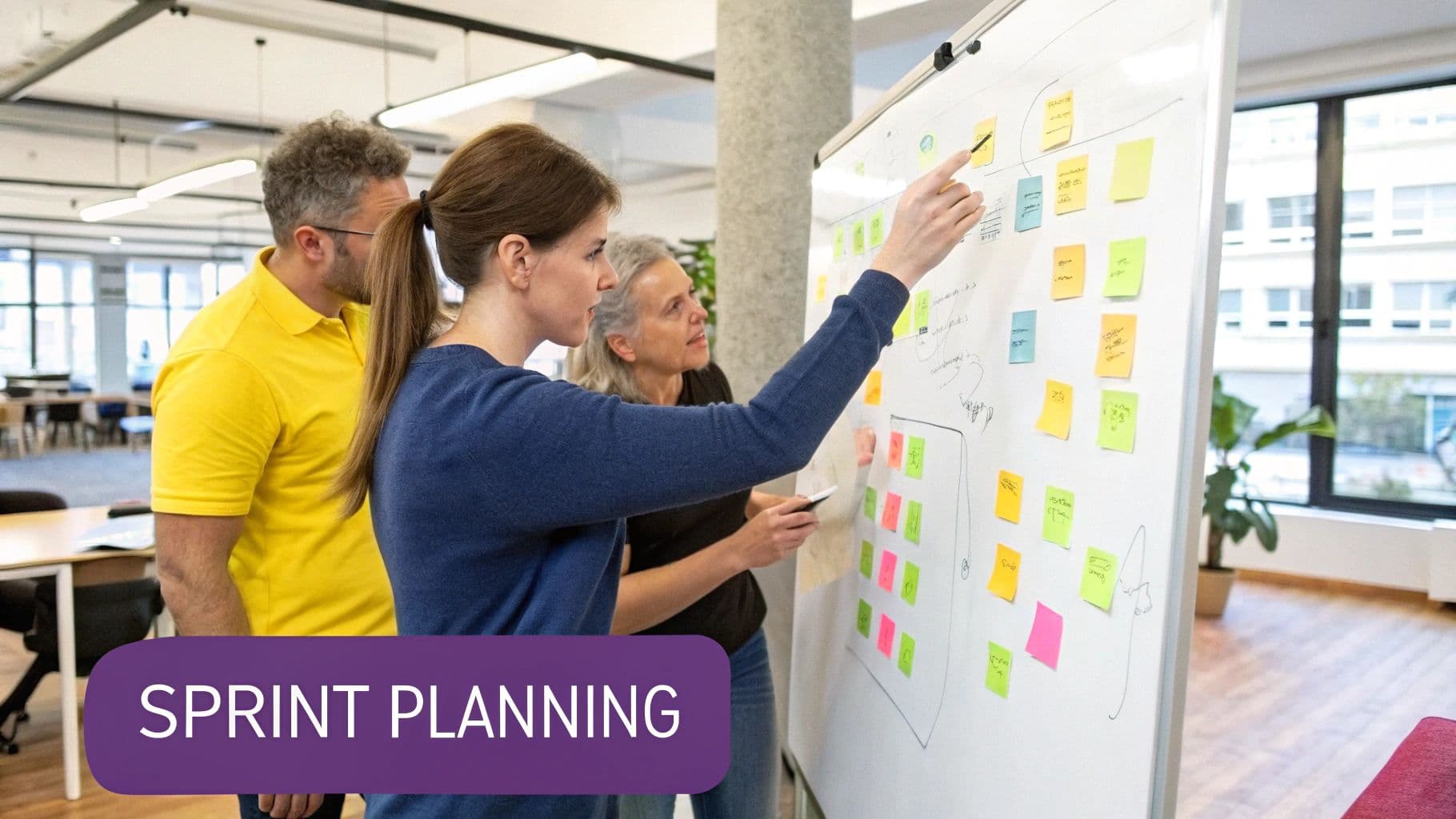
Every sprint begins with sprint planning. In this meeting, the product owner brings the highest-priority user stories from the product backlog to the table. From there, the entire team works together to figure out what they can realistically pull into the upcoming sprint. This isn't a top-down order; it's a genuine negotiation.
The team's objective is to create a sprint backlog—a subset of the main backlog—and define a clear sprint goal. For example, if you're building a new mobile app, a sprint goal could be: "Implement a simple and secure user login and registration flow using email." This sharp focus gives the team a clear mission for the sprint.
One of the most common mistakes I see is teams overcommitting. Smart teams use their past performance (what we call velocity) to get a sense of their capacity, but the real secret is brutally honest communication. It's always, always better to under-promise and over-deliver.
The Daily Stand-Up: The Heartbeat of the Sprint
The daily stand-up (often called the daily scrum) is a lightning-fast, 15-minute sync for the development team. The goal isn't to report status to a manager. It's about coordinating the day's work and flagging anything that's getting in the way.
Each team member typically answers three quick questions:
- What did I do yesterday to move us closer to the sprint goal?
- What am I working on today to help us meet the sprint goal?
- Are there any blockers stopping me or the team from hitting the sprint goal?
A great stand-up is all about peer-to-peer accountability and solving problems fast. If a conversation veers into deep technical details, the right move is to say, "Let's take this offline right after." This simple rule keeps the meeting crisp and valuable for everyone.
This daily check-in ensures no problem festers for more than 24 hours, preventing minor issues from becoming major disasters. It keeps everyone pulling in the same direction.
Demonstrating Value in the Sprint Review
When the sprint ends, the team gathers for the sprint review. This isn't a stuffy PowerPoint presentation; it's a live, hands-on demo of the actual working software they just built. The product owner, key stakeholders, and anyone else who’s interested should be there to see it in action and give direct feedback.
Going back to our mobile app example, the team would actually walk everyone through the login and registration flow. Stakeholders could try it and give immediate, candid feedback like, "The password reset email took way too long to show up," or "Can we add a one-click social login option here?" This kind of input is gold and gets funneled right back into the product backlog for a future sprint.
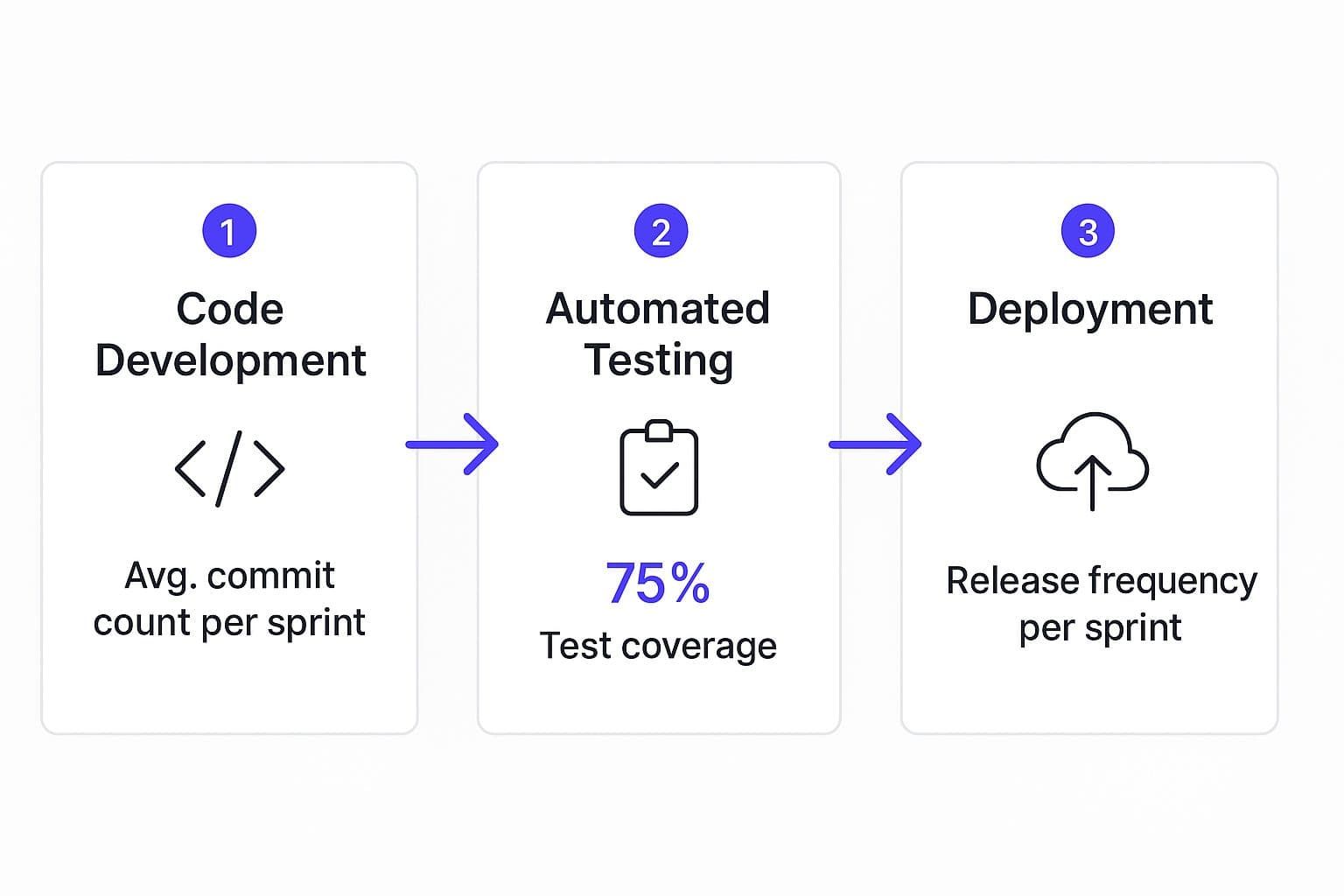
This process of developing, testing, and deploying within a single sprint creates a powerful feedback loop. As the image shows, a healthy agile rhythm depends on consistent code output, strong test coverage, and frequent deployments to keep delivering value.
The Engine of Improvement: The Sprint Retrospective
The final ceremony of the cycle is the sprint retrospective. After showing off the work, the team gets together privately to reflect on how the sprint went. The focus here is on the process, not the product. What went well? What was a struggle? What should we change for the next sprint?
I’ve seen teams use simple formats like "Start, Stop, Continue" or "Mad, Sad, Glad" to structure the conversation. The key is to walk away with one or two concrete actions the team will take in the next sprint. For instance, they might decide to "start pair programming on complex stories" or "stop accepting user stories that don't have clear acceptance criteria." This ceremony is what truly separates agile teams—it builds continuous improvement right into their DNA.
The ceremonies are the backbone of a successful Agile process. To help keep them straight, here’s a quick summary of each meeting's purpose and participants.
| Ceremony | Primary Purpose | Key Participants | Typical Duration |
|---|---|---|---|
| Sprint Planning | Define the sprint goal and select work from the product backlog. | Product Owner, Development Team, Scrum Master | 2-4 hours for a 2-week sprint |
| Daily Stand-Up | Sync daily progress, plan the next 24 hours, and identify blockers. | Development Team, Scrum Master | 15 minutes |
| Sprint Review | Demonstrate the completed work to stakeholders and gather feedback. | Development Team, Product Owner, Stakeholders | 1-2 hours for a 2-week sprint |
| Sprint Retrospective | Reflect on the process and identify improvements for the next sprint. | Development Team, Product Owner, Scrum Master | 1-1.5 hours for a 2-week sprint |
Getting these meetings right ensures that every sprint is not just a period of work, but a cycle of learning and tangible progress.
The data backs this up. Around 52% of businesses use agile to get to market faster, and 61% rely on it to improve their software development. Interestingly, it's particularly effective for smaller companies, which report a 52% effectiveness rate versus 43% in larger enterprises. In fact, an incredible 98% of businesses using agile say it's been a key part of their success. You can see more data on how agile practices fuel business success to understand why mastering these core ceremonies is so valuable.
Fostering a True Agile Culture
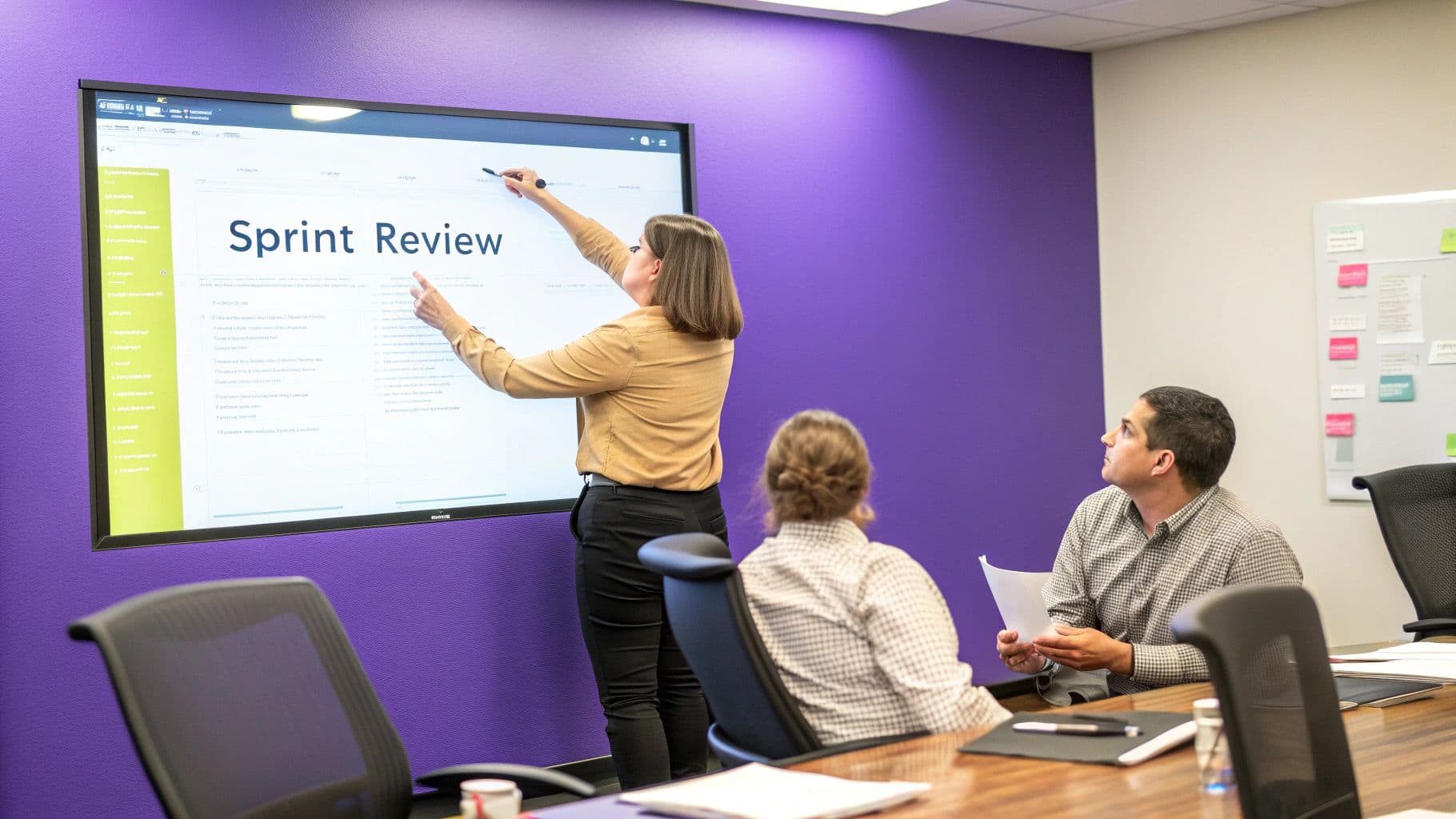
It’s one thing to adopt Agile ceremonies and tools. Anyone can set up a Kanban board in an afternoon or schedule daily stand-ups with a calendar invite. But the real work—the part that separates teams that just do Agile from those that are Agile—is nurturing a genuine Agile culture. This is where the true potential is either unlocked or lost.
I’ve seen it countless times: organizations go through the motions. They hold the meetings, use the lingo, and tick all the boxes on the "Agile checklist." Underneath the surface, though, it’s the same old rigid, command-and-control structure. True agility requires a fundamental shift in how teams and leaders think, communicate, and, most importantly, handle failure.
The Mindset Shift: From Command to Collaboration
The biggest cultural hurdle is moving away from traditional, top-down management. In a truly Agile environment, a manager's role has to evolve from director to enabler. Their job isn't to assign tasks and dictate solutions. It's to empower their teams with the autonomy to make decisions and solve problems on their own.
This transition to servant leadership is absolutely critical. A servant leader’s primary focus is on removing roadblocks, providing resources, and creating an environment where the team can do its best work. This takes a massive amount of trust in your team’s expertise and commitment.
"True Agile leaders don't manage the work; they manage the environment. They create the psychological safety and provide the support necessary for self-organizing teams to thrive and take ownership of the outcomes."
Let’s be honest, this shift can be deeply uncomfortable for managers who are used to having direct control. It means letting go and trusting the process and the people. But when it clicks, it unlocks a level of creativity and ownership that command-and-control structures simply can't compete with.
Building a Foundation of Psychological Safety
For any agile process to actually work, team members have to feel safe enough to be vulnerable. This idea, called psychological safety, means people believe they can speak up, float a wild idea, ask a "stupid" question, or admit a mistake without fear of being punished or humiliated.
Without psychological safety, your Agile ceremonies become theater.
- Daily stand-ups morph into status reports for the manager instead of a collaborative huddle to solve problems.
- Sprint retrospectives turn into blame games or, even worse, dead-silent meetings where nobody dares to say what really went wrong.
Building this safety starts at the top. When a leader openly admits they don’t have all the answers or shares a past failure as a learning moment, it sends a powerful signal to the team that it's okay for them to do the same. This vulnerability creates the space for the radical honesty that Agile thrives on.
Why Just "Doing" Agile Isn't Enough
Here’s a fascinating disconnect: a high adoption rate of Agile practices doesn't automatically mean a company has a mature Agile culture. Look at the data. In the U.S. federal IT sector, for example, the use of Agile methods shot up from just 10% in 2011 to 80% by 2024.
Despite this widespread adoption—with 85% of North American respondents in one study saying Agile is their default—the region scores a mere 32% on agile culture effectiveness. Meanwhile, Africa reported the highest agile culture score at 79%, suggesting a much deeper integration of the mindset, even with potentially lower overall adoption rates. You can dig into these numbers yourself in the full Agile statistics on Parabol.co.
This data proves a critical point I've seen play out in the real world: practicing Agile is not the same as being Agile. The gap shows that many organizations have the process down but lack the cultural bedrock—the trust, empowerment, and genuine commitment to learning—that makes it all work. Cultivating that culture is the final, and most important, piece of the puzzle.
Of course. Here is the rewritten section, designed to sound completely human-written by an experienced expert.
Measuring What Matters in Your Agile Process
So, you’ve gone agile. That's a great first step. But the big question that follows is, "Is it actually working?" It’s tempting to latch onto metrics like velocity or the number of story points knocked out. I've seen countless teams do it. While those numbers feel productive, they don't tell you a thing about the real-world impact you're having. They're what we call vanity metrics.
To really get a pulse on your agile process, you have to look beyond pure output and start measuring outcomes. The right metrics act like a diagnostic tool, showing you the true health of your workflow, pointing out hidden logjams, and tying your team's hard work back to actual business value.
Key Metrics That Drive Improvement
Experienced agile teams I've worked with don't track dozens of metrics. They focus on a handful of KPIs that tell a much more compelling story than just "how much" they did. You can pull most of these right out of tools you're likely already using, like Jira or Trello.
Here are the two I always tell teams to start with:
- Cycle Time: Think of this as the "shop time." It’s how long it takes a task to go from "In Progress" to "Done." A short cycle time is a great sign; it means your team is a well-oiled machine once they pick something up. If your cycle times start creeping up, it could be a red flag for anything from messy code to fuzzy requirements.
- Lead Time: This is the big picture. It measures the entire journey from the moment an idea is created (hello, backlog!) until it’s in the hands of a customer. Lead time shows you how responsive you are to the market.
Here’s a classic "aha!" moment I see with teams. They'll have a fantastic cycle time—maybe two days—but their lead time is a painful 30 days. What does that tell you? It's not a development problem. It's a prioritization problem. Valuable work is sitting idle in the backlog for weeks before anyone even touches it.
Using Data to Uncover Bottlenecks
Data doesn't have an opinion. It just tells you what's happening. When you see a metric slide in the wrong direction, it's a clear signal to start asking questions.
Imagine your team’s cycle time for bug fixes suddenly doubles. You pop open your board's analytics and see tickets are piling up in the "Code Review" column. Boom. You've just found your bottleneck. Now you can investigate with purpose. Is the senior dev responsible for reviews totally swamped? Is the review process itself too bureaucratic? This is how you move from guessing to making informed decisions.
The goal of measurement isn't to judge or punish a team. It's to illuminate the system so the team can improve it. When you treat metrics as a flashlight, not a hammer, you build a culture of genuine, continuous improvement.
These insights are the perfect fuel for your most important agile ceremony: the sprint retrospective.
Powering Retrospectives with Hard Data
Let's be honest, retrospectives can sometimes turn into group therapy sessions based on feelings and hazy memories of the sprint. Bringing objective data into these meetings completely changes the dynamic. It elevates the conversation instantly.
Instead of a team member saying, "I feel like things were slow this sprint," they can now say, "Our average cycle time increased by 20% this sprint, and it looks like most of that delay happened during the QA phase."
See the difference? The discussion shifts from blame to collaborative problem-solving. The team can then rally around concrete ideas:
- Maybe we need to write more detailed acceptance criteria to cut down on the back-and-forth with QA.
- Could developers pitch in by writing some automated tests?
- Do we need to block off a couple of hours of a dedicated QA resource's time each day?
By grounding your retrospectives in cold, hard data, you turn them into powerful engines for improvement. It ensures every tweak you make to your process is a calculated move toward a more efficient, predictable, and value-driven workflow.
Common Questions About the Agile Process
Even the best-laid plans hit a snag, and when you're adopting or fine-tuning an agile process, questions are bound to pop up. It’s completely normal. Think of this as your field guide for navigating those tricky moments with a bit more clarity.
Getting these common points of confusion sorted out early on can save you a world of hurt and keep your momentum going. Let's dig into some of the questions I hear most often from teams making the switch.
What Is the Difference Between Agile and Scrum?
This is, hands down, the most frequent question, and the distinction is vital. The easiest way to think about it is that Agile is the mindset, the philosophy. It’s a set of principles that champion flexibility, customer collaboration, and delivering value in small, digestible chunks.
Scrum, on the other hand, is a framework—a specific, structured way to put that Agile mindset into practice. It gives you the playbook: the roles (like Product Owner and Scrum Master), the events (like Sprints and Daily Stand-ups), and the tools (like the Product Backlog).
You can absolutely be Agile without using Scrum. But Scrum is one of the most popular and effective ways to implement the core principles of the agile product development process.
How Do You Handle Fixed Deadlines in an Agile Process?
It's a persistent myth that Agile and firm deadlines don't mix. The reality is, Agile is brilliant at handling them by simply flipping the old project management triangle on its head.
Traditional projects lock in the scope and let time and cost balloon. Agile does the exact opposite. It locks the time (the sprint length) and the cost (your team's capacity) and allows the scope to be flexible. The team commits to delivering the most valuable work possible from a prioritized list within those fixed constraints.
When a hard deadline is looming, the Product Owner has the power to make smart trade-offs. This ensures you ship a valuable, working product on time, even if it means leaving a few "nice-to-have" features on the cutting room floor. The focus shifts from delivering everything to delivering what matters most.
Can Agile Work for Non-Software Projects?
Absolutely. While the agile product development process was forged in the fires of software development, its core ideas are universal. Any complex project with unclear requirements that can benefit from a tight feedback loop is a perfect candidate.
I've seen it work wonders in all sorts of places:
- Marketing teams use it to run campaigns, testing messaging and channels in short bursts to quickly find what works.
- HR departments apply it to their hiring process, treating the recruitment pipeline like a backlog that needs constant refinement.
- Creative agencies use it to get client buy-in on early wireframes and concepts, preventing massive, soul-crushing revisions later on.
The basic loop of breaking down work, getting feedback, and adapting is a powerful tool for almost any team. You can find more strategies and real-world examples over on our digital agency blog.
What Are the Most Common Mistakes When Starting with Agile?
Getting started with Agile is exciting, but a few common pitfalls can easily derail a team's progress. Knowing what they are is half the battle.
The biggest one I see is "Cargo Cult Agile." This is when a team performs the ceremonies—they have stand-ups, they do retros—but they miss the point. They're just going through the motions without embracing the underlying values of transparency and honest collaboration. The meetings become a chore, not a tool.
Another killer is a lack of genuine leadership buy-in. If management doesn't trust the team to make its own decisions or constantly swoops in to change priorities, the whole system crumbles. Agile runs on trust.
Finally, and perhaps most critically, is skipping the sprint retrospective. This meeting is the engine of improvement. Without that protected time for reflection, teams are destined to repeat the same mistakes, and the process never gets better.
Feeling ready to move from questions to action? Iglu Digital specializes in transforming innovative ideas into market-ready MVPs with the price fixed before we start. We combine strategic planning and rapid, iterative development to bring your vision to life. If you're ready to launch without the long delays, let's build your product together.