Understanding Roles in Agile Software Development

Table of Contents
Forget the old-school, rigid job titles. Modern software development isn't an assembly line; it’s more like a skilled jazz ensemble. Each musician has a distinct part to play, but they all listen, adapt, and improvise together to create something incredible. That’s the essence of Agile.
How Modern Agile Teams Are Structured
Traditional project management often gets bogged down by communication silos and slow, top-down decision-making. Agile flips that script. It champions a fluid, collaborative setup where small, self-sufficient teams get the job done. Roles aren't about who's in charge, but about who's responsible for what. This structure is built for one purpose: to move faster, build better products, and pivot on a dime when needed.
This isn't just a fleeting trend. It's a fundamental shift in how high-performing teams work. The proof is in the numbers: between 2018 and 2023, Agile adoption among developers skyrocketed from 37% to 86%. It’s become the go-to methodology for a reason.
The Three Pillars of an Agile Team
When you look under the hood of most Agile frameworks, especially Scrum, you'll find three core roles that make everything click. Each one has a unique focus, but they're completely interdependent. Nail this trio, and you're well on your way to understanding why Agile works so well.
- The Product Owner: This person is the visionary. They're the voice of the customer, laser-focused on making sure the team is building the right thing.
- The Scrum Master: Think of them as the team's coach and facilitator. Their job is to remove roadblocks and help the team work as effectively as possible.
- The Development Team: These are the builders. They're the cross-functional crew of experts who take the vision and turn it into a real, working product.
This diagram shows how these three essential roles form the foundation of the team.
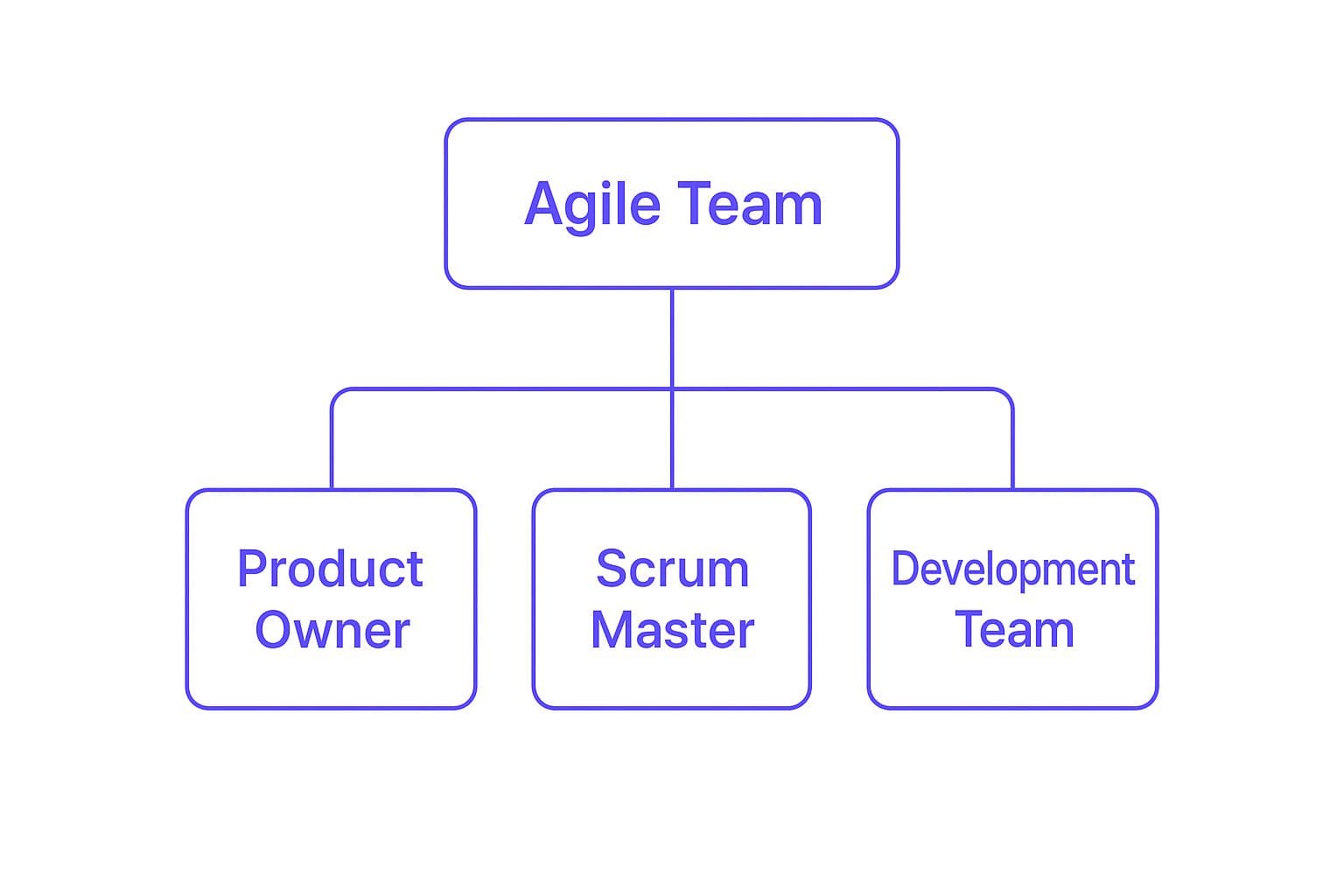
As you can see, they aren't separate departments that toss work over a wall. They're interconnected parts of a single unit. This integration ensures that the business goals, team processes, and technical work stay perfectly aligned. If you want to dive deeper into this, our guide on building the right software development team structure covers it in more detail.
Core Agile Roles at a Glance
To quickly recap, here’s a simple breakdown of the core Agile roles and what they bring to the table.
| Role | Primary Focus | Key Contribution |
|---|---|---|
| Product Owner | Maximizing product value | Defines features and prioritizes the backlog. |
| Scrum Master | Ensuring team effectiveness | Facilitates Agile processes and removes impediments. |
| Development Team | Building a high-quality product | Designs, builds, and tests the product increment. |
This clear division of responsibilities is what gives Agile teams their edge.
The real power of the Agile model is its simplicity and focus. By defining these core responsibilities so clearly, teams cut through the noise, eliminate clumsy handoffs, and can concentrate on what really matters: delivering value to users, sprint after sprint.
The Product Owner: Guiding the Vision
If you think of an agile team as a film crew, the Product Owner (PO) is the director. They hold the complete vision for the final product and make sure every single feature contributes to the overall story. They are the single source of truth for what the team needs to build and, most importantly, why.
The PO represents the voice of the customer and every other stakeholder involved. Their main job is to translate high-level business goals and messy user feedback into a clear, prioritized to-do list for the team—the product backlog.
The Art of Managing the Product Backlog
The product backlog is the Product Owner's most important tool. It’s a living, breathing, ordered list of everything that might ever be needed for the product. The PO doesn't just add ideas to this list; they are constantly refining it, re-prioritizing items, and making sure the development team understands what’s on it and why it matters.
This isn't a "set it and forget it" task. The PO is always juggling competing demands—new customer requests, paying down technical debt, and chasing new business opportunities—to figure out what will deliver the most value right now. This is where their strategic thinking really comes into play.
A well-managed backlog is the bedrock of a successful agile project. The Product Owner's ability to clearly define and prioritize this list directly correlates with the team's ability to deliver value efficiently and consistently.
Core Responsibilities of the Product Owner
A great Product Owner wears many hats, but their work boils down to a few key functions that keep the project aimed squarely at its business goals.
- Defining User Stories: They're masters at breaking down big, fuzzy ideas into small, clear, and testable user stories. For instance, a vague request like "build a login page" becomes a concrete story: "As a registered user, I want to log in with my email and password so I can access my account dashboard."
- Prioritizing the Work: They make the tough calls on what the team works on next, often using a value vs. effort analysis. Crucially, they must have the authority to say "no" to ideas that don't align with the product vision.
- Communicating with Stakeholders: The PO is the main go-between for the development team and everyone else. This means gathering feedback from real users, giving progress updates to executives, and making sure everyone is on the same page about where the product is headed.
- Accepting Completed Work: When a sprint ends, the Product Owner reviews the work the team has finished. They are the ones who give it the final "thumbs up," confirming it meets the acceptance criteria and actually delivers the value it was supposed to.
By handling these responsibilities, the Product Owner acts as a shield for the development team, protecting them from conflicting priorities and distractions. They provide the focus and clarity developers need to do what they do best: build an amazing product. This role ensures every sprint isn't just busy work, but a deliberate step toward achieving the product's strategic goals and maximizing the project's return on investment.
The Scrum Master: Your Team’s Secret Weapon
If the Product Owner is all about the what, the Scrum Master is obsessed with the how. A lot of people mistakenly think this is just a fancy new title for a project manager, but that couldn’t be further from the truth. The Scrum Master is a servant-leader, a coach whose entire mission is to get the team to its peak performance.

Think of them as the coach for a pro sports team. They're not on the field playing the game. Instead, they’re making sure the team understands the rules, has what it needs to succeed, and is shielded from outside distractions that could throw them off their game. This unique role is fundamental to making agile work, creating an environment where the team can constantly get better.
Facilitator and Blocker-Tackler
One of the most visible parts of the Scrum Master's job is running the key agile meetings, or "ceremonies." They make sure daily stand-ups are quick and to the point, sprint planning ends with a clear, achievable goal, and retrospectives actually lead to real change. They're the ones who keep these meetings on track and protect them from getting derailed.
But where they really earn their keep is by removing impediments. An impediment is anything—and I mean anything—that slows the team down. It could be a technical roadblock, a missing piece of software, or even a conflict between team members.
Imagine a developer is stuck because they need an API key from another department. Instead of the developer wasting hours chasing people down, the Scrum Master steps in. They'll hunt down the right person, escalate the issue if needed, and handle all the back-and-forth so the developer can get back to what they do best: writing code. This kind of proactive problem-solving is a massive boost for both speed and morale.
The Scrum Master is the guardian of the process. Their success isn't measured by features delivered, but by the team's growing ability to self-organize, collaborate effectively, and consistently deliver value without friction.
A Coach for Agile Principles
Beyond just running meetings, a great Scrum Master is an agile coach. They are a teacher and a mentor who helps the team truly embrace the agile mindset. This means coaching individuals, guiding tough conversations, and helping the team learn to hold itself accountable.
Ultimately, their work builds a foundation of psychological safety. It creates a space where team members feel safe enough to try new things, ask for help, and even fail—because failure is just another opportunity to learn and improve.
This kind of expertise doesn't go unnoticed. As of 2025, an impressive 44% of certified Scrum Masters earn over $100,000 per year. That's a huge jump from the 18% of non-certified professionals in the same bracket. This pay gap shows just how much companies value having a skilled guide for their agile journey. You can dive deeper into these industry trends and what they mean for Agile roles.
The Development Team: Turning Ideas into Reality
If the Product Owner sets the destination and the Scrum Master clears the road, the Development Team is the engine that actually propels the project forward. These are the professionals who get their hands dirty, transforming the concepts in the product backlog into tangible, working software. This is where the vision truly meets execution.
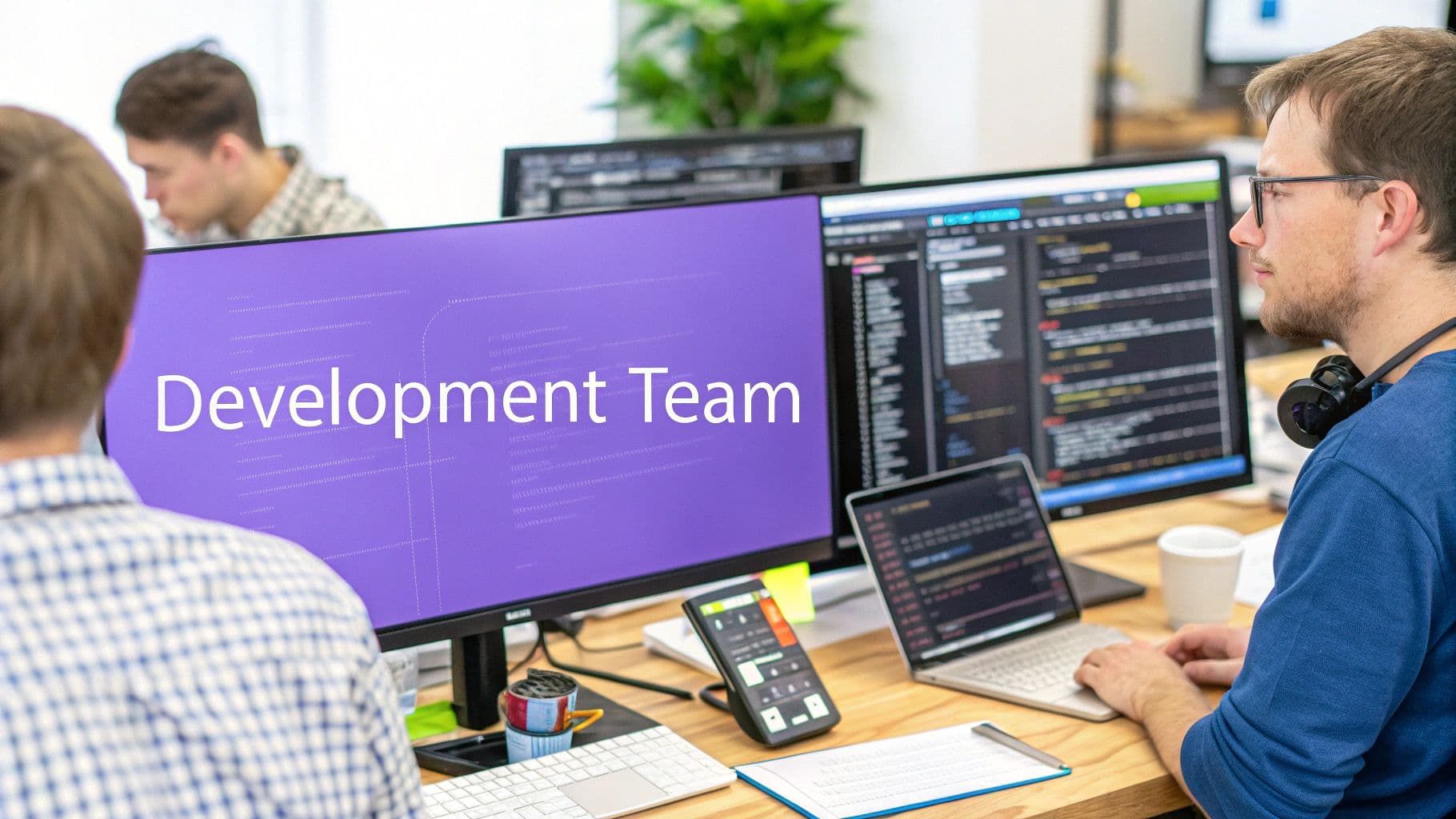
I like to think of them as a special forces unit. Every member has a unique specialty, but they operate as a single, cohesive team to accomplish the mission. There’s simply no room for a "that's not my job" attitude on a high-performing agile team. They win or lose as one.
The team is kept intentionally small—usually between three to nine people—to keep communication clear and stay nimble. The two most important characteristics are that they are cross-functional and self-organizing.
A Cross-Functional Powerhouse
A cross-functional team has all the skills onboard to deliver a finished piece of the product without waiting on outside help. This sense of collective ownership is one of the most powerful parts of agile development.
A typical team might include:
- Software Engineers who write the code.
- QA Engineers who are laser-focused on testing and quality.
- UX/UI Designers who make sure the product is intuitive and easy to use.
- Database Administrators or other specialists, depending on the project's needs.
Instead of a clunky, siloed process where designers throw mockups over the wall to developers who then toss their work to testers, everyone works in parallel. This close-knit collaboration slashes delays and misunderstandings, creating a shared commitment to quality from day one.
The goal of a cross-functional team is to minimize dependencies and maximize flow. When the team has every skill it needs to move an idea from concept to completion, it becomes a self-sufficient value-delivery machine.
The Power of Self-Organization
In a true agile setup, nobody tells the Development Team how to build the product. They are trusted as the experts with the autonomy to figure out the best technical path to get the job done.
This freedom is critical. The team collectively decides who will work on what, how they’ll navigate technical hurdles, and the best way to hit the sprint goal. This empowerment creates a deep sense of ownership and accountability, which almost always leads to more innovative solutions and a better final product.
Their main responsibility is delivering a "potentially shippable increment" of the product at the end of every single sprint. This doesn’t just mean the code is done. It means the feature is designed, built, tested, integrated, and genuinely ready for release. By consistently delivering these high-quality increments, the team provides the steady, predictable value that is the hallmark of any successful agile project.
How Supporting Roles Fuel Agile Success
An Agile project is so much more than just its core team. To really succeed, you need key supporting players—think of them as the pit crew for a Formula 1 car. They aren't in the driver's seat, but without their specialized skills, insights, and feedback, you're not going to win the race.
These supporting roles don’t get in the way of the core team's rhythm; they make it better. They bring in that crucial outside perspective, the deep understanding of the user, and specific domain knowledge that the Development Team needs to turn a good product into a great one. Learning how to weave them into the process is a sign of a truly mature Agile operation.
The Critical Role of Stakeholders
So, who are stakeholders? They're anyone with a vested interest in the product's success. This includes your customers, company executives, the marketing team, and even the end-users themselves. While they aren't involved in the day-to-day work, their feedback is the lifeblood of continuous improvement.
Getting them into the Sprint Review is absolutely non-negotiable. This is where you make sure the product is still on track with what the business needs and what users actually want. Consistent engagement with stakeholders saves you from incredibly expensive mistakes. Imagine the team spends three Sprints building a new feature, only to find out it solves a problem nobody has. By giving feedback early and often, stakeholders help the team steer the ship, making sure every ounce of effort delivers real value.
A project without engaged stakeholders is like a ship without a navigator. The team might be moving fast, but they have no way of knowing if they’re heading toward the right destination.
Integrating Specialized Expertise
Beyond stakeholders, a whole cast of other experts can make or break a project. Their involvement ensures the final product isn’t just functional, but is also intuitive, compliant, and built on a solid foundation.
- UX/UI Designers: These are the people who make sure the product is a joy to use. The best teams embed them directly or have them work shoulder-to-shoulder with developers. This way, user-centric design is part of the product's DNA from day one, not a coat of paint slapped on at the end.
- Subject Matter Experts (SMEs): When you're working in a complex field like finance or healthcare, SMEs are indispensable. They provide the deep industry knowledge needed to navigate tricky business rules and regulatory requirements, saving the team from making critical, and costly, errors.
To see how these roles fit together, let's look at a simple breakdown of who does what.
Core Team vs Supporting Roles: A Responsibility Matrix
This table shows how the responsibilities of core team members differ from the supporting roles, and how they typically interact.
| Role | Primary Responsibility | Interaction with Dev Team | Decision-Making Authority |
|---|---|---|---|
| Product Owner | Maximizing product value | Daily / Constant | Final say on backlog priorities |
| Stakeholder | Providing feedback and validation | Primarily during Sprint Reviews | Influences priorities through feedback |
| UX/UI Designer | Ensuring product usability | Frequent collaboration | Authority on design and user experience |
| SME | Providing domain knowledge | As needed for clarification | Advises on domain-specific requirements |
Knowing how to plan for these interactions is a game-changer for any project manager. If you're looking to tighten up your own process, checking out a well-defined agile sprint planning template can give you a great framework for scheduling these essential conversations.
Ultimately, when you treat these supporting roles as true partners, you build products that aren't just well-engineered, but are also perfectly aligned with what your users and your business need to succeed.
Agile Roles Are Spreading Far Beyond Tech
For years, Agile was the secret language of software developers. But its core ideas—being adaptable, making steady progress, and keeping the customer front and center—are just too powerful to stay locked in the IT department. Now, those same principles are popping up all over the business world, completely changing how companies get work done.
Think about it: we're starting to see roles like a "Marketing Product Owner" or an "Operations Scrum Master." A marketing team, for instance, might run two-week sprints to test different ad campaigns. They launch, measure the results, and then quickly adjust their strategy based on what the data tells them. It's the exact same feedback loop a dev team uses to build a new feature.
Agile is Becoming a Must-Have Skill for Everyone
This isn't just a small shift; it's a major trend. Agile thinking is being woven into the very fabric of how modern companies operate. As the 2025 State of Agile report highlights, these roles are moving beyond purely technical functions and into leadership, operations, and strategic planning.
What this really means is that understanding Agile roles is no longer a niche skill for coders. It’s becoming a fundamental part of being effective in any modern workplace.
Mastering Agile concepts is an investment in your career. It equips you with a framework for navigating uncertainty, delivering value quickly, and collaborating effectively in any fast-paced business environment.
Learning these principles prepares you to lead teams that are built to thrive in today's unpredictable market. It's a lot like how the benefits of a minimum viable product went from a startup tech tactic to a core business strategy. By getting a handle on Agile, you’re positioning yourself as someone who can drive results in any forward-thinking organization.
A Few Common Questions About Agile Roles
Even with the best definitions, theory and practice can be two very different things. When you start putting agile roles into motion on a real team, questions and a bit of confusion are bound to pop up. Let's tackle some of the most common ones to head off any issues before they become real problems.
One of the first things people ask is whether one person can wear multiple hats. For example, can the Scrum Master also be the Product Owner? While you might see this in a tiny startup, it's a really bad idea. These roles are designed to have a healthy, built-in tension. The Product Owner is always pushing for more value and more features, while the Scrum Master is focused on protecting the team and maintaining a sustainable pace. When one person tries to do both, it creates an immediate conflict of interest that ultimately hurts the team and the product.
Clarifying Key Distinctions
Another frequent question is about the perfect team size. Is there a magic number? Agile frameworks, particularly Scrum, recommend a Development Team of three to nine people. This isn't an arbitrary range; it's the sweet spot. It's small enough for communication to stay fast and simple, but large enough to have all the skills needed to get a piece of the product completely "done."
And what about the Scrum Master versus a traditional project manager? This is a huge point of confusion for teams transitioning to agile. A classic project manager is often in charge—they direct the work, assign tasks, and make sure everyone is sticking to the plan.
A Scrum Master, on the other hand, is a coach and a facilitator. Their job isn't to manage the project but to manage the process. They're there to clear roadblocks and empower the team to manage itself.
It’s a fundamental shift in mindset from "command and control" to what we call "servant leadership." Getting these practical details right is what separates teams that are just going through the agile motions from those that are actually delivering great products consistently.
Ready to turn your idea into a market-ready product? Iglu Digital specializes in rapid MVP development. Learn how we can build your vision.