Guide to Outsourcing Product Development
Table of Contents
At its heart, outsourcing product development is a strategic choice. It means you're bringing in an external company or team to take on some, or even all, of the work involved in creating a new product. Instead of going through the long, expensive process of building an in-house team from the ground up, you partner with specialists who already have the experience to handle everything from design and engineering to testing and launch.
What Does Outsourcing Product Development Actually Mean?
Think of it like making a Hollywood blockbuster. The movie studio doesn’t keep a full-time special effects crew, a team of stunt coordinators, and an army of costume designers on its permanent payroll for every single film. That would be incredibly inefficient. Instead, for each project, they hire the absolute best in the business to bring their specific vision to life.
Outsourcing product development operates on the exact same logic. You bring in proven experts to execute a specific part of your strategy, which frees up your own team to focus on what they do best—growing the business. This isn't just a simple cost-saving trick; it's a powerful strategic move used by everyone from lean startups to Fortune 500 companies to gain an edge. It's about getting the skills you need, getting to market faster, and staying nimble.
Beyond the Buzzwords: The Real 'Why'
So, why do companies actually choose to outsource? The reasons go far deeper than just the numbers on a balance sheet. It’s a calculated decision to boost capabilities and fuel real growth.
This choice is often driven by a few critical needs:
- Access to Specialized Talent: Your project might need deep expertise in a niche field like AI, advanced cloud architecture, or a specific mobile technology. Finding, hiring, and onboarding that kind of talent can take months, if not longer. Outsourcing gives you instant access.
- Accelerated Speed to Market: A seasoned outsourced team comes with battle-tested workflows and processes already in place. They can start building right away and launch your product much faster than a brand-new internal team that’s still learning to work together.
- Maintaining Core Business Focus: When you hand off the technical heavy lifting, your leadership and key employees are free to concentrate on strategy, marketing, sales, and building customer relationships—the things that only they can do.
The sheer scale of this trend is hard to ignore. The global IT outsourcing and software product development market is projected to soar past $591 billion by 2025. This explosive growth shows just how much modern businesses rely on outsourcing to innovate and connect with global expertise. You can dive deeper into these market trends in a detailed software development report from Arkenea.
Let's break down these drivers into a clearer view. The decision to outsource is rarely about a single factor but a combination of strategic goals.
Core Reasons to Outsource Product Development
The table below summarizes the primary motivations for outsourcing, connecting each driver to its underlying strategic advantage.
| Driver | Strategic Benefit |
|---|---|
| Specialized Skills | Instantly gain access to world-class talent and niche expertise without the long hiring cycle. |
| Speed to Market | Launch products faster with an experienced team that has established, efficient development processes. |
| Core Focus | Allow your internal team to concentrate on high-value activities like strategy, sales, and customer relations. |
| Cost Efficiency | Reduce overhead costs associated with salaries, benefits, and office space for a full-time, in-house team. |
| Scalability | Easily scale your development capacity up or down based on project needs without long-term commitments. |
As you can see, outsourcing is fundamentally about strategic resource management. You're putting your time, money, and internal talent where they can have the biggest impact, while trusting a specialized partner with the technical execution. This approach turns product development from a potential bottleneck into a powerful, streamlined engine for growth, allowing you to build, adapt, and scale with a speed and efficiency that’s tough to achieve on your own.
The Strategic Gains of an Outsourcing Partnership

Let's look past the textbook definition. The true value of outsourced product development is how it can fundamentally reshape a business. This isn't just about handing off tasks; it's about forging a partnership that becomes a powerful engine for growth. A solid outsourcing relationship gives you a real competitive edge, letting you innovate faster and more nimbly than anyone else in your space.
Think about it. Imagine trying to hire an in-house expert for every new technology that pops up, from AI to blockchain. The sheer cost and hassle of recruiting, training, and managing that team would be overwhelming. Outsourcing simply cuts through all that noise, giving you on-demand access to a global talent pool with the exact skills you need, right when you need them.
Amplifying Your Financial and Human Capital
One of the first things you'll notice is the cost savings. It's a huge, immediate benefit. When you partner with an external team, you sidestep the hefty overhead that comes with direct hires—salaries, benefits, office space, and new equipment all add up fast.
But the financial win is bigger than just saving money. It’s about being smarter with your capital. You can redirect those funds into core business activities like marketing, sales, and winning new customers. This shift means every dollar is actively growing your business, not just funding an internal development department. It’s a key reason why 70% of companies point to cost reduction as a primary motivator for outsourcing.
On top of that, you free up your most valuable resource: your people. When your own leaders aren't stuck managing the day-to-day grind of a development team, they can put all their energy into the big picture—strategic vision and market expansion.
Accessing a World-Class Talent Pool
For many growing companies, hiring for specialized tech roles is a major roadblock. Finding a local expert in a niche field like machine learning or embedded systems can take months of searching and cost a fortune.
Outsourcing smashes those geographical barriers to pieces. Suddenly, you have access to a global market of seasoned professionals who have deep expertise in almost any technology imaginable. This lets you:
- Fill skill gaps instantly: Get the precise expertise you need for a project without getting bogged down in a long, expensive hiring cycle.
- Bring in fresh perspectives: External teams have seen it all. They bring diverse experiences and creative solutions from working across countless industries.
- Tap into global innovation: Plug directly into tech hubs around the world that are known for their excellence in specific fields.
This access to talent is a complete game-changer. It means the quality of your product is never held back by who you can hire in your city. It also helps explain why the global software development outsourcing market is projected to hit $613.69 billion USD in 2025 and swell to $806.53 billion USD by 2029.
Gaining Unmatched Speed and Agility
In today's market, speed is everything. The company that can launch, test, and adapt its product the fastest is the one that wins. Outsourcing is like a turbo-boost for your entire development cycle.
An experienced outsourcing partner brings more than just coders; they bring proven, battle-tested processes. They walk in the door with established agile workflows, project management systems, and communication channels, allowing them to start delivering value from day one.
This operational readiness gets you to market much faster. Instead of burning months building a team from scratch, you can get to work almost immediately. That agility is vital, letting you pivot on a dime based on user feedback or a shift in the market. The ability to scale your development team up or down as needed, without being locked into permanent hires, is what makes an outsourced product development strategy so powerful. You always have the right resources for the job—no more, no less.
How to Navigate Outsourcing Risks and Challenges
While the benefits of outsourcing can be huge, a successful partnership is never a given. You have to go in with your eyes wide open to the potential hurdles. Thinking of your outsourced team as a distant group you just lob tasks at is a surefire way to fail. In my experience, the biggest blowups aren't about technical skill; they come from breakdowns in communication, alignment, and security.
But here’s the good news: these risks aren't dealbreakers. They're just challenges you need a plan for. With the right strategies and a proactive mindset, you can navigate these issues and build a resilient, incredibly productive partnership. It's not about trying to eliminate risk entirely—that’s impossible. It's about understanding the risks and putting solid guardrails in place from day one.
Fortifying Your Intellectual Property
Let's be clear: your intellectual property (IP)—your code, your designs, your unique business logic—is the lifeblood of your company. Protecting it when you bring in an outside partner is absolutely non-negotiable. The fear of someone misusing or stealing your IP is a major reason companies hesitate to outsource, but you can lock it down with the right legal and procedural safeguards.
Your first move, before you even whisper a secret, is a comprehensive Non-Disclosure Agreement (NDA). This is your initial line of defense. From there, your main service contract needs an ironclad IP assignment clause. This should state, without any wiggle room, that 100% of the work product created by the partner belongs to your company. A trustworthy partner won't bat an eye at this; they'll be upfront about their own internal security and sign on the dotted line.
Mastering Cross-Cultural and Time Zone Communication
When your team spans multiple continents, you're dealing with more than just a time gap. You’re navigating different cultural norms around everything from giving feedback to what "urgent" really means. If you ignore these dynamics, you're setting yourself up for friction and misunderstandings that can poison the well of trust.
For instance, direct, blunt feedback might be the norm in your office, but it could be seen as disrespectful or overly harsh in another culture. To get ahead of this, you need to establish crystal-clear communication protocols right out of the gate. Define your expectations for daily updates, meeting etiquette, and how constructive criticism should be framed and delivered.
A classic mistake I see is letting time zones become a communication black hole. But what if you flipped that script? Instead of an obstacle, a well-managed offshore team can create a true 24-hour development cycle, with one team handing off work just as the other is logging on.
To make that seamless handoff a reality, you need a solid communication rhythm. Here are a few tactics that work wonders:
- Establish a "Golden Hour" Overlap: Carve out a 1-2 hour window each day where both teams are online. Use this precious time for real-time collaboration, daily stand-ups, and tackling tough problems together.
- Document Everything: Your project management tool, whether it's Jira or Asana, must be the single source of truth. This ensures everyone is working from the same information, no matter their time zone.
- Embrace Asynchronous Tools: For anything that isn't a five-alarm fire, lean on tools like Slack or short, recorded video updates with a tool like Loom. It keeps information flowing without forcing everyone onto the same schedule.
Ensuring Quality and Transparency
One of the biggest fears in outsourcing is losing control and visibility. You worry that you won't know if the project is going off the rails or if the quality is tanking until it's far too late. The antidote to this fear is simple: build a partnership grounded in radical transparency and agile principles.
Insist on an agile development methodology with regular "sprints." These short, 1-2 week work cycles force constant communication and mean you get to see real, tangible progress at the end of every sprint. This approach busts up a massive, intimidating project into bite-sized pieces and gives you frequent chances to review the work, give feedback, and pivot if needed.
To keep things transparent, your partner should give you direct access to a few key things:
- The Project Management Board: You should be able to log in anytime and see the exact status of every task. No secrets.
- The Code Repository: Regular access to the codebase lets you monitor quality and ensure best practices are being followed.
- Regular Demos: A live demo of the work completed during each sprint is non-negotiable. It’s proof of actual progress, not just talk.
By putting these practices in place, you shift outsourcing from a gamble to a genuine strategic advantage. You’re no longer just delegating tasks; you're engineering a system of trust, transparency, and shared accountability that ensures your product gets built, and built right.
Choosing the Right Outsourcing Model and Partner
Picking the right model and partner for your product development is probably the single most important decision you'll make in this entire process. This choice ripples through everything that follows—your daily communication, your final budget, and ultimately, the quality of your product.
You're not just hiring someone to write code. You’re looking for a genuine partner who gets your vision and is invested in bringing it to life. Think of it like picking a co-pilot for a transatlantic flight. You need someone with skill, a compatible style, and total reliability. Get it wrong, and you're in for a turbulent ride. Get it right, and you're set for a smooth journey and a perfect landing.
The Three Core Outsourcing Models
Your first big decision is geographical. Where in the world will your team be? This is a classic trade-off between cost, collaboration ease, and the talent you can access.
Here's a breakdown of the three main models:
- Onshore: Your partner is in the same country. This means no time zone headaches or cultural disconnects, making communication a breeze. It’s also the most expensive option.
- Nearshore: Your team is in a neighboring country, usually with a similar time zone. This model offers a great balance, giving you cost savings without the communication hurdles of working across the globe.
- Offshore: You partner with a team in a distant country, often with a major time zone difference. This is where you'll find the biggest cost savings and access to a massive global talent pool.
The offshore model, in particular, has exploded in popularity. The market is projected to hit $151.9 billion in 2025 and is expected to grow at a staggering 12.5% CAGR to reach nearly $389.7 billion by 2033. This isn't just a trend; it's driven by real advantages in cost and talent.
To give you a better sense of how these models stack up, here's a quick comparison.
Comparison of Outsourcing Models
| Model | Cost Level | Time Zone Overlap | Talent Access | Best For |
|---|---|---|---|---|
| Onshore | High | Complete | Local/National | Projects needing constant, real-time collaboration and minimal cultural friction. |
| Nearshore | Medium | High | Regional | Companies seeking a balance of cost savings and easy communication. |
| Offshore | Low | Low | Global | Cost-sensitive projects where access to a large, diverse talent pool is a priority. |
Each model has its place. Your job is to figure out which one aligns best with your project's budget, timeline, and collaboration needs.
The infographic below shows what a well-managed outsourced team can achieve, no matter which model you choose.
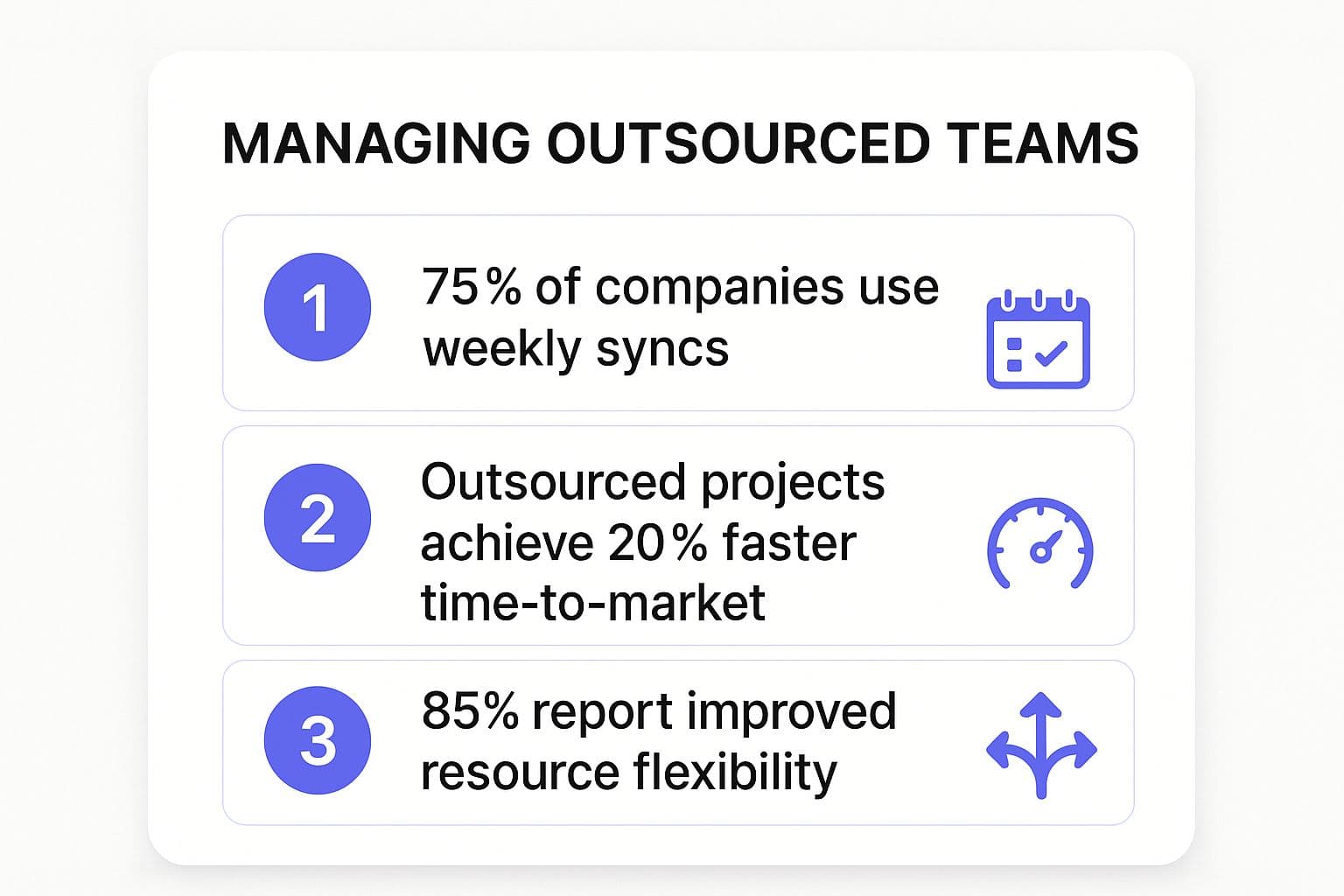
These numbers prove that outsourcing is more than just a cost-cutting play. The right partnership can deliver serious improvements in speed and efficiency.
How to Vet a Partner (Beyond Their Slick Website)
Once you’ve settled on a model, the real hunt begins. A polished website and a flashy portfolio are just table stakes. To find a team that will truly be a partner, you have to dig deeper. It's about finding a team you can trust. For a more detailed guide on this, check out our article on how to choose a product development outsourcer.
Here’s what you should be looking for:
- Technical Chops and Real-World History: Don't just look at what they built; ask how they built it. Request detailed case studies on projects with similar complexity to yours. Grill them on their problem-solving process and the specific tech they used.
- Client Feedback and Live References: This is huge. Actually talk to their past and current clients. Ask tough questions about communication, reliability, and how they handled things when the unexpected happened. A great partner will have a lineup of happy clients ready to sing their praises.
- Rock-Solid Security and IP Protection: This is non-negotiable. Get specifics on their security protocols, data handling policies, and how they guarantee your intellectual property is safe. They should have clear, documented answers for all of this.
A vendor completes tasks. A partner invests in your success. They ask "why," challenge your assumptions, and suggest better ways to reach your goals. They add strategic value far beyond just code.
At the end of the day, you’re looking for a team that clicks with your company culture and business goals. It's a search for a real relationship built on trust, transparency, and a shared passion for building something amazing.
Here is the rewritten section, designed to sound like it was written by an experienced human expert.
Your Roadmap for a Successful Outsourcing Journey
Trying to outsource your product development without a solid plan is a recipe for disaster. It's like trying to cross an ocean without a compass—you might hit land eventually, but it almost certainly won't be where you intended to go. A clear, phased approach is what separates a smooth, successful partnership from a chaotic and expensive mess.
This isn't about creating rigid, bureaucratic steps. Think of it more as a flexible game plan that brings clarity and control to what can be a very complex process. It ensures you and your partner are on the same page about goals, expectations, and how you’ll work together from day one all the way to launch.
Phase 1: Define Your Vision and Scope
Before you even start looking for a partner, the first step is internal. You need to get crystal clear on what you're building and, more importantly, why. A fuzzy idea will only ever lead to a fuzzy product. You have to nail down the specific problem you're solving, who you're solving it for, and what a "win" actually looks like for you.
This initial phase boils down to a few key activities:
- Nail the Problem-Solution Fit: Can you clearly explain the pain point your product solves for your users?
- Prioritize Core Features: What are the absolute, non-negotiable features for your Minimum Viable Product (MVP)? What’s the leanest version of your product that still delivers real value?
- Set Success Metrics: Define what success looks like in numbers. Is it a certain number of sign-ups, a specific user engagement rate, or revenue? Quantify your goals.
Without this groundwork, you can't effectively communicate your vision to an outside team, and that communication is the bedrock of any successful partnership.
Phase 2: Select Your Partner and Finalize Terms
With a clear vision in your back pocket, you're ready to find the right team to bring it to life. This part of the process is about so much more than just comparing hourly rates. You’re looking for a genuine partner who gets your business goals and is just as committed to quality as you are.
Once you’ve vetted potential partners—checking out their technical chops, client testimonials, and security practices—the focus shifts to making it official. This is where you hammer out all the details that will govern how you work together. A rock-solid contract is your best friend here, clearly spelling out everything from payment schedules and IP ownership to deliverables. This isn't just a legal hoop to jump through; it’s a critical alignment tool.
A crucial document in this phase is the Statement of Work (SOW). It translates your vision into a concrete action plan, detailing the project scope, timeline, milestones, and deliverables. A well-written SOW is your best defense against scope creep and keeps everyone working toward the same goals.
Phase 3: Kickoff and Agile Development Sprints
The project kickoff is where the rubber meets the road. This isn't just a quick "hello" call; it’s a deep-dive session to get both teams fully aligned on the vision, goals, communication channels, and tools. Everyone should walk away from that meeting knowing exactly what’s expected of them.
From there, the real work begins, ideally using an agile development approach. Agile breaks the entire project down into short, manageable work cycles called "sprints," which usually last 1 to 2 weeks.
At the end of each sprint, the dev team delivers a small, working piece of the product. This iterative process has some major advantages:
- Total Visibility: You see tangible progress every couple of weeks, which gets rid of that nagging "I wonder what they're doing" feeling.
- Constant Feedback: You get to test new features and give feedback right away, preventing the project from veering off course.
- The Ability to Pivot: If you get user feedback that points in a new direction, the agile model lets you adjust quickly without blowing up the whole project.
Phase 4: Continuous Communication and Management
Great products are built on great communication. When you're working with an outsourced team, setting up a clear and consistent communication rhythm is absolutely essential for keeping the project on track and the partnership healthy.
Your communication plan shouldn't be an accident; it should be deliberate. It usually includes:
- Daily Stand-ups: Short, daily check-ins (even done asynchronously over Slack) to quickly cover what got done, what's next, and any roadblocks.
- Weekly Syncs: A more in-depth meeting each week to review progress against the sprint goals and plan for the next one.
- A Single Source of Truth: Use a project management tool like Jira or Asana to track every single task. This creates complete transparency, so anyone can see the status of any piece of the project at any time.
This constant flow of information builds trust and ensures you’re always in the driver’s seat, guiding the project even from thousands of miles away.
Phase 5: Launch, Iterate, and Support
The initial launch isn't the finish line—it's the starting line. This is the moment your product finally meets the real world, and you start collecting priceless data and user feedback.
Your post-launch plan should already be in place. This includes monitoring performance, squashing bugs, and planning the next set of features based on how people are actually using your product. A great outsourcing partner doesn't just disappear after launch; they stick with you, offering support and helping you evolve the product. This cycle of launching, learning, and improving is what fuels long-term success.
Common Questions About Outsourcing Product Development

Even with a solid plan, taking the leap into outsourcing product development can feel like heading into uncharted territory. It’s completely normal to have a few questions. In fact, asking the right ones is a sign you’re serious about getting it right.
This section tackles the most common and critical questions we hear from founders and CTOs. We'll give you direct, no-fluff answers to help you cut through the noise and make your next move with confidence.
How Do I Protect My Intellectual Property When Outsourcing?
This is usually the first question out of the gate, and for good reason. Your intellectual property (IP)—your code, unique designs, and core business logic—is the lifeblood of your company. Protecting it isn't just important; it's everything.
Your first line of defense is a rock-solid Non-Disclosure Agreement (NDA). Get this signed before you share a single sensitive detail. From there, your main contract needs an ironclad IP assignment clause. This clause must state, without any ambiguity, that 100% of the work product created by your partner belongs to you and you alone.
A trustworthy partner will not only expect this but will be open about their own internal security and data protection policies. Don't be shy about vetting them on this. Any reputable firm will have a long history of protecting client IP and will welcome your questions.
What Is the Real Difference Between Outsourcing and Offshoring?
These two terms get tossed around and used interchangeably all the time, but they mean different things. Nailing the distinction is crucial for figuring out what strategy actually fits your business.
Outsourcing is the big-picture practice of hiring any outside company to handle a task or build a product. That partner could be in the same building as you or on the other side of the world.
Offshoring is a specific type of outsourcing. It’s when you deliberately partner with a company in a different country, usually one with a lower cost base and a significant time zone difference.
In simple terms, all offshoring is a form of outsourcing, but not all outsourcing is offshoring. You can outsource to a firm in your own city (onshore) or a neighboring country (nearshore). The choice comes down to balancing cost savings, the need for real-time collaboration, and access to a specific talent pool.
What Should I Realistically Budget for Outsourcing Development?
There’s no one-size-fits-all answer here. The cost of outsourcing development can swing wildly based on your project's complexity, the tech stack involved, and your partner's location. Hourly rates can be as low as $25 in some regions and climb past $150 in others.
But here's a word of caution: fixating only on the hourly rate is one of the biggest mistakes you can make. It's dangerously shortsighted. A slightly more expensive team with deeper experience might deliver a superior product in half the time, ultimately lowering your total cost and giving you a much better return.
When you budget, look at the total value proposition—their skill, speed, communication, and the quality of their work—not just the price per hour. A great partner helps you build a product that actually grows your business, and that’s a value that goes far beyond what’s on the invoice. If you're just starting, you can get a better handle on what goes into a launch-ready product by exploring the concept of a minimum viable product.
How Do I Actually Manage an Outsourced Team?
Effectively managing an outsourced team really comes down to one thing: treating them like a true extension of your own team, not like disconnected freelancers. Success is built on clear communication, solid processes, and the right tools.
Establish a regular rhythm for communication, like daily stand-ups or weekly syncs, to close the distance and keep everyone on the same page. Use project management tools like Jira or Asana for total transparency and something like Slack for the day-to-day chatter that keeps projects moving.
Here are a few practical tips to get you started:
- Define Clear KPIs: Everyone needs to know what success looks like from day one. Set specific, measurable Key Performance Indicators.
- Designate a Single Point of Contact: Avoid confusion and mixed messages by having one person on your team serve as the main go-between.
- Build a Real Relationship: The best work comes from partnerships built on trust and respect. Take the time to actually get to know your team.
At the end of the day, you're not just managing a list of tasks; you're leading people toward a shared vision. The more they feel like part of your crew, the more invested they'll be in your product's success.