What Is Minimum Viable Product? Key Insights & Examples
Table of Contents
Let's talk about the Minimum Viable Product, or MVP. It’s one of those terms that gets thrown around a lot, but what does it really mean? At its core, an MVP is the most basic, stripped-down version of your product that you can release to your first users. It’s not about launching something half-baked; it’s a calculated first step to see if your big idea actually has legs.
Think of it less as a final product and more as a strategic experiment. The whole point is to get the maximum amount of real-world learning from actual customers while spending the minimum amount of time, money, and effort.
What Exactly Is A Minimum Viable Product?
Let's clear up a common misunderstanding. An MVP isn't just a product with a bunch of features hacked off to meet a deadline. It's much smarter than that. An MVP is really a learning tool that looks and feels like a product. Its main job isn't to make a ton of money right away, but to answer the single most important question you have: Do people actually want this?
Imagine you have an idea for a brand-new car. The old way of doing things would be to spend years and a small fortune designing and building the perfect vehicle, only to find out nobody wants it. The MVP approach is different. You start with a skateboard. It solves the core problem—getting from point A to B.
Once you give it to users, you start learning. Maybe they say, "It's too slow," or "This is hard to steer." Great! That's valuable feedback. Based on what you learn, your next version is a scooter. Then maybe a bicycle, then a motorcycle, and eventually, after many cycles of feedback and iteration, you arrive at the car you originally envisioned. You built what people wanted because they helped you build it.
The MVP Is A Process, Not A Product
It's easy to get fixated on the "product" part of the name, but the real magic is in the process. The goal is to pinpoint your single riskiest assumption—the one thing that, if you're wrong about it, will sink your entire project—and then design the smallest, cheapest experiment to test it.
"There is surely nothing quite so useless as doing with great efficiency what should not be done at all." - Peter Drucker
This quote from Peter Drucker is the perfect summary of the MVP philosophy. It’s a gut check that stops you from flawlessly engineering a beautiful product that absolutely no one will ever use. Research shows that the number one reason startups fail—a staggering 42% of the time—is a lack of market need. The MVP process is your best defense against this, forcing you to prove your core idea with real users before you go all in.
This also means your first MVP might not even be a piece of software. It could be something as simple as:
- A landing page that describes your idea and has a button to collect email sign-ups for a waitlist.
- An explainer video that walks through how your product will solve a problem.
- A "concierge" service where you manually perform the service for your first few customers to validate demand.
Each of these is a low-cost experiment designed to test a hypothesis. This approach is the polar opposite of how products were traditionally built.
MVP Approach vs Traditional Development
The difference in mindset between building an MVP and taking a traditional development path is night and day. One focuses on learning fast and reducing risk, while the other bets the farm on being right from the start.
| Aspect | MVP Approach | Traditional Development |
|---|---|---|
| Primary Goal | Learning and Validation | Product Completion and Launch |
| Initial Focus | Core Problem & Riskiest Assumption | Full Feature Set & Polish |
| User Feedback | Early and Continuous | Post-Launch or Late Stage |
| Financial Risk | Minimized; Small Upfront Cost | High; Significant Upfront Investment |
| Time to Market | Fast (Weeks or a Few Months) | Slow (Many Months or Years) |
Ultimately, the MVP approach is about being smart with your resources. It's a system for navigating uncertainty and ensuring that what you're building is something the market will actually embrace.
The Real Business Benefits of an MVP Strategy
Thinking about an MVP strategy as just a way to launch faster is missing the point. It's a savvy business move that stacks the deck in your favor. These aren't just separate perks; they work together to forge a smarter, more resilient path from a simple idea to a product people actually use and love.
The biggest win? A massive reduction in financial risk. The old way of building products involved huge upfront bets on time, money, and resources—often based on pure guesswork. A staggering 42% of startups fail because they build something nobody wants. An MVP is the antidote to this, turning a wild financial gamble into a small, controlled experiment.
Instead of burning a six-figure budget over a year on a full-blown app, you can spend a tiny fraction of that to build and test the core idea. It’s the single best way to avoid pouring good money after a bad idea.
Harnessing the Power of Early Feedback
Getting direct, unfiltered feedback from actual users is gold. An MVP puts your product in front of real people right away, letting you learn what they truly need versus what you thought they needed. This kind of insight is priceless.
It helps you do a few critical things:
- Validate (or kill) your core assumptions about the problem you're trying to solve.
- Stumble upon new ways people use your product that you never imagined.
- Figure out which features hit the mark and which ones fall flat, shaping your roadmap with real data.
This constant feedback loop transforms product development from a shot in the dark into a data-driven conversation. You stop building in an echo chamber and start building with the very people you want to help.
By putting a working product in front of users, you get undeniable proof of what works. This early validation is how you start building something with genuine market fit.
Accelerating Your Time-To-Market
In today's world, speed is often the name of the game. Getting to market first can help you grab attention, define your brand, and start building a loyal following before competitors even have a chance. The MVP approach is built for speed.
By trimming the fat and focusing only on the must-have features that solve one core problem, you can shrink your development timeline from months or years down to just a few weeks. This lets you jump into the market, start learning, and begin improving while everyone else is still stuck on the drawing board. That head start can be the difference between leading the pack and always playing catch-up.
Building a Community of Early Adopters
When you launch an MVP, you don't just get users; you attract a very special group: the early adopters. These are the forward-thinkers and enthusiasts actively hunting for better solutions. They’re more forgiving of a product's initial rough edges and are genuinely excited to give you feedback to help shape what it becomes.
These first fans are your secret weapon for a few reasons:
- They become your most passionate champions, spreading the word to their friends and colleagues.
- Their feedback is usually the most insightful because they're deeply invested in your success.
- They form the foundation of your community, creating a loyal base that will stick with you as you grow.
At the end of the day, an MVP isn't just a development tactic; it's a complete business strategy. It cuts risk, supercharges learning, gets you to market faster, and helps you build a tribe of loyal followers from day one. It’s about laying the right foundation for real, long-term success.
How the MVP Concept Became a Startup Staple
While the Minimum Viable Product might seem like a recent buzzword born from the tech world, its core philosophy is anything but new. The idea of learning quickly, managing risk, and focusing on value has been kicking around for over a century, long before software was even a thing. Its DNA can be traced back to the gritty trial-and-error of early inventors and the waste-slashing principles of manufacturing.
Take Thomas Edison, for instance. He didn't just dream up the lightbulb and build it perfectly on the first try. He famously slogged through thousands of different filament materials. Each failed attempt wasn't a loss—it was a fast, cheap experiment that gave him critical feedback, pushing him one step closer to a solution that actually worked. That relentless cycle of prototyping is the very soul of the MVP.
From the Factory Floor to the Dot-Com Boom
The concept got a major upgrade in the mid-20th century with the Toyota Production System. Their obsession with lean manufacturing was all about one thing: eliminating waste. By empowering teams to constantly find small improvements and deliver value efficiently, they laid the groundwork for modern product development.
This mindset of building just enough to learn and then iterating became a full-blown survival strategy during the dot-com bust. The late 90s were littered with the corpses of startups that burned through millions of dollars to build massive, feature-packed products that, it turned out, no one actually wanted. The MVP rose from those ashes as a core tenet of the lean startup movement, offering a smarter way forward.
The goal of an MVP is to test your riskiest assumption with the smallest possible experiment. It's a process of repeated learning, not a one-time product release.
This history lesson matters. It shows that the MVP isn't a lazy shortcut to building less. It's a battle-tested strategy for building the right thing from the start.
A Modern Strategy Forged from Old Lessons
Today, the MVP approach is the gold standard for a very simple reason: it directly tackles the #1 killer of startups. Research consistently shows that 42% of failed startups die because they built something nobody needed. The MVP is the antidote, forcing founders to prove there’s a real market for their idea before they bet the farm.
This is precisely why MVP development for startups (https://iglu.dev/blog/mvp-development-for-startups) is no longer optional—it's fundamental. It shifts product development from a high-stakes gamble into a structured process of discovery. By starting small and listening to what real users do (not just what they say), companies can find their way through the fog of uncertainty and build products that genuinely solve a problem. It’s an old, hard-won lesson from the factory floor, perfectly adapted for the digital age.
A Practical Guide to Building Your First MVP
Alright, let's move from theory to action. This is where the real work begins. Building a Minimum Viable Product isn't a single, grand event; it's a disciplined, cyclical process. Think of it as a tight loop: build, test, learn, and repeat. You can toss out those complex, sprawling project plans. This is all about swift, focused execution to see if your core idea has legs.
The journey doesn't start with lines of code. It starts with a simple, brutally honest question: what's the single biggest assumption your entire idea is riding on? Answering that question is the bedrock of a successful MVP.
This chart lays out the fundamental cycle of developing an MVP, from validating the initial spark of an idea to building a prototype and, most importantly, listening to what real users have to say.
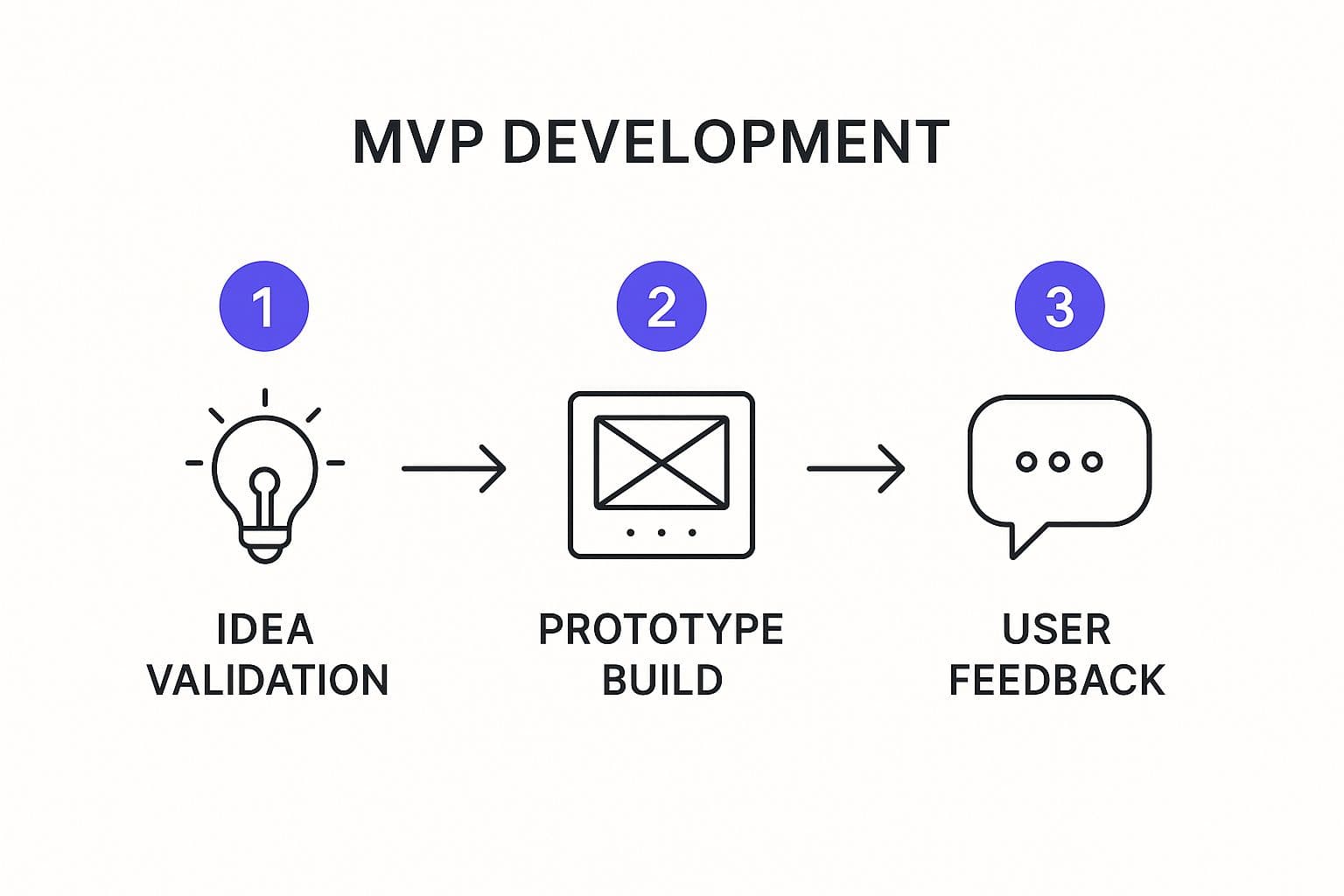
As you can see, building the thing is only one piece of the puzzle. The true value comes from the learning you get from user feedback, which then fuels the next round of improvements.
Stage 1: Start with Focused Market Research
Before a single engineer starts working, you have to confirm that the problem you think you're solving is a real, painful one for a specific group of people. This isn't about asking your friends if they like your idea. It's about rigorous, impartial validation.
Your main goal here is to find hard evidence that a market need actually exists. Without it, even the most beautifully engineered product is dead on arrival. Remember this sobering statistic: 42% of startups fail simply because they built something nobody wanted. Your first job is to make sure you aren't building for an audience of one.
To get this right:
- Identify Your Target User: Who, exactly, are you building this for? "Small business owners" is way too broad. "Florists in urban areas who struggle with managing online delivery orders" is getting much closer.
- Conduct User Interviews: Go talk to these people. Ask open-ended questions about their daily frustrations, the workarounds they currently use, and what they’ve tried in the past to solve their problems.
- Analyze Competitors: See what's already out there. What are competitors doing well? Even more important, where are their weaknesses? User complaints and bad reviews for rival products are a goldmine of opportunity.
Stage 2: Ruthlessly Prioritize Your Core Features
Once you have a validated problem, the next big challenge is fighting the temptation to build everything. This is where so many teams fall into the trap of "feature creep"—that slow, toxic addition of "just one more thing" until the project becomes a bloated mess. Your MVP has to be, by definition, minimal.
A fantastic tool for this is the MoSCoW method. It's a simple but powerful framework for sorting every potential feature into one of four buckets.
By forcing you to classify every feature, the MoSCoW method brings ruthless clarity. It helps you draw a sharp line between what's absolutely essential for learning and what's just a "nice-to-have."
Here’s the breakdown:
- Must-Have: These are the non-negotiables. Without them, the product simply can't solve the core problem. This is the heart and soul of your MVP.
- Should-Have: These are important features that add a ton of value but aren't critical for the very first version. They're at the top of the list for the next iteration.
- Could-Have: These are desirable but less important features. Think of them as bells and whistles you can add later if you have the time and resources.
- Won't-Have (This Time): These are features you explicitly decide to leave out for now. Acknowledging what you're not building is key to maintaining focus.
For a more thorough look at this part of the process, you can check out our detailed guide on how to build an MVP, which gets into more prioritization techniques. Using a structured approach like this keeps your team aligned and laser-focused on what really matters for launch.
Stage 3: Embrace the Build-Measure-Learn Loop
Popularized by the Lean Startup movement, this three-step cycle is the engine that drives your MVP forward. It’s a continuous loop that systematically turns your assumptions into facts using real-world data.
First, you Build the smallest possible version of your product based on your "Must-Have" features. Speed is everything here—getting something into users' hands quickly is far more important than getting it perfect.
Next, you Measure how people actually interact with it. Don't just ask for opinions. Track hard data (like sign-up rates or which features get used most) and gather qualitative feedback (through surveys and follow-up interviews). What are they clicking? Where are they getting stuck or confused?
Finally, you Learn from all that data. Did your core feature solve the problem you thought it would? Did users find a surprising new way to use it? These insights tell you exactly what to do next. You then use what you've learned to start the loop all over again—either by improving a feature, adding a new one, or in some cases, making a major strategic pivot. This cycle transforms product development from a guessing game into a smart, adaptive journey.
Real-World MVP Stories and What They Teach Us
Theory is great, but nothing drives the MVP concept home like a good story. The biggest names in tech didn't just appear overnight with flawless products. They started with smart, lean experiments designed to answer one critical question: Does anyone actually want this? These origin stories are the best teachers, showing how a simple test can be the first step toward building an empire.
At the heart of every great MVP is a core hypothesis. It’s less about building a product and more about proving a market exists before you bet the farm on your idea.
Dropbox: The Video That Launched an Empire
Before Dropbox became the file-syncing giant we all know, founder Drew Houston was stuck. He knew building a seamless, cross-platform file service would be a technical nightmare—and incredibly expensive. But the real risk wasn’t the code; it was a question of human behavior: Would people even trust a new service with their personal files?
Instead of building the whole thing, Houston created a simple, three-minute explainer video.
It wasn't a slick production. It was just a screen recording of a prototype, narrated by Houston himself, showing how the proposed service would work. He peppered it with inside jokes for his target audience on the tech forum Hacker News, and the response was immediate.
The video took Dropbox's beta waiting list from 5,000 to 75,000 people overnight.
That overwhelming sign-up rate was all the proof he needed. With almost no cost, he validated that massive demand was waiting for his solution. It was a perfect MVP—not a product at all, but a powerful experiment that proved the market was ready.
Zappos: Testing Demand Without a Warehouse
Back in the late 90s, selling shoes online seemed crazy. The core assumption to test was simple: Would people really buy shoes without trying them on first? To find out, founder Nick Swinmurn created a brilliant MVP without spending a dime on inventory.
He went to local shoe stores, snapped pictures of their shoes, and posted them on a basic website. When an order came in, he’d go back to the store, buy the shoes at full retail, and ship them out himself.
He wasn't making a profit—in fact, he was losing money on every single sale. But that wasn't the point. The goal was to collect data. This "concierge" style MVP proved that yes, people were absolutely willing to buy shoes online. That crucial piece of knowledge gave him the confidence to find investors and build what would become the Zappos empire.
If you want to see more clever takes like this, we've collected several other compelling minimum viable product examples that show this lean mindset in action.
Amazon: Starting with a Single Bookshelf
Today, Amazon is the "everything store," but it started with a much narrower focus. Jeff Bezos had a grand vision, but his starting point was incredibly specific. He needed to test the core assumption of e-commerce itself: Would consumers feel comfortable using credit cards to buy things on the internet?
The MVP concept, which you can read about in detail on its Wikipedia page, is all about getting the most learning for the least amount of work. Amazon's first version was a perfect example. It was a simple online bookstore with a bare-bones website. Bezos chose books because they're commodities—a specific title is the same no matter where you get it—and there are millions of them, far too many for a physical store to carry.
This initial test, selling used college textbooks from his garage, was the smallest possible experiment to validate his big idea. It was the first step on a long, iterative journey toward becoming the global powerhouse we see today.
Each of these stories teaches us the same lesson. Your first move isn't to build the perfect, feature-packed product. It’s to find your single biggest risk and design the smallest, fastest experiment you can to see if you're on the right track.
Common MVP Mistakes and How to Avoid Them

Building an MVP sounds straightforward on paper, but the path is littered with common pitfalls that can trip up even the most seasoned teams. Knowing what these mistakes are is the best way to steer clear of them and make sure your efforts lead to real learning and a better product.
One of the biggest misunderstandings comes from the word "viable." Too many founders hear "minimum" and think "buggy," "ugly," or "incomplete." This is a huge mistake. Your MVP shouldn't be a broken-down version of your grand vision; it needs to be a polished and reliable solution to one specific, core problem.
Think of your MVP as your product's first handshake. If it's clunky, confusing, or keeps crashing, users won't care that it has limited features. They'll just think your product is bad, period. Viable means it works, it solves a real problem, and it provides genuine value from the moment someone starts using it.
Resisting the Urge of Feature Creep
The silent killer of many MVPs is feature creep. It’s that slippery slope of adding "just one more little thing" until your simple, focused product becomes a complicated, delayed mess. This usually happens out of fear—the fear that what you have isn't "enough" to impress anyone.
The only way to win this battle is with discipline. Your mission is to test one critical assumption, and that's it. For every feature idea that comes up, you have to ask a tough question: Is this absolutely essential to validate my core hypothesis right now? If it's not a clear "yes," it goes on the backlog for later.
The purpose of an MVP is not to end the conversation with your users; it's to start one. Resisting feature creep ensures you get to that conversation faster.
Ignoring Your Most Valuable Asset
So, what’s the whole point of building a what is minimum viable product? It's all about getting feedback and learning from real people. This makes ignoring that feedback the single costliest mistake you can possibly make. Launching an MVP and then failing to listen to your users completely defeats the purpose.
You have to be proactive about gathering feedback. Every single user interaction is a goldmine of insights. Here's how to start digging:
- Talk to Users Directly: Don't just hide behind analytics dashboards. Get on the phone, send personalized emails with open-ended questions, and do whatever it takes to have real conversations.
- Analyze Behavior: Use simple tools to watch what people do in your product, not just what they say they do. The two are often very different.
- Act on Insights: Feedback is worthless if it just collects dust in a spreadsheet. Turn what you learn into concrete actions for your next development sprint.
Treating the MVP as the Final Product
Finally, a surprisingly common trap is seeing the MVP as the finish line. It’s not. It’s the starting line of a marathon. The MVP is not a one-time launch; it’s the very first step in a continuous cycle of building, measuring, and learning.
The teams that succeed are the ones who treat their MVP as the beginning of an ongoing dialogue with their customers. Each update, guided by real user data, gets them one step closer to achieving product-market fit. So, pop the champagne on launch day, for sure. But be ready to roll up your sleeves and start working on version 1.1 the next morning.
Frequently Asked Questions About MVPs
Even with a solid grasp of what an MVP is, a few practical questions almost always pop up when it's time to actually build one. Let's walk through some of the most common hurdles I see teams face. Getting these right can make all the difference.
It’s one thing to talk about being "minimal," but it’s another to decide what that actually means for your product. It's so easy to get attached to a dozen different features, but a great MVP is born from ruthless, strategic focus.
How Do You Decide Which Features to Include?
You need a system. Relying on gut feelings alone is a recipe for scope creep. The whole point is to pinpoint the smallest possible feature set that solves a real problem for your first users and lets you test your core business idea.
A simple value vs. effort matrix is a great place to start. But for a more structured approach, many teams I’ve worked with have had great success with the MoSCoW framework. It’s a simple way to force clarity by sorting features into four buckets:
- Must-have: These are the absolute, non-negotiable essentials. Without them, the product is broken or simply doesn't test your main hypothesis.
- Should-have: These are important and add a ton of value, but if they slipped to the next release, the product would still work.
- Could-have: Think of these as the "nice-to-haves." They're great ideas, but they aren't critical right now.
- Won't-have: Features you explicitly agree not to build for this version. This is just as important as deciding what to include, as it protects your timeline and focus.
Going through this exercise ensures you’re not just building features for the sake of it. You’re building a focused product that delivers value from day one.
What's the Difference Between an MVP and a Prototype?
This question comes up all the time, and the distinction is critical. They might both be "early versions," but they answer fundamentally different questions. A prototype asks, "Can we build this?" An MVP asks, "Should we build this?"
A prototype is a non-functional model designed to test a look, a feel, or a user flow. An MVP is a functional product you release to real customers to see how they behave and to validate your entire business concept.
You use a prototype to figure out the how internally. You release an MVP to figure out the if externally.
How Much Should an MVP Cost?
This is the classic "how long is a piece of string?" question. Honestly, the cost can be anything from a few thousand dollars to tens of thousands, or even more. The final number really boils down to the technical complexity, the features you’ve defined as "must-haves," and the team you have building it.
But here’s the most important thing to remember about the cost: the real value of an MVP isn't what you spend, it's what you save. By validating your idea with a relatively small investment, you avoid the soul-crushing risk of sinking a huge budget into a perfect product that nobody actually wants to buy. The goal isn’t to be cheap; it’s to spend just enough to learn whether you have a viable business on your hands.
Ready to turn your idea into a functional, market-ready product without the guesswork? Iglu Digital specializes in building high-quality MVPs for a price agreed before a line of code is written. We help you validate your vision and launch with confidence. Find out how we can accelerate your journey from concept to reality.