MVP vs Prototype Choosing Your Product Development Path
Table of Contents
When people talk about building a new product, the terms MVP and prototype often get thrown around interchangeably. But make no mistake, they are fundamentally different tools with completely different jobs. The simplest way I've found to explain it is this: a prototype asks, "Can we build this?" while an MVP asks, "Should we build this?"
One is about exploring a concept's look and feel, and the other is about testing if that concept can survive in the real world.
The Definitive MVP vs Prototype Comparison
Getting this distinction right from the start can save you a world of headaches, time, and money. While both are early-stage versions of a product idea, their strategic roles couldn't be more different.
A prototype is really a tangible exploration of an idea. Think of it as a mock-up, something you can touch and see. Its entire purpose is to nail the user experience (UX) and user interface (UI) to get feedback on the design and flow before you sink a dime into heavy-duty coding.
On the other hand, a Minimum Viable Product (MVP) is a different beast altogether. It's a real, functioning product—albeit a stripped-down one. It has just enough features to solve one critical problem for a specific group of early users. The goal isn't to get feedback on colors and buttons; it's to validate your core business idea with actual customers. An MVP has to work, be secure, and offer real value from the get-go.
This image really drives home what an MVP is all about. It’s not just a product with fewer features; it's a strategic tool designed to learn from the market.
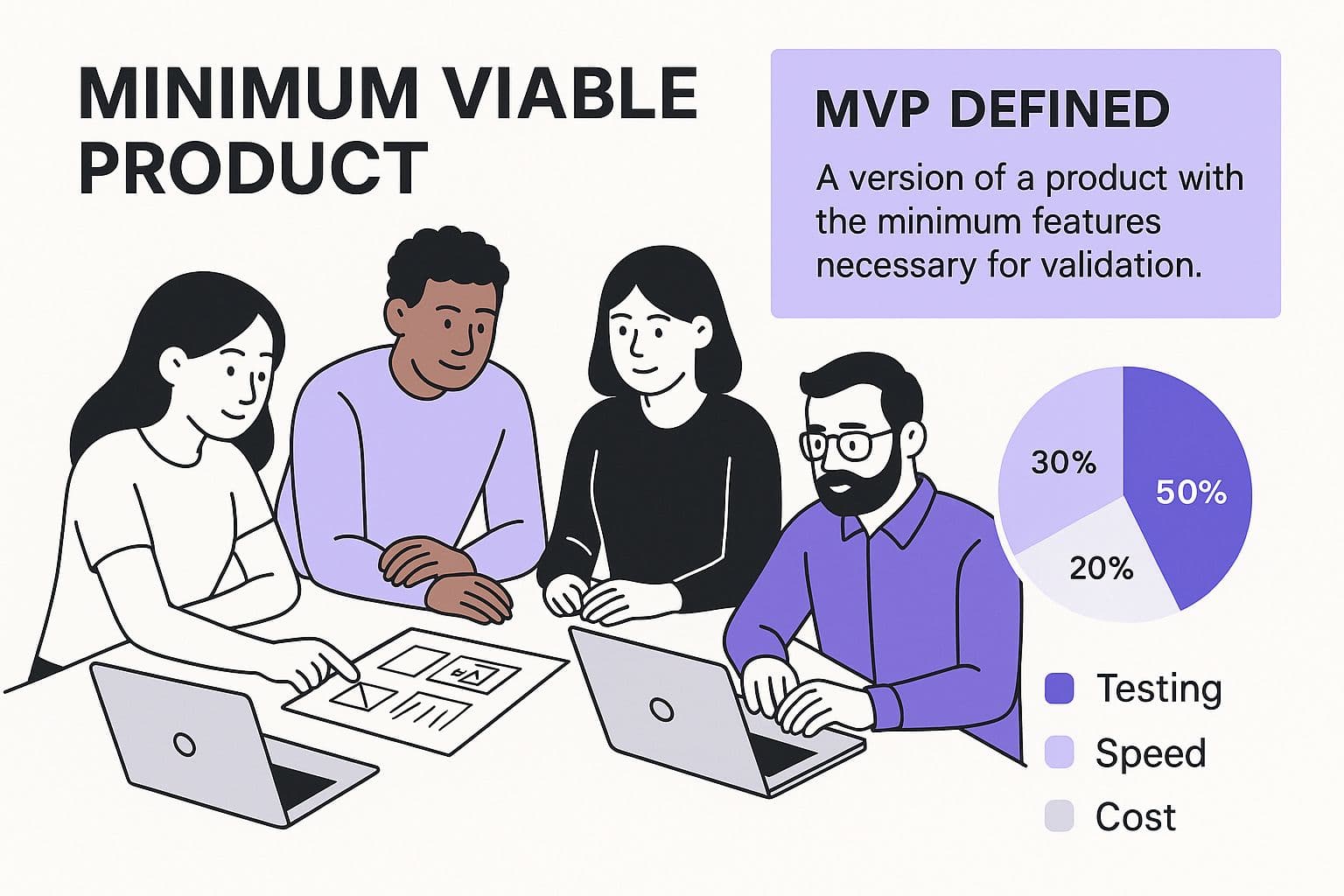
As you can see, the MVP sits at the intersection of viability, functionality, and design, creating a feedback loop that guides future development.
Quick Comparison MVP vs Prototype
To break it down even further, here's a quick side-by-side look. This table cuts through the noise and shows you exactly how these two approaches stack up against each other in terms of their goals, audience, and the resources they demand.
| Attribute | Prototype | MVP (Minimum Viable Product) |
|---|---|---|
| Primary Goal | Validate design, user flow, and usability. | Validate the core business hypothesis and product-market fit. |
| Audience | Internal teams, stakeholders, and small user testing groups. | Real, early-adopter customers in the open market. |
| Functionality | Can be non-functional (sketches) or interactive (clickable mock-ups). | A working, reliable, and functional product with core features. |
| Focus | User Experience (UX) and User Interface (UI). | Business viability and learning from user data. |
| Effort & Cost | Low; often created in days or weeks with minimal cost. | High; requires significant development, time, and financial investment. |
| Output | A tangible concept or visual model. | A live product that can be sold or used. |
Ultimately, choosing between a prototype and an MVP isn't about which one is "better." It's about understanding what question you need to answer at your current stage. Are you testing a design, or are you testing a business? Your answer points you to the right tool for the job.
The Strategic Role of a Prototype
While an MVP is built to test a business idea, a prototype answers a much more fundamental question about the product itself: “Is this even usable?” Think of it as your most powerful risk-reduction tool, letting you bring ideas to life and test core concepts without writing a single line of production code. Prototyping is all about learning fast and cheap.
Its main job is to make an abstract concept tangible. Whether you start with a simple paper sketch or build a clickable digital model, a prototype lets you explore, test, and polish the user experience (UX) and user interface (UI) when changes cost next to nothing. This is a huge deal, since fixing a core design flaw after development has begun can be 10 to 100 times more expensive than catching it in the design phase.
A prototype isn’t built to be sold; it's built to be broken. Its entire purpose is to expose misunderstandings, confusing user flows, and design weaknesses before they morph into costly engineering headaches.
Low-Fidelity vs. High-Fidelity Prototypes
Prototypes aren't one-size-fits-all; they exist on a spectrum. Picking the right level of detail depends entirely on what you need to figure out right now. Understanding this distinction is central to the MVP vs. prototype debate because it shows just how flexible the prototyping stage can be.
- Low-Fidelity Prototypes: These are the quick-and-dirty versions, often nothing more than hand-drawn sketches or basic wireframes. They’re all about mapping out the main user journey and screen layouts. You'd use these for early internal brainstorming to get the whole team on the same page.
- High-Fidelity Prototypes: These are far more detailed and interactive, built with tools like Figma or Adobe XD. They look and feel almost like a real app, complete with clickable buttons, animations, and polished design elements. This type is perfect for user testing or for wowing stakeholders and investors who need to see a clear vision of the final product.
When a Prototype Is Your Best Move
The choice between a prototype and an MVP really boils down to your biggest unknown. A prototype is the clear winner when your main risk isn't about market demand, but about design and usability.
You should definitely build a prototype first if your primary goal is to:
- Secure Early-Stage Funding or Stakeholder Buy-in: A polished, high-fidelity prototype turns your vision from a slide deck into something tangible and exciting for investors.
- Validate a Complex or Innovative User Interface: If your product depends on a novel or unconventional interaction, a prototype lets you test if it's actually intuitive for real users before you commit to building it.
- Explore and Finalize Design Directions: Got a few different ideas for the product's look and feel? Spinning up several quick prototypes allows you to A/B test designs and gather feedback without wasting resources.
At the end of the day, a prototype is there to answer your design questions. It’s the tool you use to validate the how before you invest a fortune in building the what.
What Is a Minimum Viable Product (MVP)?
So, we've talked about prototypes answering how a product could work. But an MVP tackles a much bigger, more fundamental question: should we even build this thing? This is where you move past just validating a design and start validating the entire market for your idea.
Think of an MVP not as a stripped-down version of your final product, but as a strategic tool built specifically for learning. It’s a real, working product that solves at least one core problem for a very specific group of early users. Unlike a prototype, which you might show to your internal team or a few friendly investors, an MVP gets released into the wild. Its whole purpose is to test your core business assumptions with actual customers—people who will use it, and hopefully, pay for it.
Putting a live product in front of real people gives you data you simply can't get any other way. We're not talking about feedback on button colors here. We're talking about hard data on user behavior, how often they come back, and if they're willing to open their wallets. If you want to dig deeper into the concept, we've put together a comprehensive guide on what is a Minimum Viable Product.
The Heart of the Lean Startup
The MVP is the absolute cornerstone of the Lean Startup methodology. The whole philosophy revolves around a simple cycle: build, measure, learn. By launching a focused, streamlined version of your product first, you kickstart that feedback loop with the smallest possible investment of time and money.
The real aim of an MVP isn't to build a small product; it's to maximize what you learn from real customers while minimizing the effort you put in. It's about discovering what people truly want, not just building what you assume they need.
This isn't just a nice theory; it drastically cuts down the risk of spending months or years building something nobody uses. The data backs this up. Startups that launch with an MVP have roughly a 60% higher chance of long-term success compared to those that go all-in from day one. By dipping a toe in the water first, you can confirm there's actually a demand before you drain your resources.
What an MVP Is Really For
The primary goals of an MVP are what truly set it apart from a prototype. It's designed to accomplish several critical business objectives all at once.
- Test for Product-Market Fit: This is the big one. Does your solution actually solve a real, painful problem for enough people that you can build a business around it? The MVP is built to give you a clear "yes" or "no."
- Collect Real-World User Data: An MVP lets you track vital metrics that a prototype can't, like how much it costs to acquire a customer, how many users stick around, and which features they actually use.
- Build Your First Community: It helps you attract those crucial first users. These early adopters become a valuable community you can learn from, iterate with, and grow alongside.
- Validate Your Business Model: The MVP is your first real-world test for your pricing, your core value proposition, and your strategy for reaching customers.
At the end of the day, an MVP isn’t the end of the road; it’s the very first step. It’s about delivering immediate, tangible value to a small group of users while gathering the essential market intelligence needed to steer your product toward sustainable growth.
Timelines and Financial Investment: What's the Real Cost?
When you’re deciding between an MVP and a prototype, the discussion always comes down to two things everyone cares about: time and money. The resources you'll need for each are worlds apart because they're built to do completely different jobs. Think of a prototype as a quick, low-cost experiment, while an MVP is a serious, long-term business investment.
A prototype is all about speed. You can knock out a low-fidelity version—like paper sketches or simple wireframes—in just a few hours or days. Even a polished, interactive high-fidelity prototype made with professional tools like Figma or Sketch rarely takes more than a couple of weeks. Because of this, the cost stays low, mostly tied to a designer's time instead of a full engineering team.
An MVP, on the other hand, is a whole different ballgame. It's a real, working product that needs a backend, solid infrastructure, and a user interface that people can actually use. You're not measuring this work in days; you're measuring it in months. A typical MVP build can easily take three to six months, sometimes even longer, from the first line of code to launch. Naturally, the financial commitment is much, much higher because it requires a complete development team to bring it to life.
From a Napkin Sketch to a Market Reality
The path from a rough idea to a product people will pay for is a journey of escalating commitment. You aren't just adding more features at each stage; you're seeking a higher level of proof that you're on the right track. A prototype is there to prove a design concept. An MVP is there to prove a business concept.
The real difference in investment boils down to what you’re trying to learn. A prototype asks a handful of specific questions about usability and feel. An MVP asks the big, scary question: "Is this a viable business?" Answering that requires a real, reliable, and secure product.
The story of the email client Superhuman is a perfect example of this. Their internal Proof of Concept took them just two weeks. Then came the prototype, which they tested with 50 power users over two months at a cost of $75,000. Finally, their MVP launched as a full-fledged product that accepted payments from day one, which required a six-month build and a $500,000 investment. This deliberate, step-by-step approach shows how the scope—and the cost—grows as you get closer to a true market-ready product. You can dive deeper into their strategy in this detailed breakdown of their early stages.
A Comparative Look at Resource Allocation
To make the right call, you need to see exactly how these commitments compare. The resources you have on hand will directly influence what you can realistically accomplish at this stage.
| Resource | Prototype | MVP (Minimum Viable Product) |
|---|---|---|
| Typical Timeline | Days to a few weeks. | 3 to 6+ months. |
| Financial Cost | Low (hundreds to low thousands of dollars). | Significant (tens to hundreds of thousands). |
| Team Required | Often just a designer or product manager. | A full team: developers, designers, QA, and a product manager. |
| Primary Goal | Visual and user flow validation. | Market and business model validation. |
In the end, your choice depends entirely on what you need to figure out right now. If you need to test a user flow, get feedback on an interface, or secure some initial interest from investors, a prototype is your fastest and most affordable tool. But if you’re ready to see if customers will actually use—and more importantly, pay for—your solution, you need to be prepared for the much larger investment in time and money that an MVP requires.
How to Choose the Right Path for Your Goal
The choice between a prototype and an MVP isn't about which one is inherently better. It’s about picking the right tool for the job at hand. The best way to make this decision is to pinpoint your biggest risk right now. Are you more worried about the user experience being confusing, or are you concerned that no one will actually pay for your idea?
Answering that question will immediately point you in the right direction. Prototypes are all about exploring and refining the product's look, feel, and flow when changes are cheap and easy to make. An MVP, on the other hand, is built to see if your business idea has legs in the real world with actual customers. As detailed in this comparison of MVP and prototype goals, understanding this core difference is everything.
Scenario-Based Decision Guide
Let’s break this down into common situations every startup founder faces. Your immediate objective should be your guide.
- Goal: Secure Pre-Seed Funding or Get Stakeholder Buy-In
Recommendation: High-Fidelity Prototype At this early stage, you're selling a vision. Investors and stakeholders need to see and feel what you're building, not just read about it in a slide deck. A polished, clickable prototype makes your concept real and compelling, showing you've thought deeply about the user journey without having to spend a fortune on development.
- Goal: Test a Complex or Unconventional User Interface
Recommendation: High-Fidelity Prototype Is your app's success riding on a brand-new navigation style or a unique interaction? If so, your greatest risk is poor usability. A high-fidelity prototype lets you put that specific interface in front of real people to find out if it clicks or confuses. Don’t build a whole MVP around a UI that nobody understands.
The rule of thumb is this: If your biggest question is about design, flow, or feel, you need a prototype. If it’s about market demand, user value, or willingness to pay, you need an MVP.
When to Commit to an MVP
Building an MVP is a much bigger undertaking, both in time and resources. You should only head down this path when you’re reasonably confident in the user experience and are ready to test the business itself.
- Goal: Validate Product-Market Fit with Real Users
Recommendation: MVP You've done your homework and believe you've found a real problem with a workable solution. Now it's time to prove it. An MVP gets a functional, albeit minimal, product into the hands of early adopters to see if they'll actually use it. This is where you get the hard data on engagement that investors love to see.
- Goal: Start Building a Customer Base and Revenue
Recommendation: MVP If you're ready to start charging for your solution and building a community, an MVP is the only way forward. It’s a live product that delivers on your core promise. This allows you to test pricing, gather feedback from paying customers, and start generating the traction you'll need for your next funding round.
In the end, this isn't an either/or debate. Think of it as a logical sequence. You prototype to iron out design risks, then you build an MVP to tackle business risks. In fact, the journey often starts even earlier with technical validation, which is why knowing the difference between a Proof of Concept vs. MVP is also a critical piece of a solid product strategy.
Common Questions About Prototypes and MVPs
When you're in the thick of early-stage product development, the practical questions start piling up. The whole MVP vs prototype debate gets a lot clearer when you look at how these concepts play out in the real world. Let's tackle some of the most common questions to help you figure out which path to take and what to expect.
A big one we hear all the time is whether you can just "upgrade" a prototype into an MVP. The short answer is almost always no, and it's a crucial distinction. Prototypes are built for show-and-tell. They're often stitched together with design tools like Figma or use throwaway code that's meant to look good, not run a business.
An MVP, on the other hand, is a real product. It has to be secure, reliable, and built to handle actual users. The entire foundation—the architecture—is fundamentally different. You don't evolve a prototype; you take what you learned from it and use that insight to build a solid MVP from scratch.
Is a Prototype Always Necessary Before an MVP?
While you could technically skip it, jumping straight to an MVP without a prototype is a gamble I wouldn't recommend. Prototyping first is a smart, low-cost way to test your entire user experience and visual design before a single line of production code is written.
Think about it: building an MVP means sinking months of development time and a significant amount of cash into a working product. If you get to the end of that process only to discover major usability flaws, you're in trouble. Fixing those deep-seated issues after launch costs exponentially more than getting the design right in the first place.
The purpose of a prototype is to de-risk the design before you commit to development. The purpose of an MVP is to de-risk the business after you've committed to a design. Rushing past the first step jeopardizes the second.
Making the right strategic calls early on is everything. Sometimes, that means bringing in fresh eyes. For founders looking to move quickly without cutting corners, exploring options like outsourced product development can provide the specialized expertise needed to nail these stages. It frees you up to focus on the business while a dedicated team handles the technical lift.
What Happens After the MVP Is Launched?
Here's a key mindset shift: launching an MVP isn't the finish line. It's the starting pistol. This is where the real work of building a successful product begins. The entire post-launch phase is driven by the "build-measure-learn" feedback loop—a cycle of constant improvement.
Here’s what you’ll be doing next:
- Collecting Data: You'll be gathering hard numbers (like user metrics and conversion rates) alongside qualitative feedback from surveys and user interviews.
- Analyzing Insights: This is where you dig in to understand what people truly love, where they're getting stuck, and which features they're begging for.
- Prioritizing the Roadmap: Armed with real data, you can confidently decide what to build next, ensuring your efforts are focused on what users actually need.
This cycle repeats over and over, slowly evolving your MVP into a more complete, feature-rich product—sometimes called a Minimum Marketable Product (MMP)—and eventually, a full-scale solution.
Can I Get Funding with Just a Prototype?
Absolutely. It’s quite possible to secure funding with just a prototype, especially at the earliest stages like pre-seed or angel rounds. A well-crafted, high-fidelity prototype is a powerful tool because it makes your vision tangible for investors. It shows them you've thought deeply about the user and the problem you're solving.
However, as you move up the funding ladder to a Seed or Series A round, investors' expectations change dramatically. They'll want to see more than just a great concept. For these bigger checks, they will almost always demand proof of market validation, user traction, and the kind of real-world data that only a live MVP with active users can deliver.
Ready to transform your idea into a market-ready product without the typical delays and uncertainties? At Iglu Digital, we specialize in building and launching your MVP for a price agreed before a line of code is written. We combine strategic planning with rapid, high-quality development to get your vision into the hands of real users faster.