Proof of Concept vs Prototype Choosing the Right Path
Table of Contents
The core difference really boils down to one simple question. A Proof of Concept (POC) is a small, internal experiment designed to answer, "Can we actually build this?" It’s all about testing a single, core idea to see if it’s technically feasible.
On the other hand, a prototype is an early, interactive model built to answer, "How will a user experience this?" It’s a tangible representation of how the final product will look, feel, and function. They serve completely different purposes at very different points in the development journey.
Defining Proof of Concept And Prototype
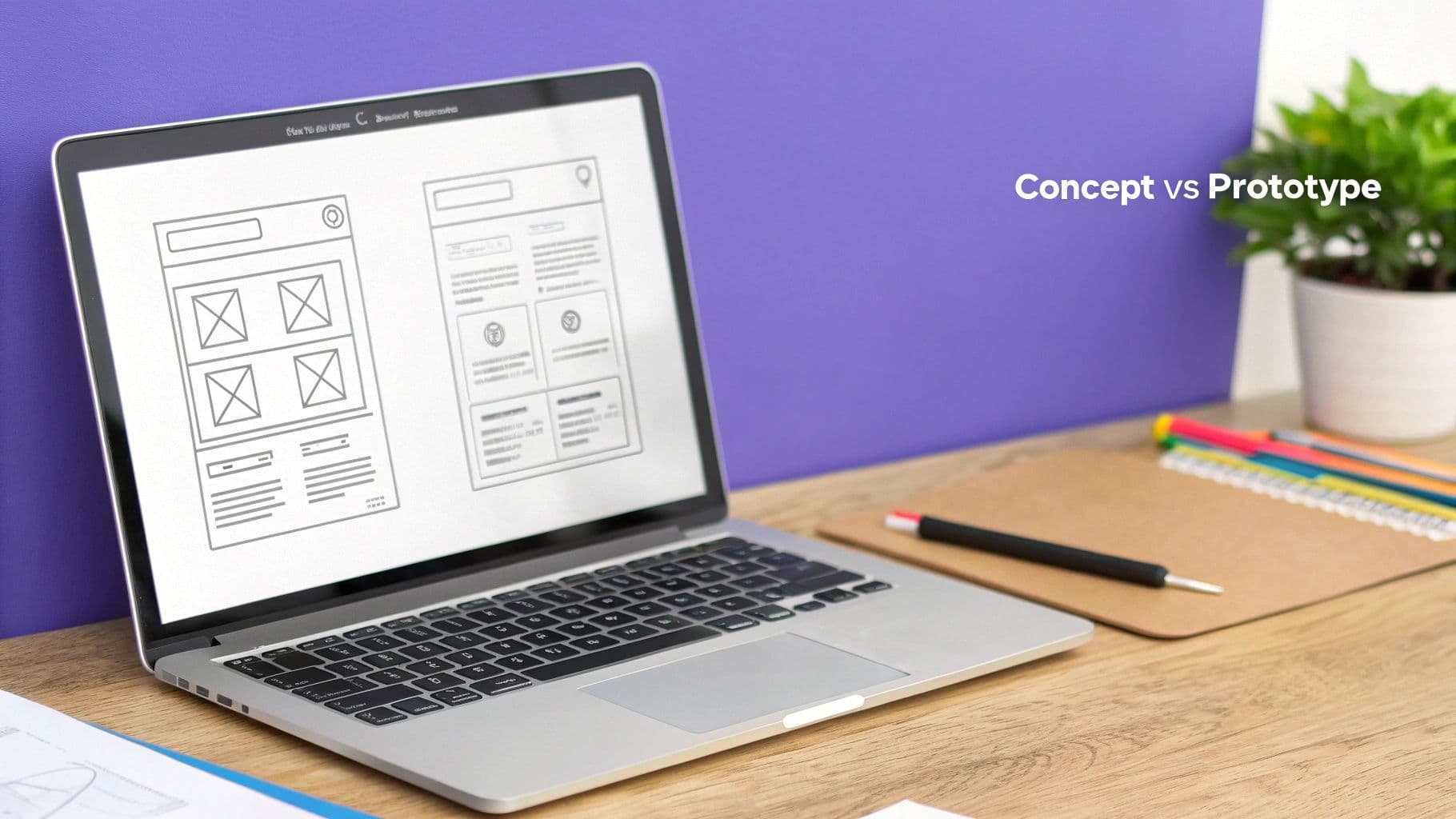
Before we jump into a side-by-side comparison, it’s critical to get on the same page about what these terms actually mean. Mixing them up is a common mistake that can lead to wasted time, blown budgets, and seriously misaligned expectations.
A POC and a prototype are not interchangeable. Think of them as specialized tools, each designed to tackle specific questions at crucial moments. A POC is laser-focused on proving out a core technical assumption, often with zero regard for how it looks or feels. A prototype, however, is all about the user—it’s built to demonstrate design, showcase functionality, and get early feedback on the user journey. For a deeper dive, you can find more insights on how to create a successful proof of concept on studiographene.com.
Core Differences Between a POC and Prototype
To make this crystal clear, let's break down the key distinctions in a simple table. This gives you a quick snapshot of their unique goals, audiences, and outputs, helping you decide which tool is right for the job at hand.
| Attribute | Proof of Concept (POC) | Prototype |
|---|---|---|
| Primary Goal | To test technical feasibility | To demonstrate design and user flow |
| Audience | Internal teams (developers, engineers) | Internal and external stakeholders (users, investors) |
| Scope | Narrow; focuses on a single function or problem | Broad; simulates multiple features and user journeys |
| Output | Often simple, throwaway code or documentation | Interactive wireframes, mockups, or clickable models |
| Main Question | "Can this be built?" | "How will this be used?" |
This table lays out the fundamental differences, but a simple analogy can often make it stick.
A Proof of Concept validates the kitchen's ability to cook a new, complex dish, while a prototype presents a sample of that dish for customers to see and taste. One confirms capability, the other tests the experience.
The Strategic Role of a Proof of Concept

Before you invest serious time and money into a big idea, you need to answer one crucial question: is it even possible? This is precisely where a Proof of Concept (POC) comes in. Think of it as a small, focused experiment designed to test a single, high-risk technical assumption.
Its entire purpose is to de-risk innovation. You're not building a product or worrying about user interfaces. Instead, you're isolating the trickiest technical part of your idea—maybe an unproven algorithm or a complex API integration—and seeing if it actually works.
This whole process is strictly an internal affair, usually just for the developers and technical leads. The result is a simple "yes, it works" or "no, it doesn't." It’s a minimalist, targeted approach that's absolutely essential when you're stepping into new territory.
Pinpointing Technical Uncertainty
At its core, a POC is your early warning system. It's built to expose any major technical roadblocks that could completely sink your project later on. The whole philosophy is to fail fast and cheap on a single concept, not on a fully developed product.
So, when does a POC make the most sense? Here are a few classic examples:
- New Tech Adoption: Can that new machine learning model or database technology really handle our specific performance needs? A POC will tell you.
- Complex Integrations: You need two separate systems to talk to each other, but one has a poorly documented API. A POC is perfect for testing if that connection is stable.
- Algorithm Validation: You’ve cooked up a new algorithm to process data. A POC lets you test it against a sample dataset to see if it produces accurate results.
A POC isn't a mini-product. It's a surgical strike on the most uncertain piece of your technical puzzle. Success isn't a working feature—it's a clear answer to a technical question.
By keeping the scope incredibly narrow, you sidestep the cost and complexity of building out a larger system. In fact, the code written for a POC is almost always thrown away. Its only value is the knowledge you gain from the experiment itself.
Making Informed Go or No-Go Decisions
When all is said and done, a successful POC gives your team the hard evidence needed to move forward with confidence. It proves to stakeholders that the project's technical foundation is sound. Or, if the POC fails, it saves everyone from pouring resources into a dead end.
Imagine a team wants to know if a certain video library can transcode 4K video streams in real-time on their current servers. They build a quick POC. If it can't hit the performance benchmarks, they haven't wasted months on development; they simply pivot to another solution.
This kind of strategic validation is a pillar of smart product development. It turns risky assumptions into proven facts, paving the way for bigger steps like prototyping. When you find yourself stuck on the proof of concept vs prototype debate, just remember the POC always comes first to answer that fundamental question of possibility.
How a Prototype Puts the User Front and Center
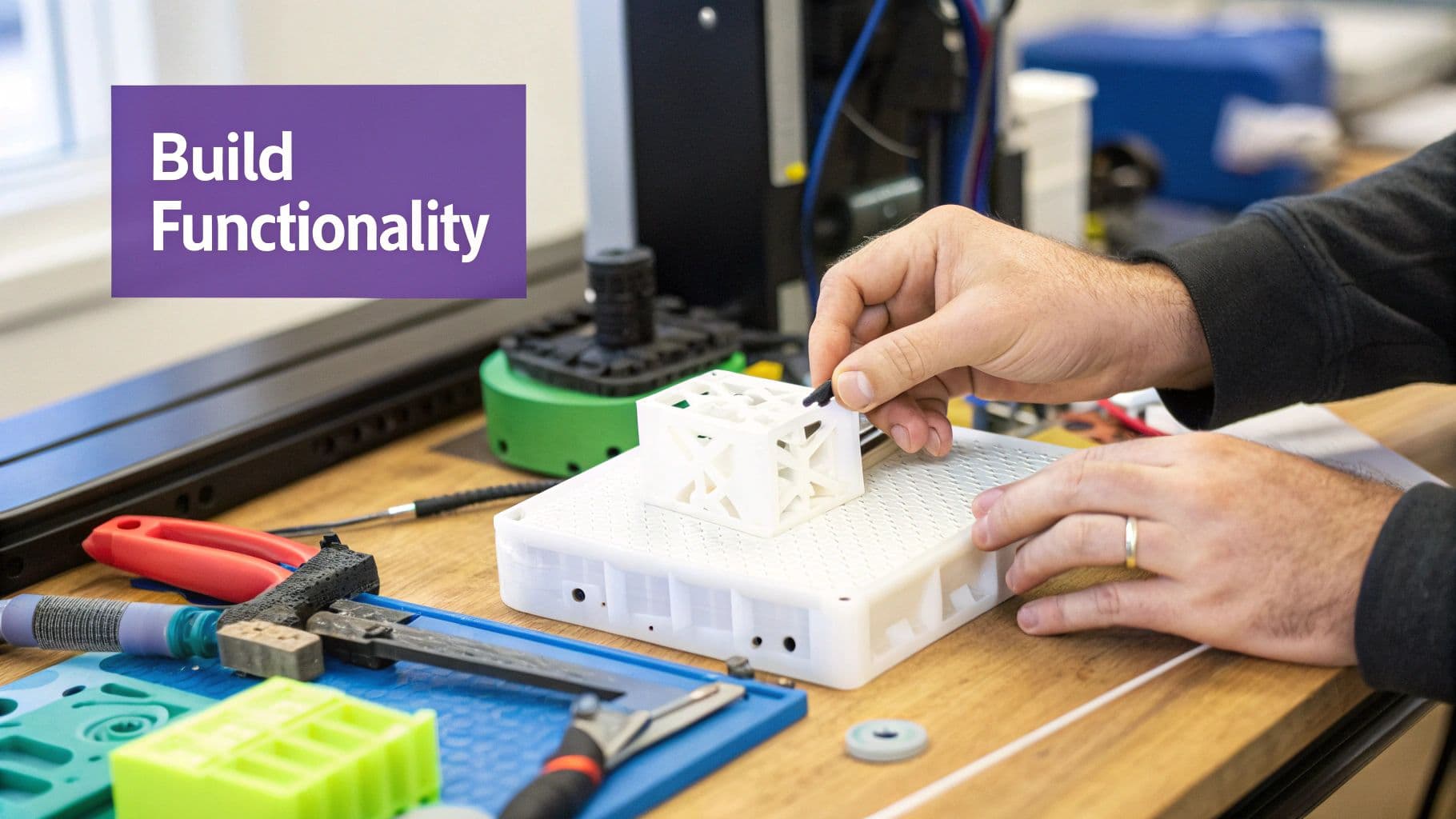
If a proof of concept is an internal reality check, a prototype is all about the external experience. Its job is to make a product idea real enough for people to see, touch, and interact with. The central question it seeks to answer is simple but critical: "How will this actually feel to a user?"
This isn't a one-and-done task; it’s a journey. Prototyping usually starts small, with low-fidelity wireframes sketched out to map the basic user flow and make sure the navigation is logical. Eventually, it evolves into a high-fidelity, interactive model that looks and behaves almost exactly like the finished product.
Having this tangible model is invaluable for getting the entire team on the same page. It’s far more than a design exercise—it’s a powerful communication tool that helps prevent expensive misunderstandings later on.
Who Really Gets Value from a Prototype?
A well-executed prototype is a hub of communication, serving different groups in very specific ways. It helps align everyone's vision, making sure the final product hits the mark for both business objectives and user needs.
Here’s a breakdown of who benefits the most:
- Designers and Developers: They get to test UI components, fine-tune user flows, and catch glaring usability problems long before any production code is written.
- Users and Testers: It’s one thing to look at a static image, but it’s another to click through a working model. This hands-on feedback leads to much more meaningful insights—in fact, direct user feedback can boost usability metrics by as much as 73%.
- Investors and Stakeholders: A prototype takes a concept from a slide deck to a tangible experience. It’s an incredibly effective tool for demonstrating the product's potential and securing the buy-in needed to move forward.
Think of a prototype as the ultimate blueprint for development. It ensures everyone—from the design team to the C-suite—is building toward the same shared understanding of the user experience.
Moving From Static Pictures to an Interactive Experience
The real power of prototyping lies in its evolution. The process deliberately moves through different levels of detail, or fidelity, with each stage designed to answer specific questions about the design and user journey.
This gradual progression helps teams validate ideas quickly without sinking a ton of resources into a fully developed product. For teams that need to move even faster, rapid prototyping techniques can be a major advantage, condensing this entire process into a much shorter timeframe.
The typical stages look something like this:
- Low-Fidelity Wireframes: These are the bare-bones sketches, often done by hand or with simple software. They focus entirely on structure and flow, helping answer fundamental questions like, "Does this navigation even make sense?"
- Mid-Fidelity Mockups: Now we’re in the digital realm. These mockups add visual details like color palettes, typography, and spacing to start establishing the product's look and feel.
- High-Fidelity Prototypes: Built with tools like Figma or Sketch, these are clickable, interactive models that mimic the final product's experience. They’re so realistic they can be used for detailed user testing and compelling stakeholder demos.
In the proof of concept vs prototype debate, this phased approach makes the prototype's role crystal clear. It's the bridge that turns an abstract idea into a concrete experience, steering the development team toward a solution people will actually want to use.
Comparing Critical Differences in Practice
Knowing the textbook definitions is one thing, but seeing how a Proof of Concept (POC) and a prototype play out in the real world is where the distinction truly clicks. Their goals, who they're for, and how they're built are worlds apart, and choosing the right one has a massive impact on your project's budget, timeline, and overall direction.
Think of it this way: a POC is a small, behind-the-scenes experiment to answer a technical question for your team. A prototype, on the other hand, is a tangible model you put in front of people to see how they actually use it. One proves a concept is possible; the other proves it's usable.
This chart breaks down the practical differences at a glance, covering everything from the investment required to the kind of feedback you'll get.
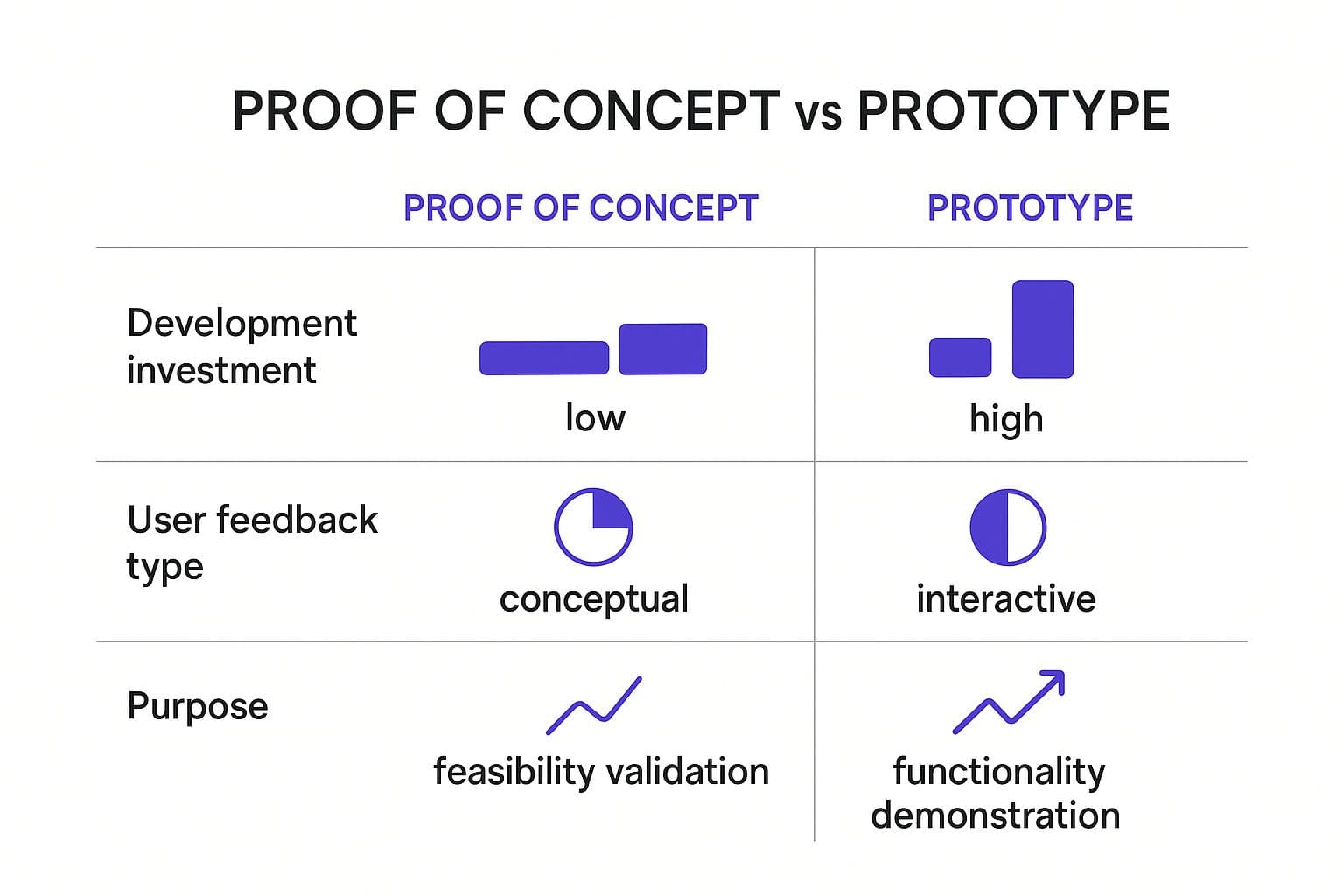
As you can see, a POC is a quick, low-cost internal check. A prototype demands more resources because it’s built to create a convincing, interactive experience for a much wider audience.
Technical Validation vs User Feedback
The single biggest difference in the proof of concept vs prototype discussion comes down to the core question each one answers. A POC is laser-focused on one thing: “Can we actually build this with the tools we have?” It's a straightforward, yes-or-no technical test for your development team.
A prototype tackles a much fuzzier, more human-centric question: “How will people feel when they use this?” It’s designed from the ground up to gather feedback on the look, feel, and flow of the user experience. Its success isn’t a simple binary; it’s measured in insights and observations.
A POC is a pass/fail exam for a technical idea. A prototype is a conversation starter designed to refine the user journey.
Audience and Scope
Who you're building for dictates what you build. A POC is strictly for an internal, technical audience—the engineers and architects who live and breathe code. Because of this, its scope is incredibly narrow, often focusing on a single, isolated function.
Prototypes, however, are made for a much broader crowd: potential users, investors, designers, and marketing teams. This means the scope has to be wider, simulating a more complete user journey to give a real taste of the final product.
- POC Audience: Developers, engineers, and architects (internal).
- Prototype Audience: Users, investors, designers, and other stakeholders (external and internal).
Resources and Investment
Let’s talk about time and money. A POC is designed to be fast and cheap. You’re aiming for a quick answer, not polished code, so it’s often done in a matter of days or a few weeks with minimal investment. The code is usually meant to be thrown away.
A prototype is a bigger commitment. It requires a real investment in design and development to create something that looks and feels like a finished product. While it costs more than a POC, it's still just a fraction of the full build. Thinking about the cost of developing software for the entire project really puts the value of this stage into perspective.
To truly grasp the nuances, let's lay out the characteristics side-by-side.
Detailed Breakdown of POC vs Prototype Characteristics
The table below offers a granular look at how these two crucial stages differ across various project dimensions.
| Characteristic | Proof of Concept (POC) | Prototype |
|---|---|---|
| Primary Goal | Validate technical feasibility. "Can it be built?" | Test user experience and gather feedback. "How will it be used?" |
| Audience | Internal technical team (engineers, architects). | Stakeholders, users, investors, designers. |
| Scope | Extremely narrow; focused on a single function or integration. | Broad; simulates multiple features and user flows. |
| Fidelity | Low-fidelity; functionality over form. Often just backend code. | Varies (low to high-fidelity); focuses on look, feel, and interaction. |
| Code Quality | Throwaway, proof-only code. Not for production. | Can be refined and built upon for the final product. |
| Time Investment | Very short (days to a few weeks). | Moderate (weeks to a few months). |
| Financial Cost | Low. Minimal resources needed. | Moderate. Requires design, UI/UX, and development resources. |
| Success Metric | A clear "yes" or "no" on technical viability. | Qualitative user feedback and actionable insights. |
This breakdown makes it clear that while both are pre-development steps, they serve entirely different strategic purposes in the product lifecycle.
When to Build a POC Instead of a Prototype
Choosing between a proof of concept and a prototype isn't just a technical detail—it's a critical strategic move that sets the direction for your entire project. The golden rule is straightforward: if your main risk is technical uncertainty, you need a Proof of Concept (POC). When the biggest question on the table is "Can we even build this thing?" a POC is the only logical place to start.
This is especially true when you're innovating or stepping into uncharted territory. Maybe you're working with a new AI algorithm, trying to connect with a third-party API that has terrible documentation, or adopting a new tech stack your team has zero experience with. A POC lets you isolate that one high-risk piece of the puzzle and get a firm "yes" or "no" on whether it’s even possible.
For instance, a team might build a POC just to see if a machine learning model can hit 95% accuracy with a small dataset. Or they might test whether an old, clunky database can actually keep up with the speed a new feature demands. It's a small, internal experiment designed to let the technology fail fast and cheap, not the entire product vision.
Navigating Key Decision Points
To decide if a POC is right, you have to be brutally honest about where your project's biggest question marks are. Is it the technology, or is it the user experience? That distinction is your clearest guide.
Here are a few scenarios where a POC is the smart play:
- Technical Feasibility: Your entire idea hinges on a technology or an integration that hasn't been done before in this way.
- Resource Validation: You're not sure if your current servers or infrastructure can handle the performance load of a new feature.
- Choosing Between Technologies: You’re weighing two different tech stacks—like competing databases or cloud providers—and need to see which one actually performs better for a core function.
A POC is like a technical insurance policy for your project. You make a small investment up front to turn critical technical assumptions into proven facts, preventing a much larger, more expensive failure later on.
This laser-focused approach is a perfect fit for agile development and lean startup thinking, which are all about learning and killing risks as early as possible. This mindset is fundamental to building successful products, and you can see how it works by understanding the principles of the Lean Startup methodology.
Real-World Success Through Staged Validation
Looking at how successful companies operate, you can see this staged approach in action. It's all about mitigating risk and using resources wisely. A great example is the email client Superhuman. They built a POC back in 2015 for one reason only: to confirm they could technically make email 35% faster. Once that was proven, they moved on to a prototype in 2016, testing design mockups with 50 power users to nail the user experience. You can discover more insights on product development stages on spaceotechnologies.com for other case studies.
At the end of the day, the proof of concept vs prototype decision boils down to what kind of risk you're facing. If you're asking, "Can we make this work?"—build a POC. If you're asking, "Will people want this?"—it's time for a prototype.
Got Questions About POCs and Prototypes? Let's Clear Them Up.
To really get the hang of this, let's walk through some of the most common questions that pop up when people try to distinguish between a Proof of Concept and a prototype. Think of this as your quick-reference guide for navigating project decisions and stakeholder chats.
Can a Single Project Use Both a POC and a Prototype?
Yes, and honestly, for anything truly new or technically tricky, it's the smart way to go. They aren't an either/or choice; they’re different tools for different stages of the journey. A project often kicks off with a POC to answer a very specific, make-or-break technical question. Something like, "Can this new algorithm actually process our dataset in under a second?"
Once the POC gives you a confident "yes," you've proven the core idea is technically sound. Now you can move on to the prototype. The focus completely shifts from the tech to the user. The questions become, "How would someone actually use this feature? Is the workflow intuitive?" This one-two punch is a fantastic way to de-risk a project—first, you prove it can be built, then you figure out how it should be built for the people who will use it.
So, What Happens After the Prototype Is Done?
Once your prototype has been through the wringer—tested, tweaked, and has given you confidence in the user experience and design—you're ready for the next big step: the Minimum Viable Product (MVP). This is a huge leap because, unlike a prototype, an MVP is not a simulation. It's the very first, bare-bones version of your product that you actually release to the public.
An MVP has just enough functionality to be genuinely useful to your first wave of users, your early adopters. The whole point is to see if people will actually use it—and maybe even pay for it—in the real world. You're testing the market, not just the user interface.
A prototype helps you design the right product. An MVP helps you find out if you've built a product people actually want.
The feedback you get from an MVP is pure gold. It tells you what to build next based on real behavior, not just what you think users want.
How Should I Pitch a POC to Stakeholders?
Pitching a Proof of Concept is all about managing risk and proving viability. You’re not selling a grand vision here; you’re proposing a calculated experiment. Your audience is usually internal—think CTOs, engineering managers, or a product board.
A good POC pitch sounds something like this: "Before we commit a full team and budget, we need to run a small, fast experiment to make sure the core technology works as expected. This POC will answer one critical question and give us the hard data we need to move forward confidently."
To nail the pitch, you need to hit these three points:
- The Big Technical Question: State the one, specific assumption you’re testing.
- Low Cost, Short Timeline: Frame it as a quick, cheap way to avoid a much bigger, more expensive failure later.
- A Clear Yes/No Answer: Make it clear that the result won't be ambiguous. It either works, or it doesn't.
How Is Pitching a Prototype Different?
When you’re pitching a prototype, you change gears completely. The conversation shifts from technical risk to user value and market potential. Your audience is often much wider and can include investors, the marketing team, or even early customers. Your goal is to get them excited about the product's vision.
This pitch is much more visual and story-driven: "Let me show you an interactive model of our product. You can click through it and see for yourself how it solves this frustrating problem for our users. You'll really get a feel for the experience."
A winning prototype pitch always highlights:
- The User's Problem: Start with the pain point you’re solving. Make it relatable.
- The Visual Solution: Let the prototype do the talking. Show off the design, the flow, and how easy it is to use.
- The Market Opportunity: Use the prototype as a prop to paint a picture of the product's value and why people will love it.
Understanding when to build a POC versus a prototype—and how to talk about each—is key. It helps you align your team, manage expectations, and make sure you're building the right thing, the right way.
Ready to turn your validated idea into a market-ready product? Iglu Digital specializes in building functional MVPs on a fixed price, agreed up front, helping you go from concept to launch with speed and confidence. Learn how we can build your vision.