Proof of Concept vs MVP Which Do You Need?
Table of Contents
At the heart of it, the difference between a PoC and an MVP boils down to the fundamental question each one is designed to answer.
A Proof of Concept (PoC) is an internal exercise that asks, "Can we actually build this?" Its sole focus is on technical feasibility. On the other hand, a Minimum Viable Product (MVP) is an external test that asks the market, "Should we build this?", by seeing how real users react.
Understanding PoC vs MVP: A Quick Guide
It’s easy to get lost when looking at a new product roadmap. People often throw around the terms Proof of Concept and Minimum Viable Product as if they’re the same thing, but that confusion can burn through your budget and send your team in the wrong direction. Nailing the distinction is your first real step toward reducing risk and building genuine momentum.
A PoC is a small-scale, internal experiment. You build one to check if a critical technical idea will work—a specific feature, a new technology, or a tricky integration. Its purpose is singular: prove that something is technically possible before you pour serious resources into it. It’s not a product; it’s a piece of evidence.
An MVP, however, is the very first, bare-bones version of your product that you release to the public. It has just enough functionality to be useful to early adopters and, more importantly, to validate your core business idea. A PoC confirms how you can build something; an MVP confirms if anyone even wants it.
Core Differences at a Glance
The Proof of Concept and the Minimum Viable Product play completely different roles. The PoC is all about confirming technical capability, while the MVP is about testing the waters with the market.
Typically, you’ll start with a PoC to answer the question, "Can we pull this off?" It’s a low-cost way to see if an idea or technology is viable before committing significant funds. In contrast, an MVP is built to answer, "Should we even bother?" by getting a stripped-down version of the product into the hands of real users for feedback. You can find a great breakdown of their roles in the development lifecycle on The Mobile Reality.
This core distinction in purpose shapes everything else—from who sees it to what you get out of it.
Here’s a simple way to think about it: A PoC is like a powerful engine bolted to a test bench in a lab. It proves the engine works. An MVP is the first basic, drivable car built around that engine, put on the road with real drivers to see if they like the ride.
A Clear Comparison
To really sharpen the focus, let's lay out the key differences side-by-side. This table shows how each approach fits a unique strategic need.
| Aspect | Proof of Concept (PoC) | Minimum Viable Product (MVP) |
|---|---|---|
| Primary Goal | Validate technical feasibility | Validate market demand & learn |
| Target Audience | Internal team, stakeholders, tech leads | Early adopters, real users |
| Scope | One core function or technical question | A minimal, usable product |
| Key Question | "Can we build it?" | "Do people want it?" |
| Outcome | A yes/no answer; a functional demo | A market-ready product with data |
Internalizing this table is the key to making smarter strategic moves. Think of a PoC as your technical insurance policy. An MVP is your first real conversation with the market. Both are essential tools, but knowing which one to use and when is often what separates a successful launch from an expensive lesson.
Comparing The Strategic DNA of a PoC and an MVP
When you're trying to understand the proof of concept vs mvp debate, you have to look past the buzzwords. These aren't just two steps on a project timeline you can swap out. They are completely different tools, each designed to answer a very specific, high-stakes question at a critical stage of your product's journey.
A Proof of Concept, or PoC, is your internal reality check. It's a quick, focused experiment to answer one single question: "Is this core piece of technology even possible?" Think of it as a behind-the-scenes feasibility study. The goal isn't a product; it’s a confident "yes" or "no" on a technical challenge before you sink real time and money into it.
A Minimum Viable Product, on the other hand, is your first handshake with the market. Here, the question changes from "Can we build it?" to "Should we even bother?" An MVP is the absolute simplest version of your product that you can give to real users to start collecting feedback and validating whether your big idea actually solves a real-world problem.
This massive difference in purpose shapes everything—from who it's for, to how much it costs, to what success even looks like.
Primary Goals: From Technical Hurdles to Market Hunger
The biggest split between a PoC and an MVP is what they're built to achieve. A PoC is all about eliminating technical risk. An MVP is about reducing market risk.
- A PoC’s Goal: Its one job is to prove technical feasibility. Let's say a health-tech company wants to use a brand-new AI model to analyze medical scans. The PoC would be a small-scale project, maybe for just one or two developers, to confirm that the model can actually identify anomalies with the necessary speed and accuracy. Success is simple: a clear demonstration that the tech works as hoped.
- An MVP’s Goal: An MVP takes that now-proven technology and asks if anyone actually wants it. For our health-tech company, the MVP would be a basic, working application where a handful of early-adopter radiologists can upload a scan and get a result. The goal here is to see if they find it useful. Is it saving them time? Is it accurate enough for them to trust? Success is measured in user engagement, direct feedback, and early signs that you're onto something people will pay for.
A PoC is about what happens in the lab. An MVP is about what happens in the real world.
A Proof of Concept is like a scientist testing a single hypothesis in a controlled lab setting. An MVP is taking the first batch of a potential new medicine and giving it to a small patient group to see if it actually helps them.
Audience and Scope: Internal Test vs. External Launch
Who you're building for directly impacts how polished the result needs to be. A PoC is for your internal team, while an MVP has to be ready for the outside world.
The audience for a PoC is usually a project manager, a CTO, or an investor who just needs to see that a core technical piece is viable. Because it's an internal-facing test, it can be rough. The UI might be just a command line, and the code is often throwaway, written just to get a quick answer. The scope is laser-focused on a single function.
An MVP, however, must be a real, usable product. It might be minimal, but it has to work, look decent, and deliver on its core promise to that first group of customers. The audience is early adopters—people who are hungry for a solution and willing to forgive missing bells and whistles. This requires a much broader scope, covering not just the main feature but also things like basic design, user accounts, and a way to collect feedback.
This is why the time and investment for an MVP are so much greater than for a PoC.
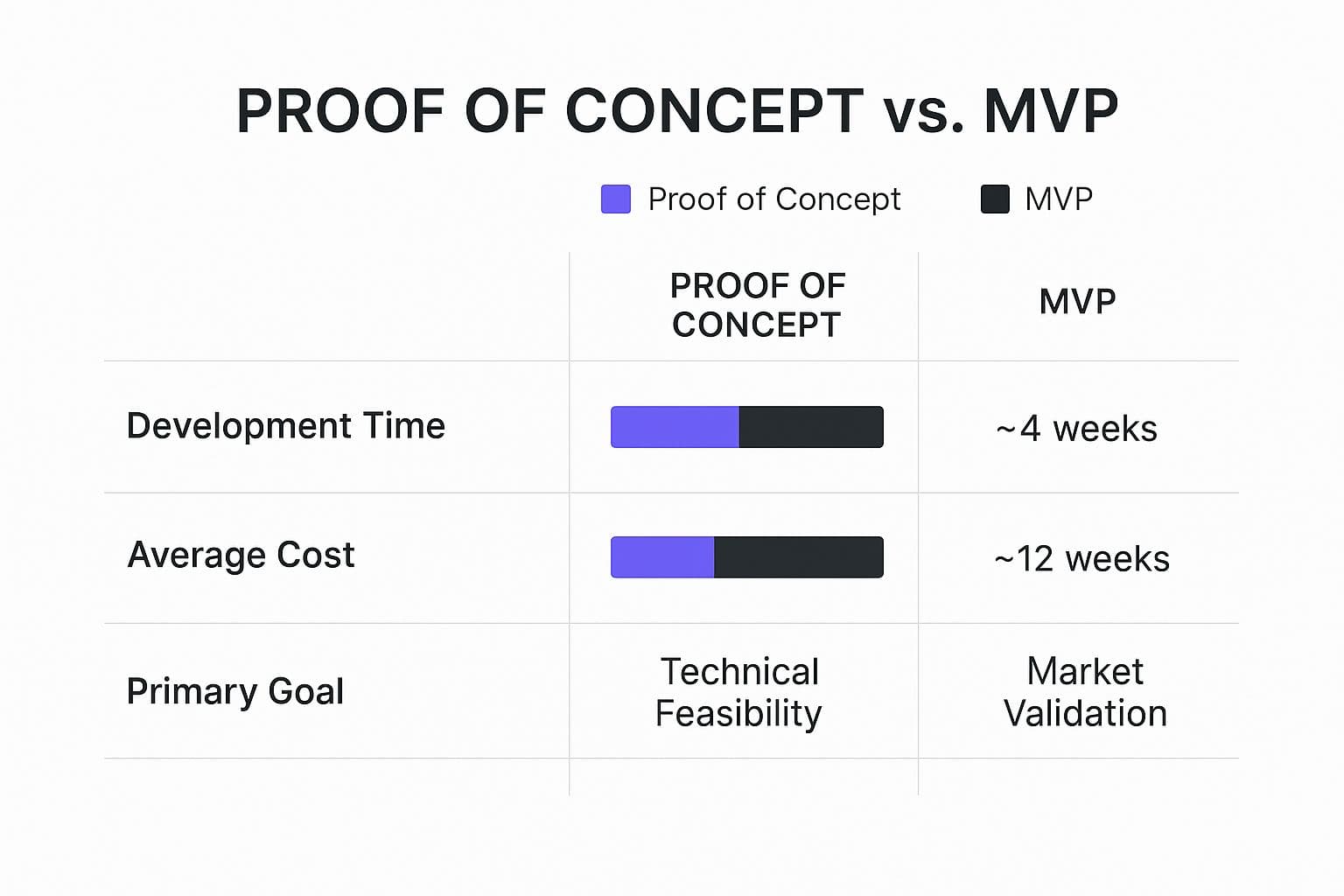
As the infographic highlights, an MVP is a much bigger commitment, because it’s a market-facing product, not just an internal experiment.
To put it all together, here’s a straightforward breakdown of how a PoC and MVP stack up against each other.
Key Differentiators PoC vs MVP
| Attribute | Proof of Concept (PoC) | Minimum Viable Product (MVP) |
|---|---|---|
| Key Question | "Can this specific function be built?" | "Does the market want this product?" |
| Focus | Technical feasibility | Market viability & user feedback |
| Risk Mitigation | Reduces technical uncertainty | Reduces business and market risk |
| Deliverable | A functional demo or a yes/no answer | A usable, shippable product |
| Success Metric | Validation of a technical hypothesis | User adoption and actionable learning |
Getting these two concepts straight is critical. One of the most common—and expensive—mistakes teams make is building a full-blown MVP to answer a simple technical question, or shipping a rough PoC and expecting market feedback.
Remember: a PoC de-risks the build, and an MVP de-risks the business.
When a Proof of Concept Is Your Smartest Move
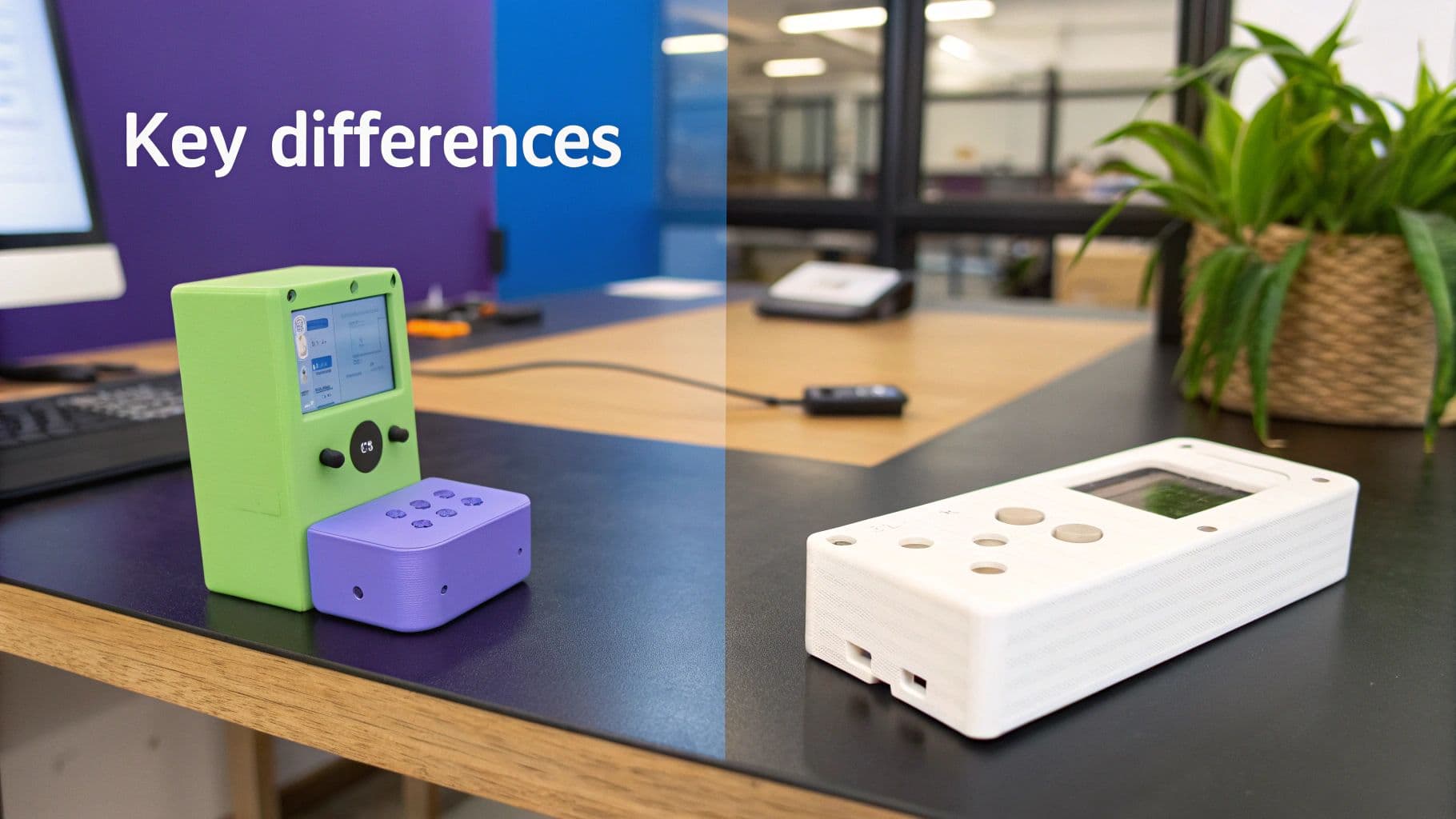
Deciding to build a Proof of Concept isn't just an early item on a checklist. It's a calculated, strategic move designed to confront a specific, high-stakes question head-on: is this technically possible?
Think of a PoC as your technical insurance policy. It stops you from sinking time and money into a product built on a foundation of unproven, high-risk assumptions. It’s the right call when the question "Can we even build this?" is much more pressing than "Will people want to buy this?"
A PoC is a surgical strike against technical uncertainty. It isn't about building a piece of a product; it’s about getting a clear, binary "yes" or "no" answer to a make-or-break technical challenge. This is the only responsible way to start when you're stepping into uncharted territory.
Navigating High Technical Risk
A PoC is non-negotiable any time your core idea depends on technology that’s brand new—either to your team or to the market itself. This is your chance to isolate the single riskiest component and prove it works before you commit to the rest of the project.
Here are a few scenarios where this approach is critical:
- Novel AI or Machine Learning Models: If your product's entire value hangs on a custom algorithm, you have to prove it can actually deliver the accuracy and performance you need. A PoC lets you test that model with a small, representative dataset to see if it holds up.
- Complex Third-Party API Integrations: Are you sure that essential payment gateway or third-party data provider will integrate cleanly with your system? A PoC can verify the connection, confirm the data flows correctly, and test reliability before you build features that rely on it.
- Unproven Hardware Capabilities: For an IoT or health tech product, you might need to confirm a new type of sensor can capture data accurately under real-world conditions. The PoC validates this single, vital function.
In these situations, a technical failure isn't just a bug; it's a project-killer. A PoC effectively quarantines that risk within a small, low-cost experiment.
Securing Stakeholder and Investor Buy-In
Sometimes the biggest hurdle isn’t technical at all—it’s convincing the people with the money to back your vision. Skeptical stakeholders and investors often need more than a slick presentation. They need to see tangible proof that your core idea is actually feasible.
A PoC delivers exactly that.
Imagine you're pitching a project that requires a significant budget for a complex new backend system. A successful PoC demonstrating that system's core logic in action is the most persuasive tool you can bring to the table. It instantly changes your pitch from, "We think we can do this," to "Look, we've already proven the hardest part works."
For a better sense of how these small-scale tests deliver major strategic value, exploring a range of proof of concepts examples can make it all click. Ultimately, a PoC is a powerful tool for building confidence and unlocking the resources you need to move forward.
When It Is Time to Build Your Minimum Viable Product
So, you’ve built a Proof of Concept and confirmed your idea is technically possible. That’s a huge step. But if technical risk was never your biggest hurdle in the first place, it's time to shift your focus from the lab to the real world. This is where you graduate from asking, "Can we build this?" to the far more critical question: "Will anyone actually use it?"
This is the moment to start thinking about a Minimum Viable Product. Building an MVP isn't just the next step on a checklist; it's your first real conversation with the market. It’s a strategic move to stop theorizing and start learning from actual users, gathering the kind of feedback that turns a cool idea into a product people genuinely want.
An MVP isn't a stripped-down, buggy version of your final product. It's the simplest, most focused version that delivers core value to your very first customers. Think of it less as a feature-packed product and more as a surgical tool designed to test your biggest business assumptions.
Answering The Most Critical Business Questions
The right time to build an MVP is when you have questions that a PoC simply can't answer. A PoC can prove your algorithm works, but an MVP is what tells you if people will pay for the problem that algorithm solves.
It's time to move forward with an MVP when your priority shifts to these areas:
- Validating Market Need: The data doesn't lie. A lack of market need is the killer of more than a third of startups. An MVP is your direct line of defense against this, putting a real solution in front of potential customers to see if it truly solves their problem.
- Gathering Actionable User Feedback: You need to see how people interact with your product. What do they love? What’s clunky or confusing? This feedback isn't just nice to have; it's the foundation of a data-driven product roadmap that actually works.
- Securing Your Next Funding Round: Investors are impressed by technical demos, but they’re compelled by market traction. An MVP that can show early user adoption, solid engagement metrics, and positive feedback is the kind of powerful evidence that proves you're building a real business.
If you want to get into the nitty-gritty of this process, our guide on what is a minimum viable product is a great resource. The entire goal is to cycle through building, measuring, and learning as quickly and cheaply as possible.
Capitalizing on First-Mover Advantage
In a crowded market, speed is everything. If you're confident in your technical plan and see a clear window of opportunity, the MVP is how you seize it. It lets you plant your flag, start building a user base, and learn from the market while your competitors are still on the drawing board.
An MVP is not just a product; it is a learning vehicle. Its purpose is to test the riskiest assumptions in your business model—the ones concerning your customers—with the least amount of effort and resources.
Think about a new social media app. Instead of launching with a dozen features like chat, events, and groups, the MVP might do just one thing exceptionally well—like sharing a single photo with a unique filter. The goal isn't to take on Instagram on day one. It's to answer a fundamental question: do people want this new, specific way of sharing? Success isn't measured by a long feature list, but by genuine user engagement and a clear desire for what’s next. That sharp focus is the hallmark of a smart MVP strategy.
Breaking Down The Costs, Timelines, and Resources

When you get down to brass tacks with a proof of concept versus an MVP, the conversation always lands on two things: time and money. How long will it take? What’s the budget? The answers really get to the heart of how different these two approaches are. Think of it this way: a PoC is a quick sprint, while an MVP is the first lap of a marathon.
A Proof of Concept is all about speed and surgical focus. The timeline is intentionally tight, often just a couple of weeks. You're trying to answer a single, critical technical question as quickly and cheaply as possible, so the resource drain is minimal. You can usually get by with just one or two developers who can isolate the core technical problem and test it without building a whole application around it.
What you get at the end isn't a product; it's a demonstration. The entire point is to get a firm "yes" or "no" on whether the tech is even possible. Because the scope is so narrow, the code is often throwaway, and any user interface—if there is one at all—is bare-bones. This keeps costs low and makes a PoC a fantastic way to kill a bad idea before it eats up a serious budget.
The Strategic Investment of an MVP
An MVP, on the other hand, is a real investment in building a market-ready asset. The timeline is much longer, typically stretching over several months. That's because an MVP isn't just about writing code; it's about crafting a complete, though minimal, user experience.
This requires a completely different team structure and resource plan. An MVP team is almost always cross-functional, bringing together:
- Developers to build the core features.
- A UI/UX designer to make sure the product is easy and enjoyable to use.
- A project manager to keep everything moving forward.
- QA specialists to hunt for bugs and smooth out usability kinks.
And the budget for an MVP goes well beyond just development. You have to factor in costs for servers, an initial marketing push to attract those crucial first users, and tools to collect and analyze their feedback. This methodical process of running smaller, controlled experiments before making bigger bets is proven to work. In fact, these strategies can cut potential sunk costs by up to 70% and shorten time-to-market by 50-75%. You can learn more about how PoC and MVP approaches de-risk AI projects on OCHKO.cloud.
The core financial distinction is this: A PoC is an expense to validate a technical assumption. An MVP is an investment to validate a business model.
Getting this distinction right is key to managing stakeholder expectations. A PoC's cost is a small price for technical certainty. An MVP's budget, while much larger, is an investment in learning directly from your actual customers—and that's an invaluable foundation for building a successful business.
How PoC and MVP Work Together in Your Product Roadmap
It’s a common mistake to think of the proof of concept vs mvp debate as an either/or decision. From an experienced product perspective, that's rarely the right way to look at it. They aren’t rival approaches; they’re sequential partners on the same team, each with a specific job to do in methodically de-risking your journey from a raw idea to a market-ready product.
When you see them as a sequence, your product roadmap starts to look a lot more like a logical progression and a lot less like a high-stakes bet. You’re taking deliberate, measured steps, gathering crucial intelligence and building confidence with each phase. Honestly, this is the secret sauce for teams that consistently build successful products without burning through their budget.
From Technical Validation to Market Validation
Every product journey starts with a mountain of risk. If your big idea relies on a new piece of tech or a tricky third-party integration, the very first question you have to answer is brutally simple: "Can we even pull this off?" This is where a Proof of Concept shines.
- Step 1 Idea Generation: It all starts with the spark. Let's say you want to build a new secure messaging app based on a groundbreaking, unproven encryption algorithm.
- Step 2 PoC for Feasibility: Before a single line of user-facing code is written, your technical team gets to work on a PoC. The goal here is laser-focused: prove that your new algorithm can actually encrypt and decrypt messages within acceptable performance limits. It’s a small, internal project that delivers a clear "yes" or "no" on technical viability.
A successful PoC is your technical green light. It confirms your core assumption isn't just wishful thinking and gives you—and your stakeholders—the confidence to invest more time and money. Skipping this step means you could end up building a beautiful house on a foundation of sand.
A PoC is your foundational technical check. An MVP then takes that validated tech and wraps it in just enough of a product to see if anyone actually wants what you’ve built. One answers how you can build it; the other answers if you should.
Building on Confidence to Test the Market
Once your technical worries are put to rest, the primary risk shifts from "Can we build it?" to a much scarier question: "Will anyone care?" This is the perfect time to pivot your efforts toward building a Minimum Viable Product. You already know the core technology is sound, so now you can put all your energy into validating the market.
At this point, you might create a quick prototype to visualize user flows and iron out the UI before development kicks off. But the real test, the one that matters most, is the MVP. It’s the first version of your product that real users get their hands on, and the feedback you get is worth its weight in gold—something no internal test can ever replicate. If you want to dive deeper into this stage, our guide on how to build an MVP breaks down how to turn your validated concept into a powerful learning tool.
Let’s go back to our messaging app example:
- Step 3 Prototype for Usability (Optional): You could quickly design some clickable wireframes to test the core messaging flow. Does the interface make sense to a handful of test users?
- Step 4 MVP for Market Demand: Finally, you build the MVP. This isn’t the feature-packed app of your dreams. It’s a stripped-down version that does one thing perfectly: it lets a user send and receive a message using your proven encryption. You release it to a small group of early adopters to gauge their true reaction. Do they use it? What do they love? What’s missing?
Thinking this way completely reframes the PoC vs. MVP discussion. It’s not about choosing one over the other. It's a natural, collaborative flow—a clear and logical path for turning innovative concepts into products that people actually want.
Common Questions About PoCs vs. MVPs
When you're in the early stages of building a new product, it's easy to get tangled up in the terminology. The lines between a proof of concept and an MVP can feel blurry, but getting them right is crucial. It's the difference between a smart investment and a costly misstep. Let's clear up a few of the most common questions I hear from founders and product managers.
Can I Skip a PoC and Go Straight to an MVP?
You absolutely can, but whether you should boils down to one thing: technical risk. If your idea relies on well-established tech and integrations that your team knows inside and out, then a PoC is probably unnecessary. The "can we build this?" question is already a given.
However, if your core feature depends on a brand-new algorithm, a shaky third-party API, or untested hardware, skipping the PoC is a huge gamble. Think of it as your technical safety net. When you're facing a genuine technical unknown, a PoC is a low-cost experiment that can save you from a much more expensive failure down the road.
Is a Prototype the Same as a PoC or an MVP?
Nope. Each of these serves a completely different purpose, and they each answer a very different question. Here's how I break it down:
- Proof of Concept (PoC): Asks, "Can this core technology even work?" It's all about technical validation.
- Prototype: Asks, "How would a user interact with this?" This is about validating the user experience and design flow, often with clickable mockups.
- Minimum Viable Product (MVP): Asks, "Will people actually use (and pay for) this?" This is where you validate your business idea in the real market.
A prototype is the bridge between a technically-proven concept and a market-ready product. It lets you test the user journey and iron out UI wrinkles before you write a single line of backend code for your MVP.
How Do You Measure the Success of a PoC?
Success for a PoC is incredibly straightforward: it's a binary outcome. It either worked, or it didn't. The entire goal is to get a definitive yes-or-no answer to a very specific technical question. You're not looking for user engagement metrics or revenue; you're looking for proof.
The real measure of a successful PoC is clarity. Did it give you the hard data needed to confidently approve—or kill—the technical approach? If you got that clarity, the PoC was a success, even if the answer was "no, this won't work."
For instance, your success criteria might be as simple as, "Did our custom algorithm process the test data in under 500ms?" or "Did we successfully pull data from the new API with an error rate below 1%?" A clear result like that gives your team the green light to proceed with confidence or the wisdom to pivot before wasting another dollar.
Ready to turn your validated idea into a market-ready product without the typical delays? At Iglu Digital, we specialize in building high-quality MVPs on a fixed price, agreed up front. We transform your concept into a tangible, scalable solution that you can put in front of real users fast. Start building your vision today at https://iglu.dev.