How to Hire Software Developers for Your Startup

Table of Contents
Before you even think about writing a job description, you need to get crystal clear on what you actually need. Rushing this step is like trying to build a house without a blueprint—you'll burn through time and money, and the end result probably won't be what you envisioned.
The real first step isn't listing technologies; it's defining the business problem you're trying to solve.
Defining Your Needs Before You Start Hiring
So, where do you begin? Start by asking one simple, powerful question: "What specific business goal will this developer achieve?" The answer to this question shapes everything that comes next.
Let's say your goal is to launch a Minimum Viable Product (MVP) in three months to see if your big idea has legs. In that case, you don’t need a perfectionist or a niche specialist. You need a versatile generalist who can jump between the front end and back end, isn't afraid of ambiguity, and knows how to ship a functional product—fast. Their mission is to get something into users' hands, not to build a fortress of perfect, scalable code.
But what if you're already past the MVP stage? If your product is growing and your goal is to "improve database performance to handle 10x more traffic," your needs are completely different. Now, you’re looking for a specialist. You probably need a backend developer who geeks out on database optimization, caching, and building resilient systems that don’t buckle under pressure. Their focus is on stability and scale, a world away from the scrappy MVP builder.
Translating Business Goals into Technical Skills
Once you've nailed down the business goal, it's time to translate that into specific technical skills. And here’s a common trap I see founders fall into: creating a "unicorn" job description that lists every trendy technology under the sun. This doesn't attract the best talent; it just scares them away or attracts people who are great at embellishing their resumes.
Instead, keep it simple. Grab a piece of paper or open a doc and create two columns:
- Must-Haves: These are the absolute, non-negotiable skills someone needs to solve your immediate problem. For an MVP, this might be "Strong command of Python/Django for the backend" and "Solid experience with React for the UI."
- Nice-to-Haves: These are the bonus skills. They’re great if a candidate has them, but they’re not deal-breakers. Think things like "Familiarity with AWS for deployment" or "Experience with Stripe integrations."
This little exercise forces you to be realistic and focus on what truly matters for the role.
Choosing the Right Experience Level
Your project's needs will also point you toward the right seniority level. A junior developer is great for well-defined tasks under supervision, while a senior developer can take a vague business concept and turn it into a full-fledged technical strategy. Misjudging this is a classic mistake—hiring a junior for a senior's job leads to project delays, while hiring a senior for a junior's tasks leads to boredom and a quick exit.
Here’s a quick breakdown to help you decide who you really need on your team.
Developer Seniority Level Breakdown
Understanding what each level brings to the table is key to making the right hire. This table lays out the typical expectations for Junior, Mid-Level, and Senior developers.
| Level | Typical Experience | Key Responsibilities | Level of Autonomy | Best Suited For |
|---|---|---|---|---|
| Junior | 0-2 years | Writing code for well-defined features, fixing bugs, learning the codebase, working under mentorship. | Low. Requires clear instructions and regular code reviews. | Assisting a team on a larger project, handling specific, scoped-out tasks. |
| Mid-Level | 2-5 years | Owning small to medium-sized features, contributing to technical discussions, mentoring juniors. | Moderate. Can work independently on tasks but needs guidance on complex architecture. | Building out core features of an application, taking ownership of a specific product area. |
| Senior | 5+ years | Leading technical design, architecting systems, mentoring the team, translating business needs into technical roadmaps. | High. Can operate independently, solve ambiguous problems, and drive projects forward. | Leading a new project from scratch (like an MVP), solving complex scalability issues, setting technical direction. |
Choosing the right level isn't just about budget; it's about matching the right skills and autonomy to the job at hand. For an early-stage MVP, a strong senior developer who can act as a technical lead is often worth their weight in gold.
Understanding the Global Talent Pool
Finally, defining your needs also means thinking about where you'll find your talent. We're not limited by geography anymore. The global developer workforce is exploding, projected to jump by 70% from 21.8 million in 2022 to 36.5 million by 2025.
While North America and Western Europe are still major tech hubs, you can’t ignore the incredible growth elsewhere. South Asia’s developer population has nearly doubled in just three years, and Greater China’s has almost tripled. You can dive deeper into these figures in SlashData's latest report on global developer population trends.
Your job isn't to find someone who knows everything. It's to find someone who has the core skills to solve today's problem and the curiosity to learn what's needed for tomorrow's challenges.
Thinking globally from the start opens up a massive advantage. If you embrace remote work, you can tap into thriving tech scenes in places like Brazil or India. This gives you access to a much wider pool of skilled developers who might be a perfect fit for both your project and your budget, giving you a serious edge over competitors stuck hiring in their own backyard.
Writing a Job Description That Actually Attracts Great Developers

Think of your job description less like a formal HR document and more like your startup's landing page for talent. In a market this competitive, a dry list of requirements is the fastest way to get completely ignored. The best developers aren’t just looking for another job; they're looking for a mission they can get behind and a problem they’ll be genuinely excited to solve.
Your goal is to stop saying, "Here's what we want," and start showing them, "Here's the impact you can make." This document is your first and most important sales pitch. It needs to be compelling, honest, and speak directly to the kind of person you’re hoping to hire.
Ditch the Corporate Jargon
First things first: cut the fluff. Phrases like "fast-paced environment" or "team player" are empty clichés that tell a developer absolutely nothing about the actual role. Instead, you need to paint a vivid picture of what their day-to-day will actually look like.
Be specific and be real. Instead of asking for a "rockstar coder," describe the real-world challenges they'll be tackling.
- What to avoid: "Seeking a motivated full-stack engineer for an innovative tech company."
- What to aim for: "We're looking for a pragmatic full-stack engineer to help us build the core of our new scheduling platform, taking it from a rough prototype to a product that serves our first 1,000 users."
That second example immediately gives them context, a clear objective, and a sense of ownership. It’s a challenge, not just a job title.
Lead With the Mission and Impact
Why should a top-tier developer join your tiny startup instead of a big tech company with endless perks and a massive salary? The answer is impact. It's your most powerful currency.
Your job description has to lead with your mission and clearly explain how this specific role helps achieve it. Developers want to build things that matter. Show them how their code will directly affect users and quite literally shape the future of your company.
Your job description shouldn't just list what the developer will do. It must sell them on what they will build and the difference it will make. This is your biggest competitive advantage against larger, more established companies.
For example, don't just say "write APIs." Frame it as "design and build the APIs that will power our real-time collaboration feature, helping remote teams finally feel more connected." One is a task; the other is a purpose.
Be Radically Transparent About the Role
Honesty builds trust from the very first interaction. The best talent appreciates transparency, especially when it comes to the less glamorous parts of a startup job. Be upfront about the compensation, the tech stack, and the real challenges they'll face.
Here’s what to include for maximum clarity:
- Compensation Range: Always, always include a salary range. It's a non-negotiable in today's market. Job posts that include salary ranges get way more applicants because it shows you respect their time and are serious about hiring.
- The Actual Tech Stack: Don't just list technologies. Briefly explain why you chose them. For example, "We use Python and Django for its speed in prototyping and robust ecosystem, which is crucial for helping us move quickly."
- The Real Challenges: Be honest about the problems they'll be solving. Mentioning things like "refactoring some early-stage code" or "building our deployment pipeline from the ground up" attracts problem-solvers who aren't afraid to get their hands dirty.
Being this transparent helps you filter for the right candidates—the ones who are genuinely excited by your specific opportunity, not just any job. This simple act of honesty saves everyone a ton of time and sets the stage for a much better hiring process. You'll end up talking to people who already understand the mission and are ready to jump in from day one.
Finding Talent in Places Other Founders Miss
The hard truth about hiring is that the best developers are almost never scrolling through job boards. They're already employed, neck-deep in interesting projects, and frankly, too busy building cool stuff to be actively looking for a new gig. If your entire strategy is just posting a job and waiting for the applications to roll in, you're missing out on the top 90% of the talent pool.
That means you have to get out there and hunt. You need to shift from being a passive recruiter to an active talent scout, going where developers actually hang out, not just where you hope they'll be.
Go Where Developers Live and Breathe Code
For a minute, let's forget the traditional job sites. The real gold is in the online communities where developers spend their time learning, collaborating, and showing off their work. This is where you can see their skills in action long before a resume ever hits your inbox.
Focus your energy on these key spots:
- GitHub: This is so much more than a place to store code; it’s a living, breathing portfolio. I always look for developers contributing to open-source projects that are relevant to our tech stack. An active GitHub profile tells me more than a resume ever could—it shows me their coding style, how they collaborate with others, and whether they're genuinely passionate about their craft.
- Stack Overflow: Pay attention to who is consistently providing smart, high-quality answers to complex technical questions in your field. These people are often the real experts who actually enjoy solving tough problems—exactly the kind of person you want on your team.
- Niche Communities: Find the specific Slack channels, Discord servers, or subreddits dedicated to the programming languages or frameworks you use. By participating authentically in these communities, you can build real relationships and spot standout talent organically.
A great starting point is GitHub's trending developers page. It’s a real-time pulse on who's making waves in specific technologies.

This gives you a direct path to discovering passionate, skilled people who aren't even on the traditional hiring radar.
The Art of Personalized Outreach
Once you've identified someone who looks promising, your next step is absolutely critical. A generic, copy-pasted outreach message will be deleted on sight. Good developers, especially senior ones, get spammed by lazy recruiters all day, every day.
To cut through the noise, you have to prove you've done your homework. Reference a specific project they worked on. Mention a thoughtful comment they made on a forum. Point to a piece of open-source code they contributed. Show them you're reaching out because of who they are and what they’ve built, not just because their profile matched a keyword.
Keep your message short, be respectful of their time, and focus on the interesting problem you think they could help solve. Frame it as the start of a conversation, not a sales pitch. This approach is fundamental, just like knowing https://iglu.dev/blog/how-to-pitch-to-investors requires you to understand your audience and tailor your message.
Choosing Your Hiring Model
Let's be real—proactive sourcing takes time. You need to pick a hiring model that fits your runway and your urgency.
- Freelance Platforms: Sites like Upwork or Toptal are fantastic for short-term projects or finding highly specialized skills quickly. They offer a ton of flexibility but might not be the best for building a cohesive, long-term team.
- Vetting Services: Companies like Lemon.io or Andela do the heavy lifting by pre-screening and vetting developers for you. This can save you a ton of time and give you access to a global talent pool—a great middle-ground for startups that don't have a dedicated HR team.
- Traditional Recruiters: A great recruiter can tap into their network and find those hidden-gem candidates. The downside? It’s expensive. Expect to pay 20-30% of the candidate's first-year salary.
The market is always shifting. While overall IT spending is projected to grow 9.3%, creating more demand, big tech firms are hiring fewer new grads, which means the market is flooded with experienced talent. This reality underscores the advantage of tapping into a global, remote-ready talent pool to build your team.
By looking beyond the obvious job boards and engaging talent on their own turf, you'll build a pipeline of incredible candidates your competitors will completely miss.
Running an Interview Process Developers Actually Respect
Let's be blunt: a bad interview process is the fastest way to lose a great candidate. Top developers have their pick of roles, and they’re absolutely judging your entire company by how you interview. If your process is clunky, disrespectful, or poorly planned, it screams chaos. That’s a massive red flag that will send them straight to your competitors.
The goal here isn't just to vet skills. It's to create a genuinely positive experience that leaves every single applicant feeling respected, whether they get the job or not. This means being clear, being efficient, and focusing on what actually matters—a candidate's ability to solve problems they’ll face on the job.
This image shows a pretty standard candidate funnel. It’s a good visual for how you’ll narrow a big pool of applicants down to your final hires.
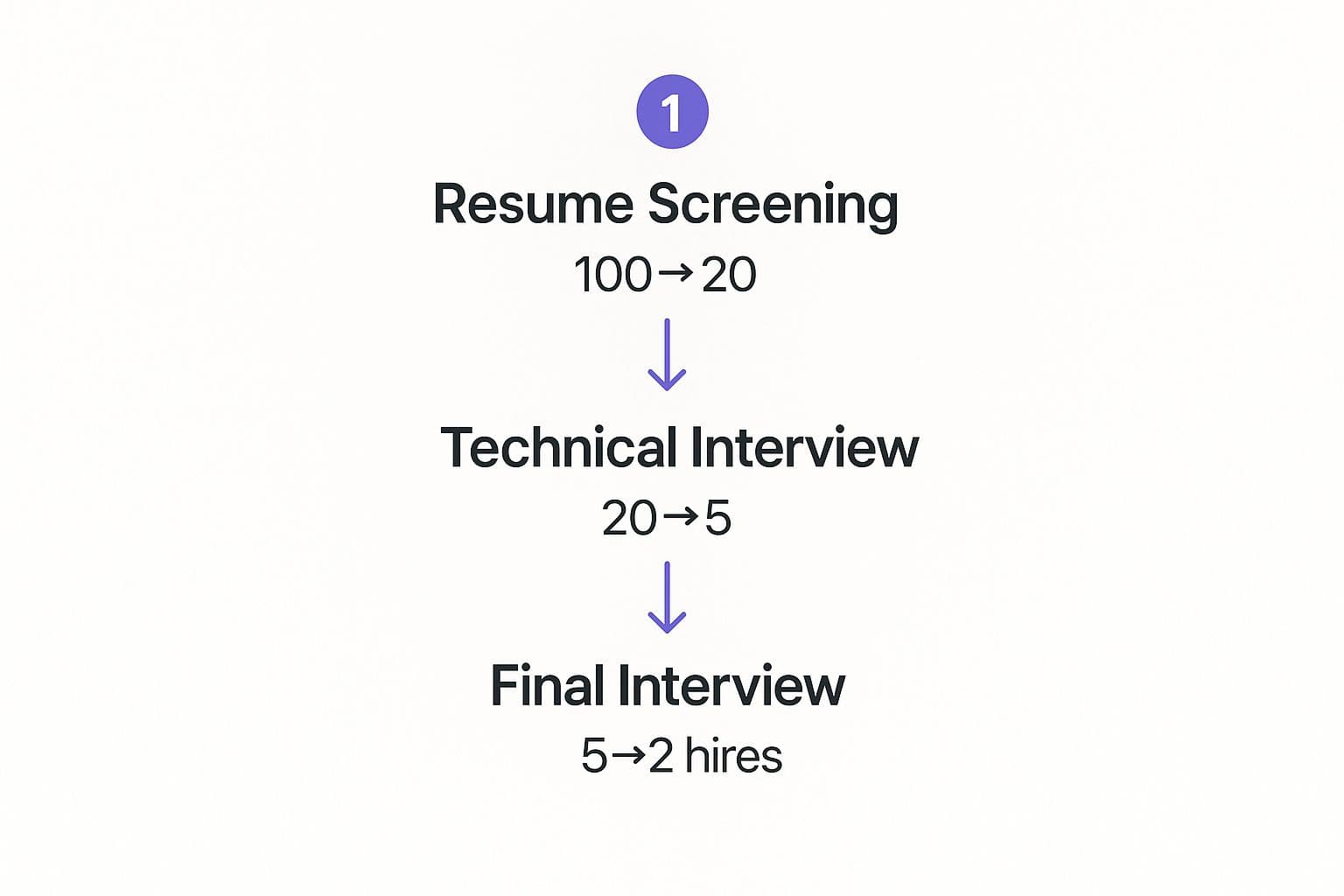
It really highlights why you need to be smart about screening at each stage. You want to make sure your team's valuable time is spent only on the most promising people.
Crafting a Multi-Stage Interview Plan
A structured interview plan is non-negotiable. By breaking it down into distinct stages, you can evaluate both technical chops and those crucial soft skills without burning out the candidate. Each step should have a clear purpose, building on the last and giving both of you a chance to decide if it's the right fit.
A well-structured interview process gives you a holistic view of a candidate's abilities. The plan below is a solid starting point, designed to efficiently evaluate everything from their initial interest to their practical coding skills and team dynamics.
Sample Interview Process Stages
| Stage | Objective | Format | Evaluates |
|---|---|---|---|
| 1. Initial Screening | Confirm baseline interest and experience. | 30-minute video call | Basic qualifications, salary expectations, communication skills |
| 2. Technical Assessment | Evaluate practical coding and problem-solving. | 2-3 hour take-home project or pair-programming | Real-world coding ability, thought process, code quality |
| 3. Team & Culture Fit | Assess collaboration and problem-solving with others. | 1-hour panel interview | Teamwork, communication, problem-solving approach |
| 4. Final Offer | Discuss the big picture and finalize details. | 30-minute call with a founder/hiring manager | Long-term alignment, answering final questions |
This layered approach ensures that by the time you're ready to make an offer, you have a well-rounded understanding of who you're hiring, and they have a clear picture of what it's like to work with your team.
Key Takeaway: The best interviews feel less like an interrogation and more like a collaborative problem-solving session. You’re not trying to trip them up; you’re trying to see what it would actually be like to work alongside them.
Designing a Technical Assessment That Works
Your technical assessment is the heart of the process. Get it right, and it tells you everything you need to know. Get it wrong, and all you’re testing is their ability to memorize obscure algorithms under pressure.
What to avoid at all costs: Abstract brain teasers or live whiteboarding of complex algorithms. This high-pressure environment is nothing like a real workday and often just filters for performance anxiety, not actual coding ability.
What to do instead: Give them a practical, real-world task. A great approach is to hand them a small, self-contained project that mirrors a simplified version of a problem your team has actually solved. This could be anything from building a small API endpoint, to debugging a broken React component, or even refactoring a messy piece of code. It gives you a direct window into their thought process, coding style, and problem-solving approach in a realistic setting.
Getting this right means understanding where this new developer will slot in. For more on that, you can explore our guide on building an effective software development team structure to see how different roles need to work together.
Questions That Reveal True Potential
When you get to the team and culture interviews, you need to dig deeper than "What are your strengths and weaknesses?" You're trying to uncover how a person thinks, how they handle adversity, and how they collaborate.
Here are a few questions I've found to be incredibly revealing:
- "Tell me about a technical decision you made that you later regretted. What did you learn from it?" (This tests for self-awareness and the ability to learn from mistakes.)
- "Walk me through the most complex project you've worked on. What was your specific role and contribution?" (This uncovers their level of ownership and true technical depth.)
- "Describe a time you had a major disagreement with a colleague about a technical approach. How did you handle it?" (A perfect question for assessing communication and collaboration skills.)
- "If you could start your last project from scratch, what's one thing you would do differently?" (This shows if they can think critically and reflect on their experience.)
These kinds of questions get you past the canned, rehearsed answers. They give you a genuine glimpse into how a developer will perform when they're actually on your team, tackling the messy, real-world challenges that come with building something new.
Making a Confident Hiring Decision and Offer

The interviews are done. You’ve met some impressive people. Now for the tough part: picking the one. It's all too easy to get caught up in gut feelings or be charmed by the most charismatic person in the room. But a structured, objective approach is your best defense against making a costly hiring mistake.
The goal here is to shift from subjective impressions to a side-by-side, objective comparison. This is where a simple evaluation scorecard becomes your most important tool. By scoring every candidate against the same criteria, you introduce fairness and clarity, making the final choice something you can truly stand behind.
Using a Scorecard to Compare Candidates
Before your first interview, you should already have a scorecard roughed out. It doesn't need to be some complex system—a simple spreadsheet is perfect. The real magic of a scorecard is that it forces you to evaluate everyone on a level playing field, keeping the focus on what actually matters for the role.
Your scorecard should zero in on the key areas you absolutely need to get right. Think about the non-negotiables and break them down into a few core categories.
Here’s a simple, practical structure I’ve used before:
- Technical Skills: How did they actually do on the practical test? Look at their code quality, their approach to solving the problem, and their fluency with your core tech stack. Give it a score.
- Experience Alignment: Does their background directly map to the problems you need solved right now? Consider if they’ve worked on similar products, in teams of your size, or in the scrappy startup trenches before.
- Communication & Collaboration: How well did they articulate their thought process? You're looking for someone who can explain complex ideas clearly and, just as importantly, handle a technical disagreement without getting defensive.
- Mission & Culture Alignment: Do they actually seem to care about the problem you're solving? This isn't about finding a new best friend; it's about finding someone whose work ethic and values won't clash with the team's.
By giving each candidate a simple score (say, 1-5) in each category, you get a holistic view of who really stands out. This data-driven approach helps you sidestep common biases, like the "halo effect," where you let one amazing quality blind you to other potential red flags.
Crafting an Offer They Can’t Refuse
Once you've landed on your top candidate, the next step is putting together an offer that’s not just competitive but truly compelling. Let’s be real—as a startup, you’re probably up against bigger companies with deeper pockets. That means you have to sell the entire opportunity, not just the salary.
A great offer is a complete package that clearly lays out the value beyond the base pay.
Remember, you're not just offering a job; you're inviting someone to join your mission. Top developers are driven by impact, growth, and ownership just as much as they are by compensation.
Make sure your offer letter highlights these key components:
- Equity: For any early-stage startup, equity is your ace in the hole. Explain it clearly—the number of options, the vesting schedule, and what that represents as a percentage of the company. Frame it for what it is: a chance to own a real piece of what they’re building.
- Professional Growth: What new things will they learn here? Talk about mentorship opportunities, the chance to get their hands on new technologies, or the path to a leadership role as the company scales.
- Flexibility and Benefits: Never underestimate the power of remote work, flexible hours, or a generous vacation policy. For many developers, these perks are far more valuable than traditional corporate benefits.
Navigating Negotiations and Sealing the Deal
Always try to present the offer over a call, not just in an email. That personal touch lets you share your excitement and get an immediate read on their reaction. And be ready to negotiate—it’s a normal part of the process and a good sign they’re seriously considering the role.
When you get to the negotiation table, know your hard limits but look for areas where you can be flexible. If you’re maxed out on salary, maybe you can offer a signing bonus, a more senior title, or an extra week of vacation. The key is to listen to what’s most important to them and find a solution that works for everyone.
Finally, send a crystal-clear offer letter that documents everything you discussed. A swift, transparent process from your decision to the final offer shows respect for their time and reinforces the idea that your startup is a great place to work.
Getting Your New Developer Up to Speed for Day-One Impact
You’ve got the signed offer letter. Huge win. But the real work starts now. That window between the "yes" and their first day is more important than most people realize. A solid onboarding plan gets a new developer contributing to your MVP from the get-go. A bad one leaves them swimming in confusion, wondering if they made a mistake.
The process kicks off the second they accept the offer. Don't go dark on them. A welcome email from the team, their new laptop showing up a week early, maybe some company swag—these things matter. Make sure their email, Slack, and GitHub accounts are ready and waiting. It’s the small stuff that shows you’re organized and genuinely excited to have them join.
This prep work completely bypasses that classic day-one disaster where your new hire spends half the day just waiting for account access. It sets the right tone from the start and builds momentum before they’ve written a single line of code.
Your New Developer’s First Week: A Blueprint
A developer’s first week shouldn't be a free-for-all. It needs to be a well-thought-out experience. You want to immerse them in the team, the project, and the mission without completely overwhelming them. A structured week builds the confidence and context they need to start making real contributions.
The trick is to find the right balance between learning and doing. A full week of reading documentation is a recipe for burnout, but throwing them at a massive, complex feature is just setting them up to fail.
Here’s a practical way to structure that critical first week:
- Day 1: The Welcome Wagon. This day is all about people. Schedule a few casual 1-on-1s with everyone on the team. Give them the big-picture view of the company’s mission and where this product fits in. Context is king—it’s the why behind the code.
- Day 2: The Codebase Tour. Actually sit down with them—virtually or in person—and walk through the codebase. Don’t just point them to the README. Explain the architecture, show them the important modules, and talk through why you made certain technical choices. This is a thousand times more effective than leaving them to figure it out alone.
- Day 3: The First Small Win. Find a small, self-contained bug fix or a tiny feature request. The ideal first ticket is something they can knock out in a day or two. It should touch a couple of different parts of the application and end with a pull request they can be proud of.
- Day 4 & 5: Shipping Their First Code. Guide them through submitting their first PR. Your code review process is a huge part of your team's culture, so make sure this first one is a positive, educational experience. Pair them with a senior dev to walk them through the feedback and deployment pipeline.
The goal of week one isn't to ship a massive new feature. It's to give your new developer a win. Merging that first small piece of code is a massive confidence boost that sets the tone for everything that follows.
This approach helps your new hire learn more than just the code; they learn your team's rhythm, how you communicate, and how you work together. Getting this right early on is fundamental, especially when you're figuring out how to create a product roadmap and need the entire team pulling in the same direction.
Ready to build your MVP without the hiring headache? At Iglu Digital, we specialize in turning your idea into a launch-ready product with the price fixed before we start. Skip the lengthy recruitment process and let our expert team deliver a high-quality, user-focused solution fast. Learn more about our accelerated MVP development service.