MVP Development for Startups A Founder's Guide
Table of Contents
So, you have a killer startup idea. The temptation is to lock yourself away for a year, burn through your savings, and emerge with a perfectly polished, feature-loaded product. Resist that urge. Successful mvp development for startups is all about one thing: launching a product with just enough features to solve a core problem for a specific group of people.
It’s less about a grand unveiling and more about a strategic first step. This approach lets you test your biggest assumptions in the real world—with real users—without betting the entire farm. You're building a learning machine, not just a product.
Why an MVP Is Your Startup's Most Valuable Asset

I've seen too many passionate founders fall into the "build it and they will come" trap. They spend months, sometimes years, perfecting a product in a vacuum, only to launch to the sound of crickets. The brutal truth is that over 35% of startups fail because they build something nobody actually wants.
An MVP flips that entire process on its head. Instead of a massive, feature-rich product, you release a lean, functional version that does one thing really, really well for your ideal first customer. This isn't about shipping a buggy or unfinished product. It's a calculated move to gather hard evidence.
Think of your MVP as your secret weapon. Its main job is to test your most critical business hypotheses with the smallest possible investment of time and money. It’s no wonder that roughly 72% of startups worldwide use an MVP to validate their concepts. It’s a proven method for getting a foothold, learning from your audience, and dramatically improving your odds of survival and future funding. You can dig deeper into how startups use this model with these survival statistics.
Shifting from Dream Product to Learning Tool
Embracing the MVP approach requires a fundamental mental shift. You have to let go of the vision of a perfect, all-in-one solution and instead focus on creating a sharp, precise tool designed for learning. The goal isn't a flashy launch; it's maximum validated learning.
This mindset forces you to confront the toughest questions right away:
- Is the problem I'm solving a real, painful-enough issue for a specific group?
- Does my solution actually work for them? Is it something they'd want to use?
- Are people willing to pay for this?
Getting answers to these questions with data from actual users—not just your team's opinions—is the single most valuable thing you can do as an early-stage startup.
An MVP isn't a cheaper product; it's a smarter process. You're trading the massive risk of building the wrong thing for the certainty of learning what the right thing is.
To truly grasp this shift, it helps to see the two mindsets side-by-side. One is based on assumptions, the other on evidence.
MVP Mindset vs Traditional Product Development
| Core Principle | MVP Development Approach | Traditional Development Approach |
|---|---|---|
| Primary Goal | Maximize learning and validate core assumptions quickly. | Launch a complete, feature-rich product. |
| Focus | Solve one critical problem for a niche audience. | Address multiple use cases for a broad market. |
| Risk Management | Minimize upfront investment to reduce the cost of failure. | Invest heavily upfront, assuming the product will succeed. |
| Feedback Loop | Fast and continuous. User feedback drives every iteration. | Slow or delayed. Feedback is gathered post-launch. |
| Definition of "Done" | The product is functional enough to start the learning process. | The product has all planned features and is "market-ready." |
As the table shows, the MVP path is about being nimble and responsive. It's a dialogue with your market, not a monologue.
Building Your Company on a Foundation of Evidence
Every click, every sign-up, every piece of feedback from an MVP user is a piece of evidence. This evidence becomes the foundation you build your entire company on. Positive feedback tells you you're on the right track. Negative feedback? That's gold. It shows you exactly where you need to pivot before you've wasted a ton of resources.
This evidence-driven process delivers some powerful advantages:
- Slashed Development Costs: By concentrating only on the absolute core features, you stop hemorrhaging cash on nice-to-have functions that users don't value.
- Faster Time-to-Market: A simpler product gets into users' hands months sooner, giving you a massive head start on learning and iterating.
- A Base of Early Adopters: You start building a community of passionate first users who become your biggest champions and provide priceless insights.
- Investor Magnet: A working MVP with real user engagement and data is infinitely more compelling to investors than a slick PowerPoint deck.
Ultimately, smart MVP development is about systematically de-risking your startup. It's how you ensure the product you're building is not just viable, but truly valuable—setting the stage for real, sustainable growth.
Pinpointing the One Problem Worth Solving

It’s a hard truth, but a great idea isn't a business. Clever concepts are a dime a dozen. What truly builds a successful startup is solving a painful, persistent, or expensive problem for a very specific group of people. Before you even think about writing a single line of code, this is your most critical job: find that one problem.
This isn’t about what you think your audience needs. It’s about uncovering what they’re already struggling with every single day. The entire process of mvp development for startups hinges on this reality. Get this wrong, and you end up building a beautiful solution for a problem nobody has—a classic recipe for failure.
You need to shift from a broad vision to a sharp, focused point of attack. We're looking for the kind of headache that keeps your target customer up at night, the one they would happily throw money at just to make it disappear.
Beyond the Surface with Jobs to Be Done
A brilliant way to get this clarity is by using the "Jobs to Be Done" (JTBD) framework. It forces a crucial shift in perspective. You stop thinking about building features and start thinking about helping customers make progress in their lives.
Instead of asking, "What features do users want?" you need to be asking, "What 'job' are users hiring my product to do?"
Think about it this way: people don't buy a drill because they want a drill. They buy a drill because they need a hole in the wall. The drill is just the tool for the job. This simple reframing helps you zero in on the real motivation driving a customer's actions.
To put this into practice, frame the problem with a simple statement:
When [situation], I want to [motivation], so I can [expected outcome].
Let’s say you’re building a project management tool for freelancers. A JTBD statement could be: “When I’m juggling multiple client projects, I want to see all my deadlines in one place, so I can avoid missing a critical delivery.” Right away, that tells you a unified calendar or deadline dashboard isn't just a nice-to-have; it's a core, high-value feature.
Uncovering Truths Through Customer Discovery
While JTBD gives you a solid framework, you have to validate it with real conversations. It’s time to get out of the office (or off Slack) and talk to your potential customers. The goal of these "customer discovery" interviews isn't to pitch your idea—it's to shut up, listen, and learn.
Focus on past behavior, not what they think they might do in the future. People are terrible at predicting their own actions.
- Bad Question: "Would you use an app that managed your project deadlines?" (This is a hypothetical question that almost always gets a polite, but useless, "yes.")
- Good Question: "Tell me about the last time you were trying to track your deadlines. What did you use? What was frustrating about that process?" (This question is grounded in real experience and uncovers actual pain points.)
These conversations might feel uncomfortable, but they are pure gold. They reveal the cobbled-together spreadsheets, frustrating workarounds, and hidden pains that scream "market opportunity." Properly validating a business idea like this is the single best way to de-risk your entire startup venture.
Finding Gaps Your Competitors Missed
Let's be realistic: no idea exists in a vacuum. Your customers are already using something to solve their problem, even if it's a clunky spreadsheet or a messy combination of different apps. Your job is to analyze these existing solutions to find your unique angle.
Don't just make a list of competitor features. Instead, map their offerings against the "jobs" you've already identified from your research. Where are they dropping the ball?
| Customer "Job" | Competitor A's Solution | Competitor B's Solution | The Underserved Gap |
|---|---|---|---|
| Track time across multiple projects | Manual entry, clunky reports | Automated but very expensive | Simple, affordable time-tracking |
| Share project progress with clients | No direct client access at all | Complex permission settings | A simple, read-only client dashboard |
| Get paid on time | No invoicing features | Integrated invoicing with high fees | Low-fee, seamlessly integrated invoicing |
This kind of analysis shines a spotlight on the underserved gaps. Your MVP's sweet spot is in addressing one of these gaps and doing it exceptionally well. You're not trying to beat your competitors at their own game—you're creating a new one in the space they’ve completely ignored.
By rigorously defining the problem, understanding the customer’s true "job," and pinpointing market gaps, you lay a rock-solid foundation. This clarity ensures every ounce of your MVP development effort is focused on creating something that delivers immediate, undeniable value from day one.
How to Prioritize Features Without Guessing
Once you've zeroed in on the core problem your startup will solve, the next big fight begins: deciding what to actually build. This is a classic trap for founders. It's so easy to fall into "feature creep"—that nagging impulse to add just one more cool function, then another, until your MVP becomes a bloated, delayed mess.
The only way out is through ruthless prioritization. This isn't about guessing what users might want. It’s about making cold, hard, evidence-based decisions. Your mission is to build a product that’s minimal but feels complete, one that flawlessly solves the primary user need and nothing else.
So, where do you start? Before you even think about a single feature, you need to see the product through your customer's eyes.
Map the User's Journey
First, sketch out a simple user journey map. I'm not talking about a convoluted flowchart. Think of it as a short story outlining the essential steps a user takes to solve their problem with your product. This simple exercise forces you to think from the outside-in and anchors your feature ideas in real-world actions.
Let's imagine a SaaS tool that helps freelancers whip up proposals. The journey might look something like this:
- User signs up for an account.
- User creates a new project proposal.
- User adds services and pricing details.
- User sends the proposal to their client.
- User gets a notification when the client opens or approves it.
Each of these steps is a critical moment in getting the main job done. Now you can brainstorm features that directly support these actions, like "email notifications" or a "simple pricing editor." This instantly helps you filter out shiny ideas that are disconnected from the primary workflow.
Use a Framework to Eliminate Guesswork
With a list of potential features grounded in your user journey, you need a system to rank them. Flying on gut instinct alone is a surefire way to build the wrong thing. Instead, lean on a practical framework to force objective, clear-headed decisions.
A powerful and wonderfully straightforward method is the value vs. effort matrix. This is just a simple two-by-two grid where you plot each feature based on two things:
- Value: How much does this feature help solve the core user problem? (High or Low)
- Effort: How much time and how many resources will it take to build? (High or Low)
This matrix cuts through the noise immediately. Features that are high-value and low-effort are your quick wins—these should be at the very top of your MVP list. Anything that scores low on value should be kicked to the curb, no matter how easy it is to build.
Your MVP is the intersection of high user value and low development complexity. It’s what you build first to prove your concept. High-value, high-effort features can wait for a future release, once you've validated the core idea.
Another great framework is the MoSCoW method, which sorts features into four clear categories:
- Must-Have: Absolutely non-negotiable. The product simply won't work without them (e.g., "user login").
- Should-Have: Important, but not critical for the very first launch (e.g., "password reset via email").
- Could-Have: Nice additions you can sprinkle in if time allows (e.g., "custom branding on proposals").
- Won't-Have (This Time): Features you explicitly decide to leave out of the current scope.
This approach brings total clarity to your development team and makes sure everyone agrees on what "minimum" truly means for your MVP.
The strategic trade-offs you make with an MVP pay off massively compared to traditional development. This visual breaks down just how big the difference is in time, cost, and risk.
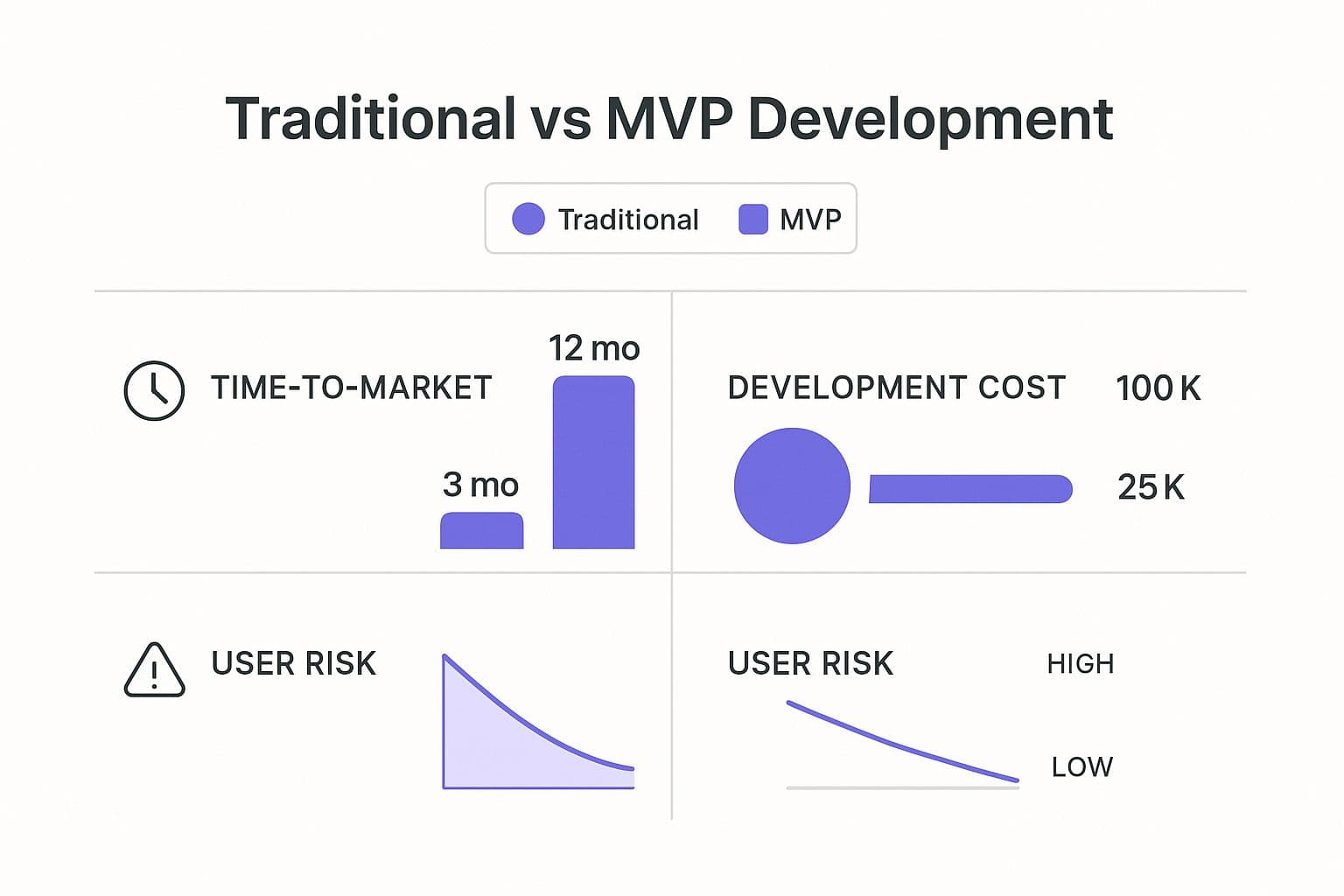
As you can see, the MVP approach can slash your time-to-market by 75% while dramatically lowering your initial investment and the risk of building something nobody wants.
The Rise of Intelligent Prioritization
We're now seeing a major trend where artificial intelligence is being woven directly into the MVP process. AI and machine learning are speeding things up in a big way, with top agencies reporting that AI-driven MVPs now make up over 40% of new startup projects in major tech hubs.
Startups are embedding ML algorithms to personalize the user experience from day one, leading to engagement rates 20–30% higher than what traditional MVPs see. They do this by delivering adaptive interfaces and content tailored to each user. You can get a deeper look into how this trend is reshaping product validation.
By combining a clear-eyed view of the user's journey with an objective prioritization framework, you can define your MVP's scope with confidence. This disciplined approach is your best defense against the siren song of feature creep and the surest path to launching a lean, powerful product that absolutely nails the core problem.
Choosing Your MVP Development Path

Alright, you’ve got your problem defined and a tight list of must-have features. Now comes the moment of truth: turning that blueprint into a real, functioning product. For many founders, especially if you're not a developer yourself, this part can feel like staring into the abyss.
Don't panic. The key is knowing that MVP development for startups isn't a one-size-fits-all process. The route you take will directly shape your budget, your timeline, and how much hands-on control you have.
Before we get into the "who" and "how," let's touch on the modern development mindset: Agile. Forget those old-school, rigid roadmaps. Agile is all about building in short, focused cycles called sprints. A sprint, typically lasting one or two weeks, is where the team tackles a small batch of features to deliver a working piece of the product.
This rhythm is a perfect match for building an MVP. It creates momentum and gives you the flexibility to pivot fast. You build, get real feedback, learn, and then adjust. It's a continuous loop that stops you from wasting months building something nobody actually wants.
Finding Your Build Partner or Platform
This is probably the single most important decision you’ll make at this stage. Who is actually going to build this thing? Your answer will depend on your cash flow, your timeline, your own technical skills, and your vision for the company's future. Each option has its own distinct trade-offs.
Hire a Specialized MVP Agency
This is often the most direct path to a professional, high-quality product. Agencies that specialize in MVPs don't just write code; they live and breathe the entire launch process. They bring a full team to the table—developers, project managers, designers, and strategists.
This option is a great fit for founders who have secured some funding and value speed and quality above all else. Yes, the upfront cost is higher, but you're paying to minimize risk and launch with a polished, scalable foundation.
Find a Technical Co-Founder
Bringing a technical co-founder on board gives you a dedicated partner who is just as invested in the product's success as you are. It’s a powerful long-term play because they own the technology from day one. You trade a salary for equity, which is a huge help for your initial cash burn.
The catch? Finding the right person is incredibly tough and can take a long time. A weak partnership can destroy a startup even faster than a bad product idea. This path is best for founders who are prepared to invest serious time into the search for a true partner and are ready to share a significant chunk of the company.
Use No-Code or Low-Code Platforms
Platforms like Bubble, Adalo, or Webflow have completely changed the game. They empower non-technical founders to build surprisingly sophisticated web and mobile apps without writing a single line of code. This is, by far, the cheapest and fastest way to get a working prototype in front of users.
The main downside is scalability. As your user base and feature set grow, you might hit a wall where the platform just can’t keep up, forcing a complete and costly rebuild from scratch. This route is perfect for validating a simple concept on a shoestring budget and getting that critical first wave of user feedback.
MVP Development Options for Startups
To make the best call for your startup, you need a clear-eyed view of what each path truly offers. The table below breaks it down simply.
| Development Path | Pros | Cons | Best For |
|---|---|---|---|
| MVP Agency | • Fast & reliable• High-quality output• Strategic expertise | • Higher upfront cost• Less day-to-day control | Founders with funding who need to move quickly and de-risk the technical build. |
| Technical Co-Founder | • Deeply invested partner• Equity-based (lower cash burn)• Full control | • Hard to find the right fit• Potential for conflict | Founders building a tech-heavy company who need a long-term partner. |
| No-Code Platform | • Very low cost• Extremely fast• Empowers non-tech founders | • Limited scalability• Potential vendor lock-in• Less customization | Validating simple concepts quickly and gathering initial user feedback. |
Ultimately, this choice goes beyond just the tech. It’s about being honest about the skills you have and the expertise you need to bring in.
Before you commit, think about how your decision will influence your ability to select the right technologies down the road. Our guide on how to choose a technology stack can help you make sure your build path aligns with your long-term product goals.
Industry benchmarks consistently show that startups that partner with specialized MVP companies report a 25% higher satisfaction rate with their final product. They credit this to better user validation and a much smoother transition to scaling after launch. Your build path isn’t just a task on a to-do list; it's a strategic decision that lays the groundwork for everything that comes next.
Launching and Learning from Real Users
Your MVP is live. It’s tempting to pop the champagne and watch the user count tick up, but hold on. The launch isn't the finish line—it's the starting gun. This is where your meticulously crafted assumptions collide with reality, and your ability to truly listen and adapt will make or break your startup.
Honestly, the "launch" itself doesn't need to be a massive, public spectacle. A quieter, more controlled release is often the smarter play. It lets you gather incredibly valuable feedback without the pressure of a huge audience expecting a perfect, polished product. You’re not trying to impress the world just yet; you’re trying to learn from a hand-picked group of ideal users.
There are a few solid ways to approach this initial release:
- Stealth Launch: You push the MVP live without any fanfare. This is perfect for quietly testing technical stability and collecting baseline data before anyone is really watching.
- Beta Group: You personally invite a small, curated group of users from your target audience. This gives you a direct line to the very people who feel the problem you're solving most acutely.
- Wider Announcement: Once you've squashed the initial bugs with your beta group, you can make a broader announcement to your email list or social media followers.
The goal isn't just to get users. It's to get the right users—the ones who will give you the honest, sometimes tough, feedback you desperately need to evolve.
Differentiating Signal from Noise
Once users start trickling in, you'll be swimming in data. The trick is to separate the meaningful signals from all the distracting noise. This means tracking both what users do (quantitative data) and what they say (qualitative data).
You need a simple dashboard that focuses on a handful of key metrics. Forget about vanity metrics like total sign-ups for now. Instead, obsess over numbers that reveal genuine engagement:
- Activation Rate: What percentage of users complete the core action that delivers your product's value? For example, sending their first proposal.
- Feature Adoption: Are people actually using the core features you decided were absolute "must-haves"?
- Retention: How many users come back after their first session? A low number here is a massive red flag that your MVP isn’t solving a real, recurring problem.
These numbers tell you what is happening. To understand why it's happening, you have to go talk to your users.
A classic mistake is treating negative feedback as a failure. It's the opposite. Negative feedback is a gift—a precise, user-generated roadmap showing you exactly what to fix next. Vague praise is far more dangerous.
Mastering the Art of Gathering Feedback
Getting truly honest feedback requires more than sending out a generic survey. You have to ask questions that uncover genuine pain points and deep-seated motivations. When you're conducting interviews or writing surveys, you have to avoid leading questions that just beg for compliments.
For instance, instead of asking, "Did you like the new dashboard?" which just invites a simple "yes," try asking, "What was the most confusing part of the new dashboard?" This open-ended question forces the user to think critically and gives you insights you can actually act on. Learning how to conduct user research effectively is a superpower for any founder; it turns fuzzy opinions into a concrete product backlog.
To get the full picture, you should blend different feedback channels:
| Feedback Channel | What It's Good For | Example Question |
|---|---|---|
| User Interviews | Deeply understanding context and motivation. | "Walk me through the last time you tried to accomplish [core task]." |
| In-App Surveys | Capturing immediate reactions to specific features. | "On a scale of 1-5, how easy was it to find what you were looking for?" |
| Support Tickets | Identifying bugs and major points of user friction. | Not a question, but a direct signal of what's broken or confusing. |
This combination of hard data and human stories is your compass. It will guide every single decision you make in the next development cycle. It ensures you aren't just building more features, but are systematically building the right features that move your startup closer to a product people can't imagine living without.
Common Questions About Building an MVP
Even the clearest roadmap can have a few bumps. It’s completely normal to have questions swirling as you get ready to build your MVP. I've heard them all over the years, from concerns about cost and timing to the nitty-gritty of strategy. Let's tackle some of the most common ones I hear from founders.
Think of this as a final sanity check before you dive headfirst into development. Getting these answers straight will give you the confidence to move forward.
How “Minimum” Does an MVP Need to Be?
This is the classic question, isn't it? The best way I can put it is this: your MVP has to be minimal, but it can't be incomplete. From day one, it absolutely must solve the core problem for your first users. It should feel like a sharp, specialized tool, not a clunky or broken gadget.
A great rule of thumb is to map out one complete, critical user journey and build just that. For example, if your app helps freelancers draft proposals, your MVP must let someone create and send a fully functional proposal. All the bells and whistles, like fancy analytics dashboards or team collaboration tools, can wait. Your product's first impression hinges on its ability to deliver on its main promise.
A huge mistake I see founders make is confusing "minimum" with "low quality." An MVP has fewer features, but the ones it has must be polished, stable, and genuinely valuable. It’s all about depth, not breadth.
The goal here isn't to build a feature-packed product. It's to provide just enough value to get those crucial early adopters using it, so they can give you the feedback you need to figure out what to build next.
What’s the Real Difference Between a Prototype and an MVP?
People often use these terms interchangeably, but they serve vastly different purposes. Mixing them up is a surefire way to make some costly strategic mistakes down the line.
- A Prototype: This is essentially a non-functional, clickable mockup. Its entire job is to test the user experience (UX) and the flow of your idea before a single line of code gets written. It answers the question, “Does this feel intuitive and easy to navigate?”
- An MVP: This is a live, working product built with real code. Real users can interact with it to solve a real problem. The question it answers is, “Will people actually use this to solve their problem?”
Here's an analogy I like: a prototype is the clay model of a car—it shows you the design and lets you test the ergonomics. An MVP is a basic, street-legal car with an engine, four wheels, and a steering wheel. It might not have a stereo or air conditioning, but it will get you from point A to point B. Skipping the prototype stage is a classic blunder that almost always leads to expensive rework during development.
How Much Is This MVP Going to Cost Me?
This is always a top-of-mind question, but the honest answer is: it depends. The price tag for an MVP can swing from under $10,000 for a simple app built with no-code tools to well over $150,000 for something complex involving specialized tech like AI.
The final cost really boils down to a few key things:
- Feature Complexity: The more features and intricate logic you need, the more development hours it will take.
- Design Requirements: A fully custom, pixel-perfect UI/UX design will always cost more than starting with a solid design template.
- Technology Stack: Building for iOS, Android, and the web is a lot more expensive than just one. Advanced tech like machine learning also adds a significant premium.
- Who's Building It: The rates for a top-tier agency, an in-house team, or a group of freelancers will vary dramatically based on their location and experience.
To give you a ballpark, for a well-scoped software product with a solid set of core features, a realistic budget often lands somewhere between $15,000 and $50,000 when you partner with an experienced development firm.
How Long Does It Realistically Take to Build an MVP?
One of the best things about the MVP approach is speed. While a full-blown product can take a year or more to get to market, a focused MVP is designed to be built much, much faster. In most cases, you're looking at a timeline of about 2 to 6 months.
That said, some highly efficient development partners can really put the pedal to the metal. We've seen specialized agencies with incredibly refined processes deliver a market-ready MVP in as little as 2 to 4 weeks. They pull this off with aggressive prioritization, tight agile sprints, and a library of pre-built foundational code.
For a startup, that accelerated timeline is everything. It means you can start learning from real users months sooner, giving you a massive head start on the competition.
Ready to turn your idea into a real product without the usual delays and guesswork? At Iglu Digital, we specialize in transforming concepts into market-ready MVPs for a price agreed before a line of code is written. We combine sharp strategy with rapid development to build the features that truly matter, getting your product into your users' hands faster than you thought possible. Let's start building your vision today. Find out more at Iglu Digital.