A Guide to App Development Outsource Done Right
Table of Contents
When people first think about outsourcing app development, their minds usually jump straight to cost savings. And while that's a definite perk, the real win is the strategic edge you gain. Essentially, you're bringing in an external team of experts to handle the entire app creation process, from the first sketch to the final launch. This lets you tap into specialized talent and get your product out the door much faster, all without the massive overhead of building an in-house team from scratch.
The Strategic Edge of Outsourcing App Development

It’s easy to get fixated on the numbers, but looking at outsourcing only through a financial lens means you're missing the bigger picture. The true power comes from its strategic impact. By tapping into a global talent pool, you can instantly bring on seasoned experts with niche skills—think advanced AI integration or complex blockchain security—that are often incredibly difficult and expensive to find and hire locally. This immediate access to top-tier talent can be a total game-changer.
There's a reason the global software development outsourcing market is booming. Projections show its value is on track to rocket past $806 billion by 2029, and that growth is fueled by the relentless demand for specialized tech skills and greater operational efficiency.
Accelerate Your Time to Market
One of the most powerful advantages of outsourcing is how it can slash your product's time-to-market. A seasoned outsourced team comes with established workflows, proven development methods, and all the necessary infrastructure ready to go. You get to skip the entire drawn-out process of recruiting, hiring, onboarding, and team-building, which can mean launching your app months ahead of your competitors.
A fintech startup I know needed to build a complex, multi-layered security protocol for their new payment app. Doing it in-house was projected to take six months. Instead, they outsourced to a specialized cybersecurity development firm and launched a secure, compliant product in just ten weeks, letting them grab that crucial early market share.
That kind of speed gives you a massive first-mover advantage. You're already out there gathering user feedback and making improvements while your competition is still trying to fill key roles on their team.
Focus on Your Core Business Strengths
When you hand off the technical heavy lifting, you free up your internal team to do what they do best: focus on strategy, marketing, user acquisition, and growing the business. Instead of getting tangled up in the daily grind of coding and bug-fixing, your key people can keep their eyes on the big picture.
Let's look at how outsourcing really moves the needle for your business.
Key Strategic Benefits of Outsourcing App Development
This table breaks down the primary advantages businesses gain when they choose to outsource their app development projects.
| Benefit | Impact on Your Business |
|---|---|
| Access to Specialized Skills | Instantly gain expertise in complex areas like AI, IoT, or blockchain without long hiring cycles. |
| Reduced Time-to-Market | Launch your product faster, capture market share, and start generating revenue sooner. |
| Core Business Focus | Allows your internal team to concentrate on strategy, marketing, and customer relationships. |
| Scalability and Flexibility | Easily scale your development team up or down based on project needs without HR overhead. |
Ultimately, outsourcing isn't just about delegating tasks; it's about strategically allocating your resources to where they'll make the biggest impact.
Building a Bulletproof Project Brief
Before you even think about talking to a potential partner, you need to get your own house in order. That means creating a detailed project brief. This isn't just paperwork; it’s the single source of truth for your entire project, the blueprint that keeps everyone on the same page. I've seen too many projects go off the rails because this step was rushed. It's the classic recipe for scope creep, blown budgets, and painful misunderstandings.
Putting together a solid brief forces you to get crystal clear on your own vision. It’s the process that turns a cool idea into a concrete, buildable plan. And honestly? This level of clarity is exactly what a top-tier development shop wants to see from a new client. It shows you're serious.
Defining Your Core Idea and Users
First things first, nail down the problem your app solves. Can you explain it in one or two sentences? What specific pain are you fixing for someone? This mission statement becomes your North Star, guiding every decision from here on out.
Next, you need to know exactly who you're building this for. Go beyond generic descriptions and create detailed user personas. Don't just say "young professionals." Give them a name and a story. For example: "Meet Sarah, a 28-year-old marketing manager. She's drowning in freelance receipts and needs a simple way to track expenses and create invoices from her phone." This kind of detail is gold. It ensures the features you dream up are things people will actually want and use.
A strong project brief doesn't just list features. It tells a story. It explains why the app needs to exist and who it's for. This context is what separates a well-prepared client from the rest, and it’s what a great development team needs to do their best work.
Prioritizing Features with the MoSCoW Method
It’s easy to get carried away and want every feature under the sun. But the most successful projects are built on ruthless prioritization. A fantastic tool for this, especially when you app development outsource, is the MoSCoW method. It’s a simple framework that brings much-needed focus.
It forces you to sort your feature list into four buckets:
- Must-have: These are the absolute, non-negotiable essentials. Without them, your app is broken. For Sarah's expense app, this is receipt scanning and invoice creation.
- Should-have: These are important features that add a ton of value but aren't strictly necessary for launch. Think bank account integration or automatic expense categorization.
- Could-have: The "nice-to-haves." These are features you’d add if you have the time and budget. A dashboard showing spending analytics would fit perfectly here.
- Won't-have: Just as important as what you will build is what you won't. This category sets clear boundaries and prevents scope creep before it starts.
Using this method helps you zero in on a lean, effective Minimum Viable Product (MVP). It also gives you a logical framework for budget talks with potential agencies, showing them you’ve thought strategically about your roadmap.
Finding and Vetting Your Ideal Development Partner
Okay, you’ve got your project brief locked down. Now comes the make-or-break moment: finding the right team to actually build your app. Honestly, the success of your entire project often hinges on this one decision. Don’t just jump at the first quote that lands in your inbox.
The search can feel like drinking from a firehose, but you can narrow the field pretty quickly if you know where to look.
I always recommend starting with curated B2B review platforms like Clutch or G2. They’re great because you can filter by location, budget, and industry focus, and the verified client reviews give you a real sense of what it's like to work with a company. But don't underestimate the power of your own network. Ask mentors, colleagues, or other founders who they’ve used and trust. A warm referral is often the best lead you can get.
Digging Deeper Than the Portfolio
Once you’ve got a shortlist, it’s time to put on your detective hat. A slick website and a polished portfolio are table stakes these days—you need to look past the surface.
When you're scrolling through their past work, don't just get wowed by the pretty designs. Look for direct relevance. Have they built apps with similar features? For the same audience? In your specific industry?
A team with a portfolio full of e-commerce sites might not be the best fit for your complex, HIPAA-compliant healthcare platform. You're looking for a partner who has already navigated the kinds of challenges you're about to face. That experience drastically cuts down on their learning curve and your project's risk.
The real test isn't about raw coding skill; it's about their problem-solving mindset. A team that asks sharp questions, challenges your assumptions, and communicates with brutal honesty is a hundred times more valuable than one that just nods and codes.
Mastering the Discovery Call
The discovery call is your best chance to see what a firm is really made of. This isn't just their sales pitch; it's your interview. You're in the driver's seat, so come prepared with questions that get to the heart of how they operate.
Here are a few questions I always ask:
- "Tell me about a project that went completely off the rails. What happened, and how did you fix it?" This tells you everything about their accountability and problem-solving skills under pressure.
- "How do you handle scope creep or significant changes mid-sprint?" You need to know how flexible—or rigid—their process is.
- "Who will be my day-to-day contact, and what's your communication rhythm?" This sets clear expectations right from the start.
Listen carefully to how they answer. Are they direct and honest, or do they give you vague, canned responses? Do they sound genuinely curious about your business goals, or are they just rushing to the sale? This first conversation often mirrors the entire working relationship.
For a deeper dive into interviewing potential hires, check out our guide on how to hire software developers. Remember, you're not just looking for a vendor; you're looking for a partner who will be in the trenches with you.
Understanding Outsourcing Costs and Contracts
Let's talk about the money and the paperwork. Getting the financial and legal side of outsourcing right is what gives your project a solid foundation. This is where you trade ambiguity for clarity and secure your investment.
Your first big decision is landing on a pricing model. Think of this as choosing the financial rules of the game for your project. The right one keeps your budget in check and aligns with your expectations, while the wrong one can lead to surprise costs or a rigid process that kills creativity.
Choosing the Right Pricing Model
You'll generally come across three main options, each with its own pros and cons.
- Fixed Price: This is your go-to for smaller projects where the scope is nailed down—think a well-defined MVP. You agree on one price for a specific list of deliverables. It’s fantastic for budget certainty, but it leaves very little room for changes once things are underway.
- Time & Materials (T&M): If you're building a complex, long-term product where you know requirements will shift and evolve, T&M is a much better fit. You pay an hourly or daily rate for the actual work done. This gives you maximum flexibility to pivot and adapt, but it also means your final cost isn't set in stone.
- Dedicated Team: This model is like hiring an extension of your own company. You get a full team of developers, designers, and project managers who work exclusively on your project. It's ideal for large, ongoing projects where you need deep integration and long-term commitment.
I always tell clients this: the best model is all about your project's maturity. If you have a fully documented MVP spec, a Fixed Price model is a safe bet. But if you’re building something that needs to adapt to user feedback and market changes, Time & Materials will give you the freedom you need.
Budgeting for Global Talent
Where your team is located will have a massive impact on your budget. The cost to outsource app development varies wildly across the globe.
To give you a clearer picture, let's look at how the numbers stack up. Here’s a quick comparison of average hourly rates in popular outsourcing regions to help you see what to expect.
Regional App Development Outsourcing Rate Comparison
| Region | Average Hourly Rate (USD) | Best For |
|---|---|---|
| North America | $100 - $250 | Companies needing close time-zone alignment and on-site collaboration. |
| Western Europe | $80 - $150 | High-quality talent with strong English skills and cultural alignment. |
| Eastern Europe | $50 - $70 | A great balance of top-tier technical skill, good communication, and cost-effectiveness. |
| Latin America | $40 - $75 | Time-zone-friendly option for North American companies looking for skilled developers. |
| Asia | $25 - $50 | The most budget-friendly option, ideal for projects where cost is the primary driver. |
As you can see, the differences are significant. While a developer in the USA might cost $150 per hour, you could find equally skilled talent in Eastern Europe for around $60 per hour. This isn't about sacrificing quality; it's about finding value in the global market.
This chart really drives home the difference between building in-house and outsourcing across a few key metrics.
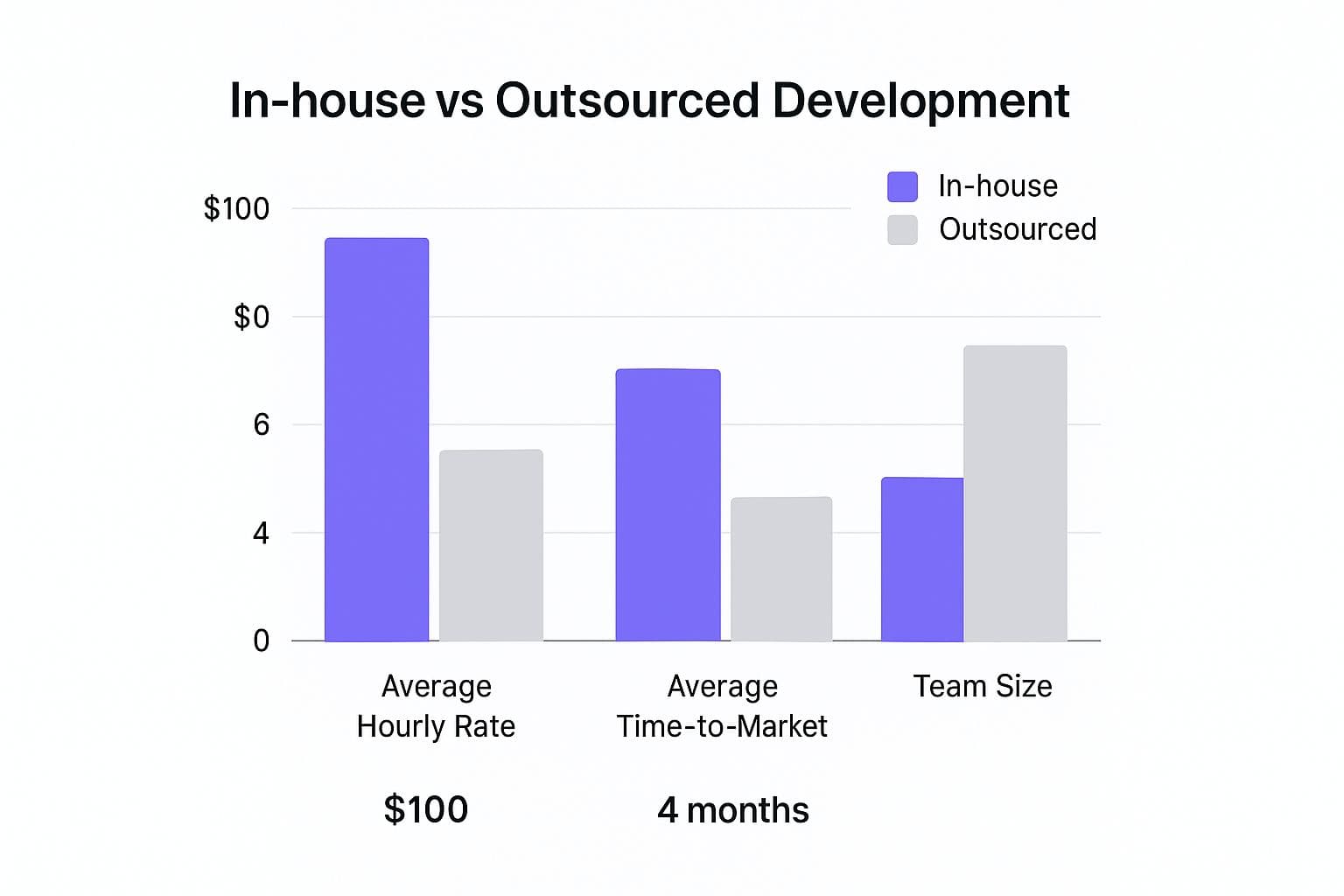
The data speaks for itself—outsourcing can often cut hourly development costs by more than half, speed up your time-to-market, and open the door to a much larger pool of specialized talent. If you want to dig deeper into the numbers behind app creation, check out our full guide on how much building an app costs.
Must-Have Clauses in Your Contract
Your contract isn't just a formality; it's the rulebook for your partnership. It protects you, your idea, and your investment. Beyond the scope and payment terms, make sure your agreement has these non-negotiable clauses baked in.
- Intellectual Property (IP) Ownership: This one is critical. The contract must state, without any ambiguity, that you own 100% of the source code and all related intellectual property once they've been paid. No exceptions.
- Non-Disclosure Agreement (NDA): A rock-solid NDA is your shield. It legally prevents the agency from sharing your confidential business information, trade secrets, and the app idea itself.
- Termination Clause: Things don't always work out. This clause outlines the specific conditions under which either party can end the contract, giving you a clear exit path if the relationship breaks down.
- Payment Milestones: Never agree to vague payment schedules. Your payments should be tied to specific, verifiable deliverables. This ensures you only pay for work that has been completed and approved.
Managing Your Outsourced Team for Success
You’ve signed the contract, and the ink is dry. Now the real work starts. This is where so many projects stumble, but it’s also where you can set yourself up for a huge win. Think of this phase less as "managing a vendor" and more as building a remote partnership. When you outsource app development, you're not just passing off a to-do list; you're integrating a new team that needs clear communication and shared goals to thrive.
The absolute bedrock of this relationship is a solid communication rhythm. Don't just assume it will happen organically—it won't. You need to establish a clear protocol right from the start. We're talking about using tools like Slack for those quick, daily touchpoints and something more structured like Jira for keeping a close eye on progress. This isn’t about micromanaging; it’s about creating a predictable pulse for the project so everyone, no matter where they are, stays in the loop.
Establishing a Productive Rhythm
One of the most common pitfalls I see is letting communication slide into a reactive mode, where you only talk when a fire breaks out. Flip that script. Be proactive. Get non-negotiable daily stand-ups and weekly demos on the calendar from day one.
The daily stand-up can be as short as 15 minutes. It’s the perfect, low-friction way to hear what’s done, what’s next, and—most importantly—what’s stuck.
Weekly demos are your reality check. This is where you see the app coming to life, build by build. It’s your opportunity to give immediate, hands-on feedback and make sure the project is still heading in the direction you envisioned. These simple rituals create momentum and squash the tiny misunderstandings that can poison a project over time.
A successful outsourced project feels less like a client-vendor transaction and more like a single, cohesive team working toward a shared goal. This collaborative spirit is built on trust, transparency, and consistent, high-quality communication.
This is exactly why Agile development methodologies are a godsend for outsourced projects. Working in short cycles, or "sprints," means the team is constantly building, testing, and getting your feedback on small, digestible pieces of the app. That feedback loop is your single greatest tool. It gives you the power to steer the ship continuously, so there are no jaw-dropping surprises waiting for you at the finish line.
Navigating Time Zones and Culture
Let's be real: managing a team across different time zones takes work. You have to be intentional about it. Find a few hours of overlap in your workdays for those crucial face-to-face meetings, but also get comfortable with asynchronous communication. Documenting decisions and discussions clearly is key, allowing team members to catch up and weigh in on their own time.
Building a positive, collaborative culture is just as critical as managing the timeline. We’ve all seen how remote work can either isolate people or bring them together. It turns out that 64% of fully remote companies have seen productivity climb simply by using effective collaboration tools, which naturally builds more trust in their outsourced partners.
This shift has also lit a fire under nearshore outsourcing. In fact, 80% of North American leaders are looking at nearshoring options specifically to get better time-zone alignment and smoother collaboration. You can dig into more of these stats and software development outsourcing trends on DesignRush.
Ultimately, it all boils down to this: treat your outsourced developers like they’re part of your core team, not just hired guns. When you do that, you foster a sense of ownership and pride in the work that pays off directly in the quality of the app you get in the end.
Wrapping It Up: Your App Launch Is Just the Beginning
As you approach the finish line, it’s time for a critical mindset shift. When you decide to outsource app development, you aren’t just hiring a coder for a one-off project. You’re forging a partnership.
The best development agencies act as an extension of your own team. They're invested in your success long after the app hits the store.
This long-term view is what separates good apps from great businesses. Launch day isn't the end—it's the beginning. Your product will need ongoing maintenance, crucial security updates, and new features to stay competitive and keep users engaged. A real partner will be there for that entire lifecycle, helping you adapt as your audience grows and the market shifts.
So, What's Next?
The version of the app you launch first is rarely the final version. Most successful companies start small with a Minimum Viable Product (MVP). This strategy lets you get to market fast, test your core idea, and collect invaluable feedback from actual users.
If you're curious about this lean approach, we break down the benefits of a Minimum Viable Product in another guide. It's a game-changer for managing risk and building something people truly want.
Remember, the goal isn't just to build an app—it's to build a sustainable business. Choosing the right outsourcing partner is one of the most impactful decisions you'll make on that journey.
Got Questions? We've Got Answers
Diving into the world of outsourced app development naturally comes with a few "what if" scenarios. Let's tackle some of the most common questions that pop up for founders and project managers.
How Do I Know the Code Won't Be a Mess?
This is a huge one. You're worried about getting handed a tangled, unscalable, and insecure codebase. The best way to prevent this is to be proactive from day one.
First, demand direct access to the code repository on a platform like GitHub or GitLab. This isn't a "nice to have"; it's a fundamental requirement for transparency. If a potential partner pushes back on this, walk away.
Next, you need to agree on clear quality assurance (QA) protocols before any work begins. This isn't just about bug hunting at the end; it's about building quality into the process. Your agreement should cover:
- Consistent code reviews: If you have a technical person on your team, they should be able to jump in and audit the work regularly.
- Automated testing: This should be part of their standard workflow to catch bugs and performance hiccups automatically.
- Dedicated manual testing: A real person needs to put the app through its paces, mimicking how actual users will interact with it.
This multi-layered approach of transparency and structured testing creates accountability and is your best defense against sloppy code.
A common mistake is waiting until a sprint is "done" to look at the code. That’s too late. Make reviews a regular part of the process. Catching a small issue early can save you weeks of headaches and a ton of money later on. Continuous oversight is what separates the good partnerships from the bad ones.
What's to Stop Them from Stealing My Idea?
Your idea is everything, and protecting it is non-negotiable. The legal safeguards here are actually quite straightforward, but you have to be diligent.
Before you share any confidential details about your project, get a Non-Disclosure Agreement (NDA) signed. This is your first line of defense and standard practice for any professional agency.
Even more important is your main service contract. It must contain an ironclad Intellectual Property (IP) ownership clause. This clause should explicitly state that you—and only you—own 100% of the source code and all related intellectual property once you've paid for the work. Any ambiguity on this point is a massive red flag.
Ready to turn your app idea into a reality without the usual delays? At Iglu Digital, we specialize in building market-ready MVPs with the price fixed before we start. Let's build your product together.