What is Iterative Development? A Beginner's Guide
Table of Contents
So, what is iterative development, really? At its core, it's a way to manage projects and build software by breaking a massive undertaking into smaller, more manageable chunks. Instead of trying to build the entire product in one go and hoping for a perfect launch, teams build, test, and improve the product in a series of repeated cycles.
Think of it as learning and adapting as you go.
Unpacking Iterative Development

Let's use an analogy: writing a book. The old-school, rigid way would be to write the entire manuscript, from the first word of chapter one to the final sentence, before letting a single person read it. This is a huge gamble. What if the plot falls flat in the middle? What if a main character just isn't compelling? You wouldn't find out until you've poured hundreds of hours into the project.
Now, imagine doing it the iterative way. You'd write just the first chapter and share it with a trusted group for feedback. You’d listen, revise, and make it better. Then, armed with those insights, you'd write the second chapter and repeat the process. With each iteration, the story becomes stronger and more engaging, dramatically reducing the risk of a total flop at the end.
Building in Cycles, Not Silos
This is the very essence of what is iterative development. It’s a rhythmic, cyclical process: build a small part of the product, test it, get feedback, and then use what you learned to plan the next small part. This approach deliberately sidesteps the "big bang" release, where a product is built entirely behind a curtain and then revealed all at once.
This method stands in stark contrast to older models like Waterfall, where each phase—requirements, design, implementation, and testing—is a silo. You have to finish one completely before you can even think about starting the next, and there's no turning back.
The core idea is simple yet powerful: start with a basic version of the system and enhance it in repeated cycles. Each cycle delivers a more refined and functional piece of the final product, allowing for early feedback and risk reduction.
The Iterative Advantage
When you compare this flexible approach to a rigid, linear one, the benefits become crystal clear. Working iteratively allows teams to:
- Catch and fix problems early when they are much cheaper and easier to solve.
- Stay flexible and adapt to new requirements or market shifts that pop up mid-project.
- Demonstrate real, tangible progress to stakeholders on a regular basis, which builds confidence and keeps everyone on the same page.
- Weave in genuine user feedback throughout the entire development process, not just as an afterthought.
To make the distinction even clearer, let's look at how the two methodologies stack up side-by-side.
Iterative Development vs Waterfall at a Glance
This table offers a high-level comparison, showing the fundamental differences between the agile, iterative approach and the traditional Waterfall methodology.
| Aspect | Iterative Development | Traditional Waterfall |
|---|---|---|
| Flexibility | High. Changes can be made in any cycle. | Low. Changes are difficult and costly after a phase is complete. |
| Risk Management | Risks are identified and addressed early in each small cycle. | Risks are often discovered late, leading to major setbacks. |
| Feedback Loop | Continuous feedback from stakeholders and users. | Feedback is only gathered at the very end of the project. |
| Delivery | Functional pieces are delivered incrementally and early. | A single, complete product is delivered at the end. |
As you can see, the philosophies are fundamentally different. One embraces change and learning, while the other prioritizes strict planning and sequential execution.
The 3 Core Principles of Iterative Development

To really get what iterative development is all about, you have to look beyond the process itself and dive into the philosophy behind it. This isn't just a checklist of tasks; it's a completely different way of thinking about how to build great products.
At its core, the iterative method is built on a few simple but powerful ideas. These principles are what shift teams away from rigid, long-range planning toward a more dynamic and adaptive way of creating. They give teams the confidence to move forward, even when the final destination isn't perfectly clear.
1. Incremental Delivery: Get Value Out the Door Early
The first major principle is incremental delivery. Instead of making everyone wait for one massive "big bang" release at the very end, teams deliver a working piece of the software after each development cycle. This isn't some buggy, half-finished feature, either. It’s a complete, tested, and usable slice of the final product.
Imagine you're building a new checkout process for an e-commerce site. Rather than trying to build the entire multi-page flow at once, the team might start by releasing a fully functional "one-click buy" button just for logged-in customers. That single feature delivers real value right away and can be tested in the wild immediately.
This approach is the heartbeat of building a minimum viable product (MVP). By zeroing in on the most critical features first, you get a valuable product into users' hands much faster. You can see exactly how this strategy works by exploring our guide on MVP software development services. It's all about reducing that initial risk and getting validation from real people as soon as possible.
2. Continuous Feedback: Stop Guessing, Start Listening
The second principle is all about creating a continuous feedback loop. Every little increment you deliver is more than just code; it's a conversation starter with your users and stakeholders. It’s your chance to ask, “Is this what you actually wanted? Does it really solve your problem?”
This feedback is the rocket fuel for the next iteration. It guides your decisions, confirms (or busts) your assumptions, and helps steer the project back on course before you drift too far. It's no surprise that organizations nailing this principle see a major uptick in project success—some studies have shown success rates 28% higher than what traditional methods produce.
The goal isn't to stubbornly stick to the original plan, no matter what. The real goal is to build the right product, and the only way to know you're on track is to constantly check in with the people who will actually be using it.
3. Adaptability: Treat Change as an Opportunity, Not a Crisis
Finally, iterative development is built to embrace change. In old-school project management, a change request often feels like a disaster—a costly disruption to a carefully laid plan. But in the iterative world, change is just another opportunity to get better.
Because the project moves forward in short, contained cycles, adapting to new information is a natural part of the workflow.
- A new market trend pops up? The next iteration can pivot to address it.
- Users are confused by a feature? The next cycle can be dedicated to simplifying the user interface.
- A competitor launches something new? The team can immediately prioritize a feature to counter it.
This level of flexibility is a massive strategic advantage. It lets a business respond to the market almost in real-time, making sure the final product isn't already outdated the day it launches. When you start treating change as an inevitable and valuable part of the journey, you free your team to learn, adapt, and ultimately, win.
How a Single Iteration Cycle Works
So, what does one of these cycles actually look like in practice? The best way to understand the iterative model is to zoom in and look at a single loop. Think of each iteration as a self-contained mini-project, complete with its own start and finish line. This tight, focused loop is where the magic happens, turning abstract ideas into working software in a predictable, repeatable rhythm.
Each cycle follows a clear, structured path, which keeps the team on track and ensures they deliver something valuable every single time. While the specifics can always be tweaked, a typical iteration almost always moves through a logical sequence of planning, building, testing, and reviewing. This isn't a one-off process; it's a cadence that helps teams build momentum and get smarter with each pass.
This diagram breaks down the three core phases of a single iterative cycle. The arrows are key—they show how everything is connected in a continuous feedback loop.
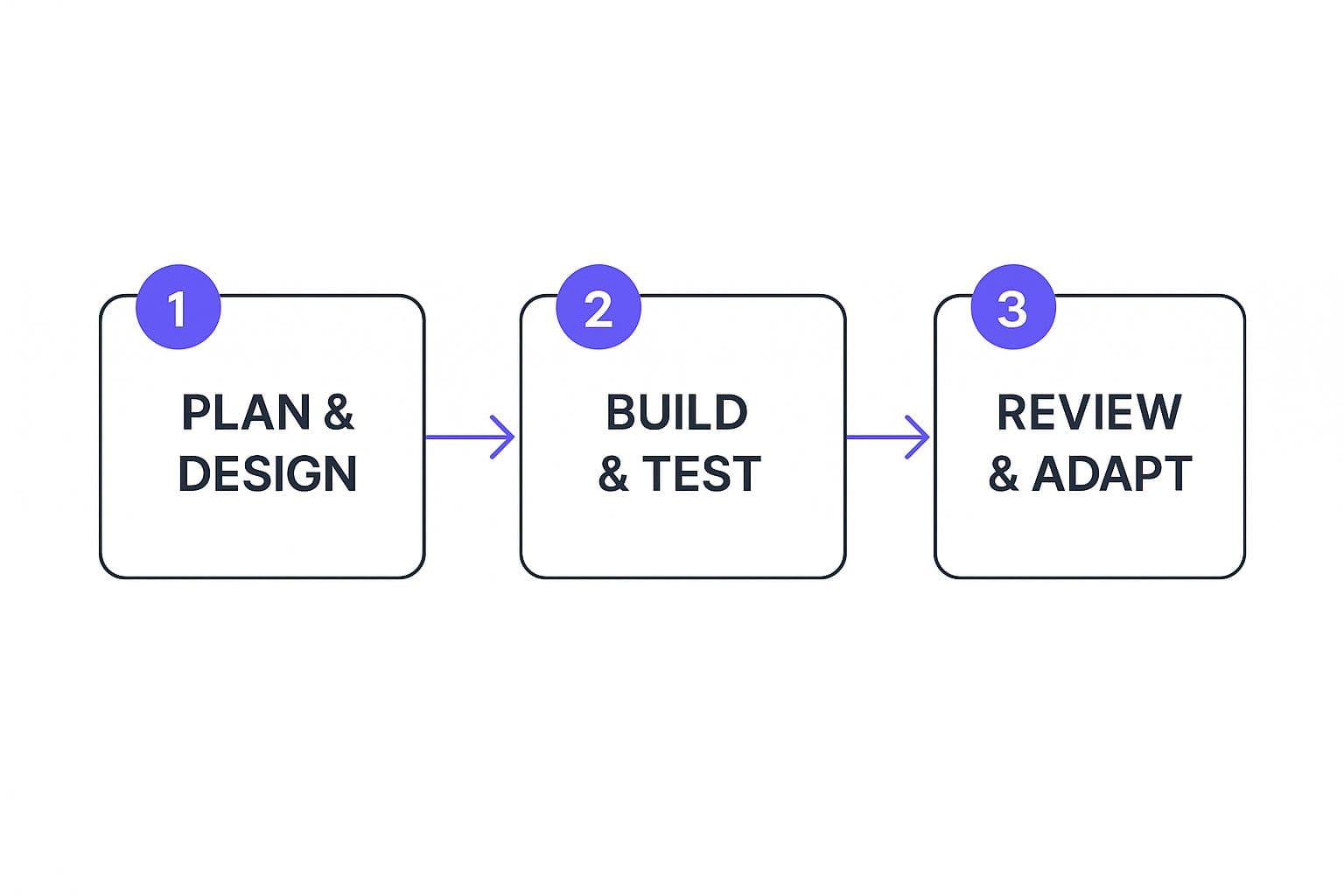
As you can see, the output from one phase becomes the direct input for the next. This ensures the work stays aligned and constantly builds on what the team just learned.
The Planning and Design Phase
Every single iteration kicks off with planning. This is where the team—developers, designers, product managers—sits down with stakeholders to agree on what they'll accomplish in this specific cycle. They'll pull a small handful of the most important features from the main project backlog.
Let's imagine a team is building a new mobile banking app. For this iteration, they might decide the top priority is creating a "quick balance view" on the home screen. They'd then flesh out simple designs and technical requirements for only that feature. The goal is to keep the scope tight and realistic for the cycle's timeframe, which is usually somewhere between one and four weeks.
The Build and Test Phase
Once the plan is locked in, the build phase begins. Developers start writing the code for the features agreed upon in the planning meeting. Crucially, this isn't happening in a vacuum. As soon as there’s code to test, the quality assurance (QA) team is right there with them, writing and running test cases.
This phase isn't about building the entire app from scratch. It's about producing one small, functional, and fully tested slice of it. For our banking app, the team would code the "quick balance view" and then immediately put it through its paces to catch any bugs before the cycle wraps up. Testing happens alongside development, not as a separate step at the very end.
The goal of each iteration is to produce a tested, integrated, and executable piece of the system. This isn't a rough draft; it's a production-quality increment that adds real, demonstrable value.
The Review and Adapt Phase
With the new piece built and tested, the cycle closes with a review. This is often called a "demo," "showcase," or "retrospective." The team presents the working increment—in our case, the functional "quick balance view"—to the stakeholders.
This is the most critical moment for feedback. Stakeholders aren't looking at wireframes or documents; they're interacting with a tangible piece of the product. This changes the entire conversation.
The team then reflects on the cycle itself:
- What went well? Let's identify our wins so we can repeat them.
- What could be improved? Where were the bottlenecks or frustrations? Let's fix them.
- What did we learn? We capture all the insights from user feedback and our own process.
The feedback gathered here is pure gold. Maybe the stakeholders love the balance view but ask if the date of the last transaction can be added. That suggestion immediately gets logged and prioritized for a future iteration. This constant loop of build-test-review-adapt is precisely what makes the iterative approach so effective for building products that people actually want to use.
You might think of iterative development as something cooked up in a Silicon Valley garage, but its roots stretch back much further. Long before "Agile" became a buzzword, the core idea of building, testing, and refining in small, deliberate steps was already being used to tackle some of the 20th century's biggest challenges.
This isn't just a fun fact; it's proof that this methodology isn't a fleeting trend. It was forged out of necessity, helping brilliant minds manage enormous complexity and risk when the stakes were incredibly high.
From Quality Control to Rocket Science
The story really begins in the 1930s with quality control pioneers like Walter Shewhart at Bell Labs. He introduced cycles of continuous improvement, laying the intellectual groundwork for what we now call iterative thinking. This idea didn't stay in the factory for long, finding its ultimate test bed in the high-pressure world of aerospace.
Fast forward to the 1950s and the North American X-15 program. Engineers building this hypersonic, rocket-powered aircraft were literally flying into the unknown. They couldn't just write up a master plan and hope for the best. Instead, they embraced an iterative approach: build a little, test it, fly it, and use what they learned to inform the next cycle. It was the only way to push the limits of aviation without catastrophic failure.
NASA adopted a similar mindset for Project Mercury in the 1960s, applying iterative principles to develop the mission's critical software. This was a groundbreaking move for the era, ensuring the code that kept astronauts safe was tested and improved piece by piece. You can get a deeper look into the history of iterative and incremental development on Wikipedia.
Iterative development was forged in environments where failure was not an option. From controlling industrial processes to guiding spacecraft, the cycle of build-test-learn was the only logical way to manage projects with countless unknown variables.
This diagram, pulled from an early paper on the subject, perfectly captures this foundational idea.
What you're seeing is a simple, powerful loop. Each "build" is its own mini-project, resulting in a functional piece of the whole. That capability then grows with every new cycle. It’s the very same philosophy that drives modern software teams today, demonstrating just how timeless and effective this approach truly is.
Real-World Examples of Iterative Development

It’s one thing to understand the theory behind iterative development, but it's another to see it in action. The true value of this approach really clicks when you look at how real companies apply it to solve concrete problems. Across countless industries, top performers use these cycles to get to market faster, lower their risk, and build products people actually want to use. The concepts we’ve discussed aren’t just academic—they translate directly into business success.
Imagine a fintech app that needs to introduce a critical security update, like two-factor authentication. This is a high-stakes feature you can't afford to get wrong. Instead of a "big bang" release to everyone, the team would iterate. The first version might only go to a handful of internal employees. They gather feedback, smooth out the user experience, and then release the refined version to maybe 5% of their customer base. Each loop provides more data and more confidence before the feature goes live for everyone.
How Different Industries Iterate
The gaming industry is another perfect example. Studios don't just build an entire game in a vacuum and hope for the best. They start with an early "alpha" build, often shared with a small, dedicated group of players. This first cycle is all about testing the core gameplay. Are the mechanics fun? Is the world engaging?
Based on that initial feedback, the next iteration might add a few more levels or characters. Each new cycle is built on a foundation of real player data and bug reports, ensuring the final product is polished and fun.
- Software as a Service (SaaS): A SaaS company could roll out a new dashboard widget as a single iteration. By tracking user engagement, they can quickly decide whether to invest more in the feature or cut their losses and try something else.
- E-commerce: An online store might test a new, streamlined checkout process on a small segment of its traffic. If conversion rates jump for that group, they can confidently roll it out to all shoppers in the next cycle.
This cyclical process is incredibly powerful for launching a brand-new product. By focusing on a small set of essential features first, teams can get a working version into users' hands quickly. We dive deep into this strategy in our guide on how to build an MVP.
Data-Backed Success Stories
The success of iterative development isn't just anecdotal; it's backed by hard data. Looking at major projects, you can see how this model excels at managing complexity. For example, the software for NASA's Space Shuttle avionics was built over 17 distinct iterations, a process that proved the model's incredible reliability for mission-critical systems.
In the wider software world, the numbers tell a similar story. Organizations that embrace iterative methods have a 28% higher project success rate compared to those still using traditional, rigid approaches. You can explore the research behind these iterative development findings to dig into the data yourself.
The real advantage is plain to see: building and testing in small, manageable cycles drastically reduces the risk of a major failure at launch. You’re not making one giant bet; you’re making a series of small, informed decisions.
The table below summarizes some of the key statistics that show why an iterative approach is so effective in today's fast-moving business environment.
Impact of Iterative Development on Project Outcomes
This table presents key statistics showing the positive impact of adopting iterative methodologies compared to traditional approaches.
| Metric | Reported Improvement with Iterative Methods | Source/Context |
|---|---|---|
| Project Success Rate | 28% higher than traditional models | Industry-wide project management studies |
| Defect Detection | Issues found much earlier in the lifecycle | Analysis of development cycle data |
| Time to Market | Functional versions delivered faster | Comparison of MVP launch timelines |
| Adaptability to Change | Significantly higher | U.S. Department of Defense (DoDI 5000.2) |
These metrics clearly demonstrate that iterating isn't just a different way to work—it's a smarter way to build successful products.
Common Questions About Iterative Development
Even after grasping the basics, it's totally normal for teams to have a few nagging questions before diving into iterative development. Making the leap from a straight-line, rigid process to something more cyclical and fluid is a big mental shift. It’s smart to get all your ducks in a row before you kick things off.
We've pulled together some of the most common questions that pop up when people start talking about what iterative development really looks like in practice. Our goal here is to give you clear, no-nonsense answers so you can start your first cycle feeling confident.
Is Iterative Development Just Another Word for Agile?
This is easily the most common question, and for good reason. The terms get thrown around together all the time, but they aren't interchangeable.
Here’s a simple way to think about it: Iterative development is the mechanic of the process—building something in repeated cycles. Agile, on the other hand, is a broader philosophy or mindset that uses iterative development as one of its core tools.
You can definitely practice iterative development without adopting the entire Agile manifesto. But you can't really be Agile without building iteratively. Agile simply adds a layer of principles (like valuing customer collaboration over rigid contracts) and popular frameworks (like Scrum or Kanban) on top of that foundational cycle.
How Do You Keep the Budget Under Control?
A huge worry for many is that the flexibility of an iterative approach will lead to a never-ending project with a runaway budget. That's a common misconception. While the scope can definitely change, the budget and timeline are typically fixed.
It basically flips the classic project management triangle upside down:
- Traditional (Waterfall): The scope is fixed, so if something unexpected comes up, you have to extend the timeline and increase the budget.
- Iterative (Agile): The time and cost are fixed, so the scope becomes the flexible part. You focus on delivering the most important work possible within that fixed budget and schedule.
This actually gives you incredible financial predictability. You know exactly what each cycle costs, which empowers you to make sharp decisions about which features give you the best bang for your buck.
The question shifts from "How much will the entire project cost?" to "What's the most valuable product we can build with this budget and in this timeframe?" That subtle change in perspective is the secret to maintaining financial control.
When Is an Iterative Project Actually "Done"?
Unlike a Waterfall project with its single, dramatic finish line, an iterative project can wrap up in a few different ways. Generally, you can call it "done" when you hit one of these milestones:
- The budget is spent. The team has built the highest-value product possible with the funds they were given.
- The deadline arrives. The project timeline is over, and whatever has been built is the version that gets released.
- The core value is delivered. The product has enough functionality to solve the main problem for users and achieve key business goals. At this point, adding more features might not be worth the investment.
This flexible definition of "done" is a huge advantage. It lets a business launch a product that works and that people want, without getting bogged down building every single feature from the original wishlist. It’s a foundational concept for building a Minimum Viable Product, which you can learn more about in our guide to MVP development for startups.
Doesn't This Approach Mean Way Too Many Meetings?
It’s true that iterative development has regular meetings, like planning sessions and end-of-cycle reviews. But these aren't your typical, drawn-out status meetings where everyone stares at the clock. They are short, sharp, and incredibly focused.
Each meeting has a clear purpose: either to agree on the next chunk of work or to get direct feedback on the software you just built.
When run properly, these check-ins actually save a massive amount of time. They stop teams from going down a rabbit hole for weeks, building something based on a vague or misunderstood requirement. A single one-hour review that gets the project back on the right path is infinitely more efficient than a month of wasted coding. The goal isn't more meetings; it's more purposeful communication.
Ready to stop just planning and start building? At Iglu Digital, we transform your idea into a market-ready MVP with the price fixed before we start. Launch your product with us.