Mastering Resource Allocation in Project Management
Table of Contents
Resource allocation is one of those project management terms that sounds simple on the surface. In reality, it’s the strategic heart of any successful project. It’s the art and science of assigning your available assets—your people, your budget, your equipment—to the right tasks at exactly the right time.
Think of it as the crucial bridge between a great plan and a successful launch. Without it, you’re just hoping for the best.
Why Resource Allocation Is Your Project’s Secret Weapon

It's easy to dismiss resource allocation as just another box to check on a project charter, a simple scheduling exercise. But I’ve seen firsthand how that mindset leads to trouble. A solid allocation strategy is the very foundation your project is built on. Neglect it, and even the most brilliant plans can collapse under the pressure of budget overruns, missed deadlines, and a completely fried team.
When you get it right, though, a project transforms from a frantic scramble into a smooth, efficient operation. It brings clarity to everyone involved, heads off bottlenecks before they even form, and ensures your most valuable resources are focused where they’ll deliver the biggest impact.
The statistics paint a pretty stark picture of what happens when this goes wrong. Data shows that less than 60% of projects actually stick to their original budget. Barely half are finished on time. A lot of that comes down to weak resource planning, meaning many projects are practically set up to fail from day one. You can dig deeper into how these practices affect project outcomes by checking out resources from Retain International.
The True Cost of Neglecting Allocation
Putting resource allocation on the back burner isn't just inefficient; it's a massive, unnecessary risk. The fallout isn't about minor hiccups—it can completely derail your project.
I’ve seen it happen in a few common, painful ways:
- Team Burnout: You have that one brilliant developer or designer everyone relies on. If you constantly overallocate them, their morale plummets, the quality of their work suffers, and you risk losing them altogether.
- Budget Creep: When materials aren't ordered on time or expensive equipment sits idle, you start racking up unexpected costs. Suddenly, your carefully planned budget is out the window, and profitability is at risk.
- Missed Deadlines: The whole timeline gets thrown off when a critical resource isn't ready. Maybe the testing environment isn't configured, or the specialized equipment is double-booked. The entire project grinds to a halt.
By treating resource allocation as a foundational pillar rather than a mere administrative duty, you shift from a reactive to a proactive management style. This foresight is what separates successful projects from struggling ones.
The Benefits of a Strategic Approach
On the flip side, putting real thought into your resource strategy pays off big time. It becomes your early warning system, letting you spot potential conflicts and capacity crunches long before they become full-blown crises.
A well-crafted allocation plan gives you:
- Increased Efficiency: When you match the right person with the right task, the work gets done faster and the quality is just plain better. It’s that simple.
- Predictable Timelines: With resources properly lined up, you can build project timelines that are actually reliable. Your stakeholders will thank you for it.
- Enhanced Team Morale: A balanced workload is key. It prevents burnout and sends a clear message to your team: their time is respected and their skills are valued.
Ultimately, mastering resource allocation in project management isn’t about becoming a spreadsheet guru. It’s about setting your team up for a win and delivering consistent, high-quality results every single time.
To really nail this down, it helps to think of resource allocation as being built on a few core pillars. I've put them into a table to give you a quick reference.
Core Components of Effective Resource Allocation
| Component | Description | Impact on Project Success |
|---|---|---|
| Resource Planning | The initial process of identifying all necessary resources, including people, tools, and budget, required to complete the project. | Sets the foundation for the entire project. Inaccurate planning leads to shortages or waste down the line. |
| Resource Scheduling | Assigning specific resources to specific tasks within a set timeframe. This involves creating a detailed timeline for resource usage. | Ensures resources are available when needed, preventing bottlenecks and keeping the project on track. |
| Resource Monitoring | Continuously tracking resource utilization against the plan to identify variances, over-allocation, or under-utilization. | Allows for real-time adjustments, preventing burnout and ensuring the budget remains intact. |
| Resource Optimization | The strategic adjustment of the resource plan to maximize efficiency, balance workloads, and adapt to changing project needs. | Creates a more resilient and efficient project, improving outcomes and team morale. |
Seeing these components as interconnected parts of a whole strategy is what separates good project managers from great ones. Each piece supports the others to create a project that runs smoothly from start to finish.
Building Your Resource Allocation Framework
Going from a great idea to a successful project doesn't happen by accident. It takes a solid plan, and that starts with a structured resource allocation framework. This isn't about guesswork; it's about building a logical blueprint that brings clarity and predictability to your projects before you even begin.
First things first: you have to define the project scope. Trying to allocate resources without a clear scope is like packing for a trip without knowing if you're going to the beach or the mountains. You need to break down the project's big goals into smaller, more tangible tasks and deliverables. This process is the bedrock of your resource breakdown structure (RBS), which is essentially a detailed, hierarchical list of everything you'll need—from people and their specific skills to software licenses and equipment.
Once you know what you're building, you can figure out what you have to build it with. This means taking a detailed inventory of every asset at your disposal. This isn't just about jotting down names. It's a deep dive into your team's skills, their experience levels, and, crucially, their current availability. You also need to account for the tools, equipment, meeting spaces, and, of course, the budget.
Forecasting Your Project's Needs
With a clear picture of what you have, you can start forecasting what you'll need. Look at every task you've broken down and ask the critical questions: "Who do we need for this? What tools are required? And for how long will we need them?" This is where resource allocation in project management becomes both an art and a science.
Let's take a software development project as an example. A vague plan might just say, "assign developers." A proper forecast gets much more specific:
- Two senior backend developers are needed for the database architecture in weeks 1-3.
- One mid-level UI/UX designer will handle wireframing and prototyping during weeks 2-4.
- Three QA testers are required for the user acceptance testing (UAT) phase in weeks 8-9.
This level of detail is what separates a smooth project from a chaotic one. It stops you from scrambling for people at the last minute and helps you spot potential roadblocks early. For instance, you might realize your only QA tester is on vacation during the UAT phase, giving you plenty of time to find a solution.
A classic mistake I see all the time is forgetting to account for the non-billable work. Things like planning meetings, daily stand-ups, and code reviews all take time. If you don't factor them into your schedule, you'll end up over-allocating your team and burning them out. For teams running on Agile, knowing how to structure these interactions is crucial. You can get some great tips on this in our guide to agile methodology meetings.
Creating a Detailed Resource Plan and Schedule
After forecasting comes the master plan. This is where you create the resource plan and schedule—the document that officially assigns specific people and tools to tasks within a clear timeline. Think of it as the single source of truth for the entire project team.
This is often visualized using a digital calendar or project management tool, making it easy to see assignments over time.
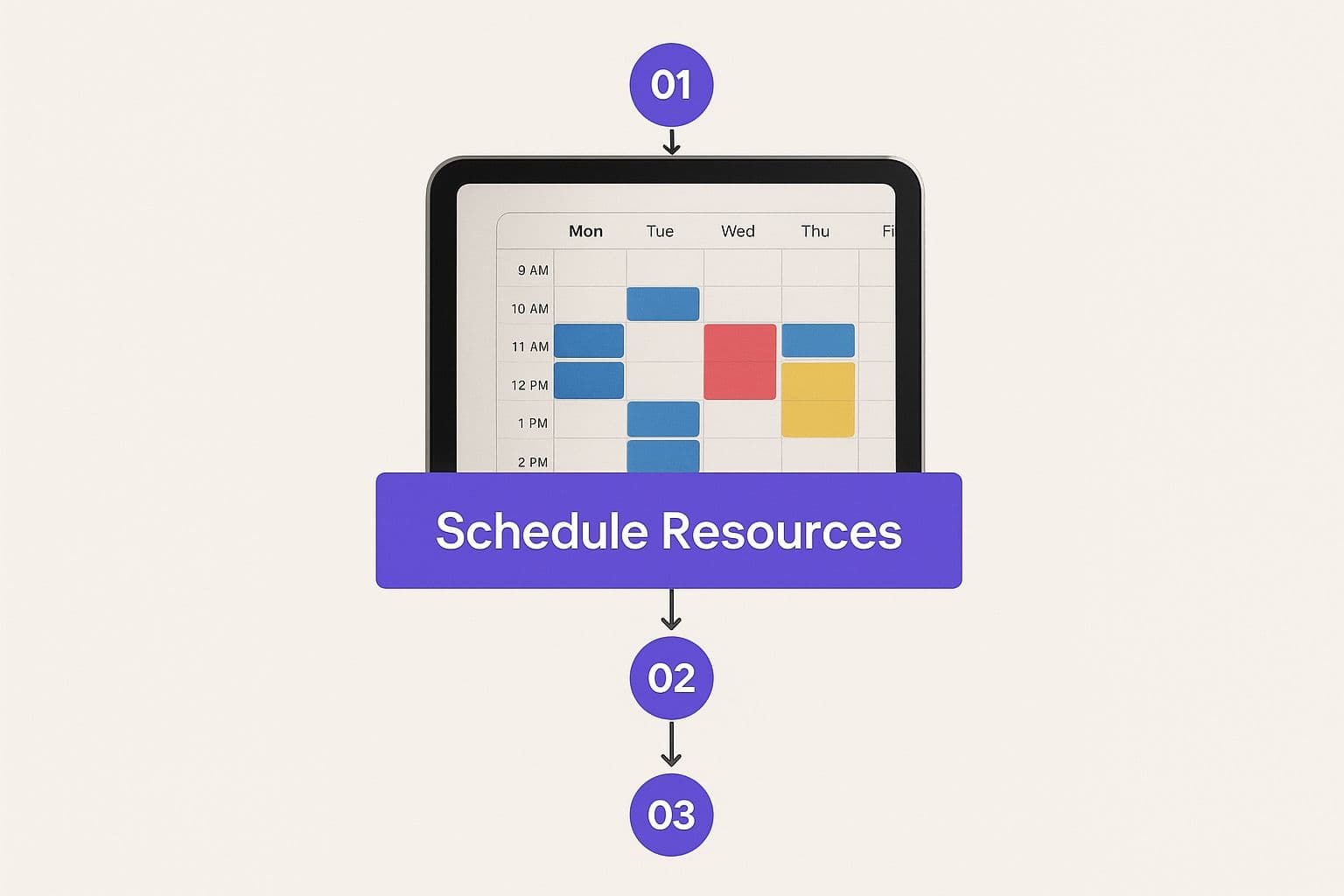
A visual schedule like this makes it incredibly easy to spot who is working on what and when. More importantly, it helps prevent scheduling conflicts and ensures you're not overloading any single team member. Remember, this schedule shouldn't be set in stone. It needs to be a living document, ready to adapt to the unexpected challenges that are a natural part of any project.
Proven Techniques to Optimize Resource Allocation

Having a solid resource plan is one thing, but making it truly efficient is where the real magic happens. Experienced project managers know it's not enough to just assign people to tasks; you have to constantly refine and optimize how those resources are used. The goal is to smooth out the inevitable peaks and valleys of a project, so your team isn't slammed one week and sitting idle the next.
Resource Leveling: The Burnout Buster
One of the most battle-tested techniques for this is resource leveling. In simple terms, it's about fixing over-allocations by adjusting your project timeline.
Let's say your lead developer is slated for 60 hours of work in a single week—a clear recipe for burnout. With resource leveling, you'd look at their task list, identify what's not mission-critical for that week, and shift it to the next. This brings their workload back down to a sane level. It's a trade-off, of course. You might have to nudge a deadline slightly, but you gain a sustainable pace and a much healthier team.
Resource Smoothing: When Deadlines Can't Budge
But what happens when deadlines are set in stone? That's where resource smoothing comes in. Unlike leveling, this method works within the existing project schedule. You aren't pushing the final delivery date; you're just being smarter about how and when work gets done inside that fixed timeframe.
Picture a marketing agency juggling three major client campaigns at once. Their star graphic designer is crucial for all three, which instantly creates a potential bottleneck.
A savvy project manager using resource smoothing would:
- Pinpoint the quieter periods in the designer’s schedule.
- Shift non-urgent design tasks from the hectic weeks into those lulls.
- Balance the designer's time across all three campaigns without ever pushing them past their weekly capacity.
This keeps every project moving forward without overwhelming your key player or missing a single deadline.
Ineffective resource management has real costs. Research shows that nearly 10% of every project dollar is wasted due to poor performance. And once you push team members past 80% utilization, you see a sharp spike in project delays.
The Critical Path Method: Your Prioritization Compass
To make smart calls with leveling and smoothing, you absolutely must know which tasks have wiggle room and which don't. This is where the Critical Path Method (CPM) is invaluable. CPM identifies the longest chain of dependent tasks that directly determines your project's final completion date.
Any delay to a task on this "critical path" will delay the entire project. Simple as that.
By mapping this out, you know exactly where your A-team needs to focus to keep the train on the tracks. For example, in a software build, coding the core login feature is almost certainly on the critical path. Designing the 'About Us' page? Probably not. It has "float," giving you flexibility. This clarity is the bedrock of effective resource allocation in project management and helps you track the right KPIs for software development.
Building a Shared Resource Pool
Another powerful strategy is to create a shared resource pool. Instead of permanently assigning specialists to a single project team, you house them in a central pool. From there, they can be deployed to different projects based on priority and need.
This approach dramatically increases your flexibility. It prevents your best talent from getting siloed on lower-priority work and ensures your experts are always focused on the most important tasks across the entire organization. It's a far more dynamic way to manage talent and react quickly when project demands inevitably shift.
Navigating the Inevitable Bumps in the Road
No matter how perfectly you map out your resource plan, reality has a way of throwing a wrench in the works. Let's be honest, projects are messy. Unexpected hurdles are just part of the game. The real skill isn't in creating a plan that never changes, but in knowing how to handle the turbulence when it hits.
One of the most common resource drains I see is scope creep. It's insidious. It starts with a small, seemingly harmless request, then another, and another. Before you know it, those "quick additions" have completely derailed your timeline and stretched your team to its breaking point.
Your best defense here is a rock-solid change control process. This isn't about saying "no" to everything; it's about creating a formal process. Every new request gets submitted, evaluated for its impact on time and budget, and then officially approved before anyone touches it. This simple checkpoint forces everyone to consider the true cost of a change. We have a whole guide on this, and you can find more strategies for how to avoid scope creep here.
The Constant Juggle of Competing Priorities
If you’re a project manager, you're almost certainly juggling more than one project. It’s the norm, not the exception. In fact, research shows that over 85% of project managers are running multiple projects at the same time. This turns resource allocation into a daily tug-of-war.
So, what do you do when your star engineer is needed on two different "top priority" projects at once? This is where you have to zoom out and look at the bigger picture—the entire project portfolio.
This visual shows the relationship between individual projects and the organization's broader strategic goals.
By seeing how each project aligns with the company's strategic goals, you can stop reacting to the loudest voice in the room. Instead, you can make a data-driven call on which project delivers more value and deserves the resource right now.
Dealing with Dependencies and Sudden Absences
Ah, resource dependencies—a classic project management headache. Task B can’t start because the specialist needed for Task A is running late. Suddenly, you've got a domino effect of delays rippling through your entire schedule. And what happens when a key person calls in sick for a week or, worse, quits? Progress can screech to a halt.
I've learned this the hard way: proactive cross-training is your secret weapon. If you build a team where multiple people can handle critical tasks, you create a safety net. The absence of one person no longer becomes a single point of failure.
Here’s how to get a better handle on these issues:
- Map Out Your Dependencies: Modern project management tools are great for this. Visually mapping out which tasks depend on others helps you see potential bottlenecks long before they become a problem.
- Keep a Skills Matrix: Have a simple, up-to-date chart of who can do what. When someone is suddenly unavailable, you can quickly scan the matrix and find a capable substitute without panicking.
- Build in a Little Wiggle Room: For those critical tasks that truly rely on one person, build a small buffer into the schedule. That little bit of extra time can be a lifesaver when minor delays pop up.
Choosing the Right Tools for Modern Resource Management
Let's be honest: spreadsheets and whiteboards just don't cut it anymore for serious resource planning. In today's fast-moving projects, the right technology isn't just a "nice-to-have"—it's the engine that drives smart resource allocation in project management.
Good software takes the manual busywork off your plate, gives you a clear view of who’s doing what, and ultimately helps you make better, data-backed decisions. But with so many options out there, how do you pick the right one?
The trick is to find a tool that fits your team like a glove. What works for a massive enterprise with a global footprint will likely be a clunky, over-engineered nightmare for a small, agile agency.
Matching Tools to Your Team's Scale
First things first, you need to know what kind of software you're looking for. Most tools fall into one of a few main categories, each designed for a different kind of team and set of problems.
Thinking through these categories can save you a ton of time and prevent you from buying a sledgehammer when you just need a regular hammer.
Here's a quick comparison to help you figure out where your organization fits.
Comparison of Resource Management Tool Types
| Tool Type | Best For | Key Features | Example |
|---|---|---|---|
| Enterprise PPM Software | Large corporations managing complex, interconnected project portfolios. | Comprehensive financial planning, risk assessment, strategic alignment, advanced reporting. | Planview |
| Dedicated Resource Platforms | Mid-sized agencies, studios, and consultancies needing precise scheduling and forecasting. | Advanced capacity planning, skills tracking, utilization reporting, project forecasting. | Float |
| Integrated PM Tools | Small to mid-sized teams who want resource management within their existing project workflow. | Task assignment, workload views, simple capacity management, timeline/Gantt charts. | Asana |
Ultimately, your choice depends on whether you need a dedicated, powerful resource planning tool or a more general project management system with "good enough" resource features built-in. There's no single right answer, only what's right for your team.
Core Functionalities to Look For
No matter which category you're leaning toward, there are a few non-negotiable features that any solid resource management tool must have.
I’ve seen teams sink a lot of money into a fancy new platform, only to find out it couldn't handle a basic function they relied on every day. Before you sign any contract, make sure the tool gives you a crystal-clear, visual answer to three questions: Who is working on what? When are they free? And how does their current workload compare to their actual capacity?
This visual capacity planning is the bedrock of good resource management. You need to see, at a glance, who's overbooked and who has room to take on more work. It’s the only way to proactively prevent burnout and keep your timelines realistic.
Another crucial feature is a solid skills tracking system. You shouldn't have to rely on memory to figure out who has the right expertise for a new task. A good tool lets you tag team members with their skills, so you can instantly find, say, your best front-end developer with React experience who's available in the next two weeks. It turns a frantic search into a simple query.
Got Questions About Resource Allocation? We’ve Got Answers.
Even with the best-laid plans, things get messy in the trenches of a project. Let's dig into some of the most common questions project managers have about allocating resources and get you some clear, practical answers for those real-world situations.
What’s the Plan for Unexpected Resource Shortages?
It’s the classic nightmare scenario: your lead developer gives their two weeks' notice, or a critical piece of equipment suddenly dies. First, don't panic. The immediate next step is to pull up your project's critical path and figure out exactly what's impacted.
Can you shuffle things around? Maybe some non-essential tasks can be put on the back burner to free up other people or equipment. This is also where having a solid skills matrix is a lifesaver—check it to see if anyone else in-house can step in. If you've been cross-training your team, you'll be thanking yourself right about now. If there's no internal solution, you'll have to have a tough but transparent conversation with stakeholders about adjusting the scope or timeline.
What’s a Realistic Resource Utilization Rate?
Chasing 100% utilization is a trap. It looks great on paper, but in reality, it just leads to burnout and leaves absolutely no wiggle room for the unexpected. A much healthier and more sustainable target is somewhere around 80%.
That 20% buffer is gold. It gives your team breathing room for all the essential work that doesn't show up on a task list—think team meetings, professional development, and just general administrative catch-up.
An obsession with 100% utilization creates a brittle system. A single sick day or a minor hiccup can throw the entire project schedule into chaos. It’s a recipe for stress and inefficiency.
Can I Really Allocate People Across Multiple Projects?
You bet. In fact, most companies have to. The secret to making it work without driving everyone crazy is having a single source of truth. A centralized resource pool, managed with a good project portfolio management (PPPM) tool like Asana or Monday.com, gives you a bird's-eye view of who is working on what, across all projects.
This high-level perspective helps you:
- Make smart prioritization calls based on what’s most important for the business, not just what’s "due next."
- Spot future bottlenecks a mile away. You'll see that your star designer is slated for two massive launches in the same week and can adjust before it becomes a crisis.
- Deploy your top talent where they can make the biggest splash.
How Do I Convince Stakeholders We Actually Need More Resources?
Walking into a stakeholder meeting and saying, "We need more people," is a non-starter. You need to build a business case backed by cold, hard data.
Pull up your resource utilization reports and show them the numbers—prove that your team is already at or over capacity. Then, use your project plan to paint a clear picture of the consequences. Don't just say you're understaffed; show them what it means.
For example: "Without a dedicated QA tester, we're looking at a three-week launch delay, which will directly hit our Q3 revenue goals." When you frame the request around protecting business objectives, it stops being an "expense" and becomes a smart investment in success.
Ready to turn your innovative ideas into a market-ready product without the usual delays? Iglu Digital specializes in building and launching MVPs for a price agreed before a line of code is written, helping you validate your concept with real users fast. Learn more and start your project today at https://iglu.dev.