How to Avoid Scope Creep and Keep Projects on Track
Table of Contents
To keep scope creep from derailing your project, you have to lock in a crystal-clear scope from day one. You also need a formal change control process and transparent, constant communication with everyone involved. These aren't just suggestions; they are the three pillars that stop those small, uncontrolled additions from turning your project into a chaotic mess.
Why Scope Creep Derails Even the Best Projects
Scope creep is the silent killer of projects. It never announces itself. Instead, it slips in through those seemingly harmless requests that sound like, "Can we just add one more button?" or the classic, "This small tweak shouldn't take long, right?"
Individually, these requests might seem minor. But together, they create a snowball effect. What starts as a tiny deviation from the plan quickly grows into a major problem, leading directly to blown budgets, missed deadlines, and a team that's completely burned out. It’s a frustratingly common issue that plagues projects in every industry.
The Real Business Risks
The danger of scope creep goes way beyond simple frustration—it creates tangible risks for your business and your client relationships. As uncontrolled changes pile up, the project's original vision gets watered down. You risk ending up with a bloated, unfocused product that doesn't even solve the core problem it was built for.
This isn't just a waste of time and money; it's a surefire way to erode client trust. When you deliver a project late and over budget, you look unreliable, even if you were just trying to be accommodating. It's a classic lose-lose situation: the client is unhappy with the final cost and timeline, and your team is exhausted from chasing a target that was always moving.
The stats below paint a clear picture of how unchecked changes can impact key project metrics, from budget overruns to the sheer number of change requests that can swamp a team.
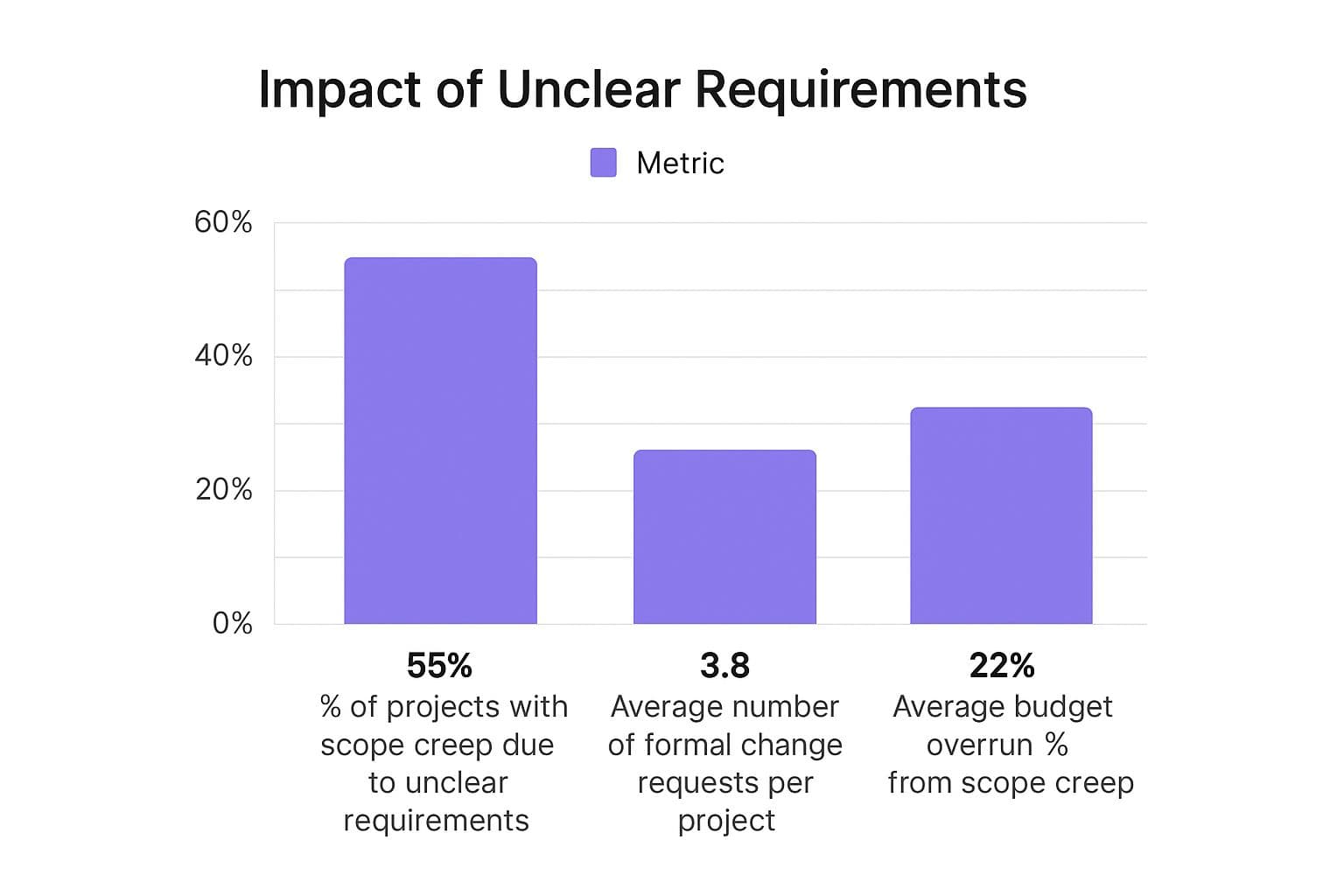
The data doesn't lie. There's a direct line connecting unclear requirements to project failure, which is exactly why a solid foundation is non-negotiable.
Spotting the Danger Signs Early
Learning to tell the difference between healthy project evolution and destructive scope creep is a critical skill. Healthy changes are strategic—they're discussed, assessed, and formally approved. Destructive creep is just the opposite: chaotic, undocumented, and purely reactive.
It's a massive problem. A 2018 study by the Project Management Institute (PMI) revealed that a staggering 52% of all projects experience scope creep. That's more than half! I highly recommend you read the full research on these project management findings to grasp just how widespread this issue is.
Not all changes are bad, but you need to know which ones are helping and which are hurting. Here’s a quick guide to help you distinguish between the two.
Scope Creep Warning Signs vs. Healthy Project Growth
| Warning Sign of Scope Creep | Sign of Healthy Project Growth |
|---|---|
| Changes are made through informal channels like casual conversations or emails. | All change requests are submitted through a formal, documented process. |
| New features are added without assessing their impact on the timeline or budget. | The impact of each change is analyzed and approved by key stakeholders. |
| The team constantly works on un-prioritized tasks that weren't in the original plan. | The project backlog is strategically re-prioritized to accommodate approved changes. |
| Stakeholders frequently add new "must-have" requirements after kickoff. | New requirements are evaluated against the core project goals and vision. |
The takeaway is simple: if a change feels rushed, undocumented, or disconnected from the main goal, it’s probably a warning sign. Healthy growth, on the other hand, is always intentional and well-managed.
Laying a Rock-Solid Foundation Before You Build
The best way to stop scope creep is to beat it to the punch. It’s all about laying such a solid and clear foundation for your project that there’s simply no wiggle room for confusion later. A shaky foundation will always buckle under the pressure of new ideas and last-minute requests, but a strong one gives you the framework you need to stay the course.

This all begins with a detailed project charter and scope statement. Don't think of these as just more paperwork; they are your team's true north. These documents define what success actually looks like, what’s in, and just as critically, what is explicitly out. That clarity becomes your go-to defense when a stakeholder casually asks for "just one more little thing."
Get Granular with Your Scope Statement
A vague scope statement is practically an open invitation for scope creep to walk right in. Saying you'll "build a user-friendly dashboard" is way too subjective and leaves a lot to interpretation.
Instead, you need to get specific. A much better version would be something like: "Build a customer dashboard that includes three core modules: order history, user profile management, and support ticket submission." See the difference?
To make your scope statement completely airtight, make sure it includes:
- Project Objectives: What is the exact business problem you are solving?
- Key Deliverables: A clear list of everything you'll hand over, from the functioning MVP itself to the final user guides.
- Explicit Exclusions: Spell out what you are not building. For example, "This initial release will not include a native mobile app or integrations with third-party payment gateways."
When you add this level of detail, your scope statement goes from being a loose guideline to a firm agreement. It gets everyone—from your developers to stakeholders and clients—on the same page, looking at the same map.
Break It All Down with a WBS
With a clear scope defined, the next move is to break it down into smaller, more manageable pieces using a Work Breakdown Structure (WBS). Think of a WBS as a family tree for your project; it's a hierarchical chart that deconstructs the total scope of work into a series of achievable tasks.
For example, a big task like "Develop User Authentication" can be broken down into:
- Design the UI for the Login and Signup pages.
- Build the frontend components for all input fields and buttons.
- Develop the backend API endpoints for new user registration.
- Implement password hashing and other security measures.
- Run full integration testing.
This approach does more than just clarify the work. It's also a massive help in accurately estimating the time and resources you'll need for each part. A detailed WBS makes it incredibly easy to see when a new request falls outside the lines of the pre-defined tasks, giving you a concrete reason to open up a discussion about it. It also provides a much better baseline for estimating your initial software development costs before a single line of code is written.
Key Takeaway: A well-defined project scope isn’t about killing creativity or being rigid. It’s about focusing all that creative energy toward a shared, defined goal, ensuring every bit of effort directly contributes to the success you all agreed on from day one.
Ultimately, keeping scope creep in check comes down to a potent mix of great documentation and relentless communication. According to research from PMI, a staggering 52% of projects experience scope creep. That number would be far higher without active management practices like a detailed WBS and a formal change control process. This upfront investment in planning is, without a doubt, your most powerful weapon for keeping your project on time and on budget.
Putting a Practical Change Control Process in Place
Let's be real: change is going to happen on your project. It’s a guarantee. You'll uncover new information, the market will zig when you expected it to zag, or someone will have a genuinely brilliant idea mid-sprint. The goal isn't to build a wall against change, but to handle it smartly. That's what a change control process is all about—and no, it doesn't have to be a bureaucratic nightmare.

Think of it less as a gate and more as a clear path for new ideas to be evaluated. A solid process turns a chaotic "Hey, can we add this?" into a structured conversation about priorities and trade-offs. Honestly, it's the single most powerful tool you have for stopping uncontrolled additions from blowing up your timeline and budget.
Designing a Simple Change Request Form
First things first, you need a single, official way for people to submit a change. This immediately gets you out of the world of managing requests from random Slack messages, emails, and hallway ambushes. A simple change request form becomes your single source of truth.
It doesn't need to be complex. Just make sure it captures the essentials:
- Request Description: What’s the change, in plain English?
- Reason for Change: Why now? What problem does this solve, or what new opportunity does it unlock?
- Expected Benefits: What’s the real value here? How does this help the user or the business?
- Submitted By: Who's asking for this?
Just the act of filling this out forces the requester to think through the "why" behind their idea. You'd be surprised how many low-value suggestions filter themselves out at this stage.
Setting Up a Lean Change Control Board
The term "Change Control Board" (CCB) sounds stuffy and corporate, I know. But in practice, this could just be two key people. For most of the projects I’ve worked on, the CCB is simply the project manager and the product owner (or a key client stakeholder).
The point is to designate who has the final say. Who can approve, deny, or push a change to a later phase? This small group should meet regularly—maybe once a week—to review what’s come in. Their job isn’t just to review the form, but to ask the hard questions and make sure every change that gets the green light actually serves the project's main goal.
Expert Tip: The CCB's real job isn't to say "no." It's to ask "why" and "what's the trade-off?" This small shift in perspective changes the dynamic completely. You stop being a gatekeeper and become a strategic partner, helping everyone focus on what’s truly going to make the launch a success.
Evaluating Impact Beyond Just Effort
Once a request is in, the CCB needs to figure out its true impact. This is where a lot of teams go wrong—they only look at the development hours. A proper evaluation means understanding the ripple effects across the entire project.
Here's a quick checklist for assessing the real cost of any change:
- Timeline Impact: How does this affect our delivery date for this sprint, this milestone, and the final launch?
- Budget Impact: What’s the hard cost in developer hours? This is obviously a big one, and the pricing model you're using matters. Understanding the nuances of time-and-material vs. fixed-price contracts is critical here.
- Resource Impact: Do we have to pull someone off a critical task to do this? Will that create a bottleneck somewhere else?
- Risk Assessment: Does this new feature introduce technical complexity or a risky dependency that could bite us later?
When you present this full picture back to the stakeholder, the decision becomes a shared one. They can clearly see that adding "Feature Y" isn't free—it's going to cost an extra $5,000 and delay the launch by two weeks. Suddenly, scope creep isn't some invisible enemy; it's a calculated business decision.
Keeping Stakeholders in the Loop and Expectations in Check
If you look at where scope creep really begins, it's almost always in the gray areas of communication. A simple misunderstanding, a stakeholder’s quiet assumption about a feature—that’s where the trouble starts. Your best defense isn't a bigger contract; it's a rock-solid communication plan that's proactive and ridiculously transparent.
This isn’t about flooding inboxes with daily updates. It's about establishing a predictable rhythm. When stakeholders know when they'll see progress and how they can give feedback, they're far less likely to bombard your team with "just one more thing" requests. This rhythm keeps everyone rowing in the same direction.
Set a Communication Cadence and Stick to It
To kill confusion before it starts, you need a simple, repeatable communication schedule. The idea is to make sharing information a routine, not a reaction to a problem. This predictability eases stakeholder anxiety and keeps them plugged in without derailing your team.
A few practices I've found work wonders:
- Weekly Pulse Reports: A quick summary of what got done last week, what’s up next, and any blockers. Keep it short, sweet, and focused on results.
- Sprint Demos are Non-Negotiable: Showing is always better than telling. A live demo of the actual, working software is the single most powerful way to get everyone on the same page about what "done" really means.
- Give Them a Window: Use tools like Trello, Jira, or Asana to create a shared project dashboard. This gives stakeholders a real-time view, which dramatically cuts down on the "Is it ready yet?" pings.
This kind of structure is critical because scope creep is a sneaky beast. Research often shows that it’s the small, seemingly harmless changes that kill a project—they get approved without anyone noticing the cumulative damage. The only way to fight this is with consistent oversight and clear communication channels, a point well-covered in these essential project management tips.
Draw Clear Lines in the Sand—And Keep Redrawing Them
Beyond just sending updates, you have to be the one who constantly reinforces the project’s boundaries. Defining the scope in a document at kickoff is step one, but you have to keep bringing people back to it.
One of the most effective tools for this is a simple "What's In, What's Out" list for every major feature. This document doesn't just list what you're building; it explicitly calls out what you're not building (for now). For a new user profile, "in" might be the ability to change a password. "Out" could be uploading a custom avatar or integrating with social media logins.
My Experience: The single biggest source of scope creep isn't malice; it's unspoken assumptions. By explicitly stating what you aren't building, you slam the door on ambiguity and force critical conversations to happen before a single line of code is written.
Master the Art of the "Graceful No"
When a new idea pops up mid-sprint (and it always will), your response is everything. A hard "no" can feel dismissive and damage a good relationship. But an immediate "yes" is an open invitation for scope creep to move in and take over. The sweet spot is reframing the conversation around priorities.
Instead of a flat-out rejection, try a different angle:
- The Parking Lot: "That's a great idea. It doesn't fit into this current sprint, but I'm adding it to our 'Parking Lot' so we can review and prioritize it for a future release."
- The Trade-Off: "I love that suggestion. To get it done in this cycle, we'd need to swap out Feature X. From your perspective, which one adds more value for our users right now?"
This approach changes your role from a gatekeeper to a strategic partner. You're helping the stakeholder make the smartest decision for the project's overall success. It validates their idea while protecting the timeline, turning a potential point of friction into a moment of collaborative alignment.
Using Agile Principles to Manage Scope Flexibly
There's a common myth that agile development is an open invitation to chaos. People hear "embrace change" and think it means they can throw in new features whenever the mood strikes. But that's not how it works at all. In practice, agile frameworks have powerful, built-in guardrails that help you manage scope without letting the project spin out of control. It’s about being adaptable, not aimless.

The secret weapon in the agile arsenal is the time-boxed sprint. It doesn't matter if your sprints are one, two, or even four weeks long; they create a fixed container for a set amount of work. Once a sprint is planned and kicked off, the scope is locked. This simple rule forces everyone to make the tough but necessary prioritization calls before the team starts coding, creating a natural defense against those "just one more thing" requests that pop up mid-sprint.
The Product Owner as Strategic Gatekeeper
In any agile team, the Product Owner is the undisputed champion of the product backlog. They are your first and best line of defense against scope creep. Their entire job revolves around maximizing the value the development team delivers, which means they are constantly grooming, prioritizing, and refining the backlog.
A great Product Owner doesn't just passively add every idea to the list. They act as a strategic filter, challenging new requests with critical questions:
- Does this feature actually support our core MVP goal?
- What specific user problem are we solving here?
- Is this truly more valuable than the other items we've already committed to building?
This gatekeeping turns the backlog from a messy wish list into a clear, strategic roadmap. Every item on it has earned its place. For anyone new to this, it’s worth exploring the different agile methodology types to see how this role functions in frameworks like Scrum versus Kanban.
Using Reviews and Retrospectives for Alignment
Agile ceremonies are far more than just status meetings; they're essential for managing scope transparently with the entire team and key stakeholders. The sprint review, for example, is where you demo the work you just finished. This creates a powerful, immediate feedback loop. It sparks informed discussions about what to tackle next, based on a tangible piece of working software, not just theory.
Key Takeaway: When a stakeholder suggests a big change during a sprint review, it doesn't derail the current work. That new idea simply becomes an item for the Product Owner to evaluate and prioritize for a future sprint. This keeps the process orderly and predictable.
Right after the review comes the sprint retrospective. This is a closed-door session for the team to reflect on what went well and what didn't. It's often here that you can pinpoint internal sources of scope creep—things like team members "gold plating" features or simple miscommunications—and agree on an action plan to fix them in the next sprint. Together, these rituals ensure every change in direction is a conscious, collaborative decision, not just a chaotic reaction.
Your Top Scope Creep Questions, Answered
Even when you've done everything right, scope creep questions always find a way to pop up. Let's walk through a few of the most common scenarios I’ve seen in the field and how to handle them.
What’s the Difference Between Scope Creep and Gold Plating?
It's easy to mix these two up, but they come from completely different places. Think of it this way:
Scope creep is almost always an external pressure. It’s the client, a key stakeholder, or even a sales team member dropping in with a "wouldn't it be cool if..." or "can we just add this one small thing?" These are the classic, unapproved changes that sneak into the project from the outside.
Gold plating, on the other hand, is an inside job. This happens when the development team decides to add extra polish or features that weren't requested. Their hearts are usually in the right place—they want to build something amazing or impress the client—but it's still work that wasn't planned or budgeted for.
The real difference is the source. Scope creep is driven by external requests, while gold plating comes from your own team. Both are dangerous because they burn through time and money you don't have, putting your deadlines at risk.
How Can I Say “No” to a Client Without Ruining the Relationship?
This is a tough one, but it's all about framing. You never want to deliver a hard "no." Your job is to shift the conversation from a simple yes/no into a collaborative discussion about priorities. You're not a gatekeeper; you're their strategic partner, helping them get the most value out of their investment.
So, when a client asks for a new feature mid-sprint, don't shut them down.
Try a script like this instead:
- "That's a really interesting idea, and I can definitely see how that would be valuable. Right now, the team is focused on delivering Feature X. To get this new request in, we'd need to pause that work. Which of these two is the bigger priority for your users at this moment?"
This simple shift changes everything. You're not saying their idea is bad. You’re validating it while gently reminding them of the existing priorities and constraints. It turns you from a roadblock into an advisor, helping them make a smart trade-off.
Is All Scope Change a Bad Thing?
Not at all. In fact, refusing to adapt is a recipe for building the wrong product. The whole point of agile development is to learn and respond to new information, whether it's user feedback or a shift in the market.
Healthy, controlled scope change is a sign of a mature and responsive project.
The key difference is the process. A good change is one that's formally requested, analyzed for its impact on the timeline and budget, and then officially approved by everyone involved. It’s documented. It's intentional. This is how you make smart pivots.
Destructive scope creep is the opposite: it's the undocumented, unapproved, and unassessed changes that chip away at your project's foundation.
Ready to turn your idea into a market-ready product without the risk of scope creep? Iglu Digital specializes in building and launching MVPs on a fixed price, agreed up front. We provide the structure and speed you need to get to market fast. Learn more about our process at Iglu Digital.