Time & Material vs Fixed Price a Guide for Projects
Table of Contents
Deciding between a Time & Material or Fixed Price contract really comes down to a classic trade-off: flexibility versus predictability. Time & Material is your go-to when you expect the project scope to evolve, while Fixed Price is perfect for locking in costs when you have a crystal-clear set of requirements.
Choosing Your Project Financial Model

The contract model you pick at the outset will fundamentally shape how your team works together and how you manage the budget. It sets the tone for the entire project.
- Agility: T&M allows for easy scope changes and quick pivots without a ton of administrative overhead.
- Budget Certainty: Fixed Price gives you a locked-in budget, which is a huge relief for stakeholders who need financial predictability.
- Risk Tolerance: With T&M, the client shoulders the risk of variable costs. In a Fixed Price model, the risk of scope creep and unforeseen work shifts to the vendor.
Key Trade-Offs
Let's break down the core differences side-by-side to make the decision a bit clearer.
| Aspect | Time & Material | Fixed Price |
|---|---|---|
| Budget Flexibility | High | Low |
| Scope Change | Seamless | Restricted |
| Risk Ownership | Client | Vendor |
It’s interesting to note that between 2017 and 2021, roughly 11% of U.S. government contracts were structured as T&M. This was specifically to handle projects with evolving requirements that benefited from continuous feedback. You can dive deeper into these contracting trends on Tateeda.
The best financial foundation aligns your project's complexity with the right balance of flexibility and predictability.
Think of these insights as a starting point. Your goal is to match your project's unique DNA with the right model to get started on solid financial footing.
When to Use Each Model
So, when does one make more sense than the other?
- Time & Material is ideal for exploratory work, like R&D projects or early-stage software development where features are still being defined. It supports an iterative process of discovery and frequent updates.
- Fixed Price shines when you have clearly defined deliverables. Think of a standard marketing website, a straightforward data migration, or any project where you can confidently write down every requirement upfront.
For a real-world example, a startup building its first MVP would almost certainly benefit from a T&M contract to refine user flows based on early feedback. On the other hand, a project to build a compliance reporting tool with strict, non-negotiable specifications is a perfect candidate for a Fixed Price agreement.
Aligning the project phase with the contract type is one of the best ways to prevent budget overruns and scope creep.
This approach ensures your financial plan supports the project's growth instead of becoming a roadblock.
Prioritizing Your Criteria
Every project is a balancing act. You need to weigh your priorities carefully. Ask yourself how risk, budget, timeline, and collaboration will influence your choice.
- Scope Stability: How likely are your requirements to change? Be honest.
- Budget Flexibility: How much wiggle room do you have in your budget? Can it handle some variance?
- Timeline Criticality: Are your deadlines iron-clad and non-negotiable?
- Collaboration Level: How closely will stakeholders need to be involved throughout the development process?
A practical next step is to rank these factors. You can even create a simple weighted scorecard, assigning values based on what matters most for your project. This exercise often reveals which model naturally scores higher for your specific situation.
A simple scorecard turns a complex decision into a clear, actionable insight.
Once you have that scorecard, gather your team to talk through the trade-offs. This collaborative discussion will help you finalize a contract format that truly fits your project's entire lifecycle.
Understanding the Mechanics of Each Model

To really get to the heart of the Time & Material vs. Fixed Price debate, you have to look past the surface-level definitions. It’s about how each model actually works on a day-to-day basis. Each one is built on a totally different philosophy that shapes everything from workflows and communication to how you track your money. Getting these mechanics right is the key to picking the best path for your project.
The Time & Material Framework
Think of the Time & Material (T&M) model as a transparent, pay-as-you-go service. It’s a framework that’s all about partnership and evolving the project together. The billing is refreshingly simple and breaks down into two main parts:
- Time: You get an invoice for the actual hours the project team—developers, designers, project managers—puts in. This is based on an hourly or daily rate you both agree on upfront.
- Materials: This bucket covers any direct, out-of-pocket costs, like third-party services, software licenses, or specific resources needed to get the job done.
This setup is built for flexibility. When new ideas pop up or market feedback tells you to pivot, the team can change direction without having to tear up the contract and start over. The real focus is on building the best possible product, not just sticking to a plan that might be outdated a month later.
The Fixed Price Framework
On the other side of the coin, the Fixed Price model is built on predictable outcomes and shifting the risk. The whole process kicks off with a massive, in-depth discovery phase where every single feature, function, and design detail is documented down to the last pixel. This exhaustive scope document becomes the foundation for a single, locked-in price for the entire project.
All that heavy lifting upfront is essential because the vendor is taking on the financial risk. If they underestimate the effort, that's on them. The price they give you is the price you pay, which is great for budget certainty. But here’s the catch: any change, big or small, that isn't in that original scope requires a formal change request, which almost always comes with extra costs and delays. The model’s rigidity is both its greatest strength and its biggest weakness. For a deeper dive into how these costs add up, you might want to check out our guide on how much building an app costs.
The T&M model asks, "How can we work together to build the best possible product?" while the Fixed Price model asks, "What will it cost to deliver this exact scope?"
This difference in the core question is what truly separates them. T&M is perfect for projects that embrace the unknown, where innovation and discovery are part of the journey. Fixed Price shines when the destination is crystal clear from day one and there’s no room for deviation.
Operational Philosophies at a Glance
Let's quickly compare the core mindset behind each approach.
| Aspect | Time & Material Philosophy | Fixed Price Philosophy |
|---|---|---|
| Foundation | Collaborative Partnership & Iteration | Risk Transfer & Predictability |
| Focus | Product Value & Adaptability | Scope Adherence & Budget Control |
| Mindset | "Let's discover the best path together." | "Let's execute this precise plan." |
Ultimately, choosing between these two isn't just a financial choice—it's a commitment to a particular way of working. T&M demands that you, the client, stay involved and are comfortable with a budget that can evolve. Fixed Price requires you to do all your homework upfront and stick to the plan. Your project’s DNA and your own company culture will be the biggest factors in deciding which model will feel like a natural fit.
A Comparative Analysis of Core Project Dynamics
When you get down to it, the real difference between a Time & Material contract and a Fixed Price one goes way beyond how the invoices are handled. These models create entirely different project environments, shaping everything from team collaboration and risk management to the potential for innovation. Looking at them side-by-side reveals the critical trade-offs that can make or break a project.
Budget Predictability Versus Cost Efficiency
The first and most obvious point of contention is always the budget. A Fixed Price contract gives you absolute budget predictability. You know exactly what you'll spend before the project even starts, which is a huge plus for organizations with rigid financial planning. But that certainty comes at a cost—vendors almost always build in a hefty risk premium to cover any surprises.
On the other hand, a Time & Material model is all about cost efficiency. You’re paying for the actual hours worked and materials used, which can often result in a lower total cost, especially if the project goes smoothly. The trade-off? You lose predictability. The final budget is an estimate, not a guarantee, which means the financial risk of scope creep or delays falls on you, the client.
Scope Flexibility and Change Integration
How a project deals with change is where these two models really diverge. Fixed Price models are, by nature, rigid. The scope is locked in tight from day one. If you want to change anything—even a small feature—you're looking at a formal change order process that can be slow and expensive. This rigidity protects the budget but can suffocate innovation and stop the team from reacting to new market insights.
This is where Time & Material shines. It's built for scope flexibility. Change isn't just allowed; it's expected. New ideas can be folded into development sprints seamlessly without having to renegotiate the entire contract. This kind of agility is non-negotiable for projects where you're learning as you go, like building a new SaaS product from scratch or launching an MVP.
A Fixed Price contract treats change as a disruption to be managed, while a Time & Material contract embraces change as an opportunity for improvement.
This core philosophical difference really dictates a project's ability to evolve. One model is about sticking to the plan, no matter what. The other is about delivering the best possible product, even if it looks a little different from what you first imagined.
This chart helps visualize the key trade-offs in budget, risk, and flexibility between the two.
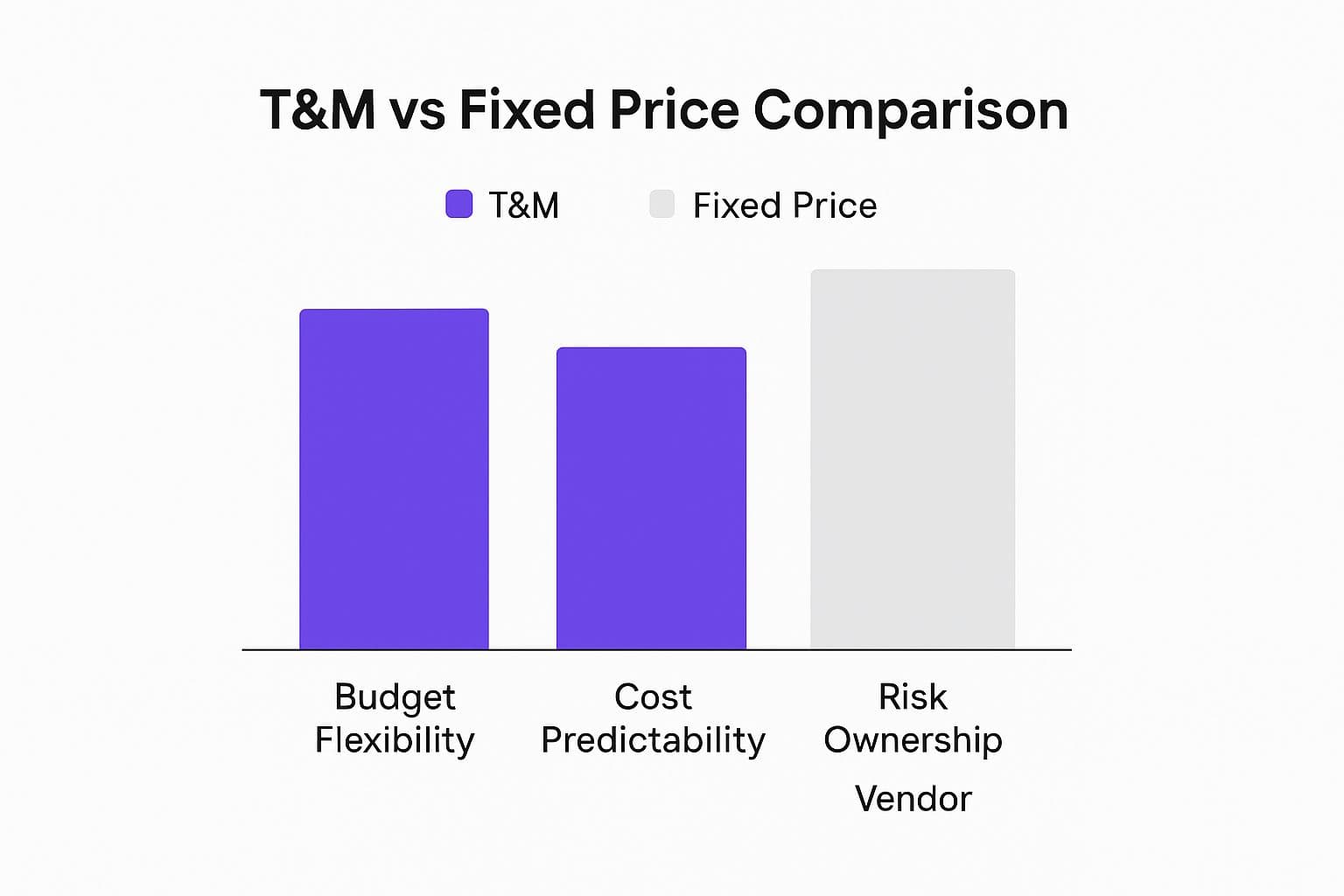
As you can see, Fixed Price offers that coveted cost certainty, but T&M provides the flexibility to adapt. The risk, however, sits firmly with the vendor in one model and the client in the other.
Time & Material vs Fixed Price At a Glance
To make the comparison clearer, here’s a quick-reference table that breaks down the key differences across the most important project criteria.
| Criterion | Time & Material (T&M) | Fixed Price |
|---|---|---|
| Budget | Variable, based on actual effort. Offers potential savings. | Fixed and agreed upon upfront. High predictability. |
| Scope | Flexible and adaptable. Changes are easily integrated. | Rigid and defined in detail from the start. |
| Risk | Client assumes the financial risk of overruns. | Vendor assumes the financial risk of underestimation. |
| Client Involvement | High and continuous. Client is part of the agile team. | Heavy upfront, then periodic approvals. |
| Best For | Complex, long-term projects with unclear requirements. | Simple, short-term projects with well-defined scopes. |
| Speed to Market | Fast start, enabling quicker MVP launch. | Slower start due to extensive initial planning. |
This table is a great starting point, but the right choice always depends on the unique context of your project.
Risk Allocation and Mitigation
Every project has risks, but who holds the bag is completely different in these models. With a Fixed Price agreement, the vendor is on the hook for most of the financial risk. If they get their estimates wrong and the project takes longer, it eats into their profit margin. This is precisely why they demand an ironclad scope document upfront—it's their primary defense.
In a Time & Material contract, the client assumes the risk of the budget going over. If the project's complexity was underestimated, you're the one paying for the extra hours. This arrangement absolutely requires a deep well of trust and transparency. Your main tools for managing this risk are staying actively involved, holding regular progress reviews, and maintaining open lines of communication.
Required Client Involvement and Collaboration
The level of hands-on engagement you’ll need is another major differentiator. A Fixed Price project is sometimes called a "set it and forget it" model, but that's a bit of an overstatement. It requires intense collaboration during the initial discovery and scoping phase. Once development is rolling, however, the client's role can become more passive, mainly focused on signing off on milestones.
A Time & Material project is the polar opposite. It demands continuous and active client collaboration. You aren't just a stakeholder; you are a core part of the development team. You’ll be in sprint planning meetings, giving constant feedback, and making key decisions that steer the product. This high-touch approach ensures the final result is exactly what you want, but it's a serious time commitment.
- Fixed Price Involvement: Heavy upfront, then lighter during the build phase.
- T&M Involvement: Consistent and high throughout the entire project.
Impact on Project Timeline and Speed to Market
Finally, how does each model affect your timeline? The deep, exhaustive planning needed for a Fixed Price contract can seriously delay the project kickoff. That detailed scoping phase can easily eat up 20-30% of the total project timeline before a single developer starts coding. Once it's going, the timeline is predictable, but getting to the starting line is often a marathon.
Time & Material projects can get off the ground almost immediately. The focus is on agile development, which means the team can start building the most important features in the very first sprint. This allows for a much faster speed to market, especially for an initial version or MVP. You get to collect real user feedback sooner and iterate based on what the market actually wants—a massive advantage in a competitive space. The total timeline might be fuzzy, but your time-to-value is often much, much shorter.
How Each Model Truly Impacts Your Budget

When you're weighing a Time & Material contract against a Fixed Price one, it's easy to get tunnel vision and focus only on the initial quote. But that’s a rookie mistake. The real financial impact of your choice runs much deeper than the number on a proposal. To make a smart investment, you have to understand how each model handles the inevitable bumps in the road: risk, change, and efficiency.
A Fixed Price contract feels safe. It gives you a predictable, upfront cost you can take to the bank. But that certainty comes at a price, and it's never free. Your vendor has to build a significant buffer into their quote to shield themselves from unforeseen problems. This "risk premium" is what you pay for them to absorb all the project's unknowns.
The Hidden Cost of a Fixed Price
This built-in premium can seriously inflate your total project cost before a single line of code is ever written. Trust me, this buffer is far from trivial.
In a Fixed Price model, the vendor isn't just quoting for the work; they're essentially selling you an insurance policy against the unknown. You're the one paying the premium, and it often makes the project more expensive than it needs to be.
Across the industry, you'll see Fixed Price contracts bake in a risk premium of 15% to over 30% of the estimated work. That’s a hefty chunk of change added to cover "what-ifs."
And that’s not the only hidden expense. The massive amount of upfront planning needed to lock down a Fixed Price scope can eat up 20-30% of the project's timeline before development even kicks off. That's a huge investment of time and resources spent on planning instead of building.
The Efficiency Potential of Time and Material
On the other hand, a Time & Material (T&M) model can be a much more direct path to cost efficiency precisely because it gets rid of that risk premium. You’re only paying for the actual hours worked and materials used. When a project is managed well, it can come in significantly under the budget of an equivalent Fixed Price proposal.
Of course, this efficiency comes with a trade-off. With T&M, the financial risk shifts squarely onto your shoulders. If the scope creeps or unexpected complexities pop up, you bear the cost of the extra hours needed to solve them.
The success of this model really boils down to transparency, trust, and your active involvement. Regular check-ins and crystal-clear communication become your best tools for keeping the budget in line. To get a better handle on the numbers, you can explore what goes into the total cost in our guide on software development costs.
Comparing Financial Drag from Change Orders
One of the biggest, yet most overlooked, budget killers in a Fixed Price project is the change order. Any time you need to deviate from the painstakingly defined initial scope, you have to kick off a formal change request. This triggers a whole new round of estimation, negotiation, and approval.
This process creates a huge amount of financial drag and project delays:
- Administrative Overhead: Every change order forces project managers on both sides to spend hours on paperwork and negotiation, pulling them away from actual work.
- Costly Re-Estimates: Even a small tweak can have a ripple effect, forcing an expensive and time-consuming re-evaluation of the entire project plan.
- Stalled Momentum: Development often grinds to a halt while a change order is processed, which means lost time and productivity you can never get back.
With a T&M contract, adjusting the scope is just part of the workflow. New ideas or user feedback can be folded into the next development sprint without the bureaucratic friction of a formal change order. This keeps the momentum going and avoids wasting money on administrative tasks. Your budget gets spent building great features, not managing contract amendments.
Real World Scenarios: When to Use Each Model
Knowing the theory behind Time & Material vs. Fixed Price is great, but the real lightbulb moment comes when you see how they play out on actual projects. The best choice always boils down to the specifics of your situation—how clear is the scope, how complex is the work, and how much room do you need for new ideas?
Let's ditch the theory and look at some concrete examples. Seeing these models in action will help you figure out which one is the natural fit for your next project.
When to Choose a Fixed Price Contract
A Fixed Price contract is your best friend when your project's scope is locked down, thoroughly documented, and isn't going to change. This model is all about predictability.
Here are a few scenarios where it just makes sense:
- Building a Standard Marketing Website: You need a straightforward, five-page website for your business—home, about, services, blog, and a contact page. The features are common, the design is based on a template you've already approved, and the scope is completely defined. This is a textbook case for a fixed price.
- Executing a Well-Defined Data Migration: Your company needs to move all its customer data from an old CRM to a new one. Every data field is mapped, the entire process is documented, and success is black and white—the data is either migrated correctly, or it isn't. There's no room for creative detours, making a Fixed Price agreement the safest, most logical option.
- Creating an MVP with an Unchanging Feature Set: You've got a solid, validated concept for a mobile app and have already mapped out every detail with wireframes and functional specs for your minimum viable product (MVP). If you are 100% certain that this initial feature set won't budge before launch, a Fixed Price contract gives you the budget certainty you need to get it done.
When a Time & Material Model Is Better
A Time & Material (T&M) contract is designed for projects where the path forward isn't totally clear. It shines in situations that require flexibility, discovery, and the agility to react to new information as it comes in.
Think about these situations where T&M is the clear winner:
- Developing a New SaaS Platform: You're building a new software-as-a-service product from scratch. You have a core vision, but you're also smart enough to know that user feedback and market shifts will force you to pivot and refine features along the way. A T&M model lets you build those necessary changes into your development sprints without the headache of renegotiating a contract every time.
In projects focused on innovation and market fit, the flexibility to evolve is not just a benefit—it's a requirement for success. T&M provides the framework for that evolution.
- Engaging in a Research & Development Project: Your team has been tasked with exploring how an emerging technology could be integrated into your business. The goal here isn't to deliver a predefined product; it's to experiment, learn, and see what's possible. Because the scope is intentionally open-ended and the outcome is unknown, a T&M model is really the only practical way to fund this kind of exploratory work. If you're looking for the right people for such an open-ended project, our guide on how to hire software developers has some great insights.
- Securing Ongoing Support for a Legacy System: You have a business-critical but aging software system that needs constant maintenance, bug fixes, and the occasional new feature. The workload is completely unpredictable. Some months might be quiet, while others require a massive effort. A T&M contract lets you pay for support exactly when you need it, making it a flexible and cost-effective way to handle ongoing maintenance.
A Practical Framework for Making the Right Choice
Deciding between a Time & Material and a Fixed Price contract isn't about which one is universally "better." It's about picking the right tool for the job you need to do. To get past the debate and make a confident call, you need a simple framework that starts with an honest look at your project and how your own organization works.
Answering a few key questions will point you in the right direction. This isn't just about process; it's about making sure the financial model you pick actually helps you hit your goals instead of becoming a source of constant friction.
Key Questions to Guide Your Decision
Start by running your project through these four critical filters. Your answers will quickly build a profile that leans toward either the flexibility of T&M or the predictability of a Fixed Price deal.
- How well-defined are my project requirements right now?
If you can confidently document every feature, user story, and technical spec down to the last detail, a Fixed Price model is a real possibility. But if your vision is solid but you expect the details to shift based on user feedback, T&M gives you the room to adapt.
- Realistically, how likely are we to change the scope?
Think about your market, the feedback you’ll get from user testing, and how your stakeholders operate. If you know you'll need to pivot or add features as you learn more, a T&M contract is designed for that reality. Fixed Price contracts, on the other hand, treat change as a formal, often slow, and expensive exception.
The decision really boils down to this: Are you building a well-documented structure with a detailed blueprint, or are you exploring a new landscape where the map is drawn as you go?
The way you manage scope is fundamentally different between the two. Fixed Price forces you into a massive upfront scoping effort—which can feel like a whole project in itself. T&M, however, is built on constant collaboration, where your engagement guides the project. This tight feedback loop is why T&M can often speed up time-to-market by 10-25%—you’re spending less time on bureaucratic change requests. You can get more details on how T&M helps launch products faster by exploring these project management insights on Brainhub.
Matching the Model to Your Company Culture
Finally, take a look in the mirror at your own team's availability and priorities.
- How much time can my team really commit on a weekly basis? A T&M model needs your team to be in the trenches, giving feedback and making decisions regularly. If your key people are already stretched thin, the more hands-off nature of a Fixed Price project after the initial kickoff might be a better fit.
- What's more important: budget certainty or speed to market? If you have zero wiggle room and the budget is set in stone, Fixed Price is the safer bet. But if your main goal is to get a product out there fast and improve it based on real-world use, the agility you get with T&M is priceless.
Walking through these questions gives you a solid, logical case for the model that fits your project's reality, setting you up for a much smoother ride.
Frequently Asked Questions
Even when you feel you've got a solid grasp on Time & Material vs. Fixed Price, a few specific questions always seem to pop up. Let's tackle some of the most common ones to help you make a truly informed decision for your project.
Can I Use a Hybrid Approach?
Absolutely. In fact, a hybrid model is often the smartest way to go. It gives you the best of both worlds: the cost certainty of a Fixed Price deal combined with the adaptability of a Time & Material agreement.
Here’s a common scenario: you kick off the project with a Fixed Price contract for the initial discovery and planning phase. This puts a firm budget and timeline around nailing down the project's foundation. With the core requirements set in stone, you can then switch to a T&M model for development, giving your team the freedom to iterate and adapt as the product comes to life.
How Do I Keep a T&M Budget from Spiraling Out of Control?
Managing the budget on a Time & Material contract comes down to one thing: being an active, engaged partner. The final cost isn't set in stone, so you can't just sign the contract and disappear. Your involvement is what keeps the project on track and on budget.
Here are a few practical ways to manage that risk:
- Set Budget Caps: Agree on clear "not-to-exceed" limits for specific timeframes, like a two-week sprint or a project milestone.
- Demand Regular Reports: Insist on seeing detailed timesheets and progress reports. This transparency is crucial for knowing exactly where your money is going.
- Prioritize Ruthlessly: Get involved in sprint planning. Make sure the team is always focused on delivering the features that provide the most value first.
In a Time & Material project, your greatest tool for budget control isn’t the contract—it’s your own consistent oversight. This shifts your role from a passive client to a true project partner.
What Happens if a Vendor Lowballs a Fixed Price Project?
If a vendor underestimates the effort needed for a Fixed Price project, that financial hit is their problem, not yours. The contract binds them to deliver the full scope for the price they quoted, no matter how many hours it ends up taking.
But be careful what you wish for. This scenario can quickly turn a partnership sour. A vendor who is losing money on your project might be tempted to cut corners, compromise on quality, or pull their senior developers off to work on more profitable accounts. That’s why vetting your partners thoroughly is just as critical as picking the right contract. A realistic budget from the start is always better for everyone involved.
Ready to build your idea without getting bogged down by endless planning or budget uncertainty? Iglu Digital specializes in turning concepts into market-ready MVPs with the price fixed before we start. Let us help you launch quickly and iterate with confidence. Start building your MVP today.