

Time and Materials vs Fixed Price Guide
Table of Contents
When it comes to software development contracts, the fundamental difference between time and materials vs fixed price is straightforward. A T&M contract is all about flexibility for projects that are likely to evolve, whereas a Fixed Price agreement gives you budget certainty for projects with a crystal-clear scope.
With T&M, you're paying for the actual time and resources spent on the project. This makes it a perfect fit for innovative or complex initiatives where the path forward isn't set in stone. On the other hand, a Fixed Price contract locks in the cost and deliverables right from the start, making it the go-to choice for simpler tasks where you don't expect any surprises.
Choosing Your Project Pricing Model

Settling on a pricing structure is one of the most critical decisions you'll make before a single line of code is written. It directly influences your budget, where project risks lie, and even the kind of relationship you'll have with your development partner. This choice establishes the rules of engagement and dictates how you'll navigate the changes that will almost certainly pop up.
The two most common models in the software world, Time and Materials (T&M) and Fixed Price (FP), are built for entirely different project scenarios. The right one for you hinges on how well-defined your project is, how much flexibility you need, and how involved your team can be.
Quick Comparison T&M vs Fixed Price
Before we dive deeper, let's start with a high-level look at how these two models stack up. This quick comparison table can help you get your bearings and understand the core trade-offs at a glance.
| Attribute | Time & Materials (T&M) | Fixed Price (FP) |
|---|---|---|
| Budget | Variable, based on actual effort | Predetermined and constant |
| Scope Flexibility | High; changes are easily incorporated | Low; changes require formal renegotiation |
| Best For | Complex, long-term, or evolving projects | Simple, short-term projects with clear requirements |
| Client Involvement | High; requires active participation | Low; minimal oversight after initial planning |
| Risk | Budget risk lies with the client | Scope risk lies with the service provider |
Looking at the table, you can see the a-ha moment: the models aren't just about price, but about where risk and control live. Your choice reflects your priorities—predictability or adaptability.
Understanding the Financial Implications
While a Fixed Price contract seems to offer total cost certainty, that security usually comes with a hidden cost. To protect themselves from unexpected issues or scope creep, vendors build a risk buffer into their pricing. In practice, this often means Fixed Price projects can be 10-20% more expensive than a similar T&M engagement.
That extra cost is essentially you paying the vendor to take on the project's risk. You can learn more by exploring different software development pricing models and how they impact project results.
How the Time and Materials Model Works

At its core, the Time and Materials (T&M) model is incredibly straightforward: you pay for the actual time spent on your project and the cost of any materials used. Think of it less like a rigid, one-time purchase and more like a collaborative partnership where your investment directly fuels the work being done.
Unlike a fixed-price contract that locks in a total cost upfront, T&M operates on a pay-as-you-go basis. Billing is broken down into two simple parts. "Time" refers to the billable hours from developers, designers, project managers, and anyone else on the team. "Materials" covers direct costs like software licenses, third-party services, or stock assets. You’ll see regular, detailed invoices, so you always know exactly where your money is going.
This structure's greatest asset is its natural flexibility. It’s designed to handle the unexpected, making it the perfect choice for projects where the full scope isn’t clear from the start or is likely to change based on market feedback.
A Natural Fit for Agile Development
The T&M model and Agile development go hand in hand. It’s almost as if they were made for each other. Agile methods, like Scrum or Kanban, break down huge projects into small, manageable cycles known as sprints. At the end of each sprint, the team delivers a working piece of the product.
This iterative process is all about continuous feedback and making smart adjustments along the way. If user testing shows a new feature is a dud, or a competitor’s move creates a new opportunity, the team can pivot in the very next sprint. There are no lengthy contract renegotiations to slow things down. T&M makes this possible because the budget isn't shackled to a feature list that was defined months ago.
This adaptability is essential for any innovative product, a long-term development effort, or when building a Minimum Viable Product (MVP). It's in these scenarios where learning and iterating are the keys to success.
Managing Budgets in a Flexible Framework
Let's address the elephant in the room: budget control. The most common hesitation I hear from clients about T&M is the fear of runaway costs. And it's a valid concern. While the budget isn't fixed, it's far from a blank check.
Effective cost management in a T&M engagement boils down to three things: transparency, active client involvement, and crystal-clear communication. With the right practices in place, you can maintain financial control while reaping the benefits of flexibility.
Here are a few proven strategies for keeping a T&M project on track financially:
- Set Budget Caps: You can establish a "soft" or "hard" spending limit for a specific period, like a month or a quarter. Hitting that cap acts as a checkpoint, forcing a review and requiring your approval before any more work is done. No surprises.
- Maintain a Prioritized Backlog: The product backlog is your master list of all desired features, ranked by business value. The team always works on the most important items first. This ensures that even if the budget were to run out unexpectedly, the most critical functionality is already complete.
- Hold Regular Check-ins: Consistent meetings are non-negotiable. Use them to review progress, track hours against the budget, and align on upcoming priorities. This keeps everyone on the same page and accountable.
- Demand Transparent Reporting: Your development partner should provide you with detailed, frequent reports showing time logs and expenses. This visibility builds trust and gives you the data you need to make informed decisions about where to invest next.
When it comes down to the time and materials vs fixed price decision, the T&M model does place the budget risk on you, the client. But in exchange, it gives you something invaluable: complete control and the flexibility to build a better product.
How the Fixed Price Model Works

Now, let's switch gears from the pay-as-you-go nature of Time & Materials to its polar opposite. The Fixed Price (FP) model is all about certainty. In this arrangement, you and your development partner agree on a single, total cost for a very specific set of deliverables before a single line of code is written. It’s a lot like building a house with a general contractor—you agree on the blueprints, materials, and a final price before they break ground.
Everything in a Fixed Price project rests on a single, all-important document: the Scope of Work (SOW). This isn't just a simple to-do list; it’s an incredibly detailed blueprint that outlines every feature, function, screen, and technical specification. The client has to have a very clear, concrete vision of the final product, because putting this SOW together is a major upfront investment of time and effort from both sides.
The main draw for the client is obvious: budget predictability. You know exactly what you'll spend from the get-go, which makes financial planning a breeze and removes the fear of costs spiraling out of control. But that peace of mind comes with some significant trade-offs.
The Foundation of a Rock-Solid Scope
For a Fixed Price model to have any chance of success, exhaustive planning is absolutely essential. We're talking about documenting every last detail of the project. This discovery and planning phase can take weeks and often feels like a mini-project all on its own.
This intense upfront work is critical because that SOW becomes the project's constitution. It defines exactly what the team will deliver. If it's not in the document, it's considered "out of scope" and won't be built.
So, what kind of detail are we talking about? A good SOW needs to include:
- Functional Specifications: A deep dive into every feature and exactly how it needs to work from a user’s perspective.
- Technical Requirements: The specific technology stack, required integrations, performance benchmarks, and security protocols.
- Design and UX/UI: Pixel-perfect mockups, comprehensive wireframes, and detailed user flow charts that leave zero room for ambiguity.
- Acceptance Criteria: A clear, objective set of conditions that define when a feature—and the project as a whole—is officially "done."
This is why the Fixed Price model is a natural fit for the traditional Waterfall methodology, where the project flows sequentially from one phase to the next, and the final destination is locked in from day one.
The Inevitable Challenge of Change
Here’s the catch. The greatest strength of the Fixed Price model—its rigid predictability—is also its biggest weakness. In the real world of software development, change is practically a given. The market can pivot, early user feedback can uncover a critical flaw in your logic, or a stakeholder might have a brilliant new idea halfway through the project.
Under a Fixed Price contract, adapting to change is a bureaucratic and often expensive process. Any deviation from the original SOW requires a formal change request. This kicks off a new cycle: the request has to be analyzed, scoped, and estimated, resulting in a separate quote that adds both cost and time to the project.
This is where the "fixed" price can become anything but. If your project needs several adjustments, the final bill can easily climb far beyond the initial quote. Even worse, this dynamic can strain the relationship, turning a collaborative partnership into a series of tense negotiations over what is and isn't included in the contract. This is one of the most critical points of friction when weighing time and materials vs fixed price.
Comparing Cost Flexibility and Risk Allocation
When you're trying to decide between time and materials vs fixed price, the conversation goes much deeper than just how you'll get the bill. The real difference is how each model deals with the one constant in every project: uncertainty. Every software build has risks—budget, timeline, scope—and your choice of contract model decides who holds that risk and how much room you have to pivot when things inevitably change.
A Time and Materials (T&M) contract is designed for partnership and flexibility, operating on the understanding that you can't know everything on day one. On the other hand, a Fixed Price agreement tries to lock everything down from the get-go. This pushes most of the initial risk onto the development agency, but it comes with its own set of trade-offs.
Let's break down how these two approaches stack up in the areas that matter most: the cost structure, who's on the hook when things go wrong, and the kind of relationship you'll have with your development partner.
This chart gives you a quick visual on the core trade-offs. You'll see how Fixed Price offers predictable budgeting, while T&M provides the flexibility to adapt, with risk being the balancing act between them.
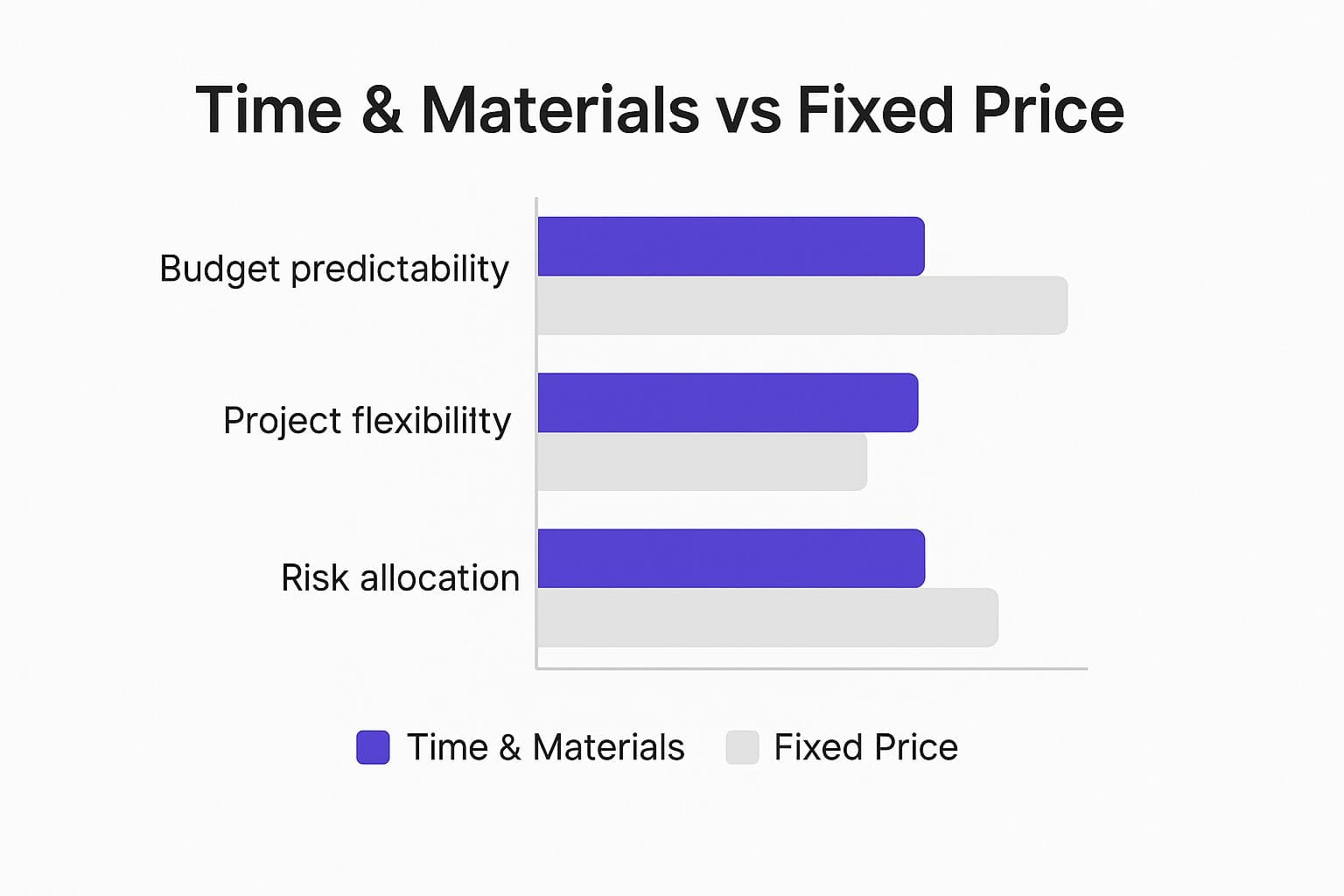
As the infographic shows, it’s a classic tug-of-war. Fixed Price gives you certainty on the budget, but T&M gives you the freedom to evolve the project. Where you land depends on what you value more.
To help you decide, let's take a closer look at how each model handles the critical factors that determine a project's success. This table breaks down the practical differences feature by feature.
Detailed Feature Analysis T&M vs Fixed Price
| Decision Factor | Time & Materials (T&M) | Fixed Price (FP) | Key Takeaway |
|---|---|---|---|
| Budget | Variable, based on actual effort. Offers potential cost savings but lacks predictability. | Set in stone upfront. High predictability, but includes a risk premium. | T&M is for cost-efficiency; FP is for budget certainty. |
| Flexibility | High. Scope changes are expected and easily integrated into the workflow. | Low. Any change requires a formal, and often costly, change request process. | If you expect requirements to evolve, T&M is the only practical choice. |
| Risk Allocation | Client assumes budget risk; vendor accommodates scope risk. A shared-risk model. | Vendor assumes budget risk for the defined scope; client assumes 100% of the scope risk. | Your choice depends on whether you'd rather manage a budget or a rigid scope. |
| Client Control | High. The client is actively involved in prioritizing features and steering the project. | Low. The plan is locked in. Client involvement is often limited to milestone reviews. | T&M empowers active client leadership; FP is more hands-off. |
| Transparency | High. Regular reports show exactly where time and money are being spent. | Low. You see the final output, but the internal process and effort are a black box. | If you want to see the work as it happens, T&M provides that visibility. |
Ultimately, the table highlights a fundamental truth: T&M is built for collaboration and adaptation, while Fixed Price is structured for predictability and risk transfer. Neither is inherently better—they just solve for different project realities.
The Client-Vendor Relationship Dynamic
Your choice of pricing model directly influences the relationship you'll have with your development team. It sets the tone for every conversation and decision.
A Fixed Price contract can, unfortunately, create an adversarial dynamic. The vendor's profit depends on completing the pre-defined scope as efficiently as possible. This means they are financially incentivized to resist any change, no matter how good the idea is. What should be a creative discussion about a new feature can quickly become a tense negotiation over a change order. It's a transactional relationship, not a collaborative one.
In stark contrast, a Time and Materials model inherently fosters a partnership. With T&M, everyone is on the same team, working toward a shared goal: building the best possible product. The vendor is focused on delivering value, and the client is focused on providing clear direction. This alignment builds trust and encourages the kind of open, honest communication needed to navigate the challenges of software development. It’s a relationship built for success, especially when the path forward isn't perfectly clear.
When to Use the Time and Materials Model
Let's get practical. The Time and Materials (T&M) model isn't just an entry on an invoice; it's a strategic decision. Figuring out when to use it is the key to harnessing its flexibility without letting your budget run wild. The right call really comes down to how complex your project is, how clear your vision is, and how hands-on you want to be.
T&M truly comes into its own when you don't have a perfect roadmap from the start. It’s built for situations where you expect to learn, iterate, and adapt as you go. If your project sounds like one of the scenarios below, a T&M contract is almost certainly your best bet.
Developing an Innovative MVP
Building a Minimum Viable Product (MVP) is fundamentally an exercise in discovery. You have a core idea, a hypothesis, but the final product gets hammered into shape by real user feedback. A Fixed Price contract would chain you to your initial assumptions, and let’s be honest, some of those assumptions are bound to be wrong. T&M gives you the breathing room to pivot.
- Real-World Example: Let's say you're building a new SaaS platform for project managers. Your first sprint delivers what you thought was a genius dashboard, but user testing shows it's just confusing. Under a T&M model, you can instantly shift gears, push a UI redesign to the top of the backlog for the next sprint, and spend your budget on fixing the real problem instead of building features no one will use.
Long-Term Projects with Evolving Needs
If a project is slated to run for months, or even years, trying to define every single requirement on day one is a fool's errand. Markets change, new tech pops up, and your own business goals will evolve. A T&M approach lets the project grow and adapt right along with your business. This is especially true when working with a partner, as clear communication in outsourcing product development is the lifeblood of making those necessary long-term adjustments.
When You Want Deep Involvement
Do you and your stakeholders want to be in the trenches, making daily decisions, prioritizing features, and giving constant feedback? If so, T&M is the only model that makes sense. It’s fundamentally built on collaboration and transparency. It actually relies on your active participation to guide the project, making sure the development team stays perfectly aligned with your evolving vision.
Red Flags When Considering T&M
As effective as it can be, T&M isn’t a silver bullet. It’s a terrible fit if your project has any of these characteristics. Steer clear if you find yourself in these situations:
- A Rigid, Non-Negotiable Budget: If you have an absolute spending cap that cannot be exceeded for any reason, the variable nature of T&M spending is simply too risky.
- Limited Client Availability: This model demands your time. If you can't commit to regular meetings, feedback sessions, and grooming the backlog, the project will drift without direction. That leads to wasted time and a bloated budget.
- Simple, Highly Defined Tasks: For dead-simple projects where there’s no ambiguity—think migrating a small website without any design or functionality changes—the flexibility of T&M is just overkill. A Fixed Price contract will give you cost certainty for a scope that's already crystal clear.
When to Use the Fixed Price Model
While the flexibility of Time & Materials is a huge advantage for projects that need to evolve, there are times when predictability is what matters most. The Fixed Price (FP) model really comes into its own when your project's scope is crystal clear and locked in, making it the right call when budget certainty is non-negotiable. Think of it as a contract built for precision, not for discovery.
A Fixed Price agreement works best for projects where you can define and document every last detail before a single line of code is written. If you have a fully-formed vision and can map out every feature, screen, and user interaction, the FP model gives you a powerful sense of control. You get the exact cost and delivery date locked in from the start, which is a massive plus for companies with tight financial planning and procurement rules.
Projects with Ironclad Requirements
The classic scenario for a Fixed Price contract is when the project requirements are completely buttoned up. This means there's absolutely no room for interpretation about what needs to be built. These projects are usually smaller, well-understood, and carry a very low risk of running into unexpected problems.
Here are a few situations where Fixed Price makes a lot of sense:
- Building a Standard Website: Need a straightforward marketing site with a defined set of pages (like Home, About, Services, Contact) and standard functionality? The scope is easy to pin down.
- A Small, Defined Task: Outsourcing a single, self-contained piece of a larger system—like integrating a specific payment gateway—is a perfect candidate for an FP contract.
- Projects for Strict Organizations: Government bodies or large corporations often have rigid procurement policies that require a fixed budget from the outset, making FP the only viable option.
In all of these examples, the stability of the requirements makes a Fixed Price contract the logical path forward. It shields your budget from overruns, provided the scope doesn’t change.
The Dangers of an Incomplete Scope
The safety net of a Fixed Price model can quickly turn into a trap if the scope isn't genuinely complete. This is, without a doubt, the single biggest risk of this approach. If you forget to document a critical requirement, it simply won't be part of the deal. Any change or addition, no matter how minor, will require a formal change request, which means more money and more time.
This is especially risky when you're developing a brand-new product. Locking yourself into a Fixed Price contract for a full-featured product can suffocate the very iteration and learning that leads to success. For new ideas, it’s much smarter to define a smaller, core set of features first. You can dive deeper into this strategy in our guide explaining what is a Minimum Viable Product and how it helps you validate ideas without breaking the bank.
Answering Your Top Questions About Pricing Models
When you're trying to decide between Time & Materials and Fixed Price, the high-level pros and cons only get you so far. The real questions pop up when you start thinking about how these models work in practice. Let's dig into some of the most common questions clients ask to help you avoid a costly misstep.
A big one I always hear is whether you have to be stuck with one model for the whole project. The answer is a definite no.
Can You Combine T&M and Fixed Price?
Yes, and you absolutely should consider it. A hybrid approach is often the smartest way to go, giving you the best of both worlds. It blends structure with much-needed flexibility.
Here’s a popular way to do it: start with a Fixed Price contract for the initial discovery and planning phase. This is perfect for setting a clear budget and timeline to nail down the core requirements and build a solid project blueprint. Once that foundation is in place, you can switch to a Time and Materials model for the actual development. This lets your team adapt, build, and test features based on real feedback as the project evolves. You get cost certainty upfront and the agility to build a better product in the long run.
Is a Fixed Price Contract Really Fixed?
Not in the way most people think. The price is only "fixed" for the exact scope of work laid out in the initial contract. The moment you need a new feature, run into an unforeseen technical hurdle, or decide to change direction, that's considered a scope change.
These changes kick off a formal change request process. Each one is scoped and billed separately—often at a premium—which can quickly inflate your total project cost. A Fixed Price project only stays on budget if the scope never, ever changes. And let's be honest, that almost never happens in software development.
Which Model Is Best for a Startup?
For most startups getting their first product off the ground, the Time and Materials model is almost always the right call. The entire startup journey is about learning and reacting to what the market tells you, which means your product requirements are guaranteed to evolve. You can learn more about this iterative approach by reading about how to build an MVP that truly connects with users.
A T&M contract gives you the flexibility to pivot and iterate without being handcuffed to a rigid plan built on early, unverified ideas. A Fixed Price contract might feel safer when you have a tight budget, but it can easily suffocate the innovation and responsiveness a startup needs to survive and find product-market fit.
Ready to turn your idea into a market-ready product without getting bogged down by endless planning? Iglu Digital specializes in building functional MVPs with the price fixed before we start. We help you launch faster, gather real user feedback, and iterate your way to success. Transform your concept into a tangible product today.