Expert Guide to Software Development for Medical Devices
Table of Contents
Before you write a single line of code, you have to get the foundation right. For medical device software, that foundation is all about regulatory strategy and quality. This isn't just bureaucratic box-ticking; it's the strategic work that prevents catastrophic rework, shortens your path to market, and, most importantly, keeps patients safe.
Building Your Regulatory and Quality Foundation
Trying to build medical software without a solid regulatory plan is like trying to build a hospital without a blueprint. It might look fine on the surface, but it's doomed to fail inspection. Every single decision you make—from budgeting to your development timeline—is shaped by the rules set by bodies like the U.S. Food and Drug Administration (FDA) and their international counterparts.
The very first job is to figure out what, exactly, you’re building. The regulatory path you'll have to walk depends entirely on how your software fits into the healthcare world. Getting this right from the start is non-negotiable.
Distinguishing Between SaMD and SiMD
One of the first and most common stumbling blocks is understanding the difference between Software as a Medical Device (SaMD) and Software in a Medical Device (SiMD). They sound similar, but they are worlds apart from a regulatory perspective. Get this wrong, and you could send your whole project down a dead-end street.
To help clear things up, here’s a breakdown of how they differ.
Comparing SaMD vs SiMD Characteristics
| Characteristic | Software as a Medical Device (SaMD) | Software in a Medical Device (SiMD) |
|---|---|---|
| Function | Operates as a medical device on its own. | Is a component of a physical medical device. |
| Platform | Runs on general-purpose hardware (e.g., smartphone, server, cloud). | Embedded within or essential to the function of a specific hardware device. |
| Independence | Independent of any specific hardware to fulfill its medical purpose. | Dependent on the hardware to function and achieve its intended use. |
| Example | A mobile app that uses a phone's camera to analyze moles for signs of cancer. | The firmware that controls the infusion rate of an insulin pump. |
Essentially, if the software is the medical device, it's SaMD. If the software is what makes a physical device work, it's SiMD. Knowing which bucket your product falls into is the first real step in charting your course.
Navigating FDA and International Classifications
Once you know if you have a SaMD or SiMD product, the next step is determining its risk class. Regulators everywhere classify medical devices based on the potential harm they could cause a patient.
In the U.S., the FDA uses a straightforward three-tier system:
- Class I: These are low-risk devices. Think of software that simply stores and displays medical images for a doctor to review later.
- Class II: This is the moderate-risk category, where most medical software lands. These devices often require special controls. An example would be software that analyzes patient data to help a clinician make a diagnosis.
- Class III: These are high-risk devices, the ones that support or sustain human life. Software that actively controls a life-support ventilator is a clear-cut Class III example.
Your device's classification is the single most important factor determining your path forward. It dictates the depth of documentation you'll need, the rigor of your testing, and the type of submission you'll make for market approval. A Class III device journey is exponentially more demanding than that for Class I.
The cost and complexity of bringing medical-grade software to market in 2025 are higher than ever, driven by tougher regulatory scrutiny and the capabilities of modern tech. Project costs can swing wildly based on the software's complexity, the number of users it will serve, and its feature set. Plus, compliance with regulations like HIPAA, GDPR, and FDA rules adds a significant layer of expense and effort. You can discover more insights about healthcare software development trends to see how these factors play out in real-world budgets.
This chart gives you a sense of what a typical development lifecycle looks like when you’re doing it right under a structured QMS.
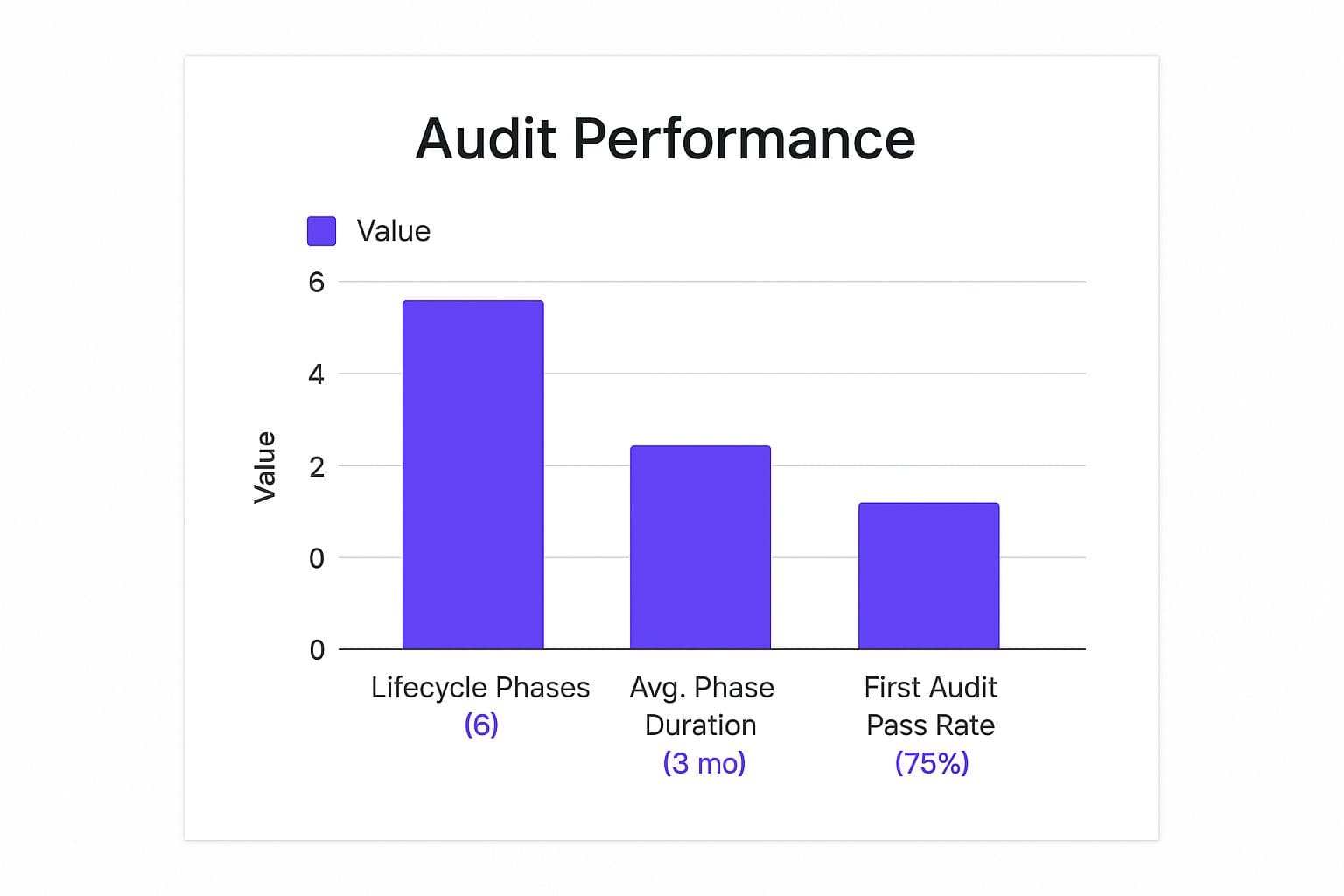
As you can see, compliant development isn't a free-for-all. It's a highly structured process with clear phases, and the need to be "audit-ready" is baked in from the very beginning.
The Role of a Quality Management System
This brings us to the Quality Management System (QMS). Your QMS is the operational spine of your entire development effort. It’s not a dusty binder of documents on a shelf; it's the living, breathing set of processes and procedures that ensures you build, test, and maintain your software in a consistent and safe way.
Think of it as your rulebook. Your QMS provides the auditable proof—the paper trail—that shows you followed your own rules, managed risks appropriately, and rigorously verified that your software does exactly what you claim it does.
Designing and Developing with Compliance in Mind
Alright, you've got your regulatory strategy sorted. Now for the fun part: actually building the thing. This is where your vision starts to become a real, functioning piece of medical software. But hold on—software development for medical devices isn't like building a standard consumer app. The rules are entirely different, and for good reason.
Every single decision, from a rough UI sketch to the last line of code, has to be deliberate, documented, and traceable. This isn't about bureaucracy getting in the way of progress. It's about creating an airtight, auditable record that proves patient safety was your guiding principle from day one. The international standard IEC 62304 is your bible here; it provides the essential framework for the software lifecycle to keep your process compliant and structured.
Adapting Agile for a Regulated World
Most modern dev teams live and breathe agile. It’s fast, flexible, and iterative. On the other hand, the medical device world has historically favored the traditional "waterfall" model because its linear, rigid structure seems to fit the heavy documentation requirements.
But here’s the good news: you don't have to sacrifice speed for compliance. You can absolutely have both.
The trick is to create what I call an "agile-but-auditable" workflow. You still run your sprints, but you make sure that the output of each cycle—every updated requirement, risk assessment, and verification test—is formally captured and logged in your Quality Management System (QMS).
Think of it this way: a user story in your Jira backlog is more than just a feature request. It's a formal requirement that needs to be tied to a risk analysis and traced all the way through to the specific test that proves it works correctly. This hybrid approach lets you stay nimble without losing the rock-solid traceability that auditors demand.
Crafting a Bulletproof Software Requirements Specification
Your Software Requirements Specification (SRS) is the absolute foundation of your project. Get this wrong, and you're setting yourself up for scope creep, compliance headaches, and expensive rework down the line. It’s the single document that details what your software must do, how it must perform, and the environment it will live in.
There is no room for ambiguity here. Your SRS needs to be painstakingly specific and should cover:
- Functional Requirements: What the software actually does. (e.g., "The system shall calculate drug dosage based on the patient's weight and age inputs.")
- Performance Requirements: How well it does its job. (e.g., "Dosage calculations must be completed and displayed in under 500 milliseconds.")
- Safety Requirements: Built-in guardrails to prevent harm. (e.g., "The system shall block users from entering a weight below the neonatal minimum.")
- Security Requirements: How you protect sensitive data. (e.g., "All patient data sent to the cloud must use AES-256 encryption.")
A well-written SRS becomes your project's single source of truth. If you need a bit more guidance, take a look at our guide on how to write technical requirements to really nail down your documentation.
Conducting a Thorough Risk Analysis
Risk management in this field isn't a box you check once. It's an ongoing process that starts the moment you begin designing. Before a single line of code is written, you need to be systematically identifying, analyzing, and figuring out how to control potential hazards. The goal is to design safety into the software from the ground up, not bolt it on as an afterthought.
A go-to tool for this is the Failure Mode and Effects Analysis (FMEA). It’s a structured way to ask all the tough "what if" questions.
What if the software hangs during a critical procedure? What if a network glitch corrupts patient data? What if a clinician enters the wrong value? For every potential failure, you have to assess its severity and likelihood, then design and document a control measure to bring that risk down to an acceptable level.
This deep-dive analysis directly shapes your software design. For instance, identifying the risk of bad data entry might lead you to implement input validation, use dropdown menus instead of free-text fields, and add confirmation pop-ups. All of these become documented, safety-critical features.
Designing a Secure and Scalable Architecture
The software architecture is the blueprint for your entire system. For medical devices, that blueprint has to be built on a foundation of security, reliability, and scalability. A weak architecture can introduce vulnerabilities that are almost impossible to patch later on.
The rise of Software as a Medical Device (SaMD) is a huge driver here. By 2025, the SaMD market is expected to surge, especially as AI and machine learning become more common for diagnostics and treatment. This puts even more pressure on getting data privacy and cybersecurity right, since many of these systems depend on the cloud.
When mapping out your architecture, keep these principles front and center:
- Modularity: Design your software in smaller, independent modules. This makes it far easier to test, update, and maintain one piece without breaking the whole system.
- Data Encryption: Patient data must be encrypted everywhere—both at rest (in a database) and in transit (over a network).
- Fault Tolerance: The system needs to handle errors gracefully without putting patients at risk. If a critical sensor fails, for example, the software should immediately alert the user and shift into a pre-defined safe state.
By weaving these elements—an agile-but-auditable process, a meticulous SRS, proactive risk management, and a robust architecture—into your development from the start, you're not just building a product. You're building a compliant and fundamentally safe tool that clinicians and patients can trust.
Executing Effective Verification and Validation
You’ve poured countless hours into designing and developing your medical software. Now comes the moment of truth: proving it works correctly, safely, and for its intended purpose. This is where Verification and Validation (V&V) come into play.
These aren't just buzzwords. They're two distinct, mandatory pillars that provide the evidence for your safety and effectiveness claims.
I've seen many teams trip up by using these terms interchangeably, a mistake that immediately raises red flags for auditors. Let's get it straight. Verification asks, "Did we build the software right?" while validation asks, "Did we build the right software?" It's the difference between meeting your technical specs and meeting the user's actual needs.
Verification vs. Validation: What's the Real Difference?
Grasping this fundamental distinction is absolutely critical for building a compliant V&V strategy. One is all about technical precision, while the other is focused on clinical utility. They answer different questions and use entirely different methods to find those answers.
To put it into perspective, here's a direct comparison of their activities and goals within the world of software development for medical devices.
Key Differences in Verification vs Validation Activities
| Aspect | Software Verification | Software Validation |
|---|---|---|
| Core Question | "Did we build the product correctly?" | "Did we build the correct product?" |
| Focus | Conformance to specifications and design requirements. | Meeting user needs and the defined intended use. |
| Methods | Code reviews, static analysis, unit tests, integration tests. | Usability testing, clinical evaluations, user acceptance testing (UAT). |
| Timing | Continuously throughout the development lifecycle. | Primarily on the final or near-final product. |
| Example | A test confirms that the algorithm calculating heart rate from sensor data precisely matches the formula in the SRS. | A clinical study shows cardiologists can use the software to accurately diagnose arrhythmias in a real-world setting. |
As you can see, verification is about looking inward at your own blueprints, while validation involves looking outward to the real-world environment where your software will be used.
Building a Comprehensive Testing Strategy
A solid V&V plan is built on a tiered testing strategy. You start with the smallest building blocks and work your way up, making sure every component is solid before it's integrated into the larger system. This layered approach is your best defense for catching bugs early and maintaining traceability.
Your strategy needs to include several distinct levels of testing:
- Unit Tests: This is the bedrock of your testing pyramid. Here, you test each tiny, isolated piece of code—a single function or module—to confirm it behaves exactly as expected. A classic example is a unit test that verifies a function converting pounds to kilograms always returns the correct value to a specific decimal place.
- Integration Tests: Once the individual units are verified, you start connecting them. Do different modules communicate and pass data correctly? Does an action in one part of the system trigger the right response somewhere else? This is where you find the friction points and bugs at the seams of your software.
- System Tests: Now you're testing the fully assembled software as a single, cohesive system. The goal is to verify that the entire application meets every requirement laid out in your SRS. This is a comprehensive effort, covering everything from functional performance and security to stress testing and failure recovery.
Throughout this entire process, documentation is everything. Every single test case must be meticulously linked back to a specific requirement in your SRS. This traceability matrix isn't just good practice; it's a non-negotiable artifact for auditors, proving you’ve systematically tested every specified function.
Properly forecasting the time for this exhaustive process is critical. If you're looking for more guidance, check out our article on estimating software development time for practical tips on planning your V&V phase.
Focusing on User and Clinical Validation
Verification can prove your software is technically perfect, but it can never prove it's clinically useful or safe in the hands of a healthcare professional. That's the crucial role of validation, which almost always culminates in formal usability studies and clinical evaluations.
Think of it this way: you’ve developed software for a new portable ultrasound scanner.
Your verification tests would confirm the image processing algorithms are mathematically correct and the system doesn't crash under load. But your validation study would put that device in the hands of sonographers to use on actual patients. Can they get a diagnostically sufficient image? Is the user interface intuitive enough to use in a high-pressure clinical situation?
This validation evidence is the absolute cornerstone of your regulatory submission. It provides the objective proof that your device not only works as designed but also fulfills its medical purpose safely and effectively. Without it, your software is just a collection of well-written code with no proven clinical value.
Weaving in Cybersecurity and Data Privacy
In today's connected healthcare world, cybersecurity isn't some feature you tack on at the end. It's a non-negotiable part of patient safety, and it needs to be baked into your software from the very first concept sketch. Thinking about security after the fact is a recipe for disaster—it leads straight to regulatory headaches and, worse, shatters the trust of your users.
Real security is proactive. It starts long before anyone writes a single line of code, right in the design phase, with a process called threat modeling.
Getting Ahead with Threat Modeling
Threat modeling is basically a structured way for your team to think like the bad guys. You get together and brainstorm all the ways things could go wrong. It’s about asking the tough questions upfront:
- How could someone without permission get their hands on patient data?
- What if a network connection drops or gets hijacked while data is being sent?
- Could a malicious user feed the software bad information to cause a harmful outcome?
By spotting these potential weak points early, you can build security controls directly into the software’s architecture. It’s a whole lot easier and more effective than trying to plug security holes in a product that’s already built.
Secure Coding and Encryption: The Nuts and Bolts
Once you move into development, the focus shifts to the technical details. This is where secure coding practices are absolutely essential. Your entire development team needs to be on the same page, following established guidelines to shut down common vulnerabilities like SQL injection or insecure data storage.
A huge piece of this puzzle is encryption. You're handling sensitive patient health information (PHI), and it must be protected at all times, no exceptions.
- Data in Transit: Any information moving between the device and a server or app has to be encrypted. We rely on strong, proven protocols like TLS (Transport Layer Security) to prevent anyone from snooping on the data as it travels.
- Data at Rest: Data that’s just sitting there—on the device, in a database, or on a cloud server—also needs to be locked down. Using a robust standard like AES-256 ensures that the information is unreadable even if someone manages to steal a laptop or breach a server.
Building trust is just as important as building features. A single data breach can destroy your product's reputation for good. Regulators, doctors, and patients all demand a system where privacy is a core principle, not just a checkbox on a form.
The medical device field is growing fast, but that growth comes with some serious challenges. We’re seeing that navigating the maze of regulations and staying on top of cybersecurity risks are major roadblocks for many companies. As the rules around software and data get even stricter, these areas need to be top-of-mind. You can read a full analysis of industry trends to get a better sense of these dynamics.
Planning for the Long Haul: The Entire Product Lifecycle
Cybersecurity work doesn't stop at launch. That's really just the beginning of the journey. The FDA and other global regulators now fully expect a total product lifecycle (TPLC) approach to security. This means you need a solid, documented plan for how you’ll handle security after your product is in the hands of users.
Think of your post-market plan as your ongoing commitment to keeping patients safe. It needs to clearly define how you will:
- Monitor for New Threats: You have to keep an eye out for new vulnerabilities, especially in any third-party software components you’ve used.
- Assess the Risk: When a new vulnerability pops up, you need a process to figure out how it could impact your device and its users—and fast.
- Deploy Updates: You must have a secure and efficient way to create and push out software patches to fix issues before they can be exploited.
This isn't optional anymore. A critical piece of modern regulatory submissions is the Software Bill of Materials (SBOM). It's an exhaustive list of every single third-party and open-source component in your software. This transparency is a game-changer, allowing everyone to quickly see if a newly found vulnerability in a common library affects your device, which makes for a much faster and more effective response.
Navigating Regulatory Submission and Post-Market Strategy
Getting your medical software to market is a huge milestone, but the work is far from over. In reality, launching the product is just the beginning. The focus now shifts from building the software to proving its real-world performance and maintaining its integrity over the long haul.
The first major gate you have to pass through is the regulatory submission itself. All the painstaking work you've put in—from defining user needs to executing every last V&V test—gets bundled into one comprehensive package of evidence. For regulators like the FDA, this documentation is the only window they have into your entire process.
Compiling Your Technical Documentation
Think of your submission package as the final exam for your entire development journey. Whether you’re preparing a 510(k) for a device with moderate risk or a more demanding Premarket Approval (PMA) for a high-risk one, your success lives or dies by the quality of this documentation.
Your Quality Management System (QMS) tells the story of how you built the software, while your verification and validation results provide the proof. Every single claim you make about your software's safety and performance has to be backed up with objective, traceable evidence.
Here are the non-negotiable documents you’ll need to have in order:
- Device Description: A detailed breakdown of the software’s architecture, what it does, and how it’s meant to be used.
- Software Requirements Specification (SRS): This is the blueprint, listing every functional, performance, and safety requirement you built against.
- Risk Management File: The complete record of your risk analysis (think FMEA), the controls you implemented, and your residual risk assessment, all aligned with ISO 14971.
- V&V Reports: This includes all test protocols, the results, and, crucially, the traceability matrix that links every single requirement to a specific test.
- Cybersecurity Documentation: Your threat model, vulnerability scans, and your Software Bill of Materials (SBOM) are essential here.
This isn’t just about collecting files; it's about weaving a coherent narrative that proves you built a safe and effective product from the ground up.
Establishing a Post-Market Surveillance System
Once your software is out in the wild, your responsibilities actually increase. You are now legally and ethically on the hook for monitoring its performance with real users. This is called post-market surveillance, and it’s an active, ongoing process, not a passive one.
A common pitfall is treating post-market activities as just a complaint hotline. A truly robust surveillance plan actively seeks out data to spot potential issues before they turn into serious adverse events.
Your system needs to be designed to capture all kinds of feedback and performance data. This means setting up clear channels for users to report bugs, monitoring key performance metrics from the software itself, and keeping a constant watch for new cybersecurity threats. This creates a critical feedback loop that will inform every future update and improvement.
Managing Software Updates and Iteration
Software is never really "done." The ability to iterate is a huge advantage, but in a regulated space, every change demands extreme care. You can't just push an update on a whim.
Before a single line of new code goes out, you have to run a thorough impact analysis.
- Assess the Change: Does this tweak affect a critical safety feature or the software’s core intended use?
- Evaluate the Risk: Could this update introduce a new hazard or mess with an existing risk control?
- Determine Regulatory Impact: Is this a tiny bug fix you can just document internally, or is it a significant change that means you have to go back to the regulators?
For example, changing a color in the UI is a low-risk, low-impact change. But if you modify the diagnostic algorithm? That’s a major change that would almost certainly require a new regulatory submission. This controlled approach is a world away from the fast-and-loose cycles you might see when comparing an MVP vs. prototype in other industries. A solid post-market strategy ensures your software evolves safely, maintaining compliance and patient trust for its entire lifecycle.
Common Questions About Medical Device Software Development
Diving into the world of medical device software development can feel like learning a new language. You're trying to merge the fast-paced world of software with the meticulous, safety-focused demands of medical regulations. It’s a lot to take in, so let’s clear up some of the most common questions we hear from founders, developers, and product managers.
What’s the Difference Between SaMD and SiMD?
This is one of the first and most important distinctions to get right, as it shapes your entire regulatory strategy.
Software as a Medical Device (SaMD) is the product itself. It’s software that performs a medical function on its own, running on non-medical hardware like a smartphone or a standard server. A great example is a mobile app that uses a phone's camera to analyze a photo of a mole and assess the risk of skin cancer.
Software in a Medical Device (SiMD), on the other hand, is an essential component of a physical medical device. It’s the embedded software that makes the hardware work. Think of the code running an insulin pump or the complex software that processes signals and generates images inside an MRI machine.
Basically, with SaMD, the software is the device. With SiMD, the software is part of the device.
Which Regulatory Standards Should I Focus On?
While the list of regulations can seem endless, a few key standards are the bedrock of nearly every medical software project. If you're building medical-grade software, these are non-negotiable.
- IEC 62304: This is the international gold standard for the software development lifecycle. It’s a comprehensive framework that dictates the processes for designing, building, testing, and maintaining safe software for medical devices.
- ISO 14971: This standard is all about risk management. It gives you a structured process for identifying potential hazards, estimating the associated risks, and putting controls in place to mitigate them. It’s your guide to proving your device is safe.
- FDA 21 CFR Part 820: For the U.S. market, this is the Quality System Regulation. It lays out the requirements for establishing a Quality Management System (QMS) to ensure your processes are documented, controlled, and consistent.
Don’t just view these as bureaucratic hurdles. Think of them as blueprints for building high-quality, safe products. Integrating them into your process from day one will save you from massive headaches and costly rework down the line.
Can We Still Be Agile in Such a Regulated Environment?
This is a huge point of confusion for teams coming from a traditional tech background. Do you have to ditch sprints and stand-ups for a rigid, old-school waterfall model? Absolutely not.
You can—and should—use agile methods, but with a crucial twist. We call it "agile with auditability." Your team can still iterate in two-week sprints and adapt to feedback, but the outputs of each sprint must be rigorously documented. Every design change, risk assessment update, and test result needs to be captured and traced within your QMS.
This hybrid approach gives you the best of both worlds: the speed and flexibility of agile development combined with the bulletproof traceability that regulators demand.
What Exactly Is an SBOM and Why Do I Need One?
Think of a Software Bill of Materials (SBOM) as the list of ingredients for your code. It's a detailed, formal inventory of every single third-party library and open-source component that you’ve built into your software.
SBOMs have become a cornerstone of modern cybersecurity, especially in the medical field. Let's say a major vulnerability is discovered in a widely used open-source library. With an SBOM, you can immediately check if your device uses that component and is therefore at risk.
This allows you to respond and patch the vulnerability fast, which is a key expectation from the FDA. It’s all about having transparency into your own product and being proactive about managing cybersecurity risks throughout the device's entire lifecycle.
At Iglu Digital, we specialize in transforming complex ideas into market-ready MVPs with speed and precision. If you need a partner to navigate the intricacies of software development and launch a viable product fast, let's build your vision together.