

Prototype vs Proof of Concept A Practical Guide
Table of Contents
The simplest way to grasp the difference between a prototype and a proof of concept is to look at the core question each one answers. A Proof of Concept (PoC) asks, “Can we build this?” while a prototype asks, “How will users experience this?”
A PoC is a small-scale, internal experiment designed to check if a core technical idea is even possible. On the other hand, a prototype is a tangible, often interactive model built to explore user experience and design.
Understanding the Core Differences
To make the right call for your project, you have to understand that a PoC and a prototype solve completely different problems. They aren't interchangeable steps in a process. Think of them as distinct tools you pull out to answer specific questions at different moments in the product development journey. Picking the wrong one can burn through your budget and send your team down a dead-end path.
A Proof of Concept is your internal reality check. It’s a targeted, sometimes rough-and-ready exercise to validate a single, high-risk technical assumption. It’s more like a science experiment where the outcome isn’t a product, but a clear answer—a "yes" or "no" on feasibility. The audience here is strictly technical: your engineers, architects, and CTO.
A prototype, however, is built to tell a story. Its whole purpose is to make your product vision real for a wider, less technical audience, like stakeholders, investors, and early users. It moves way past technical validation to map out the user journey, nail down the visual design, and test usability.
For more on this, it's worth seeing what product development experts have to say about the distinction.
To quickly see how they stack up, this table breaks down the key differences.
PoC vs Prototype at a Glance
| Attribute | Proof of Concept (PoC) | Prototype |
|---|---|---|
| Primary Goal | Validate technical feasibility | Visualize user experience and gather feedback |
| Core Question | Can this technology work as intended? | How will users interact with this product? |
| Audience | Internal (engineers, technical leads) | External & Internal (investors, users, stakeholders) |
| Focus Area | Functionality, a single core feature | Design, user flow, look and feel |
| Deliverable | A simple demo or technical report | Wireframes, interactive mockups (e.g., Figma) |
| Fidelity | Low-fidelity, often disposable code | Ranges from low to high-fidelity, interactive |
| Investment | Low cost, short timeline (days to weeks) | Higher cost, longer timeline (weeks to months) |
Ultimately, this side-by-side view makes it clear: a PoC is about proving a function can work, while a prototype is about showing how it will work for a human being.
Comparing Strategic Goals and Business Impact
Putting the technical definitions aside, the real heart of the prototype vs proof of concept debate is about their strategic missions. Each serves a completely different business purpose, and picking the right one has a direct impact on your project's path, budget, and chance of success.
A Proof of Concept (PoC) is, at its core, an internal tool for managing risk.
Its main job is to answer a single, critical technical question before you pour serious resources into a project. Think of it as a small, focused experiment. Can this new technology actually work for us? Is this complex algorithm feasible? Will this third-party API do what we need it to? By tackling the single biggest technical question mark, a PoC can save you a mountain of time and money down the road.
The business impact here is immediate but stays within the company. A successful PoC gives your technical team the green light and the confidence to move forward, making sure they aren't building a product on a shaky foundation. For new ventures, this is a non-negotiable step, a common theme in guides on custom software development for startups where getting the tech right from day one is everything.
The Prototype as a Vision-Selling Tool
A prototype, on the other hand, has a mission that faces outward: it's designed to sell the vision. Its strategic goal is to turn an abstract idea into something real and tangible for stakeholders, investors, and even early users. While a PoC asks if we can build it, a prototype shows why we should build it from a user's point of view.
This is where the business impact shifts from internal validation to external persuasion. A well-crafted, interactive prototype becomes a powerful tool for hitting major business milestones:
- Securing Funding: Let's be honest, investors are much more likely to back a vision they can see and click through than a dry technical document. A polished prototype that walks them through the user journey can be the deciding factor in landing that crucial seed funding.
- Validating Market Demand: Before a single line of production code is written, you can get a prototype in front of potential customers. Their feedback is gold, giving you early confirmation that you're solving a real problem in a way that actually connects with them.
- Aligning Stakeholders: A prototype gets everyone, from the CEO to the marketing lead, on the same page. It cuts through ambiguity and builds a shared understanding of the product's direction, look, and feel, preventing expensive misalignments later on.
Ultimately, a PoC's success is measured by the costs it avoids and the technical risks it eliminates. A prototype's success is measured by the funding it secures, the user interest it validates, and the unified vision it creates for the team.
Analyzing the Development Process and Final Deliverables
When you're building something new, the path from an idea to a tangible asset looks completely different for a prototype vs proof of concept. Each one follows a unique process, involves different people, and works on a separate timeline. Getting these operational details right is crucial for spending your time and money wisely.
A Proof of Concept (PoC) is best thought of as a quick, surgical strike. It’s usually a short, intense sprint carried out by a very small technical team—sometimes just one or two engineers. Their entire mission is to tackle a single, high-risk technical question with as little fuss as possible. The code they write is often disposable; it’s a means to an end, not the foundation of a product.
The final deliverable from a PoC isn't a piece of software; it's an answer. It might be a simple internal demo or a technical report that gives a clear "yes" or "no" on whether the core idea is even possible.
The Collaborative Prototyping Journey
Building a prototype, on the other hand, is a much more collaborative affair. It’s a team sport that brings together designers, product managers, developers, and most importantly, actual users. The focus here shifts away from pure technical validation and squarely onto crafting the user experience.
This journey usually kicks off with low-fidelity wireframes to map out the basic flow and structure. As the team gathers feedback, they'll level up to high-fidelity, interactive mockups using tools like Figma or Adobe XD. Every decision is driven by the question: "How will a user interact with this?"
This fundamental difference in process has a huge impact on timelines and costs. A PoC typically requires less than 10% of the total product budget and can be wrapped up in 2-6 weeks. Prototypes demand a bigger investment, often taking 6-12 weeks and using up 15-30% of the project's budget. You can get a deeper dive into this topic in our guide to estimating software development time.
Comparing Deliverables and Timelines
The final outputs of these two processes serve completely different strategic goals. One gives you a technical thumbs-up, while the other offers a sneak peek into the user experience.
- PoC Deliverable: A clear-cut validation. This could be a short report, a screenshot of a terminal, or a bare-bones demo showing that a specific function works as theorized.
- Prototype Deliverable: An interactive model. You get a clickable, visually refined representation of the final product that mimics how a user would navigate it and showcases the design.
Think of it this way: a PoC is the backstage experiment to make sure the tech won't fail. A prototype is the full dress rehearsal to see if the audience will love the show.
How Your Audience Shapes Your Choice
When you’re stuck between building a proof of concept and a prototype, the deciding factor often comes down to one simple question: who are you trying to convince? This isn't a minor detail—it's everything. The audience dictates the entire approach because each tool is designed to deliver a very different message.
Your choice hinges on whether you need to win over your internal tech team or get buy-in from the outside world.
A Proof of Concept (PoC) is an inside job. It’s built by engineers, for engineers. Think of it as a focused experiment designed to answer a single, critical technical question for your CTO, developers, or system architects.
The goal isn't to look pretty or feel intuitive; it's to prove something works. A PoC provides the hard evidence needed to move forward on a risky technical decision, like confirming if a third-party API can handle the load or if a new algorithm is even possible. The conversation is strictly about feasibility.
Getting Everyone Else on Board
A prototype, on the other hand, is your product’s ambassador to the rest of the world. You build one when you need to shift the conversation from “can we build this?” to “should we build this?” It’s designed to tell a compelling story to people who care less about the how and more about the why.
These groups have entirely different concerns that a raw technical demo just can’t address:
- Investors: They need to see the big picture and feel the market opportunity. A tangible, clickable prototype that shows the user's journey is far more persuasive than a technical document. It makes the vision real.
- Potential Customers: Getting early feedback is crucial. A prototype lets you put something directly into users' hands to see if the design is intuitive and if you’re actually solving a problem they care about.
- Marketing and Sales Teams: To craft a winning go-to-market strategy, these teams need to understand the product's story. A prototype gives them something concrete to build messaging and campaigns around.
In the end, a prototype is your tool for aligning everyone around a shared vision. It translates a technical capability into a real business opportunity, making it the right choice when you need to secure funding, validate market demand, or get your entire organization excited about what’s next.
Making the Right Choice for Your Project
So, how do you decide between a proof of concept and a prototype? It really boils down to answering one straightforward question: What is the single biggest unknown you're facing right now? Your choice hinges on whether your primary risk is technical feasibility or user acceptance.
A Proof of Concept (PoC) is your first port of call when the entire project depends on a technical piece that’s never been done before. Forget design, forget user flow. This is a laser-focused experiment to get a simple "yes" or "no" on a critical technical question.
When to Start with a Proof of Concept
You absolutely need to build a PoC in a few specific scenarios:
- You're creating a new algorithm: If your product’s magic lies in a totally novel way of processing data, you have to prove it actually works first.
- You're integrating an unknown API: When your system relies on a third-party service and you have no idea about its performance or reliability, a PoC is a must. It confirms the API can handle what you need before you build your whole product around it.
- You're testing a core technical assumption: Is your big idea built on a single, complex technical gamble? A PoC is the perfect tool to see if your bet will pay off.
When a Prototype Is Your Next Move
Once you've confirmed your tech is solid—or if it was never in question—it's time to shift your focus to the user. A prototype is what makes your vision real for other people, which is crucial when you need buy-in or feedback.
A prototype is the way to go when you need to:
- Secure a round of funding: Investors want to touch and feel what they’re putting their money into. In fact, startups that build a prototype have a 27% higher probability of securing funding compared to those that don't. A prototype just does a much better job of communicating your market potential and user experience.
- Nail down a complex user workflow: Before a single line of production code is written, a clickable prototype lets you test, tweak, and simplify how users will move through your app. This can save you a mountain of time and money later on.
- Run usability tests: There's no better way to get direct feedback on your design. A prototype helps you see if your product is actually intuitive and enjoyable to use.
This decision tree gives a great visual on how to approach the choice.
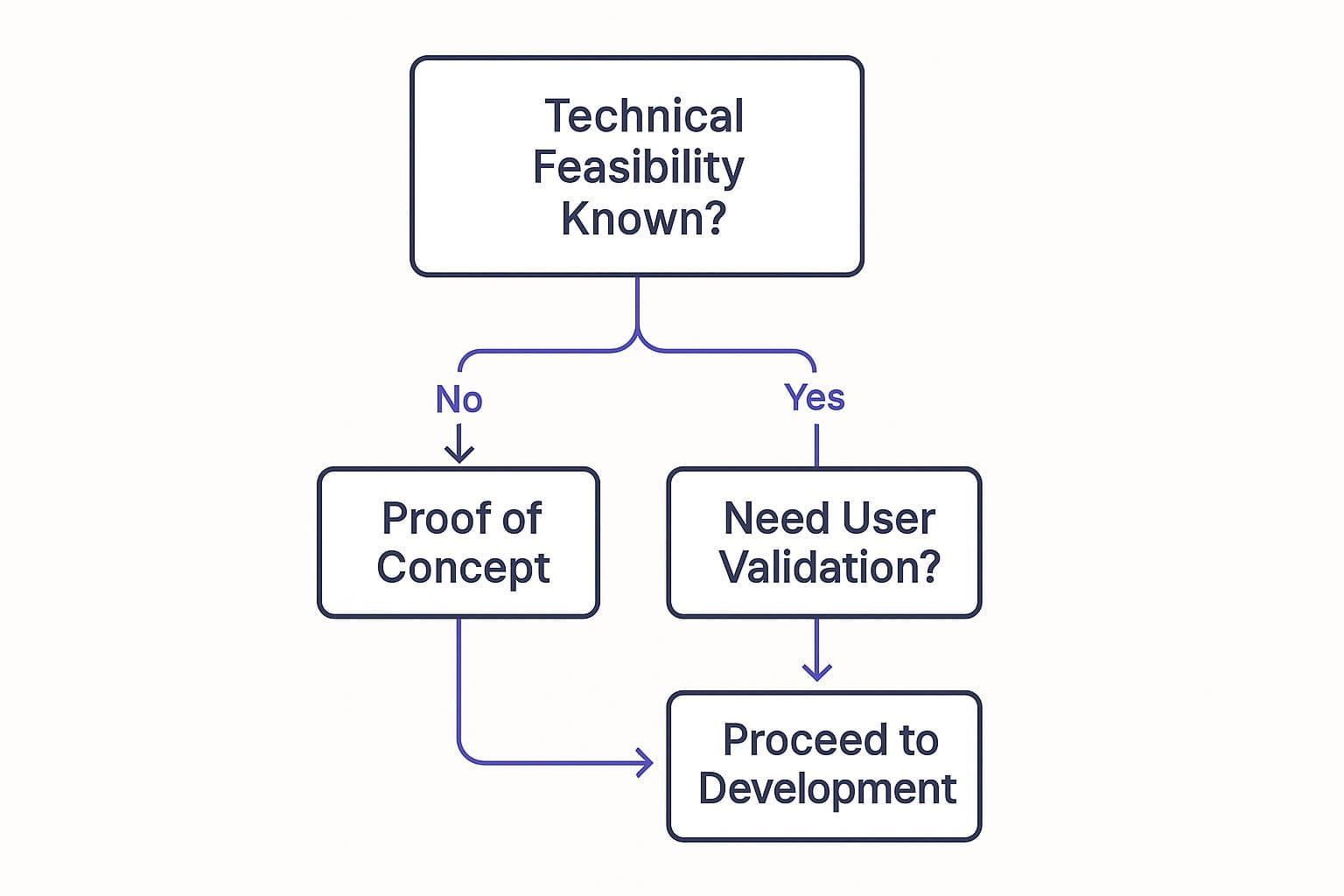
As you can see, the path always starts with figuring out your technical risk before you even think about user validation.
Ultimately, getting this right is a huge part of your early strategy. For founders just starting out, understanding these stages is non-negotiable. To get the full picture, check out our guide on how to start a tech startup and make sure you're building on solid ground.
Common Questions About Prototypes and PoCs

When you're in the thick of early-stage product development, the same questions tend to pop up again and again. Let's clear up some of the most common points of confusion between PoCs, prototypes, and the overall journey to a finished product. Getting this right early on can save you from some serious headaches down the road.
Can a Proof of Concept Become a Prototype?
The short answer? You really shouldn't. It's a tempting shortcut, but it almost always backfires. A PoC is a quick and dirty experiment, often built with hard-coded values and throwaway code just to see if a single technical idea is even possible. Its structure is not built to handle user interaction, let alone scale.
The right way to do it is to take what you learned from your successful PoC and apply those findings to build a brand new, properly structured prototype. This keeps the purpose of each stage distinct and prevents you from accumulating technical debt before you've even really started.
How Does a Prototype Differ From an MVP?
A prototype and a Minimum Viable Product (MVP) are often mixed up, but they represent very different points in a product's life. A prototype is a model, often with limited or no functionality, designed to show how a product will look and feel. Its job is to test design ideas and user flows.
An MVP, on the other hand, is the very first working version of your product that gets into the hands of real users. It has just enough features to solve a core problem and provide genuine value. A prototype asks, “Do people understand how this works?” An MVP asks, “Will people actually use and pay for this?”
Which One Costs More to Build?
Hands down, a prototype will almost always cost more to build than a PoC. The price difference comes directly from their scope and what they're trying to achieve.
- Proof of Concept: This is a quick technical validation, usually knocked out by one or two engineers in a short amount of time. The investment is minimal by design.
- Prototype: This is a much bigger effort. You'll need designers creating detailed interfaces, product managers mapping out user journeys, and possibly user researchers to test the interactive flows.
While the initial bill for a prototype is higher, it’s money well spent. A good prototype helps you avoid costly design mistakes and rework during full development, saving you a fortune in the long run.
Ready to move from idea to reality? At Iglu Digital, we specialize in building market-ready MVPs with the price fixed before we start, helping you validate your concept with real users, fast. https://iglu.dev