
A Guide to Product Market Fit Validation

Table of Contents
Validating product-market fit is all about getting concrete proof that you’ve built something people genuinely need and are happy to pay for. It’s the process of moving beyond your initial assumptions and gathering real-world evidence—both from conversations and from hard data—to confirm you're on the right track before you hit the accelerator. This is what separates a neat idea from a must-have business.
Understanding What Product Market Fit Looks Like
Let's cut through the business jargon. Product-market fit isn't just a checkbox on a startup to-do list; it's a tangible shift in momentum. It’s that moment when you stop having to push your product on people, and the market starts to pull it from you.
Suddenly, you’re not fighting for every single user. Word-of-mouth kicks in, and new customers start showing up on their own. Your sales cycle gets shorter because prospects already understand the value. Users don't just sign up; they stick around, becoming a core part of your community.
This alignment is the bedrock of sustainable growth. Without it, your marketing budget feels like a leaky bucket—you can pour more in, but you’ll struggle to see lasting results. Churn stays high, and real traction remains just out of reach. When you nail it, you've created something a specific group of people would truly miss if it vanished tomorrow.
The Tangible Signs of Strong PMF
So, how do you spot it in the wild? It’s rarely a single "aha!" moment. Instead, think of it as a collection of green lights that start flashing all at once.
Here’s what you should be looking for:
- Effortless Sales: New customers are coming in organically or through referrals, not just from your paid ad campaigns. The conversations feel less like a hard sell and more like helping someone get started.
- High User Engagement: People aren't just logging in once. They’re coming back, using the core features, and making your product a part of their routine. These are your retained, active users.
- Clear Value Perception: Customers get it. They can tell you exactly why your product is valuable without you having to explain it to them.
- Pricing Power: You can charge a price that supports your business, and customers pay it without much fuss because they believe the value they're getting is well worth it.
When these indicators start popping up, it's a powerful sign that your solution is hitting the mark with a specific audience. This is your cue to lean in and start scaling your efforts.
How to Quantify Product Market Fit
While the qualitative signs are great, you need a solid metric to take the guesswork out of your product-market fit validation. This is where a surprisingly simple survey question, pioneered by entrepreneur Sean Ellis, comes into play. The Sean Ellis test is designed to measure just how much your users depend on your product.
The core of the test is this question: "How would you feel if you could no longer use our product?"
You give them three simple choices:
- Very disappointed
- Somewhat disappointed
- Not disappointed
The magic number you're looking for is 40%. The benchmark for strong product-market fit is having at least 40% of your users say they would be "very disappointed." This isn't just a random number; it's based on Ellis's work with hundreds of startups. He found that companies that struggled to grow almost always fell below this threshold, while those that succeeded consistently cleared it. Hitting that 40% mark is a clear, data-driven signal that you've built something indispensable.
Before we dive into the step-by-step process, it's helpful to understand the different methods you can use. Some are about conversations and getting the "why" behind user behavior, while others are about crunching numbers to see what users are actually doing.
Here's a quick summary of the core validation approaches.
Core Product Market Fit Validation Approaches
| Validation Approach | Primary Focus | Key Metrics / Indicators |
|---|---|---|
| Qualitative (The "Why") | Understanding user motivations, pain points, and perceptions. | Customer interview feedback, usability test insights, direct quotes, feature requests. |
| Quantitative (The "What") | Measuring user behavior and sentiment at scale. | 40% "Very Disappointed" score, Net Promoter Score (NPS), retention rate, churn rate, LTV:CAC ratio. |
Both sides of this table are critical. The numbers tell you if you're winning, but the stories from your users tell you why. A solid validation process combines both to give you a complete picture.
Building a Testable Validation Hypothesis

Before you talk to a single customer or write a line of code, you need a sharp, testable hypothesis. This isn't a shot in the dark. It’s a focused statement that lays out exactly what you believe to be true about your customers, their problems, and your solution.
Without one, you're just collecting noise. A strong hypothesis is your guidepost for product-market fit validation, making sure every data point you gather either strengthens or refutes your core assumptions. It forces you to get crystal clear on who you're serving, what keeps them up at night, and why your idea is the answer.
Nail Down Your Target Persona
First things first: who, exactly, are you building this for? Forget vague descriptions like "small businesses" or "young professionals." The more granular you get, the easier it will be to find and learn from the right people.
Think about real behaviors and motivations. For instance, instead of targeting "freelancers," you might focus on "freelance graphic designers in their first 1-3 years of business who are constantly juggling five or more small-client projects." This level of detail isn't just an academic exercise—it tells you where to find these people and how to talk to them in a way that resonates.
A great persona is more than a list of demographics. It's a clear picture of a real person facing real-world challenges. When you can see your ideal customer in your mind's eye, you're already on your way to understanding their needs.
This is a non-negotiable step found in any solid guide on how to validate a business idea. Starting with a specific persona keeps your assumptions grounded in a real market segment, because trying to solve a problem for everyone usually means you end up solving it for no one.
Connect Their Pain to Your Solution
Once you know who you're talking to, you have to articulate the specific problem they're facing and how your product makes it go away. This is where the rubber meets the road, connecting their struggle directly to your value proposition. Your goal is to create a clear cause-and-effect statement you can actually prove or disprove.
Let's stick with the time-tracking app idea. A weak, generic hypothesis would be: "Freelancers need a better way to track time." It's true, but it's not testable. A powerful hypothesis is much sharper.
Here’s how you’d build a better one:
- Start with the Persona: "Freelance graphic designers..."
- Identify the Specific Pain: "...struggle to accurately bill for small, interruptive tasks like quick email replies and minor design tweaks, losing significant billable hours every month."
- Introduce Your Solution's Value: "...Our app fixes this by using AI to automatically capture and categorize these micro-tasks, helping them bill for 100% of their time without tedious manual entry."
This structure transforms a fuzzy idea into a concrete claim. Now, you can go into interviews with targeted questions like, "Can you walk me through how you bill for a five-minute client email?" or "How much time do you think you lose to unbilled tasks each week?" The answers you get will give you a clear "yes" or "no" on your hypothesis, pointing you in the right direction.
Gathering Qualitative Feedback That Actually Informs
Numbers can tell you what your users are doing, but they’ll never tell you why. That "why" is the whole game. To truly get a handle on product-market fit validation, you have to step away from the spreadsheets and have real conversations with actual human beings. This is where you uncover the frustrations, motivations, and unarticulated needs that drive everything they do.
Learning to conduct a great user interview is about listening between the lines. It’s the difference between collecting polite, useless answers and unearthing the kind of genuine insight that can completely redirect your product roadmap for the better. The real goal is to create a comfortable space where people feel they can share the unvarnished truth.
Designing Effective User Interviews
A truly effective interview feels less like a Q&A and more like a collaborative discovery session. Your job isn't to sell or defend your product; it's to understand your user's world entirely from their point of view.
The trick is to ask open-ended questions that get people talking and telling stories. Instead of asking, "Do you like our new dashboard?"—which just begs for a "yes"—try something like, "Can you walk me through how you used the dashboard yesterday?" This single question prompts a narrative, revealing their real workflow, where they got stuck, and what, if anything, actually helped them.
Some principles I’ve learned for better interviews:
- Kill the leading questions. Never phrase a question in a way that telegraphs the answer you want. Instead of, "Doesn't our automated billing save you tons of time?" ask, "Talk to me about how the automated billing has affected your process."
- Get comfortable with silence. This is a tough one. After you ask a question, just wait. People often rush to fill an awkward pause with their most honest, unfiltered thoughts. Resist the urge to jump in and guide them.
- Listen for "workarounds." Pay very close attention when someone describes a clunky, multi-step process they’ve cobbled together to get something done. Those workarounds are pure gold—they point directly to unmet needs and massive opportunities for new features.
The most valuable feedback often comes from observing what users do, not just hearing what they say. When their actions contradict their words, that's where the real insights are hiding. Dig in right there.
From Individual Stories to Actionable Themes
One interview gives you a compelling story. Five interviews start to show you a pattern. You need to conduct enough interviews to see those themes bubble to the surface. When you hear multiple, unrelated people describe the same frustration or wish for the exact same solution, you're onto something big.
A fantastic real-world example of using this kind of direct feedback for product-market fit validation comes from the skincare brand Topicals. They ran consumer perception studies on their Faded Serum and found that 96% of participants said their dark spots and hyperpigmentation were visibly better after only four weeks. That powerful, user-backed data didn't just confirm their product solved a huge pain point; it became undeniable social proof. You can find more examples of how customer feedback validates product-market fit on Shopify's blog.
Crafting Surveys People Actually Finish
While interviews give you depth, surveys give you breadth. A well-designed survey can help you confirm your interview findings across a much larger audience. But let's be honest—a bad survey is a one-way ticket to the trash folder.
Here’s how to create surveys that actually get you the data you need:
- Keep it short and focused. Every single question must serve a purpose tied directly to your validation hypothesis. If a question isn't essential, be ruthless and cut it. Respect their time.
- Mix up your questions. Use multiple-choice for easy-to-analyze data, but always include one or two open-ended questions to capture that qualitative richness. My favorite final question is simply, "Is there anything else you'd like to tell us?" You'd be surprised what you get.
- Offer a small thank you. A small discount, a gift card, or an entry into a giveaway can boost your response rate dramatically. It's a simple way to show you value their input.
Ultimately, qualitative feedback is your compass. It points you toward the problems genuinely worth solving and steers you away from building features that nobody ever asked for. When you combine deep, empathetic interviews with smart, targeted surveys, you get the human-centric data you need to build a product that doesn't just work, but truly resonates.
Using Quantitative Data to Track User Behavior

While candid conversations with users reveal the why behind their choices, hard data gives you the undeniable what. Quantitative analytics are your ground truth. They offer objective proof of whether people are truly engaging with your product or just being polite in an interview.
For a proper product-market fit validation, you have to look past the flashy, surface-level numbers and dig into the data that reflects genuine user behavior.
User stories are invaluable, but numbers don't lie. If all your qualitative feedback says users love a feature, but your analytics show nobody is clicking on it, you’ve just uncovered a critical disconnect. It's this combination—what people say versus what they actually do—that paints a complete picture of your product's real-world performance.
Moving Beyond Vanity Metrics
It's tempting to get swept up by a sudden spike in sign-ups or a nice jump in website traffic. But these "vanity metrics" can be dangerously misleading. They look great on a slide deck but often say very little about real engagement or long-term value.
Instead, you need to zero in on behavioral metrics that prove your product has become sticky.
True stickiness is revealed by what users do after that initial sign-up. Are they coming back on their own? Are they weaving your core features into their daily workflows? Those are the actions that separate a passing curiosity from an indispensable tool. A great way to build features that encourage this kind of loyalty is by adopting a structured framework like an agile product development process, which helps teams prioritize work based on measurable user impact.
Key Behavioral Metrics for PMF Validation
So, what should you be tracking? To get a clear, data-driven view, you need to focus on a handful of metrics that show how deeply users are interacting with your product.
Here’s an overview of the most important metrics we look at, what they measure, and what they tell you about your progress toward product-market fit.
Key Behavioral Metrics for PMF Validation
| Metric | What It Measures | Indication of Strong PMF |
|---|---|---|
| User Retention Rate | The percentage of users who continue using your product over time. | A high and stable retention rate shows that users find ongoing value and your product has become part of their routine. |
| Session Duration | The average amount of time users spend actively using your product per session. | Longer session durations suggest users are deeply engaged and invested in your product's functionality. |
| Feature Adoption Rate | The percentage of users who try and regularly use a specific feature. | High adoption of core features proves your value proposition is resonating and you're solving the right problem. |
| Returning Visitors | The ratio of new visitors to those who have come back to your site or app. | A growing number of returning visitors is a powerful sign of a loyal user base and organic product pull. |
Watching these numbers closely gives you an empirical, unbiased look at user engagement, moving you from guesswork to concrete evidence.
Demystifying Customer Lifetime Value
Of all the numbers you can track, one of the most powerful for confirming product-market fit is Customer Lifetime Value (CLV). This metric goes beyond a single purchase or session; it projects the total revenue your business can reasonably expect from a single customer over the entire course of your relationship.
A high CLV is one of the strongest indicators of product-market fit. It proves you haven't just built a popular product; you've built a sustainable business model where the value customers receive far outweighs the cost to acquire them.
When your CLV is significantly higher than your Customer Acquisition Cost (CAC), you have a profitable growth engine. It means every new customer you bring on board adds to your bottom line, giving you the financial runway to scale.
If your CLV is low or, worse, declining, it's a massive red flag. It likely means users aren't sticking around long enough to become profitable, signaling a fundamental mismatch between your product and what the market truly needs.
Ultimately, your goal is to find perfect alignment between your qualitative feedback and your quantitative data. When you have a Sean Ellis score over 40%, glowing user interviews, and strong behavioral metrics like high retention and a healthy CLV, you have a rock-solid, data-backed case. You’ve officially moved from assumption to validation.
How to Iterate Based on Your Validation Data
So, you’ve gathered a mountain of data. What now? This is where the real work begins. Validating your product isn’t a one-and-done task; it’s the start of a continuous feedback loop that should drive every decision you make. The stories you've heard and the numbers you've crunched are your new roadmap.
The aim here is to build a repeatable, almost rhythmic process. You listen to feedback, figure out the root problems, tweak your product or your core idea, and push out the next version. This cycle is what keeps you grounded, building something people actually need instead of chasing your own assumptions.
Turning Feedback into Actionable Themes
First things first, you need to find the signal in the noise. Right now, you probably have a mess of interview notes, survey answers, feature requests, and analytics data. It's time to sift through it all and group that raw feedback into clear, actionable themes.
Look for the patterns. Are five different users bringing up the same frustration? Is your analytics tool screaming that everyone bails at the same point in the user journey? These are your clues.
I find it helpful to sort feedback into a few key buckets:
- Critical Bugs: These are the showstoppers. Anything that breaks the experience and makes the product unusable needs immediate attention.
- Feature Requests: What are people asking for? Pay close attention to the requests that pop up repeatedly.
- Usability Hurdles: This is gold. Where are people getting tripped up, confused, or annoyed? This feedback points directly to design fixes.
- Value Gaps: These are the "I wish it did X" comments. They signal a potential disconnect between the problem you think you're solving and the one the user actually has.
Categorizing feedback this way takes you from a jumbled pile of comments to a prioritized to-do list for your product.
The most powerful insights often live in the gap between what users say and what they do. If they claim a feature is a must-have but your data shows it's collecting dust, that's your cue to dig deeper into their real workflow.
This whole process is a loop—a cycle of building, testing, and measuring that keeps you moving forward.
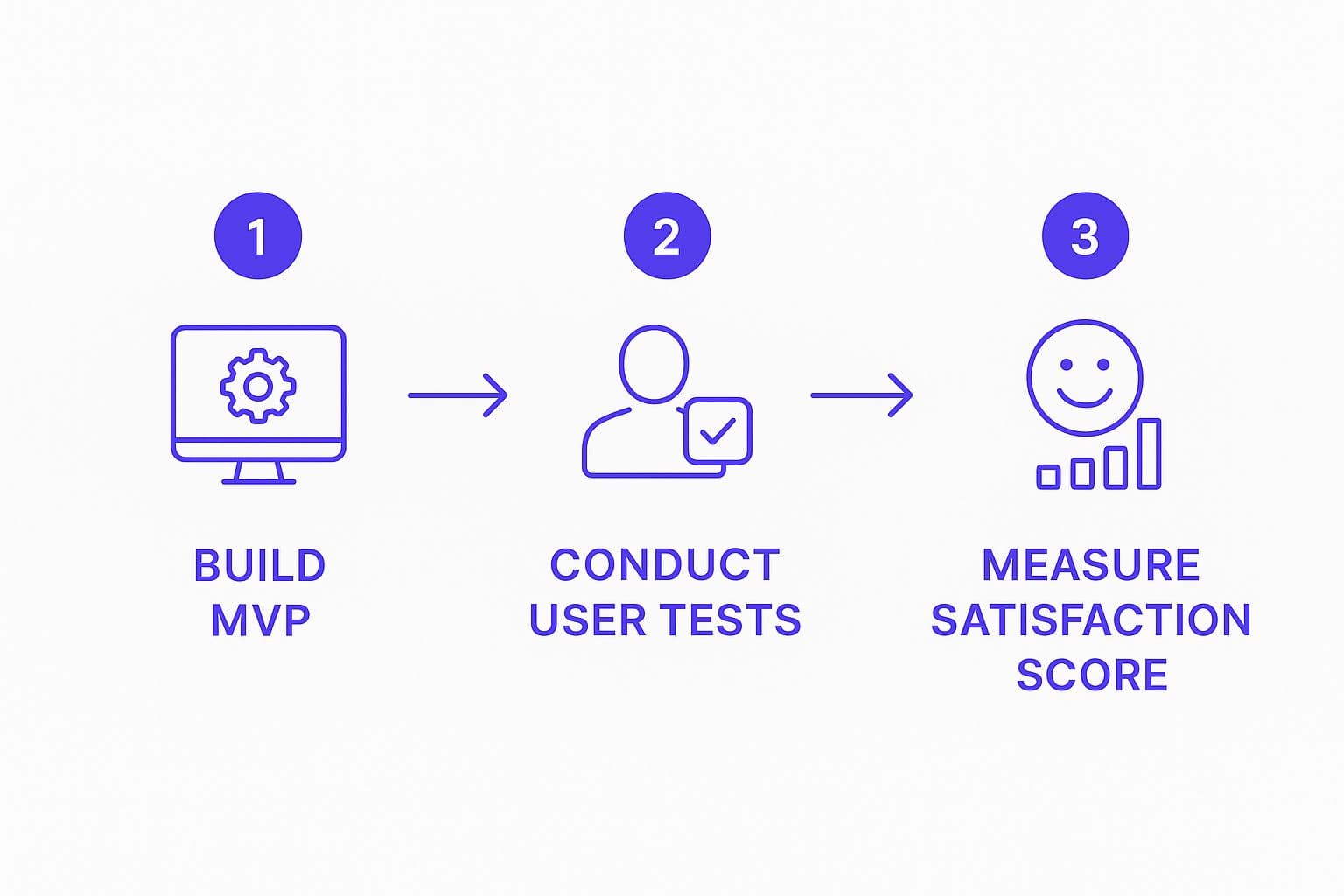
Each step fuels the next. This constant refinement is the heart and soul of finding product-market fit.
Prioritizing Your Next Move
With your themes laid out, you're faced with the next big question: what do you tackle first? You can't do it all. Prioritization is everything. You have to focus on the changes that will give you the most bang for your buck—the highest impact on the user experience for a reasonable amount of effort.
Let's walk through a real-world example. Imagine your Sean Ellis test score is stuck at 25%, a long way from the 40% benchmark for product-market fit. Your interviews reveal that people are intrigued by the concept, but the onboarding is a confusing mess. Your analytics back this up, showing a massive drop-off rate right after the first login.
The path forward is crystal clear. Fixing that onboarding flow is your top priority. It's a major usability hurdle preventing people from ever getting to your product's "aha!" moment. Spending that time polishing a minor, little-used feature would be a waste. This is where building a nimble, iterative development cycle is critical. You can learn more about structuring this kind of work by reviewing agile development best practices.
The Pivot vs. Persevere Decision
Sometimes, the data delivers a tougher message. It doesn't just tell you what to tweak; it tells you your entire hypothesis is off base. This is the classic fork in the road where you have to decide whether to make a small course correction (persevere) or a major change in direction (pivot).
- Persevere: This means you're sticking with your core strategy but making targeted fixes. It’s the right call when your validation data suggests you're on the right path, but there are a few rough edges to smooth out.
- Pivot: This is a fundamental shift in your product, target audience, or business model. A pivot becomes necessary when your data uncovers a fatal flaw in your assumptions—for instance, you've brilliantly solved a problem that nobody is willing to pay to fix.
A pivot isn't a failure. Far from it. It's a smart, strategic move based on market feedback. It's you admitting that your first idea was a learning opportunity, and now you have the data to place a much smarter bet. This whole validation process is what gives you the confidence to make those tough, but ultimately essential, decisions.
Common Product-Market Fit Questions Answered
The path to product-market fit is never a straight line. It's often a messy journey, full of tough questions, mixed signals, and moments where you feel like you’re just guessing. Let’s clear up some of the most common questions I hear from founders to help you navigate this make-or-break phase.
Getting your head around these nuances is a core part of the product-market fit validation process. It helps you cut through the noise and stay focused on what really matters, steering you away from the common traps that sink so many otherwise promising ideas.
How Do I Know if Feedback Is Real or Just Polite?
This is a classic—and one of the biggest challenges you'll face. You get excited, you demo your product, and people say, "That's a cool idea!" or "Yeah, I'd probably use that." While it feels good to hear, this kind of vague praise is often a polite brush-off and can be dangerously misleading.
Genuine demand sounds completely different. It has an unmistakable urgency and specificity to it.
- Polite Feedback: "This looks really interesting. Keep me updated on your progress!"
- Real Demand: "This is exactly what I need. When can I get access? How much does it cost? I've been trying to solve this problem for months."
The key difference is action. People with a real, burning problem will ask about pricing, timelines, or specific features that connect directly to a pain they are trying to solve right now. They might even volunteer details about the clunky spreadsheet or manual process they're currently using—the very thing your product would replace.
If you're not hearing that sense of urgency or getting peppered with specific, problem-focused questions, you probably haven't struck a real nerve yet. The best feedback isn't just positive; it's tangible and backed by a clear willingness to act.
How Long Does It Realistically Take to Find PMF?
Sorry, but there's no magic number here. Finding product-market fit can take a few months or, in many cases, a few years. It's almost never a single "aha!" moment. It’s a slow, grinding process of listening, building, testing, and refining.
Think about it: for some companies, like Slack, the initial product quickly resonated with a passionate niche. For others, like Airbnb, it took several relaunches and a much deeper dive into their users' core needs before things really clicked. The timeline really depends on the complexity of the problem, the maturity of your market, and how quickly your team can learn and iterate.
My advice? Don't fixate on a specific deadline. Focus instead on making steady, measurable progress.
- Is your user retention improving week over week?
- Are your key engagement metrics trending up?
- Are you getting closer to that 40% "very disappointed" benchmark?
This forward momentum is a far better indicator of success than any arbitrary date on a calendar.
Is Product-Market Fit a One-Time Achievement?
Absolutely not. Thinking you can "achieve" product-market fit and then you're done is a critical mistake. It's not a finish line you cross; it's more like catching the perfect wave. You can ride it for a while, but waves eventually fade, and new ones are always forming just beyond the break.
You can—and many companies do—lose product-market fit. It happens all the time for a few key reasons:
- Market Shifts: Customer needs simply change. A must-have solution from five years ago might be totally irrelevant today.
- New Competition: A competitor could launch a better, faster, or cheaper product that solves the same problem more effectively.
- Technological Changes: The rise of new platforms (like mobile or AI) can make your product feel obsolete if you fail to adapt.
Blockbuster had incredible product-market fit... until Netflix and streaming services rewrote the rules. MySpace was the king of social media... until Facebook offered a more compelling way to connect. These cautionary tales prove that fit is dynamic and demands constant vigilance.
This is exactly why product-market fit validation should be an ongoing discipline, not a one-off project. You have to keep listening to your customers, monitoring your metrics, and watching the competitive landscape to ensure your product remains the best solution. The work is never truly done.
Are you ready to stop guessing and start building? At Iglu Digital, we transform your idea into a market-ready MVP on a fixed price, agreed up front, so you can start the critical process of validation with real users. Find out how we can accelerate your journey to product-market fit by visiting us at https://iglu.dev.