

Your Guide to Outsourced Software Product Development

Table of Contents
When you hear "outsourced software development," you might picture a company handing off a simple coding task to a remote freelancer. But that's not the whole story, not by a long shot.
True outsourced software product development is a deep, strategic partnership. It’s when a business brings in an entire external team of experts to handle the whole journey of creating, testing, and launching a software product. This move allows companies to tap into world-class talent and get their product to market faster, all without the massive overhead of building a specialized in-house team from the ground up.
So, What Is Outsourced Software Development, Really?

Think of it like hiring a general contractor to build your dream house. You have the blueprint and the vision, but you need a team with specialized skills—architects, engineers, plumbers, electricians—to make it a reality. In the tech world, outsourced software product development is your general contractor. You bring the idea, and they bring the team that lives and breathes code, design, and project management.
This is far more than just delegating tasks; it's about entrusting your product's entire lifecycle, from the first sketch to the final launch, to a dedicated external partner. Doing this frees up your own team to zero in on what they do best: strategy, marketing, sales, and building customer relationships.
It's Much More Than Just Coding
A good outsourcing relationship isn't just about getting lines of code written. It's a truly collaborative effort where the external team becomes a natural extension of your own. A top-tier partner will be involved in much more than the technical execution.
Their role often covers the full spectrum:
- Product Strategy and Roadmapping: They'll help you flesh out your concept, prioritize features, and map out a plan for future updates and growth.
- UI/UX Design: They focus on creating an interface that's not just beautiful but also intuitive and genuinely solves problems for your users.
- Full-Cycle Development: This is the nuts and bolts—handling everything from the user-facing front-end to the complex back-end logic and database architecture.
- Quality Assurance (QA) and Testing: The team rigorously tests every aspect of the software to hunt down bugs, patch security holes, and ensure it runs smoothly under pressure.
A True Partnership for Growth
At the end of the day, the goal is simple: build an amazing product that people love and that helps your business grow. For a lean startup trying to make its mark or a large corporation looking to stay competitive, this model offers a powerful path to hitting ambitious technical goals.
It removes the immense operational headache of finding, hiring, and managing a large, specialized development department. By partnering with the right experts, you can build better products, faster—and finally turn that brilliant idea into a market reality.
Why Smart Companies Outsource Their Development

Most people think outsourcing is just about cutting costs. And while saving money is certainly a nice perk, the real reason savvy companies choose outsourced software product development runs much deeper. It’s less about pinching pennies and more about gaining a serious competitive advantage.
There’s a reason the global market for this is exploding—it's expected to hit a staggering USD 940 billion by 2034. This isn't just a trend; it's a strategic shift driven by the need for specialized skills in complex fields like AI and cloud computing.
Access a Global Talent Pool
Imagine you need an expert in a niche technology—say, a specific machine learning framework or advanced blockchain security. Finding that person locally can feel like searching for a needle in a haystack. It’s often slow, frustrating, and incredibly expensive.
Outsourcing blows those geographic walls down. Suddenly, you have access to a worldwide pool of specialists. You can build a dream team by hand-picking top-tier developers, designers, and project managers who live and breathe the exact technologies you need.
This means your product gets built by the best people for the job, not just the best people within a 50-mile radius.
Achieve Unmatched Operational Flexibility
The traditional hiring process is rigid. You bring on full-time employees, which means long-term commitments, benefits packages, and a ton of overhead. But what happens when your project’s needs fluctuate? That's where outsourcing really shines.
Think of your development team as a dial you can turn up or down as needed.
- Ramp Up Quickly: Need to hit a tight launch deadline? Instantly add more developers to the team.
- Scale Down Efficiently: When things slow down after a release, you can shrink the team without going through painful layoffs.
- Pivot Without Disruption: If you need to change direction based on user feedback, you can quickly swap in specialists with the right skills.
Drive Strategic Cost Optimization
Okay, let's talk about the money. While it's not the only reason, optimizing your budget is a huge benefit. Outsourcing transforms the fixed, often massive costs of salaries and benefits into a predictable, variable expense. But the savings go way beyond a lower hourly rate.
You also get to sidestep all the hidden costs of building a team from scratch:
- Recruitment and Onboarding: Forget about the weeks or months spent finding and training new hires.
- Infrastructure and Equipment: No need to buy new laptops, software licenses, or rent more office space.
- Training and Development: Your outsourced team arrives already skilled in the latest tools and best practices.
By offloading these responsibilities, you can free up capital and pour it into other vital parts of the business, like marketing or sales. To see how these numbers add up, check out our guide on understanding the true software development cost. This isn’t just about saving money; it’s about making smarter financial decisions that fuel real growth.
Finding the Right Development Partner and Location
Choosing an outsourcing partner is easily one of the most important decisions you'll make. It’s less like hiring a contractor and more like bringing on a long-term business partner. You need a team with the right skills, of course, but also a compatible work ethic and rock-solid reliability. This decision isn't just about who you work with, but also where they are in the world.
The location of your partner has a massive ripple effect on everything from your budget to daily collaboration and company culture. The three main routes you can take—onshoring, nearshoring, and offshoring—each come with their own distinct set of pros and cons. Getting a handle on these is the first step to finding a partner that actually fits your project's needs.
This simple chart breaks down the typical cost differences you'll see between hiring in-house, outsourcing locally, and going offshore.
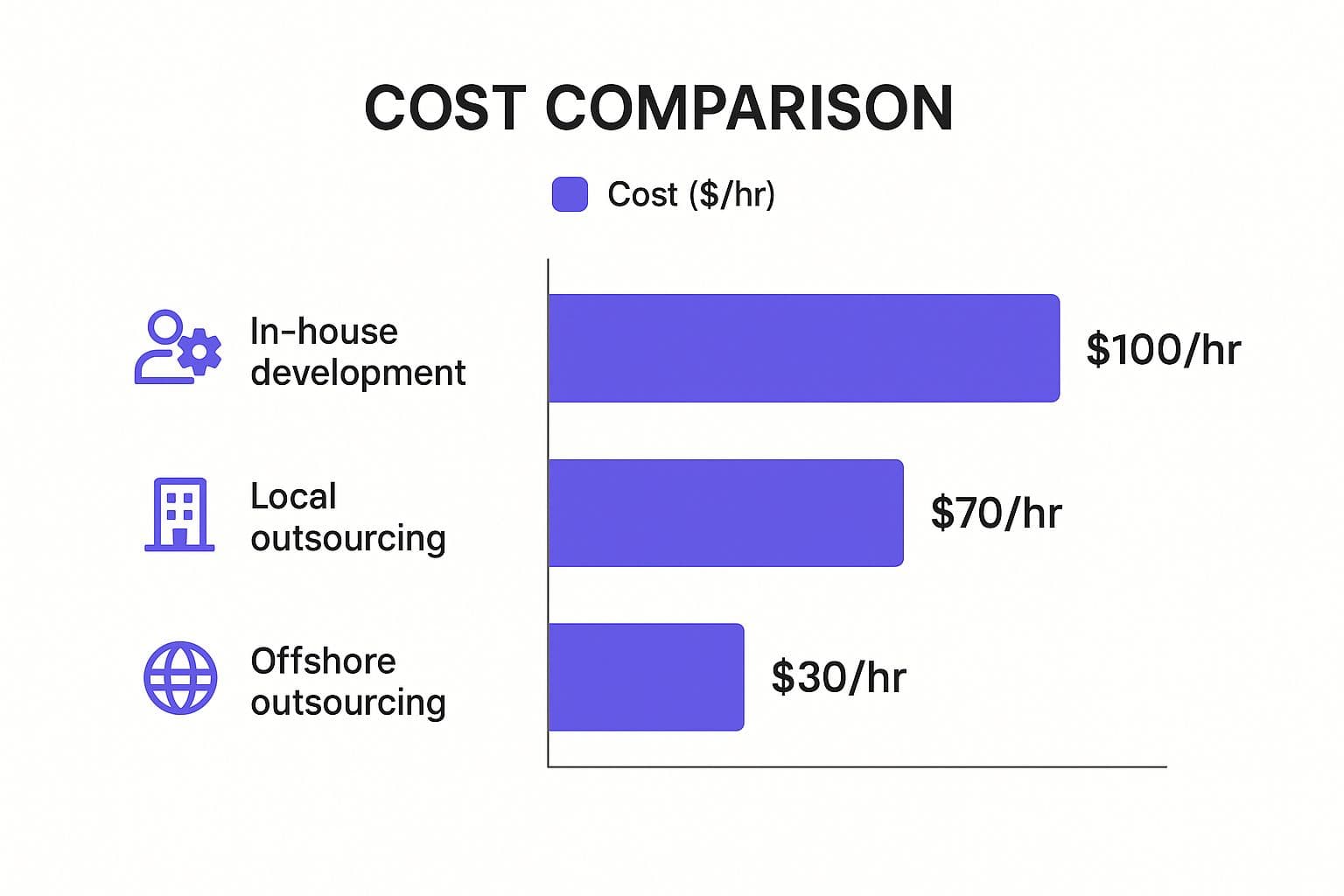
As you can see, the cost savings with offshoring can be huge. But remember, that's just one piece of the puzzle; you have to balance that against things like time zones and potential communication hurdles.
A Quick Tour of the Main Outsourcing Models
The world of outsourced software product development is brimming with talent, and different regions are becoming known for different strengths. Europe's IT outsourcing market, for instance, is on track to hit 282,149.2 million** by 2030, while Latin America is projected to reach **126,320.9 million thanks to its rapid growth.
This geographic diversity opens up a massive global talent pool. Your job is to decide which part of that pool to fish in. The choice really boils down to three models.
To make things clearer, let's break down how these models stack up against each other.
Onshore vs Nearshore vs Offshoring Models
| Model | Primary Advantage | Cost Level | Time Zone Overlap | Best For |
|---|---|---|---|---|
| Onshoring | Seamless communication, cultural alignment | High | Excellent | Projects requiring constant, real-time collaboration and minimal cultural friction. |
| Nearshoring | Balanced cost and time zone convenience | Medium | Good | Teams that want significant cost savings without sacrificing workday overlap. |
| Offshoring | Maximum cost savings, huge talent pool | Low | Poor | Budget-driven projects with well-defined scopes that can be managed asynchronously. |
Ultimately, there's no single "best" choice here. It all comes down to what you prioritize. Do you need a team you can sync with in real-time every day, or is getting the most bang for your development buck the number one goal? Answering that question will help you focus your search dramatically.
How to Properly Vet Potential Vendors
Once you've zeroed in on a location strategy, the real detective work begins: vetting potential partners. A slick website and a polished sales pitch are just table stakes. To find a partner you can truly count on, you have to dig much deeper and ask the hard questions. And before you even start looking, it’s worth thinking through the core build vs buy software decision to be sure outsourcing is the right path.
Here’s a practical checklist to guide your vetting process:
- Go Beyond the Portfolio: Don't just look at their list of past projects. Ask for detailed case studies that are relevant to your industry and tech stack. Dig into how they tackled specific technical hurdles and what their process is for ensuring code quality.
- Nail Down the Logistics: How will you actually work together day-to-day? Ask them about their go-to communication tools (like Slack or Jira), how often they hold meetings, and what project management style they prefer (like Agile or Scrum).
- Talk About Security and IP: Your intellectual property is your most valuable asset. Be direct. Ask about their security protocols, data protection policies, and what legal safeguards they have in place to protect your code and ideas.
- Check Their References: Don't just take their word for it or rely on testimonials plastered on their site. Ask if you can speak directly with a few current or former clients to get the real, unfiltered story of what it's like to work with them.
4. Choosing the Right Engagement Model for Your Project

Alright, so you've found a partner you think you can trust with your outsourced software product development. What's next? The conversation will quickly turn to how you'll actually work together—the engagement model. This isn’t just a piece of paper; it’s the rulebook for your entire relationship. It defines everything from how you pay to how much control you have.
Think of it like building a house. You wouldn't use the same contract for a prefabricated shed as you would for a custom-designed mansion. The model you pick has to fit the project's reality. The three most common models you'll encounter are Fixed Price, Time & Materials, and the Dedicated Team. Let's break down what each one really means for you.
The Fixed Price Model
The Fixed Price model is as straightforward as it gets. You agree on a precise scope, a firm deadline, and one single price for the whole shebang. It’s perfect for smaller projects where you know exactly what you need, down to the last detail.
This is your go-to when you have a crystal-clear blueprint. Think building a simple marketing website or a basic proof-of-concept app. The beauty is in its predictability—you know the cost and timeline from the start, making budget management a breeze. The catch? If you need to change anything—even a small feature—it often means renegotiating the contract, which can slow things down and drive up costs.
The Time and Materials Model
On the other side of the spectrum is the Time & Materials (T&M) model. Forget a single price tag. Here, you pay for the actual hours the team works on your project, plus any direct costs for things like third-party tools. This approach is built for flexibility.
T&M is the best fit for complex, long-haul projects where you expect things to change. It gives you the room to adapt as you get feedback from early users or as the market shifts. It’s essentially a pay-as-you-go approach that values agility over a rigid, upfront plan. This is a massive advantage for any product that needs to evolve.
Want to see a head-to-head comparison? We've got a detailed breakdown in our guide on Time and Material vs Fixed Price.
The Dedicated Team Model
Finally, we have the Dedicated Team model. This is the deepest level of partnership you can have. Your outsourcing partner assembles a full-time team that works only for you. They become a genuine extension of your own company, learning your culture and getting invested in your long-term goals.
This model is the answer for big, ongoing product development that demands deep expertise and a consistent, dedicated effort. You get the loyalty and focus of an in-house team without the headaches and overhead of direct hiring. It gives you maximum control and is ideal when you see your development partner as a core part of your company's future.
How to Build a Successful Outsourcing Partnership
Finding a great vendor for your software project is a huge win, but it's really just the first step. The real success story begins when you move beyond a simple vendor-client relationship and build a genuine partnership. This is what separates the projects that just get done from the ones that truly knock it out of the park and fuel real business growth.
Building that kind of partnership doesn't happen by accident. It takes more than a signed contract; it requires a conscious effort to create an environment built on trust, transparency, and a shared vision. You want your external team to be just as invested in your product’s success as you are. From day one, this is all about clear communication, smart processes, and mutual respect.
Establish Crystal Clear Communication Channels
Communication is the absolute lifeblood of any outsourced project. Seriously. Without it, even the most talented team on the planet will stumble. The trick is to be deliberate about how, when, and where you connect.
Don't just let communication happen organically. Set up a clear rhythm and get the right tools in place from the get-go.
- Daily Stand-ups: These quick, 15-minute check-ins are non-negotiable. They keep everyone on the same page about progress, priorities, and any blockers that have popped up.
- Weekly Demos and Retrospectives: Regular demos let you see real, tangible progress with your own eyes. Retrospectives are just as important—they're a dedicated time to talk about what’s going well and what needs tweaking, which is key for getting better over time.
- A Single Source of Truth: Use one shared platform like Jira or Asana to manage everything—tasks, conversations, documentation. This prevents crucial information from getting buried in a messy inbox.
Define and Solidify the Project Scope
Scope creep is the silent killer of software projects. It’s that slow, sneaky expansion of features and requirements that can derail timelines and blow up budgets. The best defense is a rock-solid Statement of Work (SOW) created before a single line of code is written. Think of it less as a formality and more as the rulebook that protects both you and your partner.
This need for clarity also applies to your intellectual property (IP). Your contract must make it crystal clear that you own all the code, designs, and other assets developed for your project. Sorting out IP protection from the very beginning is a critical step that safeguards your company's most valuable assets.
Measure What Matters with the Right KPIs
At the end of the day, you can't improve what you don't measure. Setting clear Key Performance Indicators (KPIs) ensures that both your team and your partner are aiming for the same concrete goals. These metrics shouldn't just be about checking off tasks; they should focus on the actual business results you're trying to achieve.
When done right, working with an outsourced team gives you a massive boost in agility and innovation. For instance, tapping into a global talent pool can help companies cut their time-to-market by up to 50% and reduce costs by as much as 40%. You can dive deeper into these benefits by exploring more software development statistics and trends. By setting KPIs that track speed, cost, and product quality, you can see the direct value your partnership is creating.
Common Questions About Software Outsourcing
Diving into outsourced software development for the first time? It's natural to have questions. This is a big strategic move, and getting clear on the common worries is the first step toward making a confident decision. Let's tackle the questions I hear most often from leaders.
How Is My Intellectual Property Protected?
This is usually the first question that comes up, and for good reason. Your intellectual property (IP)—your code, your data, your unique business logic—is the lifeblood of your company. Protecting it starts with putting a solid legal framework in place from the very beginning.
Any outsourcing partner worth their salt will insist on comprehensive agreements that leave no doubt about who owns the IP. Look for two key documents:
- Non-Disclosure Agreement (NDA): This is your first line of defense. It’s a legal contract that binds the vendor to confidentiality before you’ve even shared the sensitive details of your project.
- Master Service Agreement (MSA): This is the main contract for your engagement. It must have a clause that spells out, in no uncertain terms, that all work product, code, and related IP created for you belongs 100% to you.
But don't stop at the legal paperwork. Ask potential partners about their internal security game. How do they secure their development environments? What are their access control policies? Do they use data encryption? These practical measures are just as important as the contracts in shielding your IP.
What Happens If the Work Quality Is Poor?
Fearing a subpar final product is completely understandable, but it's a risk you can actively manage. The secret is to avoid the "big reveal" at the end of the project. A great partnership is built on a foundation of continuous feedback and total transparency.
Your best tool against poor quality is an agile development approach. By working in short cycles, or "sprints," with regular demos (often weekly), you get to see real, tangible progress all the time. This lets you give immediate feedback, catch any quality issues early, and steer the project back on course quickly. It ensures the product you get is the product you actually wanted.
How Do We Manage Different Time Zones?
Working with a team halfway around the world doesn't have to be a communication logjam. In fact, many companies learn to turn the time difference into a powerful advantage, creating a nearly 24-hour development cycle.
Making it work across time zones comes down to a few smart practices. First, establish a few hours of mandatory overlap time each day for real-time collaboration, like daily stand-up meetings. Second, rely on project management tools like Jira or Asana to act as the single source of truth for tasks and progress. This ensures work keeps moving forward even when you're sleeping.
Ready to turn your software idea into a market-ready product without the usual delays? Iglu Digital specializes in building high-quality MVPs on a fixed price, agreed up front. Learn how our accelerated process can bring your vision to life.