
How to Start a Tech Startup A Practical Guide
Table of Contents
So, you're thinking about launching a tech startup. The path from a spark of an idea to a bustling business is a long one, packed with strategic moves and tough decisions. It’s less of a sprint and more of a marathon that demands real-world execution.
The whole game is about finding a genuine problem people are desperate to solve, building a basic version of your solution (an MVP) to see if it works, gathering the right people, and securing enough cash to stay afloat until you're truly viable.
Getting Real About the Modern Startup World
Before you even think about code or logos, let's get one thing straight: the startup world is a high-stakes environment. It's a place where incredible success stories often mask the much more common reality of tough lessons and, yes, failure.
It's easy to get caught up in the excitement. We all see the headlines about the 1,245 unicorn startups globally—those privately-held companies valued at over $1 billion. It’s proof that monumental success is possible. But here’s the other side of the coin: 1 in 5 startups don't survive their first year, usually because the money runs out. Digging into startup success and failure rates can give you a clearer picture of the financial tightrope you'll be walking.
This isn't meant to scare you off. It's about grounding you in reality. Knowing the odds is the first step to beating them.
Building the Right Mindset for the Grind
A brilliant idea isn't enough to make it. Thriving in this world requires a specific, tough-as-nails mindset. The founders who win aren't just visionaries; they're practical, strategic, and ready for a long, bumpy ride.
Here are a few mental shifts you need to make right now:
- Fall in Love with Iteration: Your first idea is almost never your final one. The best founders are masters of the pivot. They listen intently to what the market tells them and aren't afraid to change course based on that feedback.
- Get Serious About Money: Fundraising isn't just a glamorous milestone; it's the oxygen that keeps your idea alive long enough to find its place in the world. You have to become obsessed with your burn rate—how quickly you're spending your cash—because managing it is just as critical as building your product.
- Think Problem-First, Always: Stop saying, "I have a great idea." Start saying, "I've found a painful problem that no one is solving well." The deepest foundation for a product people will actually pay for is a genuine understanding of their pain points.
Building a startup is as much a mental game as it is a business one. Your ability to stay focused, motivated, and resilient when things go wrong is what truly separates successful founders from those who just had a good idea.
Now, let's get into the specifics. This guide is your no-nonsense roadmap. We're cutting through the hype to focus on the concrete, strategic steps you need to take. To help you visualize the journey, here’s a high-level look at the path ahead.
Essential Startup Action Plan
This table breaks down the core phases of launching your tech startup. Think of it as your strategic compass for the journey from concept to market.
| Phase | Core Objective | Key Activities |
|---|---|---|
| Ideation & Validation | Confirm you're solving a real, valuable problem. | Market research, customer interviews, competitor analysis, defining the value proposition. |
| MVP Development | Build the simplest version of your product to test. | Prioritizing core features, agile development cycles, user feedback loops. |
| Team Formation | Assemble a core team with complementary skills. | Identifying key roles (tech, business, design), networking, defining company culture. |
| Funding & Financials | Secure capital to fuel growth and operations. | Pitch deck creation, investor outreach, financial modeling, managing burn rate. |
| Launch & Growth | Get your product into the hands of early adopters. | Go-to-market strategy, user acquisition, marketing campaigns, performance metric tracking. |
Each of these phases is a critical building block. Getting one wrong can compromise the entire structure.
This guide will walk you through each step, from validating that initial spark to navigating the complexities of funding and finally launching your product. It all comes down to careful planning and relentless execution. Let's start building your foundation.
Finding a Problem Worth Solving

Let's be honest: the startup graveyard is overflowing with clever products nobody actually needed. The single most important shift a founder can make is moving from "I have a cool idea" to "I've found a painful, unsolved problem." A great company isn't born from a flash of inspiration; it's built on a foundation of genuine customer frustration.
Your first mission isn't to build a single line of code. It’s to become an expert listener. You need to immerse yourself in a specific world and truly understand the workflows, annoyances, and costly headaches that plague a specific group of people. This process, often called customer discovery, is your best defense against building something in a vacuum.
Uncovering Real-World Pain Points
The best problems aren't dreamed up in a conference room. They're discovered out in the wild by watching, listening, and talking to your potential customers. The goal here is to gather raw, unfiltered insights about their day-to-day struggles.
Here’s where to look:
- Online Forums and Communities: Dive into Reddit, niche industry forums, and professional LinkedIn groups. Hunt for threads where people are complaining, asking for workarounds, or desperately wishing for a tool that doesn't exist. These are absolute goldmines of unsolicited feedback.
- The "Mom Test" Approach: When you finally start interviewing people, never ask leading questions like, "Don't you think my idea for a project management app is great?" It’s a dead end. Instead, ask about their life. A much better question is, "Could you walk me through how you currently manage your team's projects?" This reveals their real pain without you biasing their answers.
- Job-to-Be-Done Framework: Stop thinking about demographics and start thinking about the "job" someone is trying to get done. For instance, a project manager isn't just "managing projects." They are trying to "make sure this complex thing gets delivered on time and under budget so I don't look bad in front of my boss." When you understand that deeper motivation, you uncover much more valuable problems to solve.
A powerful problem isn't just frustrating; it has real consequences—wasted time, lost money, or serious stress. If you can solve a problem that keeps someone up at night, you've found the seed of a real business.
Once you have a list of potential problems, start qualifying them. Is this a minor annoyance or a major roadblock? Is it something a small, niche group deals with, or is it a widespread issue? Answering these questions is how you start to gauge the real market potential.
From Vague Frustration to a Clear Problem Statement
After dozens of conversations and hours of sifting through online comments, you'll start to see patterns. The next move is to distill all that research into a clear, powerful problem statement. This isn't just some corporate formality; it's the anchor for your entire strategy. A strong problem statement nails down the who, what, and why.
For example, a weak statement sounds like this: "Small businesses need better marketing tools." It’s vague and unhelpful.
A strong, validated problem statement is laser-focused: "Freelance graphic designers struggle to manage client feedback and multiple design revisions efficiently, leading to scope creep and unpaid work that costs them an average of 10 hours per project."
See the difference? This detailed statement achieves several key things:
- Identifies the Target User: Freelance graphic designers.
- Defines the Core Problem: Managing feedback and revisions.
- Highlights the Negative Consequence: Scope creep and lost income.
This kind of clarity is your north star. It guides your product development and makes planning infinitely easier. Getting this right is a skill in itself, and if you’re new to it, learning how to properly define project scope is a foundational step that will save you from wasting months of effort down the line.
Your goal is to become obsessed with this problem, not your initial solution. Features will come and go, but a deep-seated, well-defined problem is the enduring bedrock of any great tech company.
Choosing Your Startup Ecosystem Wisely

Where you decide to plant your flag is one of the most underrated decisions a founder makes. It's far more than a simple address on your business card; it's a strategic move that can either turbocharge your growth or leave you feeling like you're constantly paddling upstream.
We often get so wrapped up in the product, the team, and the mission that we overlook the very ground our startup stands on. But the right environment is an amplifier. It connects you to the right people, the right money, and the right opportunities at the right time.
Established Hubs vs. Emerging Markets
The old idea that you had to be in Silicon Valley to succeed is officially dead. Today, founders face a fascinating choice: Do you plug into a mature, resource-rich ecosystem, or do you ride the wave of a rapidly growing emerging one?
There's no denying the pull of established hubs. Places like Silicon Valley and Boston are packed with a density of resources that's tough to replicate. You have a deep bench of seasoned VCs, mentors who have seen it all before, and a massive talent pool of experienced engineers and executives. That concentration creates a powerful network effect where introductions happen organically and deals get done faster.
But then you have the challengers—places like Bengaluru, Shenzhen, or Tel Aviv. These emerging ecosystems offer a different flavor of opportunity. You'll often find faster growth, less cutthroat competition for early talent, and unique local market dynamics. For a fintech startup focused on Southeast Asia, for example, being in a regional hub is infinitely more valuable than being in a global one.
The real question isn't "Which city is best?" It's "Which city is best for me?" A B2B SaaS company might flourish with the corporate connections in Boston, while a hardware startup is going to find the manufacturing proximity of Shenzhen invaluable.
What to Look For in an Ecosystem
When you're weighing your options, you need to dig deeper than just the headlines. It’s about the practical factors that will shape your daily grind and your long-term prospects.
Here are the key things I always tell founders to evaluate:
- Venture Capital Density: How many active VCs are actually writing checks in the area? More importantly, do they invest in your sector and at your stage (pre-seed, seed, Series A)? A high concentration of the right capital is what matters.
- Local Industry Strengths: Does the city have a cluster of companies in your field? A place known for biotech will have specialized labs, regulatory experts, and talent with deep domain knowledge. That's a huge leg up for a health-tech startup.
- The Talent Pool (and its Cost): Is there a steady flow of skilled developers, marketers, and product managers? You have to balance the availability of great people with what it costs to hire them. This will be your biggest expense, period.
- Government Support & Incentives: Don't overlook this. Many cities and even countries offer grants, tax breaks, and incubator programs to lure startups. That kind of support can give you a critical financial buffer when you need it most.
- Quality of Life: This is the human element. Is this a place where you and your future team will genuinely want to live? The local culture, cost of living, and overall vibe play a massive role in attracting and keeping great people.
The landscape is always in flux. Recent research analyzing over 5 million startups across 350+ ecosystems showed that Boston has climbed into the top five global ecosystems, while London slipped to #3 for the first time since 2019. This just goes to show how much geography still influences funding and success.
Ultimately, choosing your home base is a foundational pillar of your startup journey. It sets the stage for the resources you'll tap into and the network you'll build, directly shaping your ability to turn that big idea into a reality.
Building a Minimum Viable Product That Works

This is it. Your Minimum Viable Product (MVP) is where the rubber meets the road. It's your startup's first real test, but not in the way most founders think. The goal isn't to launch a half-baked version of your grand vision. An MVP is a precision tool built to answer one question: does anyone actually want this thing?
It’s all about building just enough to validate your core idea without torching your limited time and money. This is the heart of the Lean Startup methodology—that simple but incredibly powerful cycle of build, measure, learn. You create the smallest possible version of your solution, get it into the hands of real people, and see what happens. That feedback loop is your best defense against the classic startup killer: building something nobody needs.
Defining Your Absolute Core Features
I've seen it happen a hundred times: feature creep. That's the "just one more thing" syndrome that turns a lean MVP into a bloated, expensive monster. You have to be ruthless here. Your MVP needs to solve the single most painful part of the problem you've identified, and nothing more.
Ask yourself: what is the bare minimum I need to build for my first user to get the core value? Everything else goes on a "post-launch" list. This isn’t about cutting corners; it’s about focus. The sooner you get your product in front of users, the sooner you start learning.
Let’s say you’re building a tool for freelance designers to manage client feedback. Your core MVP feature might be a simple image upload with a commenting function. That’s it. Invoicing, project timelines, a fancy client dashboard—all of that can wait. First, prove that designers will even use your tool for feedback before you spend a dime on anything else.
An MVP isn't a cheaper product; it's a smarter way to build the right product. Think of it as a scientific experiment, not a final exam. Its entire purpose is to maximize learning while minimizing risk.
To get a better handle on this early stage, diving into different rapid prototyping techniques can give you a concrete framework for turning that core feature list into something you can test, often without writing a single line of code.
Choosing the Right Tech Stack
The technology you choose for your MVP will have a massive impact on your speed and budget. You've got a few paths, and the right one depends entirely on your technical skills, wallet, and where you see this going long-term.
No-Code and Low-Code Platforms For non-technical founders, tools like Bubble, Webflow, or Glide are absolute game-changers. You can build surprisingly powerful apps with drag-and-drop interfaces.
- The upside: Incredibly fast and cheap for getting an idea off the ground.
- The downside: You might hit a wall with scalability or customization later on.
Custom Development The traditional route. You hire freelance developers or an agency to build your MVP from scratch. This gives you total flexibility but comes at a price.
- The upside: You have complete control over every feature, the performance, and how it scales.
- The downside: It’s significantly more expensive and takes much longer.
A smart hybrid approach I see a lot is starting with a no-code MVP. Use it to get your first users and maybe even your first check. Once you've proven the market exists, you can reinvest that capital into a fully custom, scalable platform.
Setting Clear Success Metrics
"Getting a lot of sign-ups" is not a success metric. It's a vanity metric. Before you launch, you need to define specific, measurable goals that will tell you whether your core idea is actually working.
Here are a few examples of MVP metrics that actually mean something:
- Activation Rate: What percentage of people who sign up actually complete the main action? (e.g., upload their first design)
- User Retention: How many users come back to use the product again in the first week? This is huge.
- Net Promoter Score (NPS): Simply asking, on a scale of 0-10, "How likely are you to recommend this?"
These numbers give you the cold, hard facts. A low activation rate could mean your user interface is a mess. Terrible retention might signal that your solution isn't compelling enough to pull users away from their current habits. This data is the "learn" part of the loop, telling you exactly what to fix or build next so you're not just guessing.
Navigating the Venture Capital Maze
Let’s be honest: securing capital is often the most grueling, high-stakes part of launching a tech startup. This world can feel opaque and intimidating, but venture capital (VC) isn't just about getting a check. It’s about finding a strategic partner who truly believes in your vision and has the experience to help you scale.
So where do you even begin? Start by understanding where the money is flowing. Investor interest is a powerful signal of market opportunity, and keeping an eye on funding trends shows you where VCs are placing their bets for future growth.
For example, healthcare startups captured a staggering 16.5% of global VC deal activity in Q1 2025. Digital health alone attracted a massive $10.1 billion in 2024, highlighting immense confidence in tech-driven health solutions. Likewise, fintech and crypto remain hot sectors, with crypto startups raising $5.85 billion in just the first quarter of 2025. You can get a much deeper look at these startup funding statistics on ff.co.
Understanding the Funding Stages
Investors have completely different expectations at each stage of your company's life. Knowing what they’re looking for is critical to approaching the right people at the right time. Your funding journey is a progressive path—each round unlocks the next level of growth.
The infographic below shows this common progression perfectly, from those early days of self-funding to raising your first significant institutional round.
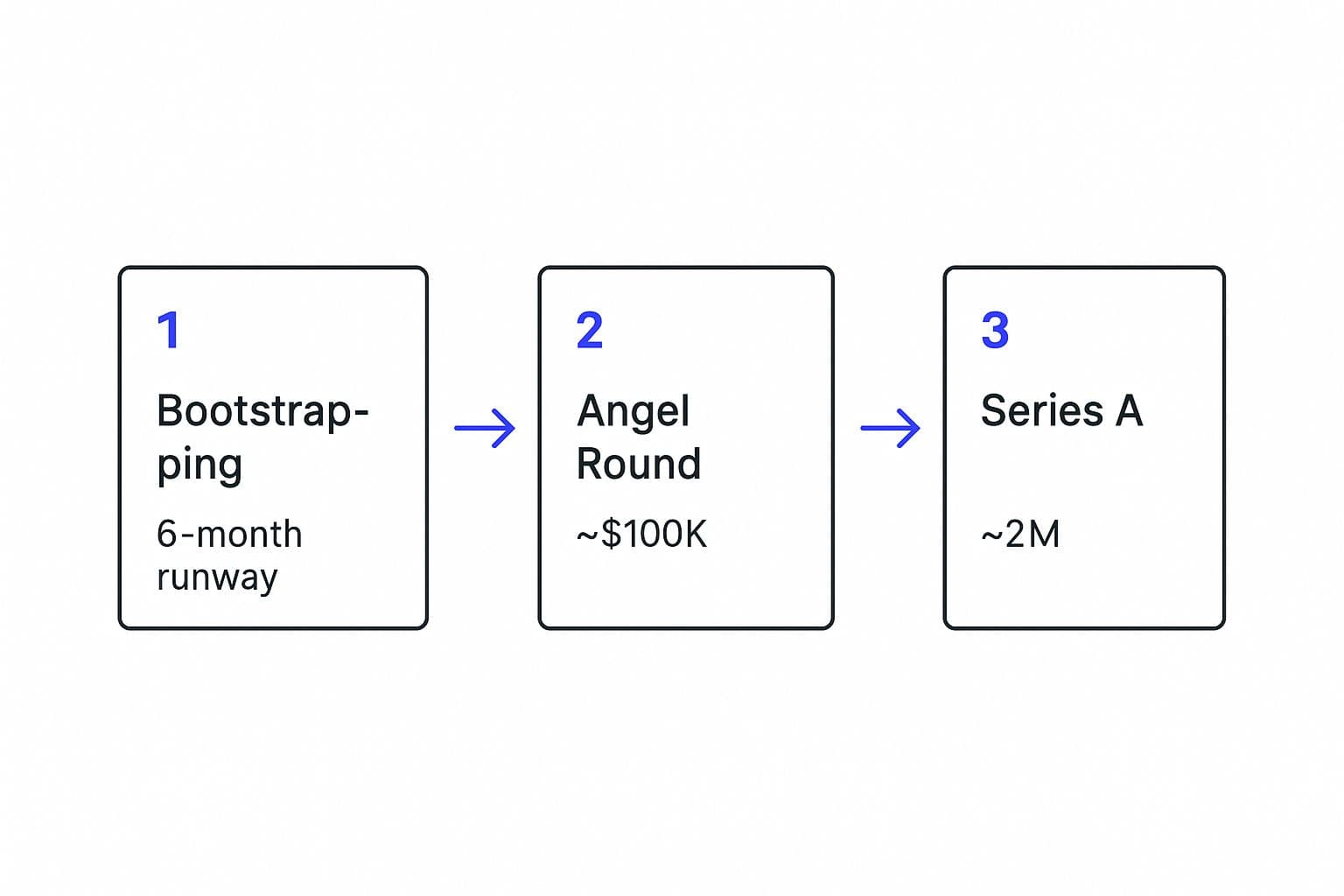
As you can see, capital builds on itself. Each stage requires you to prove out more of the business model to justify a larger investment from the next group of investors.
To give you a clearer picture, I've broken down the key funding stages, typical capital raised, and the milestones you'll need to hit.
Startup Funding Stages Explained
| Funding Stage | Typical Amount Raised | Company Status & Milestones |
|---|---|---|
| Pre-Seed / Seed | $50k - $3M | You have a great idea and a strong founding team. Focus is on building an MVP, initial market validation, and acquiring your first users. |
| Series A | $3M - $15M | You've proven product-market fit. You have a steady revenue stream (like MRR) and metrics showing a repeatable, scalable business model. |
| Series B | $15M - $50M+ | The business is scaling successfully. The goal is to grow the team, expand into new markets, and build out more robust product features. |
| Series C & Beyond | $50M - $100M+ | You are a market leader, preparing for major expansion, acquisitions, or an eventual IPO. Focus is on capturing market share and profitability. |
This table is a general guide, but it illustrates how the stakes and expectations evolve as you grow.
Here's a bit more on what those early, crucial stages feel like:
- Pre-Seed/Seed Stage: This is your first "real" money, often coming from angel investors or specialized early-stage VCs. At this point, investors are betting almost entirely on you and your team. You need a compelling story, a clear problem you’re solving, and some tangible evidence of validation—ideally, a functional MVP. It's vital to have a clear handle on your early assets; our guide on the differences between an MVP vs prototype can help clarify what investors really expect to see.
- Series A: This is your growth round. To get here, you absolutely must demonstrate product-market fit. This means having real, paying customers and hard data proving your business model works and can be scaled. Investors will dig deep into your metrics like customer acquisition cost (CAC), lifetime value (LTV), and monthly recurring revenue (MRR).
Crafting a Killer Pitch and Finding the Right Investors
Think of your pitch deck as your startup’s resume. It needs to tell a compelling, concise story that covers the problem, your solution, the market size, your team, your traction so far, and your financials. My advice? Keep it clean, visual, and under 20 slides. No one has time for more.
Finding the right investors is a lot like dating—you’re looking for a genuine fit, not just anyone with a checkbook. Don't waste your time with a spray-and-pray approach. Research VCs who have a track record of investing in your sector and at your specific stage. A "warm introduction" from a mutual connection is infinitely more effective than a cold email.
Your primary goal in a pitch isn't just to get funding. It's to find a partner who brings more than money to the table—someone who offers industry expertise, a powerful network, and strategic guidance to help you sidestep common pitfalls.
It's also important to acknowledge that systemic challenges are a reality in this space. Data consistently shows that underrepresented founders, including women and minorities, receive a disproportionately small fraction of venture funding.
While this presents a very real hurdle, it's not an insurmountable one. Founders from these groups can find incredible support through specialized funds, accelerators, and mentorship networks dedicated to leveling the playing field. Building a strong network within these communities and, most importantly, showcasing undeniable traction are powerful strategies to overcome these biases and secure the capital you need to build a landmark company.
Got Questions About Starting a Tech Startup? We've Got Answers.
When you're first diving into the world of tech startups, the number of questions can feel overwhelming. It's completely normal. I've been there, and I've seen countless founders grapple with the same uncertainties.
Here, I'll tackle some of the most common—and critical—questions that pop up on this journey. My goal is to give you straightforward, real-world advice to help you cut through the noise and move forward with confidence.
What Is the Very First Step to Start a Tech Startup?
Forget about registering a company name or writing a single line of code. Your absolute first mission is idea validation. You need to prove that your idea actually solves a painful, real-world problem for a specific group of people.
How do you do that? Get out of the building and talk to people. Your initial goal should be to have genuine conversations with at least 20-30 people who you think are your target customers. Ask them about their frustrations, the workarounds they currently use, and what a perfect solution would look like. This isn't a sales pitch; it's a fact-finding mission.
This process, often called problem validation, is the bedrock of a successful startup. It’s what separates a product people will clamor for from one that nobody needs.
I can't stress this enough: only after you've gathered solid proof that a painful problem exists should you even think about building a prototype. Starting with validation can save you months, or even years, of building something for a market that simply isn't there.
How Much Money Do I Need to Start a Tech Startup?
This is the classic "how long is a piece of string?" question. There's no single number, as the cost hinges entirely on your business model and how you plan to get started. A founder using no-code tools to build a simple SaaS product might only need a few thousand dollars to get an MVP out the door.
On the flip side, a hardware or deep-tech startup could easily require hundreds of thousands, or even millions, in pre-seed capital just for R&D.
A practical way to approach this is to calculate your "get to MVP" cost first. Then, map out your expenses for the first 12-18 months. This burn rate calculation should cover everything—software, marketing, and yes, even modest founder salaries. That figure becomes your tangible funding target.
Many founders get started by bootstrapping (using their own savings) or raising a small "friends and family" round, often in the $25,000 to $100,000 range, which is just enough to build the first version and get the traction needed to attract professional investors.
Do I Need a Technical Co-Founder?
While having a great technical co-founder is a massive advantage—and something investors love to see—it's not an absolute deal-breaker, especially at the very beginning. If you're a non-technical founder, you have options.
Here are the main paths you can take:
- Go No-Code: Platforms like Bubble or Webflow are incredibly powerful now. You can often build a surprisingly robust MVP yourself to prove the core concept and get initial users.
- Hire Help: You can bring on a reputable development agency or a skilled freelancer to build the first version. This gets the product built while you focus on the business.
- Build Traction to Attract Talent: This is your secret weapon as a non-technical founder. If you can prove the business case—get sign-ups, generate early revenue, create a buzz—you make your startup infinitely more attractive to a top-tier technical person looking to join a promising venture.
That said, for the long haul, having a dedicated technical co-founder who shares your vision and has skin in the game is almost always the best bet for scalability and deep product innovation.
What Are the Essential Legal Steps for Setting Up My Startup?
Getting your legal ducks in a row from day one is non-negotiable. It feels like a chore, but skipping these steps can cause catastrophic problems down the line that can sink your company.
Here’s a bare-bones checklist of what you absolutely need to handle early on:
- Incorporate Your Business: Decide on a legal structure and register it. In the US, a C-Corporation is the standard if you plan to seek venture capital. In other countries, structures like a Private Limited Company are common.
- Draft a Founders' Agreement: This document is your friendship-saver. It needs to clearly outline roles, responsibilities, equity distribution, and vesting schedules for every founder. It prevents ugly disputes later.
- Lock Down Your Intellectual Property (IP): Make sure every founder and early employee signs a Confidentiality and IP Assignment Agreement. This legally ensures that all the work they do for the company belongs to the company.
- Prepare Standard Contracts: Get your basic customer-facing documents ready, like a Terms of Service and a Privacy Policy. You'll also need simple contracts for any freelancers or employees you hire.
Given how critical this is, I strongly recommend you don't DIY it. Find a lawyer who specializes in startups. The small investment now can save you a fortune in legal battles later.
Ready to turn your idea into a functional product without the endless delays? Iglu Digital specializes in building ready-to-launch MVPs on a fixed price, agreed up front. We combine strategic planning with rapid development to bring your vision to life, fast. Find out how we can help you at https://iglu.dev.