How to Define Project Scope: A Step-by-Step Guide
Table of Contents
Defining your project scope is hands down the most critical step you can take to keep a project from going off the rails. It’s all about creating a shared understanding of the goals, deliverables, tasks, and deadlines. Think of it as the roadmap that guides your team, protecting the project from ballooning budgets and endless delays. All this clarity gets formalized in a document we call a scope statement.
Why Defining Your Scope Is Non-Negotiable
Kicking off a project without a well-defined scope is like trying to build a house without a blueprint. You’ll have a lot of activity, a lot of expense, but you won't end up with a functional house. Defining the scope is the process of drawing that blueprint. It sets the project’s boundaries, spelling out exactly what work is included and—just as crucially—what isn’t.
This is more than just making a to-do list. It’s about getting everyone, from the key stakeholders to the individual team members, aligned on the same vision. A solid scope acts as your project's North Star, a reference point everyone agrees on before any serious time or money is spent.
This upfront alignment is your best defense against the dreaded "scope creep"—those small, seemingly harmless additions that slowly but surely blow up your timeline and budget.
The Core Components of Project Scope
At its heart, defining your project scope is about breaking down a big, ambitious idea into smaller, actionable pieces. It’s about answering the tough questions before you start building.
Here’s a quick rundown of the essential elements that absolutely must be in your scope definition.
Core Components of a Project Scope
| Component | What It Defines |
|---|---|
| Objectives | The measurable business goals the project aims to achieve. |
| Deliverables | The tangible outputs or results produced by the project team. |
| Exclusions | Specific tasks or features that are explicitly not part of the project. |
| Constraints | Known limitations, such as budget, time, or available resources. |
| Assumptions | Factors believed to be true but not yet proven, which could impact the project. |
Nailing down these components is what turns a vague concept into a concrete plan. The Project Management Institute’s own guidance really drives this home, framing the scope as the definitive summary of all work and boundaries. It’s the foundational document that keeps everyone on the same page from kickoff to completion. If you want to dig deeper into these fundamentals, the folks at Galorath.com offer some great insights.
A project without a clear scope is just a wish. The process of defining it forces tough conversations and critical decisions upfront, saving you from much bigger problems down the road.
Ultimately, taking the time to define your project scope isn't just busywork; it's a direct investment in your project's success. It provides clarity, sets expectations everyone can agree on, and builds a stable foundation for everything that follows. Without it, you’re basically just hoping for the best.
Gathering Requirements from Key Stakeholders
A project scope built on assumptions is a project that's already in trouble. I've seen it happen time and time again. The strongest, most resilient scopes I’ve worked on were always born from a deep understanding of the "why" behind the project—and that means digging into what your key stakeholders actually need.
This is where you stop dealing with vague ideas and start creating concrete, actionable requirements. It's less about taking orders and more about being a detective. You have to move past the surface-level requests to uncover the real business problems.
For example, don't just ask, "What features do you want in the new app?" That's a direct path to a bloated wish list. Instead, try asking, "What's the single biggest operational bottleneck this app needs to solve for your team?" The shift in that question changes the entire conversation from a feature list to a problem-solving session. This is the first real step in learning how to define project scope properly.
How to Run Productive Requirements Sessions
Getting the right people in a room (or a video call) is only half the battle. If you just open the floor to ideas, you'll end up with a chaotic wish list and no clear priorities. That's just as dangerous as having no requirements at all.
I've had a lot of success using simple frameworks to add structure. For instance, when we were planning a new internal reporting dashboard, we used the "Must-Have, Should-Have, Could-Have, Won't-Have" (MoSCoW) method. This simple exercise forces stakeholders to negotiate and make tough calls. A "must-have" might be real-time sales data, while a "could-have" could be integrating historical marketing spend from three years ago.
It forces everyone to think critically and turns a cloud of unstructured ideas into a focused, tiered list of objectives.
The goal of requirements gathering isn't to say 'yes' to every idea. It's to uncover and document the essential work needed to solve the core business problem and achieve the project's primary objective.
This kind of structured approach is your best defense against scope creep. It keeps the team focused on delivering real value, not just adding bells and whistles.
Choosing the Right Technique for the Situation
People are different, and a one-size-fits-all approach to gathering information rarely works. To get the full picture, you need a mix of techniques. Think of it as building a complete case file.
- Structured Interviews: These are perfect for one-on-one sessions with key decision-makers or your subject matter experts. Prepare specific, open-ended questions beforehand to keep the conversation on track. For example, I’d ask a Head of Sales, "Can you walk me through the step-by-step process your team uses right now that this new tool will replace?"
- Workshops and Focus Groups: Nothing beats getting a diverse group together to build consensus. I use whiteboards or digital collaboration tools like Miro to map out user journeys or feature dependencies in real time. This is where you uncover the connections and conflicts that individual interviews always miss.
- Surveys and Questionnaires: When you need feedback from a larger group of end-users, surveys are your best friend. They're great for collecting quantitative data to back up your decisions. A quick survey asking, "On a scale of 1-5, how critical is mobile access for your daily work?" can give you the hard data you need to prioritize.
Let’s put this into a real-world context. Imagine you're building a new customer support portal.
You could start with a workshop involving support agents to map out their dream workflow. Then, you'd follow up with one-on-one interviews with the support manager to dig into reporting needs and budget constraints. Finally, you could send a survey to a segment of your customers to see which self-service features they’d find most valuable.
This multi-pronged strategy ensures you’re looking at the problem from every critical angle—the end-user, the manager, and the customer. Each technique gives you a different piece of the puzzle. When you put them all together, you get a comprehensive and validated set of requirements that will form the unshakable foundation of your project scope.
How to Write a Powerful Project Scope Statement
Now that you've gathered all the requirements, it's time to build the most critical document for your project’s success: the scope statement. Think of this as more than just a formality. It’s your project's single source of truth—the formal agreement that turns stakeholder wishes into a concrete, actionable plan for your team.
A solid scope statement eliminates ambiguity. It draws clear lines in the sand and gives your team the detail needed to guide every decision, from kickoff to final delivery. The trick is to break it down into its essential parts, making sure each one is handled with care and precision.
Detailing Your Project Deliverables
First things first, you need to list every single tangible output the project will produce. This isn't the place for high-level goals; it's where you define the specific "what" you'll be handing over. Being vague here is a classic recipe for disaster.
For instance, instead of just saying "a new website," a strong list of deliverables gets much more specific:
- A fully responsive, five-page marketing website with a functional contact form.
- A password-protected client portal with a document upload feature.
- A content management system (CMS) with defined user-access controls.
Each deliverable has to be distinct and measurable. This level of clarity is especially helpful when you’re deciding between building a prototype or jumping straight to a minimum viable product. If your deliverables are on the complex side, you can explore the pros and cons in our guide on MVP vs. prototype to make the right call.
Defining Your Acceptance Criteria
For every deliverable you've just listed, you also need to define its acceptance criteria. This part answers the simple but crucial question: "How will we know this is done and done right?" These criteria are the specific conditions that must be met before stakeholders will formally sign off on the work.
Let’s take our "functional contact form" deliverable. Its acceptance criteria might look something like this:
- The form must capture the user's name, email, and message.
- A success message must appear on-screen after a user hits "submit."
- An email notification with the form data must land in the sales team's inbox within 60 seconds of submission.
Without these specifics, the word "functional" is wide open to interpretation. Acceptance criteria slam that door shut.
The image below shows the direct line connecting a well-defined scope to accurate project estimates and, ultimately, a successful launch.
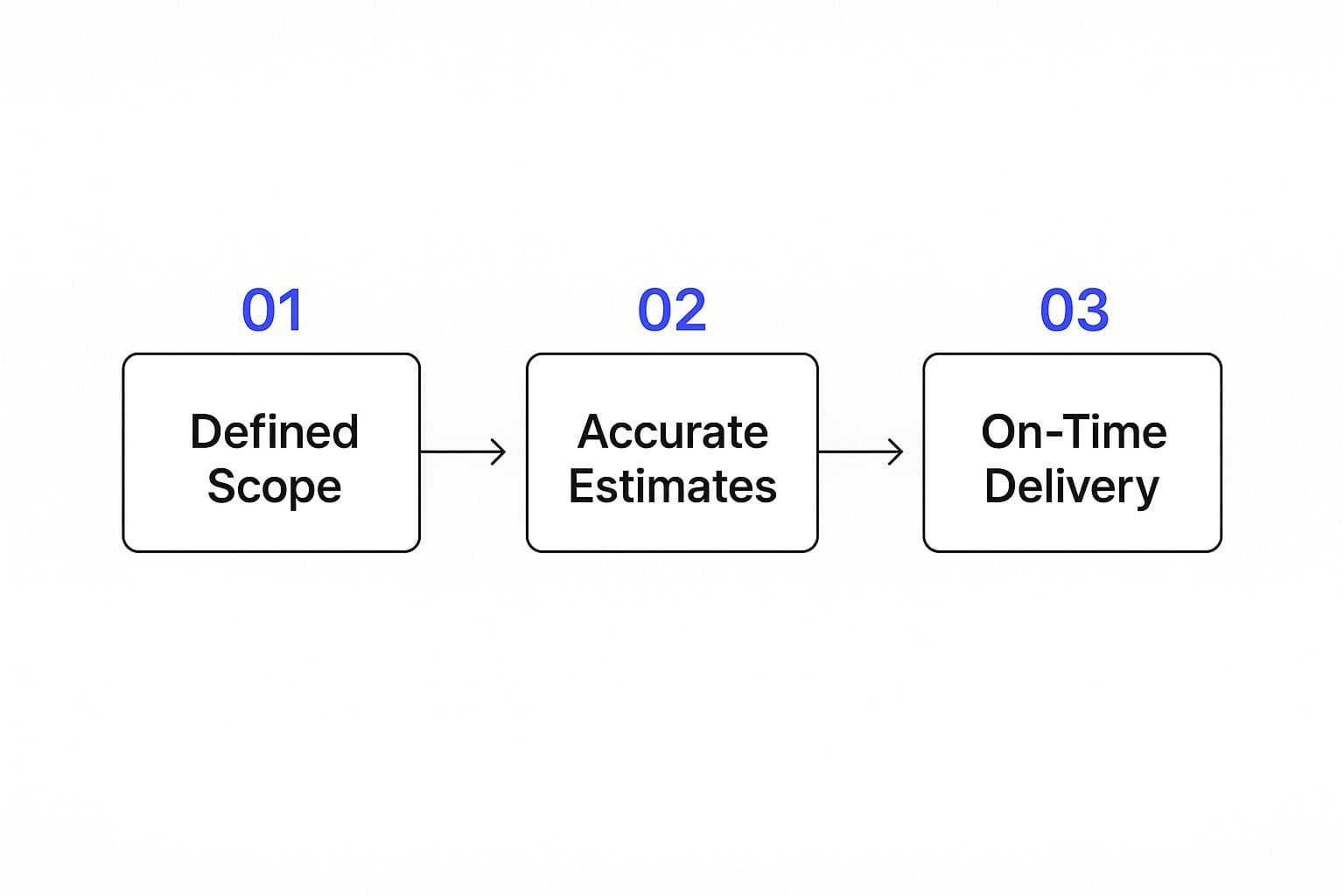
As you can see, a clear scope isn't just a document; it's the foundation that makes realistic planning and on-time completion possible.
Explicitly Stating Project Exclusions
What you won't be doing is just as important as what you will. Project exclusions are your number one defense against scope creep. This is where you get to be direct and unapologetic about what’s off the table.
Never assume something is out of scope just because it wasn't mentioned. If there’s even a hint of a potential misunderstanding, spell it out in the exclusions section.
Defining what is "in-scope" vs. "out-of-scope" is a powerful exercise in setting boundaries. The table below provides a clear example for a typical website redesign project.
In-Scope vs. Out-of-Scope Examples for a Website Redesign
| Feature/Task | Status (In-Scope or Out-of-Scope) | Justification |
|---|---|---|
| Redesign of 5 core marketing pages | In-Scope | The primary objective of the project. |
| Post-launch social media marketing campaigns | Out-of-Scope | Requires a separate marketing budget and team; not part of the core development project. |
| Integration with Mailchimp for newsletter | In-Scope | A key requirement from the marketing team to support lead generation. |
| Integration with the company's accounting software | Out-of-Scope | A complex, multi-departmental effort that will be handled as a separate future project. |
| Creating all new blog content for 6 months | Out-of-Scope | Content creation is an ongoing operational task, not a one-time project deliverable. |
Listing exclusions forces important conversations to happen early, keeping everyone’s expectations aligned with reality from day one.
Identifying Constraints and Assumptions
Finally, a truly comprehensive scope statement calls out the project's constraints and assumptions.
Constraints are the known limitations you have to work within. These are usually tied to time, budget, or resources. For example, a project might have a hard constraint like, "The entire project must be completed within the allocated $50,000 budget." Another might be, "The lead developer is only available for 20 hours per week." These are the immovable boundaries that will shape your entire approach.
Assumptions are different. These are things you believe to be true for planning purposes, but they haven't been proven yet. For example: "We assume key stakeholders will provide feedback on deliverables within a 48-hour window." If that assumption turns out to be wrong, it introduces a major risk to your timeline—a risk that needs to be documented upfront.
By meticulously detailing your deliverables, criteria, exclusions, constraints, and assumptions, you're not just writing a document. You're crafting a protective blueprint that will guide your project to a successful conclusion.
Getting Stakeholder Buy-In on Your Scope

A beautifully crafted project scope statement is worthless if it just gathers dust in a shared drive. I’ve seen it happen: a project gets derailed weeks into development because a key stakeholder finally pipes up with, “Wait, that’s not what I thought we were building.”
This is why getting genuine buy-in isn't just a box to check at the end. It's an absolutely critical phase of the work. This is where the human side of project management really shines—it's less about winning an argument and more about creating a shared vision for where the project is headed.
Presenting the Scope for Maximum Impact
Your first instinct might be to just email the scope document to everyone and call it a day. Don't do it. A document sent into the void is an invitation for misinterpretation and rarely gets the focus it needs.
Instead, schedule a dedicated walkthrough session with your key stakeholders. This is your stage. Don't just read the document line by line; that's a surefire way to put everyone to sleep. Your job is to narrate the project's story.
Here's how to connect the dots for them:
- Go Back to the "Why": Start by reminding everyone of the core business problems you're trying to solve. Frame your proposed scope as the direct, tangible solution to those pains.
- Draw Clear Lines in the Sand: Spend extra time on the exclusions and constraints. Be direct. For example, you might say, "To stay within our $50,000 budget, a native mobile app is out of scope for this phase. We can absolutely explore that as a separate project down the road."
- Make it Visual: For anything complex, a simple diagram or flowchart is worth a thousand words. This helps translate dense text into a shared mental picture of what you’re all building together.
An interactive walkthrough like this turns a passive document review into an active alignment session. The goal is for everyone to leave that room with the exact same understanding.
Handling Feedback and Negotiating Changes
If you get pushback or questions, don't panic. Feedback isn't failure; it's a sign that people are actually paying attention. When stakeholders want to add something or challenge a boundary, stay open and treat it as a chance to clarify. Your objective is to make them feel heard, turning potential critics into project champions.
When a change request inevitably pops up, your first move is to analyze its impact. If a stakeholder wants a new feature, bring it right back to the project constraints.
You could say, "That's a great idea. Looking at our plan, adding that would likely push our timeline back two weeks and add $8,000 to the budget. Do we have the approval to adjust for that?"
The point isn't to shut down every new idea. It's to make the trade-offs crystal clear. Every "yes" to a new feature must be followed by a "yes" to the extra time or money needed to make it happen.
This simple technique shifts the conversation from a casual wish list to a serious business decision. It forces a transparent discussion about what's truly a priority. By managing feedback this way, you reinforce the scope’s boundaries while also showing you value everyone's input. It's this collaborative spirit that builds a scope everyone can stand behind, creating a unified team before the real work even begins.
How to Prevent and Manage Scope Creep

Even after you’ve nailed down a perfect project scope, the real battle is just beginning. Now you're up against scope creep—the silent killer of project timelines and budgets. It starts small, with a few seemingly harmless requests, but they pile up fast and can completely derail your best-laid plans.
The trick isn't to build an impenetrable wall against every new idea. It's about having a disciplined process to manage change when it inevitably appears. This turns scope management from a one-time task into an ongoing practice that keeps your project healthy from start to finish. Without this vigilance, even the most solid initial planning can unravel.
The danger here is real and well-documented. Research shows that a staggering 37% of project failures are a direct result of unclear objectives. On top of that, 44% fail because the project's goals are misaligned with the company's core mission—a problem that scope creep makes infinitely worse. You can discover more about these project management statistics to see just how critical these boundaries are.
Put a Formal Change Control Process in Place
Your most powerful weapon against scope creep is a formal change control process. This doesn't have to be some complex legal document. It's simply an agreed-upon system for how your team will handle any request that falls outside the original, signed-off scope. The goal isn't to shut down new ideas, but to evaluate each one with clear eyes.
This process ensures every potential change is captured, reviewed, and approved before any work starts. It forces a real conversation about the impact of the request and makes the trade-offs obvious to everyone involved.
This is especially vital when working with external teams. For companies using partners for outsourced product development, a clear process provides a shared framework for communication and decision-making that keeps everyone aligned.
A solid change control process should include:
- A straightforward change request form to document what’s being asked.
- A clear approval workflow that defines who needs to sign off.
- A formal impact analysis to assess the effect on the timeline, budget, and resources.
The Anatomy of a Good Change Request Form
Your change request form shouldn't be intimidating. It just needs to gather the right information so you can make a smart decision. It also forces the person making the request to think through their idea and its consequences.
At a minimum, your form should capture these key details:
- Request Description: What exactly is the proposed change, and why is it needed now?
- Business Justification: How does this change support the project's main objectives or the company's bigger goals?
- Requested By: Who is initiating the request?
- Impact Analysis (filled out by the project manager): An honest assessment of what this will cost in terms of money, time, and people.
- Approval Status: A space for decision-makers to formally approve or deny the request.
By funneling every idea through this structured format, you put an end to those "hallway requests" and casual asks that quietly sink projects.
A change control process isn't about saying 'no.' It’s about creating a system that forces everyone to understand the true cost of saying 'yes.' It transforms scope management from a defensive posture into a strategic one.
How to Evaluate Change Requests Like a Pro
Once a request is submitted, the project manager’s job is to analyze its true impact. This is where you connect the request back to the project’s triple constraints: time, money, and resources.
Let's say a stakeholder asks to add a new user dashboard to an app you're building. Your analysis might find that this "small" addition requires 80 extra development hours. That translates to pushing the launch back by three weeks and adding $12,000 to the budget.
When you present that data, the conversation changes instantly. It’s no longer about whether a dashboard is a nice-to-have feature; it’s about whether that feature is worth a three-week delay and a hefty budget increase. This structured evaluation removes emotion from the decision and grounds it in reality, giving you the power to protect the project's integrity while still being flexible enough to embrace valuable new ideas.
Frequently Asked Questions About Project Scope
Even with the best planning in the world, a few key questions always seem to surface when it's time to lock down the project scope. Getting these right from the start is what separates a smooth project from a chaotic one. Let's tackle some of the most common queries I've seen over the years.
Answering these helps everyone get on the same page, speaking the same language. That shared understanding is the bedrock of a well-defined project.
What’s the Difference Between Project Scope and Product Scope?
It’s incredibly common for people to use these terms interchangeably, but they mean very different things. Getting this distinction right is crucial.
Here’s how I break it down for my teams:
- Product Scope is the what. It's all about the features and functions of the end result. If you're building an app, the product scope covers things like the user login system, the main dashboard, and the settings page.
- Project Scope is the how. This covers all the work your team has to do to deliver that product. It includes the planning meetings, the design sprints, the coding itself, the quality assurance testing, and the final deployment. It’s the entire process.
Think of it this way: the project scope wraps around the product scope. You can't complete the project without first knowing exactly what product you're building. They are two halves of a whole, but one is the destination (product) and the other is the entire journey to get there (project).
How Detailed Does a Scope Statement Need to Be?
The honest answer? It depends entirely on the project. There's no magic, one-size-fits-all template.
A simple internal task, like creating a new slide deck for employee onboarding, might just need a one-page summary. It's low-risk and everyone involved already has the context.
But for a massive, multi-year software build or a major construction project? You need an exhaustive document. We're talking about something that leaves zero room for misinterpretation because the financial stakes are so high. The level of detail here can also affect your contract choice; our guide on the time and materials vs fixed price model explains how scope directly influences billing.
My rule of thumb is this: your scope statement should be so clear that a brand-new team member could read it and understand the project’s goals, boundaries, and exclusions without needing a long meeting to explain it.
If you spot any ambiguity that could cause a debate down the line, you aren’t done yet. The goal is a single source of truth that the entire team can trust.
Who Is Actually Responsible for Defining the Project Scope?
While the project manager owns the final document and drives the process, defining the scope is a team sport. A project manager who tries to write the scope statement alone in a dark room is pretty much guaranteeing failure.
In reality, the responsibility is shared across a few key roles:
- The Project Manager: They act as the facilitator—the conductor of the orchestra. They gather all the requirements, document everything, and make sure the final scope is clear, agreed upon, and signed off.
- Key Stakeholders: These are the people who have a direct interest in the project's success. They provide the "why" behind the project, defining the business needs and the criteria for success. Their input is what gives the scope its purpose.
- The Project Team: These are your experts on the ground—the developers, designers, and engineers who will do the actual work. They provide the reality check on what's technically possible and how long it will realistically take.
- The Project Sponsor: This is usually the executive who champions the project and holds the budget. They provide the high-level vision and give the final, official sign-off that turns the scope document into the project's constitution.
The project manager's most vital skill here isn't dictating—it's listening. They synthesize everyone's input into a realistic plan that has buy-in from all sides.
Ready to turn your idea into a market-ready product without the typical delays? At Iglu Digital, we specialize in building and launching a functional MVP for your business for a price agreed before a line of code is written. We combine strategic planning and rapid development to get your vision into the hands of real users fast. Let's build your product together.