
How to Conduct Competitive Analysis for Real Insights

Table of Contents
When you break it down, competitive analysis is really just a structured way of figuring out who you're up against. It involves a deep dive into your competitors' strategies—from their marketing and sales tactics to their product development—and then using that intel to sharpen your own game.
The whole point isn't to play copycat. Far from it. The goal is to get a clear, unbiased view of the market so you can find your own unique way to win.
Why Competitive Analysis Is Your Strategic Compass
Let's get one thing straight: this isn't about corporate espionage. It’s about building a reliable map to guide your company’s growth. This kind of analysis is the bedrock of smart decision-making, whether you're about to launch a new product, fine-tune a marketing campaign, or just figure out why a rival is suddenly pulling ahead.
Flying blind is a recipe for disaster. Without this strategic map, you're always reacting to what the market throws at you instead of anticipating the next move.

Think of it as your practical playbook for gaining a real-world advantage. It pushes you past abstract business theories and into insights you can actually use. By methodically studying the competitive landscape, you'll start to see opportunities everyone else is missing and sidestep threats before they can do any real damage.
Before we dive into the "how," let's set the stage with a clear framework. I've found it helpful to break down competitive analysis into four core pillars. This structure ensures you cover all your bases and don't get lost in the data.
The Four Pillars of Competitive Analysis
| Pillar | What It Reveals | Why It Matters |
|---|---|---|
| Business & Strategy | Company size, funding, target audience, and overall market positioning. | Helps you understand their resources, priorities, and long-term goals. |
| Product & Pricing | Core features, pricing models, and unique value proposition. | Shows you how they solve customer problems and where you can offer a better solution. |
| Marketing & SEO | Content strategy, SEO performance, social media presence, and advertising channels. | Uncovers how they attract and engage customers, revealing potential channels for you. |
| Customer Experience | Online reviews, user feedback, and brand sentiment. | Provides a direct look at their strengths and weaknesses from the customer's perspective. |
This table is your starting point—a high-level guide to keep you focused as you gather and analyze information.
The Real Value of Understanding Your Market
A deep-seated understanding of your competitors delivers so much more than a simple list of their pros and cons. It peels back the layers to show you the fundamental dynamics of your industry. For instance, is a competitor winning because of a killer feature, or is it their legendary customer service? Knowing the answer tells you whether to pour resources into your product roadmap or your support team.
This process gives you the power to:
- Spot Market Gaps: Find those underserved customer needs that your business is perfectly positioned to fill.
- Benchmark Your Performance: Get an honest look at how your marketing, pricing, and product stack up against the best in the field.
- Anticipate Market Shifts: Catch on to emerging trends or new players before they become front-page news.
- Sharpen Your Value Proposition: Fine-tune your messaging to clearly and confidently state what makes you different—and better.
The core purpose of competitive analysis is to transform raw data into a strategic narrative. It’s not just about what your competitors are doing; it’s about understanding why it works and how you can develop a counter-strategy that plays to your unique strengths.
The demand for these insights is exploding. The global market for competitor analysis services was valued at $4.32 billion back in 2021 and is on track to hit $6.6 billion by 2025. That kind of growth tells you just how essential this intelligence has become. You can dive deeper into the market trends to get the full picture.
Ultimately, knowing how to conduct a competitive analysis isn't just a marketing function; it's a core business competency. It gives you the clarity to make smarter, data-backed decisions that drive real growth and keep you one step ahead.
Figuring Out Who You're Really Competing Against
Before you can even think about strategy, you have to know who you’re up against. It's surprisingly easy to get tunnel vision, focusing only on the big, household names in your industry. The reality is, your competitive landscape is almost always bigger and more complicated than it seems on the surface.
Your competition isn’t just the company with a look-alike product. It's anyone trying to solve the same core problem for the same customer. Getting this wrong is a classic mistake, one that sends you chasing vanity metrics while your real rivals eat your lunch.

Go Beyond the Obvious Rivals
To make sense of the noise, you need to sort your competitors into different buckets. This isn't just an academic exercise; it helps you focus your energy where it'll make the biggest difference. Not every competitor deserves a deep-dive analysis.
I find it helpful to break them down into three main categories:
- Direct Competitors: These are the ones everyone thinks of first. They offer a very similar product to the same audience. Think Asana for a project management tool like Trello. They're both going after the same customer with a similar solution.
- Indirect Competitors: These guys solve the same root problem, but with a totally different approach. For Trello, an indirect competitor might be Slack. It's a communication tool, sure, but teams often bend its channels and integrations to manage projects. It solves the "team organization" problem, just from another angle.
- Replacement Competitors: This is the trickiest group. They offer something that isn't similar at all but still competes for the same slice of the customer's budget or attention. A business process consulting firm could be a replacement competitor for Trello. Why? Because a company might choose to invest in overhauling their manual processes instead of buying software to manage them.
Just sorting your list this way brings a ton of clarity right from the start.
Practical Ways to Uncover Your Competitors
So, where do you find all these competitors, especially the ones flying under the radar? Don't just brainstorm in a conference room. You need to get out there and gather some real data.
A simple Google search is your first stop. Look up your main product category or, even better, the problem your product solves. The companies that pop up on page one are your competitors for mindshare, plain and simple—even if their product is different.
A competitor isn't just someone who might steal a sale today. It's any entity that ranks for the keywords you target, speaks to the audience you serve, or solves the underlying problem your customers face.
From that jumping-off point, you can get more specific:
- Fire Up Your SEO Tools: I lean on tools like Ahrefs or Semrush for this. Plug in your most important keywords and see which domains are ranking. You'll almost always uncover blogs, industry publications, or companies in adjacent fields that are grabbing your audience's attention.
- Talk to Humans: This is the most underrated intelligence source. Ask new customers, "What other options were you looking at?" Your sales team is an absolute goldmine here, too—they hear who you're being compared to on calls every single day.
- Scour Review Sites: Dive into platforms like G2 and Capterra, or whatever forums are popular in your niche. The "alternatives to" sections are fantastic for finding competitors you've never even heard of.
Create Your Hit List
Once you have a brain dump of names, it's time to get organized. A simple spreadsheet works perfectly.
Make columns for the company name, their website, the competitor type (direct, indirect, replacement), and a quick note on why they made the list. This isn't just busy work; this document becomes the foundation for everything that follows. It ensures you’re analyzing the whole field, not just the loudest players.
Having this list also forces you to think about your own unique place in the market. A thorough analysis can even spotlight the unique things you do that are worth protecting. As you find these differentiators, it’s worth learning how to protect your intellectual property to keep your edge.
Take the time to get this first part right. A clear and accurate picture of your competition makes the rest of your analysis infinitely more valuable.
Gathering Intelligence You Can Actually Use
Once you’ve identified who you’re up against, the real work begins. This is where you start collecting the kind of intelligence that actually drives decisions, not just data that looks good in a spreadsheet. The goal here is to build a detailed dossier on each key competitor, covering everything from their marketing playbook to their product roadmap.
Forget broad strokes. We need to get specific. You’re trying to figure out how your competitors win over customers, what makes their product so sticky, how they price their services, and where their customer experience really shines—or, more importantly, where it falls flat. This is how you find the cracks in their armor.
Dissecting Their Marketing and SEO Strategy
A competitor's marketing strategy is usually the most visible part of their entire operation, which makes it the perfect place to start digging. Your mission is to uncover how they build awareness and capture new business.
Start with their website—it’s their digital storefront. Pay close attention to their core messaging, the calls-to-action (CTAs) they use, and what the overall user experience feels like. From there, it's time to dig into their content and SEO performance.
- Content Themes: What topics are they always writing about on their blog? Are they pushing out whitepapers, case studies, or webinars? This tells you exactly who they’re trying to attract and what problems they claim to solve.
- SEO Performance: Fire up an SEO tool and see what keywords they rank for. This is a direct look into their customer acquisition strategy. Are they chasing high-intent keywords at the bottom of the funnel, or are they playing the long game with broader, educational content?
- Backlink Profile: Where are they getting links from? A portfolio of high-authority links from respected industry sites points to a serious digital PR game. A long list of links from junky directories tells a completely different story.
For a sharp, immediate picture of a competitor's SEO footprint, a tool like Ahrefs gives you a dashboard view of their organic keywords, estimated traffic value, and top-performing pages.
This kind of data instantly reveals where a competitor is winning in search and which content is their heavy hitter, essentially handing you a blueprint for what works in your market.
Unpacking Their Product and Pricing
Getting a handle on a competitor's product is non-negotiable. You need to know their core features, what they believe makes them unique, and—most importantly—where the gaps are. The absolute best way to do this? Become a customer.
Sign up for their free trial or buy their product. Use it like a real customer would. This hands-on approach delivers insights you’ll never get from just reading a features page.
As you explore, keep a running log of your findings:
- The Onboarding Experience: How easy is it to get started? A clunky, confusing onboarding process is a huge weakness and a golden opportunity for you to create a much smoother entry point for new users.
- The Core Feature Set: What are the standout features they offer? And what’s missing? Identifying feature gaps is a classic and effective way to differentiate your own offering.
- Their Unique Value Proposition (UVP): How do they position themselves in the market? Read their website copy, watch their demos, and pay attention to which benefits they shout about the loudest.
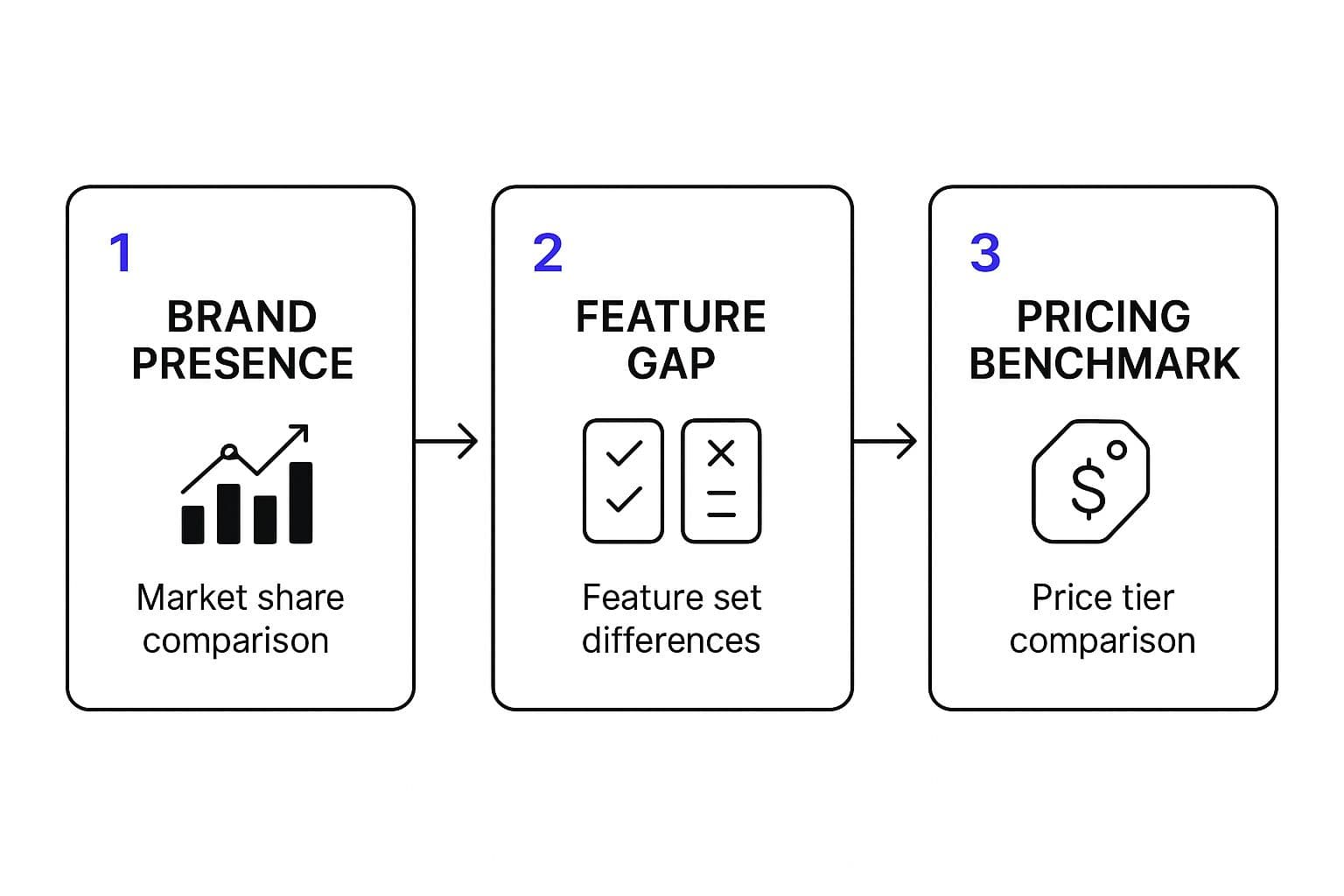
This process highlights the core data points you need to collect, from high-level brand presence down to the nitty-gritty of feature gaps and pricing benchmarks.
Tapping Into Social Media and Advertising Intelligence
Social media gives you a raw, unfiltered look at how a brand actually talks to its audience. Look past the vanity metrics like follower counts and analyze their engagement. Are people asking real questions? Are they leaving glowing reviews or airing their frustrations? This is a goldmine for understanding true customer sentiment.
You should also look into their paid advertising. Many platforms now have ad transparency libraries that let you peek behind the curtain. For instance, the Meta Ad Library lets you see every single ad a brand is currently running across Facebook and Instagram.
This gives you a direct look at:
- The exact ad copy and creative they're testing.
- The offers and promotions they're currently pushing.
- The landing pages they're sending all that paid traffic to.
This kind of intelligence can be a massive help for your own paid media strategy, helping you craft more compelling offers and steer clear of campaigns that are already flooding the market.
Curating Your Competitive Analysis Toolkit
Doing the manual research yourself is invaluable, but the right tools can put your data gathering on hyperdrive and uncover insights you'd almost certainly miss. Building a solid toolkit isn't a luxury; it's essential for doing this right.
Here’s a quick breakdown of tools I’ve found useful, sorted by category:
| Category | Recommended Tools | What It Helps You Do |
|---|---|---|
| SEO & Content | Ahrefs, Semrush | Analyze keyword rankings, backlink profiles, and top-performing content. |
| Social Media | Sprout Social, Brandwatch | Monitor competitor mentions, track engagement rates, and analyze audience sentiment. |
| Email Marketing | Owletter, MailCharts | Collect and analyze competitors' email newsletters and promotional campaigns. |
| Paid Advertising | SpyFu, Meta Ad Library | Uncover competitor ad copy, keywords they're bidding on, and campaign strategies. |
Choosing the right mix of tools can make all the difference. To help you sort through the options, take a look at our guide on the best analytics tools for your business. It’s designed to help you streamline how you collect and analyze all this data.
Ultimately, gathering intelligence is about building a rich, multi-dimensional view of your competitors. When you combine your own hands-on research with powerful tools, you can move past surface-level observations and start collecting the kind of actionable data that truly informs a winning strategy.
Analyzing the Data to Find Your Competitive Edge
Gathering competitor data is one thing, but that raw information is just noise. The real magic happens when you start connecting the dots—turning isolated data points into a clear, strategic story. This is where you transform everything you've learned about your competition into a real advantage for your own business.
This phase isn't just about making lists of strengths and weaknesses. It's about spotting patterns, understanding the "why" behind what your competitors are doing, and pinpointing the specific opportunities they’ve completely overlooked. Think of yourself as a detective, piecing together clues to reveal the bigger picture.

Weaving Your Findings Into Actionable Insights
Your first move is to get all your intel in one place. Pull your notes on their SEO performance, product features, pricing tiers, and customer reviews into a central hub. A detailed spreadsheet or a dedicated competitive analysis tool works great for this.
Once everything is organized, you can start overlaying different data sets to find some really interesting connections. For instance, does a competitor with a ridiculously complex pricing structure also have a flood of negative reviews mentioning confusion and hidden fees? That’s not a coincidence; it’s an exploitable weakness.
Keep an eye out for these kinds of patterns:
- Marketing vs. Reality: You might find a competitor has brilliant, high-ranking content, but their product reviews are consistently terrible, citing bugs and poor performance. This gap between their marketing promise and the actual customer experience is a massive opportunity for you.
- Pricing vs. Features: Does a direct rival charge a premium price but lack a key feature that your product already has? This is a powerful differentiator you can hammer home in your sales and marketing materials.
- Social Buzz vs. Support Issues: Maybe a competitor is getting a ton of engagement on social media, but a closer look reveals their mentions are filled with complaints about slow customer support. This tells you their support team can't keep up with their growth—a vulnerability you can target by highlighting your own responsive service.
The whole point of this analysis is to find the story in the data. You want to move from "Competitor X has 50,000 Twitter followers" to "Competitor X has a large audience but struggles with support inquiries, creating frustrated customers we can attract with superior service."
A Modern Take on SWOT Analysis
The classic SWOT (Strengths, Weaknesses, Opportunities, Threats) analysis is a fantastic framework, but too often it's done in a vacuum. To make it truly powerful, you have to ground every single point in the competitive data you’ve just collected. This transforms it from a fluffy brainstorming session into an evidence-backed strategic exercise.
Here’s a practical way to structure this for your business, using the data you've gathered to inform each quadrant.
SWOT Analysis Framework Example
This table shows how to move beyond generic statements and tie your SWOT directly to what's happening in the market.
| Category | Internal Factors (Your Business) | External Factors (The Market) |
|---|---|---|
| Helpful | Strengths: Data-Backed Example: Our onboarding process is significantly faster than Competitor A's, which is their #1 complaint in online reviews. | Opportunities: Data-Backed Example: None of our top competitors offer a dedicated integration for HubSpot, yet our customer surveys show 40% of users want one. |
| Harmful | Weaknesses: Data-Backed Example: Our blog content ranks for informational keywords, but Competitor B dominates all high-intent, "bottom-of-funnel" search terms. | Threats: Data-Backed Example: An emerging competitor just secured a new round of funding and is aggressively undercutting our pricing on their entry-level plan. |
This data-driven approach forces you to justify each point with hard intelligence, ensuring your SWOT analysis is rooted in reality, not just internal assumptions. The strategy that comes out of it will be far more robust as a result.
Finding the Narrative That Guides Your Strategy
Ultimately, your analysis should give you a clear, concise narrative. This story explains the current market, your unique position in it, and the most direct path forward. It's the culmination of all your research.
Think about Tesla's early analysis of the auto market. By seeing competitors' complete reliance on combustion engines and the massive gap for a viable electric car, they used that intelligence to build an entire company and lead a new sector. You can read more about this strategic approach to competitor analysis for a deeper dive.
For your business, this all boils down to answering a few key questions:
- What is the single biggest weakness we see across all our top competitors?
- What is the most common unmet need their customers are screaming about?
- Where are we uniquely positioned to deliver value that they simply can't?
The answers form the very foundation of your competitive strategy. If your competitors are weak in customer support, your strategy centers on delivering a world-class service experience. If their products are all missing a crucial feature, your product roadmap gets a clear new priority. This is how data becomes direction.
Turning Insights Into a Winning Business Strategy
All that hard work gathering and analyzing data boils down to this: what are you going to do with it? Raw intelligence is just potential. The real magic happens when you use it to sharpen your business strategy, outmaneuver the competition, and build something your market genuinely needs. This is where you close the gap between knowing and doing.
The final, and most critical, part of any competitive analysis is translating your findings into a concrete game plan. We're not talking about a few minor tweaks here. This is about making deliberate, strategic adjustments across your entire business—from marketing copy to your product roadmap—all based on the hard evidence you’ve just uncovered.
Sharpening Your Marketing and Sales Message
Your analysis has probably given you a crystal-clear picture of how your competitors talk about themselves. You know their unique selling propositions (USPs), the exact language they use, and which customer pain points they hammer on. This is your opening to find a better, more resonant way to tell your own story.
Let's say a competitor's entire message is built on being the "cheapest option," but you found their online reviews are littered with complaints about poor quality. That’s your cue. Your messaging can pivot to focus on long-term value and reliability, crafting a narrative that directly counters their main claim without ever having to mention their name.
- Spotlight Your Differentiators: Use the weaknesses you found in rivals as the perfect backdrop to showcase your strengths. Is their customer support notoriously slow? Make "24/7 Human Support" a headline feature on your pricing page.
- Go After Underserved Segments: Did you notice a competitor is completely ignoring a specific industry or type of user? Create a landing page and ad campaign just for them. Speak their language, and solve their unique problems.
This refined messaging becomes the backbone of your sales team's battle cards and your next marketing push. It gets everyone on the same page, delivering a consistent, powerful message that actually connects with customers and carves out your space in the market.
Informing Your Product and Service Roadmap
One of the best things to come out of a deep competitive analysis is clarity for your product team. You’ve likely identified feature gaps, seen the same customer complaints about rival products pop up again and again, and spotted emerging trends. This intelligence is basically a goldmine for deciding what to build next.
Imagine you discover your top three competitors all lack a critical integration that customers are constantly begging for in online forums and on Reddit. This single insight gives you a clear path forward:
- Prioritize the Integration: You can confidently move this feature to the top of your development queue because you know there's a proven, hungry market for it.
- Start Pre-Launch Marketing: Begin teasing the upcoming feature to your email list and social media followers to build some serious buzz.
- Launch with a Bang: When it's ready, announce the new integration by directly targeting users of the competing products who have been so vocal about needing it.
A data-driven roadmap isn't about just copying every feature a competitor rolls out. It's about strategically filling the gaps they've left wide open and solving the customer problems they're currently ignoring.
Building a Continuous Feedback Loop
Competitive analysis should never be a one-and-done project you dust off once a year. The market is always moving. New players pop up, and existing ones pivot. To stay ahead, you have to build an ongoing process for keeping an eye on the landscape.
Set up a simple system to keep the insights flowing. It could be a quarterly review where your team revisits key competitors' websites, scans their latest customer reviews, and breaks down their recent marketing campaigns. The goal is to make this a sustainable habit, not some overwhelming annual chore. This relies on strong internal processes, which is a key focus for successful solutions for marketing teams that want to maintain a sharp competitive edge.
By making this a continuous loop, you transform competitive analysis from a reactive exercise into a proactive, strategic weapon. It fuels constant innovation, keeps your business relevant, and ensures you’re ready to jump on the next big opportunity before anyone else even sees it coming.
Got Questions About Competitive Analysis?
Even with the best framework laid out, you're bound to run into a few tricky spots once you're deep in the weeds of a competitive analysis. Knowing the steps is one thing, but knowing how to handle the nuances is what separates a good analysis from a great one.
Let's walk through some of the questions I hear most often.
How Often Should I Be Doing This?
This is probably the biggest question people have, and for good reason. The honest answer? Competitive analysis is never a "one-and-done" task. The market simply moves too fast for that.
I always recommend a full, top-to-bottom deep dive at least annually. This is where you re-evaluate everything. But you can't just set it and forget it for the next 12 months. You also need a lighter, more regular check-in. A quarterly review is a perfect cadence for this. It helps you stay on top of major shifts—like a competitor’s surprise product launch or a big pivot in their marketing—without getting bogged down.
Is This Really Practical for a Small Business?
I get it. It's easy to look at this process and think it's only for giant corporations with dedicated market intelligence teams. But honestly, competitive analysis is even more critical for startups and small businesses. When you have limited resources, every single decision has to count. Understanding what you're up against helps you avoid incredibly costly missteps.
For a small business, this isn't about tracking 20 different companies. It's about being surgical. Focus on a handful of your most direct competitors to:
- Find Your Niche: Pinpoint the customer groups they're overlooking.
- Dodge Saturated Channels: See where they're spending big and find the less crowded spaces where you can actually make an impact.
- Learn from Their Slip-ups: Dig into their customer reviews to see what isn't working for them, and make sure you don't make the same mistakes.
This kind of focused effort gives you the strategic edge you need to punch well above your weight.
What Are the Biggest Traps to Avoid?
Knowing where things can go wrong is half the battle. If you can sidestep these common pitfalls, you'll save yourself a ton of headaches and avoid drawing the wrong conclusions.
The first and most common is the "copycat trap." Your goal here is to find inspiration and uncover opportunities, not to mimic what your competitors are doing. Their strategy is built for their brand, their audience, and their budget—all of which are likely very different from yours.
The whole point of competitive analysis is to find your unique edge, not to become a carbon copy of someone else. Use the data to figure out how you can be different and better.
Another classic mistake is getting stuck in "analysis paralysis." It's so easy to fall down the rabbit hole of data collection and never actually do anything with it. You have to set clear boundaries from the start. Decide what information is truly essential and stick to that scope. Remember, the goal isn't to write a perfect encyclopedia on your competition; it's to gather just enough insight to make a smart decision and move forward.
Ready to turn your insights into a market-ready product? Iglu Digital specializes in building and launching MVPs with the price fixed before we start, helping you move from analysis to action with speed and precision. Launch your idea with us.