

A Guide to Fintech Apps Development
Table of Contents
Before a single line of code gets written, every successful fintech app starts with a solid strategic plan. This is where you move beyond the "big idea" and get brutally honest about the problem you're solving, who you're solving it for, and why anyone should care. Getting this part right is what separates the apps that flourish from those that fade away.
Defining Your Fintech App Foundation
Let's be clear: a brilliant idea is just the ticket to the game. It doesn't guarantee a win. The real work begins now, translating that concept into an actionable roadmap. This foundational stage is all about focus, planning, and validation.
The fintech market is absolutely exploding. We're looking at a global market size projected to blast past $460 billion by 2025, growing at a blistering pace of around 23% annually. That’s a massive opportunity, but it also means the space is incredibly crowded. A rock-solid foundation is your best defense. You can get a better sense of these trends and discover more insights about fintech market growth from BlueTree.
Pinpoint a Specific Niche
Trying to build a financial app for "everyone" is a fatal mistake. You can't out-Chase Chase. The real wins in fintech come from finding a specific, often overlooked, group of people and solving their unique financial headaches better than anyone else.
Think smaller and more focused. For example:
- Budgeting for Freelancers: Forget generic spending trackers. Build something that actually understands fluctuating income, helps set aside money for quarterly taxes, and easily separates business from personal expenses.
- Micro-Investing for College Students: Create a platform that lets students invest their spare change. More importantly, build in financial education content that speaks their language, not Wall Street jargon.
- Payment Processing for Farmers' Markets: Develop a dead-simple, low-fee mobile point-of-sale for vendors who only operate seasonally and often work in areas with spotty cell service.
The goal is to find a group whose financial pain points aren't being properly addressed by the big players. That focus is what allows you to create features that feel indispensable to your target audience.
Validate Your Concept with Real Users
Here's a hard truth: your assumptions are probably wrong. Before you spend a dollar on development, you have to prove that real people have the problem you think they have and are willing to use your solution.
Validation doesn't have to be complicated. Throw up a simple landing page explaining what your app does and add a waitlist sign-up. Run a few targeted ads on social media aimed at your niche. If you get a flood of sign-ups, you're onto something. If you only hear crickets, it's a cheap lesson learned.
Even better, go talk to people. Find 10-15 people in your target demographic and just listen to them talk about their financial frustrations. Don't pitch your idea. Ask open-ended questions. Their answers will be a goldmine, helping you refine your concept and prioritize what truly matters.
Define Your Unique Value Proposition
Okay, so you've found a niche and validated your idea. Now it's time to sharpen your Unique Value Proposition (UVP). This is your elevator pitch—a crystal-clear statement explaining why you're different and better.
A great UVP answers three questions from the user's perspective:
- What exact problem are you solving for me?
- What's the real benefit I get from using this?
- Why should I pick you over the app I'm already using (or doing nothing at all)?
"Easy-to-use banking" isn't a UVP. It's a vague promise.
A strong UVP sounds like this: "For international students coming to the US, our app lets you open a fully compliant bank account from your home country in 10 minutes. You get zero hidden fees and one free international money transfer every month."
See the difference? It's specific, benefit-driven, and immediately speaks to a well-defined audience. This UVP will become the North Star for your entire development and marketing strategy.
Getting Security and Regulatory Compliance Right
In fintech, you can have the slickest features and the most beautiful interface, but if you don't have trust, you have nothing. It’s the bedrock of your entire business. A single security slip-up or a compliance oversight can vaporize user confidence and kill your app for good. This isn't just about checking a box; it's about building a fortress from day one.

Just a quick look at the FinCEN (Financial Crimes Enforcement Network) website gives you a sense of the complex web of rules you're dealing with. Trying to navigate this alone is a recipe for disaster. You need a proactive plan baked into your project from the very beginning.
Navigating the Regulatory Maze
The fintech world is tightly controlled by rules designed to stop financial crime and keep consumers safe. You can't ignore them. Your development roadmap has to account for this stuff from the get-go, because bolting on compliance after the fact is a nightmare—both financially and technically.
You'll run into three big pillars of regulation almost immediately:
- KYC (Know Your Customer): This is all about verifying who your users are. It's your first line of defense against fraud and ensures you aren't accidentally helping bad actors. Think collecting and validating government IDs and other personal details.
- AML (Anti-Money Laundering): These are the systems you need to prevent criminals from washing dirty money through your platform. AML means you have to monitor transactions for weird patterns and be ready to report anything suspicious to the authorities.
- Data Privacy Laws: Rules like GDPR in Europe or CCPA in California have real teeth. They give users control over their data and spell out exactly how you have to collect, store, and manage it. The fines for getting this wrong are huge.
This regulatory minefield is precisely why deep expertise in financial services software development is non-negotiable for building a product that can actually last.
Baking Security Into Your App's DNA
Let me be clear: you can’t just sprinkle security on at the end. It has to be part of every single architectural choice and every line of code. The aim is to create layers of defense that protect user data from every conceivable angle.
A few security measures are absolutely table stakes:
- End-to-End Encryption (E2EE): This is your baseline. Data should be scrambled on the sender's device and only decrypted by the intended recipient. This keeps it safe whether it's flying across the internet (in transit) or sitting on a server (at rest).
- Multi-Factor Authentication (MFA): Passwords alone are a joke in 2024. MFA, which demands a second check like a code from an app or a fingerprint, dramatically cuts down the risk of someone breaking into an account.
- Secure APIs: Your APIs are doors into your system. You have to lock them down. That means solid authentication like OAuth 2.0, rate limiting to stop bots from hammering them, and frequent security audits to find holes before attackers do.
Preparing for Audits and Vetting Your Vendors
Sooner or later, someone is going to come knocking to audit your security and compliance. You need to be ready. Start documenting everything now—your security policies, how you handle data, and what your plan is when (not if) a security incident happens.
And remember, when you use third-party services for things like payment processing or ID verification, their compliance is your compliance. Vet every vendor like your business depends on it, because it does. Do they have certifications like PCI DSS or SOC 2? Demand to see their security paperwork and make sure your contracts hold them accountable. A weak link in your supply chain is your biggest vulnerability.
The fintech market is exploding. Projections show it growing from 255.1 billion** in 2025 to over **1 trillion by 2034. But that growth comes with massive challenges, and cybersecurity and data privacy are at the top of the list. You can learn more about these fintech technology forecasts and challenges. If you want a piece of that market, building a secure and compliant app isn't optional—it's your entry ticket.
Choosing the Right Fintech Technology Stack
Picking your tech stack is one of those foundational decisions that will echo through the entire life of your fintech app. It’s not just about what’s new and shiny; this choice dictates your app's speed, how well it can grow with your user base, its security, and what it will cost to maintain down the road.
Get it wrong, and you could be looking at sluggish performance, gaping security holes, or a platform that just can’t handle more users. But get it right, and you’ve built a solid foundation that can support your vision for years to come. Think of it as laying the digital cornerstone for your entire business.
This diagram breaks down the journey from a simple idea to a product ready for its first users.
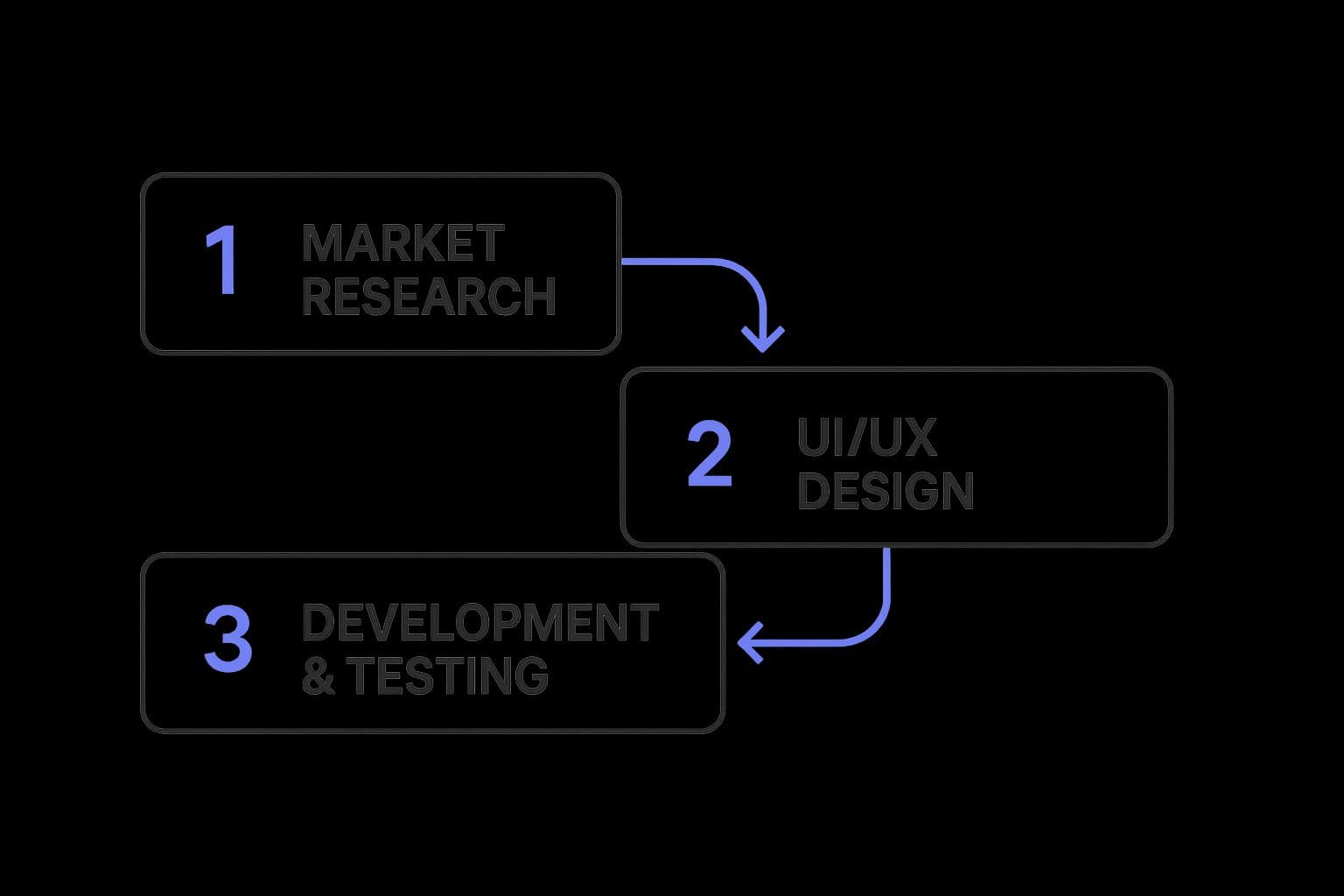
As you can see, the heavy lifting of planning and design comes long before a single line of code is written. This is to make sure your tech choices are actually solving a real-world problem.
Picking Your Core Programming Language
The language you choose for your backend is the engine of your app. It’s what will process transactions, crunch numbers, and manage all the data flowing through your system. Every language has its own community, set of tools, and available talent, making this a critical strategic decision.
Here are a few of the most common choices I see in the wild:
- Python: If your app leans heavily on data science, machine learning, or AI, Python is often the best bet. Its straightforward syntax and powerful libraries like Pandas and TensorFlow are perfect for building things like fraud detection algorithms or smart financial advisors.
- Java: A true workhorse in the enterprise world, Java is known for being incredibly stable, secure, and fast. Its ability to run anywhere makes it a go-to for massive, complex systems like core banking platforms or high-frequency trading applications.
- Kotlin & Swift: When a perfect native mobile experience is your top priority, look no further. Kotlin (for Android) and Swift (for iOS) give you unmatched performance, tighter security, and deep integration with device features like biometric scanners—a must-have for modern fintech.
Your app's main purpose should guide your choice. An AI-powered robo-advisor would be a natural fit for Python, whereas a simple mobile payment app would gain a huge advantage from a native Kotlin or Swift build.
Nailing Your Database Strategy
Let's be clear: financial data is sensitive, highly structured, and needs to be handled with absolute precision. Your database is the digital vault for this information, and choosing the right one is non-negotiable for both performance and compliance.
You’re typically deciding between two major types:
- SQL Databases (like PostgreSQL): These are the gold standard for structured data, which describes most financial information—think transaction logs, user accounts, and balances. PostgreSQL is a huge favorite in fintech because of its rock-solid reliability and strict data integrity rules. It ensures every record is consistent and accurate.
- NoSQL Databases (like MongoDB): These databases offer a lot more flexibility and are fantastic for handling huge amounts of unstructured or semi-structured data. In fintech, you might use something like MongoDB to store user behavior analytics, application logs, or customer profile details that don’t fit neatly into traditional tables.
I've found that many of the best fintech apps actually use a hybrid model. They’ll use PostgreSQL for mission-critical transaction data while relying on MongoDB for analytics and user personalization, effectively getting the best of both worlds.
Choosing Your Cloud Infrastructure
The era of managing your own physical servers is thankfully over. Today’s cloud platforms give you the power to scale on demand, with the security and reliability you need to run a modern fintech company. The "big three" providers all have incredible tools specifically designed for financial services.
To help you get started, I’ve put together a quick comparison of the common technology choices you'll be making for the different layers of your fintech application.
Fintech Tech Stack Comparison
| Component | Technology Option | Primary Strengths | Best For |
|---|---|---|---|
| Backend Language | Python | Extensive data science & ML libraries, rapid development. | AI-driven advising, fraud detection, analytics platforms. |
| Backend Language | Java | High performance, platform independence, strong security. | Large-scale enterprise systems, banking platforms, trading engines. |
| Mobile Native | Swift (iOS) / Kotlin (Android) | Superior performance, access to native device features. | Consumer-facing mobile wallets, banking apps, payment gateways. |
| Database | PostgreSQL (SQL) | Data integrity, reliability, ACID compliance. | Core transaction processing, user account management. |
| Database | MongoDB (NoSQL) | Flexibility, scalability for large data volumes. | Analytics, user profiles, logging, content management. |
| Cloud Provider | AWS | Mature, extensive services, strong compliance frameworks. | Startups needing a wide toolkit and enterprises with strict compliance needs. |
| Cloud Provider | Google Cloud | Elite data analytics & machine learning capabilities. | Fintechs building predictive models or AI-powered features. |
| Cloud Provider | Microsoft Azure | Strong enterprise integration, excellent hybrid cloud support. | Established institutions integrating with existing Microsoft systems. |
Ultimately, the choice often boils down to your team’s existing skills and which specific services your app will depend on most. A team with deep Kubernetes experience might lean toward Google Cloud, while a company already embedded in the Microsoft ecosystem would naturally find Azure to be a smoother fit. If you need the widest array of mature tools, AWS is almost always a safe bet.
Designing an Intuitive and Trustworthy UX

In fintech, your user experience isn’t just about aesthetics; it’s the bedrock of trust. You're asking people to hand over access to their financial lives. If your app feels clunky, confusing, or just a bit off, they'll be gone in a heartbeat. A great design makes someone feel confident and secure every single time they open it.
This is where a user-centric mindset becomes non-negotiable. Every single element, from the shade of a button to the copy on a confirmation screen, needs to be intentional. Your goal is to take complicated financial actions and make them feel simple and approachable, not intimidating.
Crafting a Frictionless Onboarding Experience
The onboarding process is your one shot at a first impression. If you get it wrong, you’ve lost a potential customer before they’ve even seen their dashboard. A long, drawn-out sign-up form that feels like an interrogation is a guaranteed way to send them running.
The trick is to ask for the absolute bare minimum to get them started. Break the sign-up into bite-sized, manageable steps. Apps like Chime nail this with a conversational tone and clear progress bars, making you feel guided, not grilled.
- Progressive Disclosure: Don't hit them with everything at once. Get the basics for sign-up, and then ask for things like a linked bank account only when they actually need to use that feature.
- Clear Instructions: Ditch the financial jargon. Use plain English and explain why you need sensitive info, like a social security number, to build that initial trust.
- Visual Feedback: Use instant validation to show when they've entered something correctly and provide gentle, helpful error messages when they haven't.
This approach dramatically cuts down on the frustration that causes people to abandon the sign-up process.
Designing Dashboards for Clarity and Confidence
Once they’re in, the dashboard is their financial command center. The single biggest mistake I see here is overwhelming users with a wall of numbers and charts. A good design needs to surface the most critical information immediately, so they can understand their financial health at a glance.
Think about what people do most often: check a balance, see recent transactions, or send money. These core actions should be front and center, never more than a tap or two away. Revolut, for instance, uses a super clean layout with bold typography to make account balances pop, so the most important info is instantly scannable.
For a deeper dive into creating interfaces your users will love, our guide on user experience design best practices is packed with valuable insights.
Creating Seamless and Secure Transaction Flows
Sending money is a high-stakes activity. The user experience for these flows has to be absolutely flawless to prevent costly mistakes and give users peace of mind. Each step must feel logical, predictable, and reassuring.
Let's break down the entire journey:
- Initiation: It should be completely obvious how to start. Use clear calls to action like "Send Money" or "Pay."
- Input: Use smart defaults wherever you can. Allowing users to pull recipients from their phone's contacts, for example, is far better than forcing them to type everything manually.
- Confirmation: Before they hit send, show them a simple summary of the transaction—amount, recipient, and any fees. This "moment of pause" is vital for catching errors.
- Feedback: The second a transaction goes through, provide immediate and unmistakable confirmation. A simple checkmark and a "Success!" message can instantly wash away any user anxiety.
In the world of fintech apps development, this obsessive attention to UX isn't just a nice-to-have. It's the very core of a product people will trust and use every day.
Building and Launching Your MVP
Alright, this is where the rubber meets the road.Getting from a solid idea to a live product is where your vision really comes alive. The biggest mistake I see founders make is trying to build their entire dream app all at once. Don't do that. The key is launching a Minimum Viable Product (MVP).
Think of an MVP as your strategic first strike—a clean, focused version of your app that solves one core problem, and solves it incredibly well.
This gets you into the market fast, letting you test your assumptions with real people before you sink a fortune into features nobody actually needs. And speed matters. With an estimated 30,000 new fintech startups popping up in 2024, a focused launch is your best bet for survival. The latest fintech market trends and statistics from Exploding Topics paint a clear picture: the space is crowded and moving fast.
Defining Your MVP Core Features
Let’s be clear: an MVP is not a sloppy, half-baked product. It’s a polished, reliable solution to your user's single most painful problem. If your app is for freelancers, what's the one thing they need most? Quick invoicing or simple tax estimations? You have to pick one to start.
How do you choose? Go back to your user research. What was the one complaint you heard over and over again? That’s your starting point.
- Write Out User Stories: Frame features from the user’s point of view. For example: "As a freelancer, I need to create and send a professional invoice in under two minutes so I can get paid faster." This keeps the focus on the outcome for the user.
- Prioritize Ruthlessly: A simple impact vs. effort matrix works wonders here. Plot every potential feature on it. Your MVP features are the ones sitting squarely in the "High-Impact, Low-Effort" box.
- Draw a Hard Line: Everything else goes into the backlog for later. It’s so tempting to add "just one more little thing," but that’s how scope creep kills your timeline and burns through your cash.
This discipline ensures your first build is laser-focused on what matters. We dig much deeper into this process in our guide on effective MVP development strategies.
Adopting Agile Development for Rapid Iteration
Once you’ve got that core feature list locked down, an agile development approach is your best friend. Instead of creating a massive, rigid plan for the next six months, agile breaks the work into small, manageable two-week cycles called "sprints." At the end of each sprint, you have a tangible, working piece of the product to review.
This is perfect for the inherent uncertainty of launching something new. It lets your team adapt on the fly. Maybe early testers find a button confusing or a transaction flow feels clunky. With agile, you can pivot and fix it in the very next sprint instead of finding out after the entire app is already built.
Testing and Securing Your MVP Before Launch
Testing isn't something you do at the end. It’s a continuous process that has to run in parallel with development from day one. And because we're talking about people's money, this is one area where you absolutely cannot cut corners, even for an MVP.
Your testing needs to have multiple layers.
- Functional Testing: Simple but crucial. Does the app actually do what it's supposed to? Every button, every form, every workflow needs to be hammered on to make sure it works perfectly.
- Performance Testing: What happens when 100 people try to sign up at the same time? Your app has to feel snappy and responsive, even when it’s under stress.
- Penetration Testing: This is non-negotiable for any fintech product. You literally hire professional, ethical hackers to do their worst—to find security holes in your system before the bad guys do.
Navigating App Store Deployment
Finally, getting your app onto the Apple App Store and Google Play Store is the last big hurdle. It’s not as simple as just uploading a file and hitting "publish." Both platforms have incredibly strict review guidelines, and they're especially tough on financial apps.
You'll need to have your ducks in a row with clear documentation on your security protocols, data handling policies, and customer support plans. Be prepared for a review process that could take days or even a couple of weeks. If you get a rejection, they'll give you feedback—address it, and resubmit.
Alongside this, make sure your backend is ready. Setting up a scalable server infrastructure on a cloud platform like AWS or Google Cloud from the start is essential to handle user growth without crashing on launch day.
Answering Your Top Fintech App Development Questions
When you're ready to build a fintech app, the big picture strategy is just the start. The real questions start to surface when you think about the practical side of things—namely, how much time and money this is all going to take. Let's get straight to the point and tackle the most common questions we hear from founders.
How Long Does It Take to Build a Fintech App?
This is always the first question, and the only honest answer is: it depends. A straightforward payment app is a completely different beast than a complex investment platform packed with AI-driven analytics. Still, we can map out a realistic timeline for a well-managed project.
Generally, you should plan for the entire process—from the first sketch to launch day—to take somewhere between 5 and 11 months. This isn't just one long stretch of coding; it's broken down into distinct phases.
Here’s a typical flow:
- Discovery & Planning (2-5 weeks): This is your foundation. You'll nail down the project scope, dig into market research, and lock in your core feature list.
- Design & Prototyping (3-5 weeks): The UI/UX team gets to work, creating wireframes, mockups, and clickable prototypes. This is where the user experience truly comes to life.
- Development (3-6 months): The main event. This is the longest and most resource-heavy phase, where engineers build out the frontend, backend, and all the necessary APIs.
- Testing & QA (2-4 weeks): Every corner of the app is put through its paces. Rigorous testing ensures everything is secure, bug-free, and can handle real-world stress.
- Launch & Deployment (1-2 weeks): Time to go live! This involves submitting the app to the app stores and getting the backend infrastructure up and running.
Keep in mind, these are estimates for a Minimum Viable Product (MVP). If your app requires heavy third-party integrations or has to navigate a maze of compliance rules, the timeline can easily stretch beyond this range.
What Are the Biggest Hurdles to Expect?
Every project has its own unique quirks, but a few common challenges pop up again and again in the fintech world. Knowing what they are ahead of time lets you plan for them instead of getting blindsided.
The biggest one? Navigating regulatory compliance. The rules are dense, they change by region, and they’re constantly evolving. If you underestimate the time and money needed for things like KYC (Know Your Customer) and AML (Anti-Money Laundering), you're setting yourself up for major delays and serious legal headaches.
Another classic hurdle is integrating with legacy systems. Many fintech apps need to talk to traditional banks or financial data providers, and their old-school tech can be sluggish and poorly documented. Forging a reliable API connection can become a surprisingly tough and time-consuming job.
Finally, don't overlook the challenge of ensuring multi-platform compatibility. You want a smooth, consistent experience whether your user is on an iPhone, an Android, or a web browser. Achieving that requires meticulous planning and a ton of dedicated testing, otherwise you risk alienating a huge chunk of your potential audience.
How Much Does Fintech App Development Cost?
Just like the timeline, the cost can swing wildly. The final number depends on the app's complexity, the size and location of your team, and the tech stack you choose. That said, we can give you a solid ballpark figure.
So, where does all that money actually go? Here's a rough breakdown:
| Cost Component | Description | Estimated % of Budget |
|---|---|---|
| Development Team | The salaries for your developers, project managers, and QA folks. | 50-60% |
| UI/UX Design | Crafting the look, feel, and overall user journey. | 10-15% |
| Compliance & Security | Legal advice, security audits, and penetration testing. | 10-15% |
| Third-Party Services | Fees for APIs, cloud hosting, and other licensed software. | 5-10% |
| Ongoing Maintenance | Post-launch updates, bug fixes, and server costs. | 15-25% of initial cost, annually. |
And don't forget to budget for ongoing maintenance. It’s a critical piece of the puzzle that often gets overlooked. A good rule of thumb is to set aside about 25% of the initial development cost annually. This keeps your app secure, up-to-date, and compliant long after you've launched.
At Iglu Digital, we specialize in transforming your fintech concept into a market-ready MVP on a fixed price, agreed up front. Our accelerated process helps you validate your idea and launch faster, bypassing the long timelines and uncertainties of traditional development. Turn your vision into a reality with our expert team.