
Financial Services Software Development: Build Secure Fintech Apps

Table of Contents
At its core, financial services software development is all about creating specialized applications—think mobile banking apps, powerful trading platforms, or streamlined insurance systems—that put security, compliance, and user trust above all else. It’s a move away from generic, one-size-fits-all solutions, giving businesses a serious competitive advantage with features built specifically for their customers.
The Foundations of Modern Fintech Software

In finance, software isn't just another tool. It’s the vault, the financial advisor, and the transaction engine, all rolled into one digital package. That's why building these platforms is less about writing lines of code and more about engineering trust from the ground up.
While off-the-shelf software can get you started, it often boxes businesses into a rigid model that doesn’t leave much room for innovation or growth. This is precisely where custom financial software development comes in, creating a powerful opening for companies to break away from the pack.
By building a solution from scratch, you can address very specific market needs, weave in specialized security protocols, and craft a seamless user experience that generic products just can’t replicate.
Why Custom Development Is a Game-Changer
Here’s a simple way to think about it: an off-the-shelf product is like a standard rental car. It’ll get you from point A to point B, no problem. But a custom-built platform? That’s like a high-performance vehicle designed for a specific racetrack, where every single component is fine-tuned for speed, safety, and a singular goal. In a field where precision and reliability are everything, that tailored approach is essential.
This shift toward custom solutions is clearly reflected in the market's growth. The global financial services software market was valued at around USD 151 billion in 2024, a number driven by both nimble startups and established giants looking to innovate. They're all investing in dedicated teams of developers, QA testers, and cloud specialists to build the next generation of financial tools.
A successful fintech product needs a balanced blueprint—one that marries exciting, new features with the non-negotiable foundations of security and regulatory compliance. The payoff for getting this right is huge.
- Enhanced Security: Custom builds allow for security measures designed specifically for your system, protecting sensitive data far more effectively than any generic software could.
- Superior User Experience: When a platform is built around the way your users actually behave, it builds trust and drives adoption. You can learn more about these core principles by reviewing user experience design best practices.
- Scalability for Growth: A bespoke architecture is designed to grow with your business. You can add new features and handle more users without having to start over from scratch.
- Competitive Differentiation: In a crowded market, unique features and an intuitive interface can be the one thing that convinces a customer to choose you over a competitor.
A truly effective financial application doesn't just process transactions; it builds a digital relationship with the user, grounded in reliability and intuitive design.
Ultimately, the goal is to take a great idea and turn it into a secure, compliant, and market-ready application. That journey doesn't start with code. It starts with a deep understanding of the unique challenges and incredible opportunities waiting in the financial services industry.
Navigating the Regulatory and Compliance Maze
When you're building financial software, security and compliance aren't just features—they're the absolute foundation. In many industries, you can treat regulations like a final checklist. In fintech, however, these rules are baked into the very DNA of your product. Trying to ignore them is like building a skyscraper on a foundation of sand.
At first glance, the regulatory landscape can look like an intimidating alphabet soup of acronyms and dense legal text. But the core ideas are pretty straightforward. Every rule exists for a good reason: to protect consumers, stop financial crime, and keep the entire system stable. For anyone leading a fintech project, getting a handle on this world isn't just a good idea; it's essential.
The Pillars of Financial Regulation
Think of financial regulations as the advanced safety systems in a Formula 1 car. They aren't there to slow you down. They're there to make sure you can operate at incredible speeds without everything falling apart. A few key standards really form the backbone of this system.
- Payment Card Industry Data Security Standard (PCI DSS): If your app touches credit card information in any way, this is your bible. PCI DSS sets incredibly strict rules for how you store, process, and send cardholder data. It demands things like heavy-duty encryption and secure networks to shut down fraud.
- General Data Protection Regulation (GDPR): This is a huge deal in data privacy, governing how companies manage the personal data of anyone in the European Union. GDPR champions concepts like collecting only the data you absolutely need and giving users real control over their own information. If you have global ambitions, you have to pay attention to this.
- Know Your Customer (KYC) and Anti-Money Laundering (AML): These two work hand-in-hand as your platform's digital security guards. KYC protocols are all about verifying that your users are who they claim to be. AML systems, on the other hand, keep an eye on transactions to flag suspicious activity and fight crime. They are critical for building a platform that people can actually trust.
This growing web of regulations is a massive force pushing the market forward. The Banking, Financial Services, and Insurance (BFSI) software market hit a value of USD 91.42 billion in 2024 and is expected to rocket to USD 221.39 billion by 2033. A huge chunk of that growth is fueled by the need for software that makes compliance simpler and more automatic. You can dive deeper into these BFSI market trends and projections to see where things are headed.
Adopting a Compliance-by-Design Mindset
The smartest way to handle all of this is with a compliance-by-design approach. What does that mean? It means you’re thinking about the rules at every single stage of development, from the first sketch on a whiteboard to the final code deployment. It’s a world away from trying to tack on compliance features at the last minute—a move that almost always leads to expensive rework and painful delays.
Instead of seeing regulations as a roadblock, the best fintech innovators use them as a blueprint for building trust. After all, a compliant product is almost always a more secure and reliable one.
When you think this way, compliance stops being a chore and starts becoming a real competitive edge. A product built with the rules in mind from day one sends a powerful message: you're serious about protecting your users and running a tight ship. In finance, that’s a massive differentiator.
Documenting for Success
A huge piece of the compliance-by-design puzzle is rigorous documentation. Regulators and auditors don't just take your word for it; they need to see clear, detailed records of how your system works, secures data, and follows the law. This isn't just about busywork. It's about proving you've built a transparent and verifiable system.
Well-organized records are your best defense and proof of due diligence. You can get a great head start by looking at different software documentation templates that are built for clarity and completeness. Keeping this documentation up-to-date ensures your development process is not only compliant but also organized and ready for any audit that comes your way. By making compliance an integral part of how you build, you create a stronger, more resilient financial product from the ground up.
Choosing Your Technology Stack for Fintech Success
Picking the right technologies for your financial application is a lot like designing a fortress. Every single component matters. The database is your reinforced steel vault, the APIs are your secure, guarded gateways, and the code itself is the complex locking mechanism. A single weak point can compromise the entire structure, and in financial software, there's absolutely no room for error.
This "tech stack" is more than just a shopping list of tools; it's the architectural blueprint for your entire system. It’s broken down into layers, and each layer has a very specific job. Making the right choices here means striking a delicate balance between raw performance, ironclad security, and the ability to grow with your user base.
The Frontend: The Public Face of Your Application
The frontend is everything your users see, touch, and interact with. Think of it as the polished bank lobby, the intuitive ATM screen, or the easy-to-read investment dashboard on their phone. The entire goal is to build a seamless, trustworthy experience. A clunky, slow, or confusing interface will send users running, no matter how brilliant the technology is behind the curtain.
This is why modern, battle-tested frameworks are non-negotiable.
- React: The go-to choice for building dynamic and responsive user interfaces. Its component-based architecture is fantastic for creating complex UIs that are still easy to manage.
- Angular: A more comprehensive, all-in-one framework that provides a ton of structure out of the box. It’s a favorite for large, enterprise-grade fintech projects that need that level of rigidity.
- Vue.js: Known for being incredibly approachable and easy to integrate, Vue is perfect for projects that need to move fast without sacrificing power or flexibility.
Great frontend tech makes complicated financial data feel simple and accessible. That’s the key to getting people on board and keeping them there.
The Backend: The Secure Engine Room
If the frontend is the lobby, the backend is the high-security engine room where all the real work gets done. This is where your business logic executes, transactions are processed, and sensitive data is managed under lock and key. The languages and frameworks you pick here have a direct, massive impact on the speed, reliability, and security of your entire application.
This is where your app’s integrity is forged. Performance and security are not just features; they are absolute requirements. A delay of a few milliseconds in a transaction or a tiny crack in the security can have catastrophic consequences.
A fintech app's success almost always comes down to its backend. It has to be fast enough to process a flood of transactions in an instant and tough enough to shield every byte of user data from threats.
This is where you see languages like Python, with its incredible libraries for data science and machine learning, or Node.js, which shines in handling thousands of simultaneous connections for real-time platforms.
The image below shows how these core backend systems act as the central hub, connecting internal settings with external services.
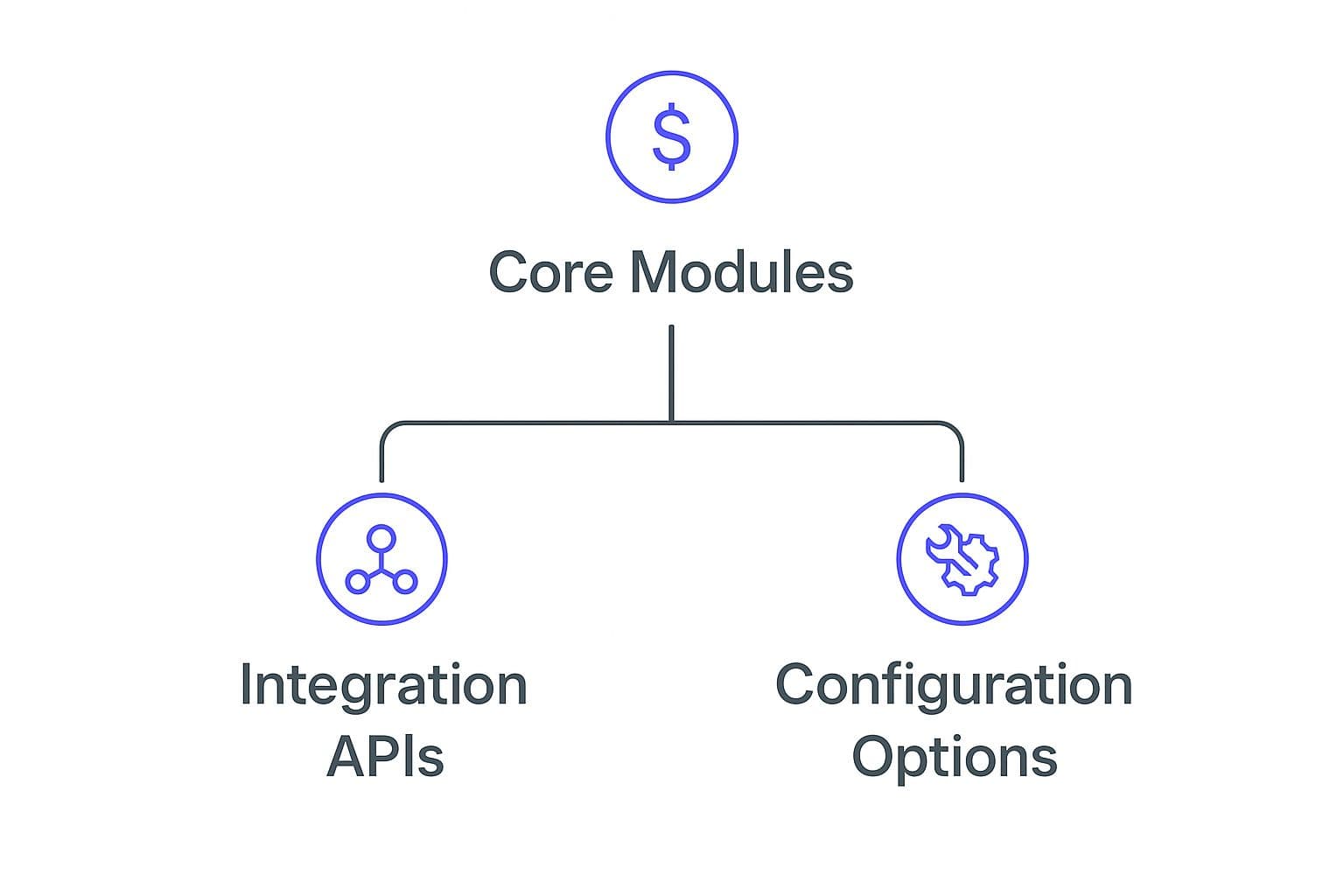
It’s a great visual for understanding how a well-built backend has to be both powerful on its own and a master of communication with the outside world.
Databases And APIs: The Foundation And Gateways
Your database is the foundation of your fortress. It's where you store highly sensitive user information and transaction histories, and its integrity must be absolute. This is why you often see relational databases like PostgreSQL in fintech; their strict rules for data consistency ensure financial records are always accurate. For less structured, high-volume data, a NoSQL database like MongoDB might get the nod.
APIs (Application Programming Interfaces), on the other hand, are the secure checkpoints. They let different parts of your software talk to each other and connect to vital third-party services like payment gateways or credit-scoring bureaus. A well-designed API is what allows you to build a connected financial ecosystem without ever lowering your security shields.
To help put it all together, here’s a look at how some popular backend languages stack up for financial applications.
Backend Technology Comparison for Financial Applications
Choosing the right backend language is one of the most critical decisions you'll make. Each option comes with its own set of strengths and trade-offs that can significantly impact your development speed, performance, and long-term maintenance. This table breaks down the top contenders.
| Language | Key Strengths for Fintech | Common Use Cases | Considerations |
|---|---|---|---|
| Python | Powerful data analysis libraries, fast development cycles, and deep AI/ML capabilities. | Algorithmic trading, risk management platforms, and data analytics dashboards. | Can be slower for CPU-heavy tasks compared to compiled languages. |
| Java | Rock-solid security, platform independence, and a huge, mature ecosystem. | Enterprise-grade banking systems, large-scale trading applications, and Android apps. | Can be more resource-intensive and has a steeper learning curve. |
| Node.js | Phenomenal for real-time apps, handles high I/O operations with ease, and is very scalable. | Payment processing gateways, mobile banking backends, and investment platforms. | Its single-threaded nature isn't ideal for heavy computational work. |
| Go (Golang) | Blazing-fast performance, built-in concurrency support, and very efficient memory use. | High-frequency trading systems, blockchain applications, and payment networks. | The ecosystem and talent pool are smaller compared to Java or Python. |
In the end, your tech stack is a strategic decision that will define your product's potential for years to come. By carefully considering the role of each layer—from the user-facing frontend to the foundational database—you can build a financial application that is secure, scalable, and built for success.
Your Blueprint for Building Financial Software

Turning a great fintech idea into a secure, market-ready product is a journey, not a sprint. You can't just wing it. This process demands a clear roadmap that balances the need for speed with the absolute, non-negotiable requirements of security and compliance. Each phase of the financial services software development lifecycle builds directly on the last, making sure the final product is not only functional but also trustworthy and resilient.
Think of it like building a high-tech bank vault. You don’t just start welding steel plates together. First, you need detailed architectural plans (Discovery), then a foolproof locking mechanism and interior layout (UI/UX), followed by meticulous construction (Development), and finally, a battery of rigorous stress tests (QA) before you even think about storing a single dollar inside.
The Critical Discovery Phase
Before anyone writes a single line of code, the most important work has already begun: the discovery phase. This is where you get to the heart of the problem your software will solve, figure out exactly who your target users are, and map out the must-have features. It’s a deep dive into both user frustrations and technical possibilities, ensuring what you build is something people actually want and need.
In this stage, your team will be talking to stakeholders, dissecting what competitors are doing right (and wrong), and drawing a clear line around the project's scope. This initial planning is your best defense against costly "scope creep" down the road and gets everyone—from developers to investors—on the same page. The output is a detailed project specification that becomes the north star for the entire build.
Designing for Trust and Usability
In finance, design isn't just about looking good; it's about building trust. A clean, intuitive, and transparent interface makes users feel secure and in control of their sensitive financial information. If they feel lost or suspect information is being hidden, that trust evaporates in an instant, and so do they.
The design phase is all about creating:
- Intuitive Navigation: Users should find what they need without a second thought, whether it’s checking their balance or making a trade.
- A Clear Visual Hierarchy: The most important information and actions should jump off the screen, guiding the user’s focus where it needs to be.
- A Responsive Design: The experience has to feel seamless and consistent, whether they're on a desktop at work or a smartphone on the go.
This user-first approach guarantees the final product is not just powerful but also genuinely easy to use, which is essential for getting people to adopt it.
Agile Development and Iteration
With a solid plan and user-focused design locked in, the coding can finally begin. Today, almost every fintech project is built using an agile development methodology. This approach breaks the entire project into smaller, digestible cycles called "sprints." At the end of each sprint, the team delivers a tangible, working piece of the software.
This iterative process is a game-changer. It allows for constant feedback and course correction, making sure the project stays on track and can adapt to new information. Instead of waiting months for a big reveal, stakeholders see real progress every couple of weeks and can steer the ship along the way. To see how to best structure this, exploring a comprehensive software implementation plan can give you a solid framework.
Rigorous Quality Assurance and Testing
In the financial world, a tiny bug can have massive, catastrophic consequences. This is why the Quality Assurance (QA) phase isn't just a box to be checked—it's one of the most critical stages in the entire lifecycle. We're not just looking for glitches; we're actively hunting for security vulnerabilities, performance bottlenecks, and compliance gaps.
Think of QA as the ultimate stress test. It's where you intentionally try to break the system to find its weaknesses before a real-world threat does.
A proper testing strategy involves multiple layers:
- Functional Testing: Does every feature work exactly as it's supposed to?
- Security Testing: This means hiring experts for penetration testing and vulnerability scans to find and patch security holes.
- Performance Testing: We simulate thousands of users logging on at once to make sure the app stays fast and responsive under pressure.
- Compliance Audits: This confirms the software follows every relevant financial regulation, like PCI DSS and GDPR.
Launching with a Minimum Viable Product
Finally, it’s time to go live. A smart and highly effective strategy in fintech is to launch with a Minimum Viable Product (MVP) first. An MVP isn't an unfinished app; it’s a lean, focused version that contains only the core features needed to solve one key problem for your first wave of users.
This approach lets you get to market faster, gather priceless feedback from real people, and prove your core idea is a winner before you invest a fortune in building out every feature you've ever dreamed of. The data and insights you get from your MVP users become the roadmap for what to build next, ensuring you create a product that customers will truly value.
Building for Today and Tomorrow: Essential Features and Future Trends
A solid financial app does more than just solve today's problems—it's designed with tomorrow in mind. Building successful financial software means weaving in the core features users have come to expect, while also keeping a close eye on where the industry is heading. This two-pronged approach ensures your app is useful right out of the gate and has the legs to evolve over time.
Think of it this way: certain features are simply the price of entry. They're the non-negotiables that build a foundation of trust and make the platform usable. Without them, you’re not even in the game.
The Table Stakes: Must-Have Features
- Multi-Factor Authentication (MFA): This is your digital deadbolt. It’s no longer enough to just have a password; MFA adds a crucial second layer of security, drastically cutting down the risk of someone breaking into an account. It's a fundamental trust-builder.
- Seamless Payment Gateway Integrations: Your software has to play nicely with the entire payment ecosystem. Whether a user is paying with a credit card, a bank transfer, or a digital wallet, the process needs to be completely frictionless. Any hiccup here erodes confidence instantly.
- An Intuitive Transaction Dashboard: People need to see their financial story clearly. A clean, visual dashboard that lays out transactions, tracks balances, and shows investment performance gives users a sense of control and clarity. It's about empowering them, not overwhelming them.
Once you have these fundamentals locked down, you can start looking ahead. The real magic happens when you anticipate what’s next and build for it. The fintech world moves fast, and new tech is constantly changing what’s possible—and what users expect.
Keeping Your Eye on the Horizon
The most successful financial platforms aren't static products; they're living systems built to absorb new technology. This forward-thinking mindset is what turns a potential market disruption into your next big advantage.
This constant push for innovation is exactly why the global financial services software market is booming. Projections show it’s set to grow at a compound annual growth rate of about 8.9%, reaching an estimated USD 268.45 billion by 2030. A lot of the drivers behind this market growth are things like cloud computing and the integration of AI.
Three trends in particular are reshaping the landscape:
- AI and Machine Learning: AI is a massive leap forward for things like fraud detection. Algorithms can catch suspicious activity in real-time, spotting patterns a human would miss. It’s also the engine behind personalized financial advice and automated risk analysis, making platforms smarter and more attuned to individual users.
- Blockchain Technology: Forget the crypto hype for a second. The real power of blockchain is its ability to create a secure, transparent, and immutable record of transactions. This is a game-changer for anything from streamlining international payments to securing digital identities and verifying complex contracts.
- API-Driven Open Banking: Open banking uses APIs to let different financial apps talk to each other securely. This creates a connected ecosystem where users can see and manage all their accounts—from different banks, investment firms, and more—all in one place. It’s about creating a truly unified and convenient financial life for the user.
By nailing the essentials today and building a roadmap for these future trends, you’re not just creating a piece of software. You’re building a platform that can stand the test of time and remain indispensable to your users for years to come.
Common Questions About Fintech Development
When you're getting ready to build a financial product, a lot of questions pop up. It’s completely normal. You're dealing with people's money, so the stakes around budgeting, timelines, and especially security are incredibly high.
Let’s get some of the most common questions out of the way. Think of this as a quick FAQ to help you ground your project in reality and make smarter decisions from day one.
How Much Does It Cost to Develop Financial Software?
There’s no single price tag for building financial software. The final cost depends entirely on what you're trying to build. A lean Minimum Viable Product (MVP) could start in the ballpark of $75,000, but a complex, enterprise-level platform can easily soar past $500,000.
What drives that huge range? It really boils down to a few key things. The number and sophistication of your features is the biggest factor. Beyond that, the third-party systems you need to connect with—think payment gateways like Stripe, credit reporting agencies, or live market data feeds—all add to the complexity and cost. Don't forget the heavy-duty security and compliance measures, which are non-negotiable in this space.
The only way to get a real number is to go through a proper discovery phase. That's where you map out every detail, which allows a development team to give you a budget you can actually count on.
What Are the Biggest Security Risks in Fintech Software?
In fintech, security isn't just a feature on a list; it’s the bedrock of your entire business. If customers don't trust you with their money, you have nothing. The biggest threats are the ones that could compromise sensitive data or break the system's integrity.
Here’s what keeps security experts up at night:
- Data Breaches: The number one concern. Unauthorized access to personal and financial details can destroy a company's reputation and harm its users irreparably.
- Insecure APIs: Your software talks to other services through APIs. If those connections aren't locked down, they become a wide-open door for attackers.
- Injection Attacks: This is a classic but still deadly attack where a hacker inserts malicious code to trick your database into giving up information it shouldn't.
- Compliance Failures: Messing up regulations like PCI DSS (for card payments) or GDPR isn't just a slap on the wrist. It can lead to crippling fines and a total loss of your license to operate.
A strong security posture isn't a one-and-done task. It’s an ongoing commitment that involves secure coding habits, regular "ethical hacking" (penetration testing), and constant monitoring to catch threats before they do real damage.
How Long Does It Take to Build a Fintech MVP?
Getting your Minimum Viable Product (MVP) out the door is all about speed-to-market. You want to get your core idea in front of actual users as fast as possible. For most fintech projects, you can expect an MVP to take anywhere from 4 to 9 months to build and launch.
Of course, that timeline is shaped by the complexity of your core features. A simple payment app is going to be a lot quicker to build than a trading platform with complex algorithms. The backend infrastructure and the number of API integrations also play a huge role in how long the process takes.
Remember, the whole point of an MVP is to solve one key problem for your target user, and do it well. This lets you gather real-world feedback fast, which is far more valuable than spending a year building something nobody actually wants. That initial feedback is what will guide your next steps and help you build a product with a real future.
Ready to turn your fintech idea into a market-ready product without the long wait? Iglu Digital specializes in building and launching MVPs for a price agreed before a line of code is written, giving you the speed and agility to test your concept with real users. Transform your vision into a reality by visiting https://iglu.dev.