Customized Healthcare Software Development: Build Better Solutions
Table of Contents
When off-the-shelf software just doesn't cut it, customized healthcare software development steps in. This is all about building applications from the ground up to solve the specific challenges your medical organization faces—whether that’s in your clinical workflows, patient interactions, or back-office operations. Unlike a one-size-fits-all solution, a custom build gives you complete control over features, security, and how the system connects with your other tools.
This guide is your starting point for creating software that's not just functional, but compliant, scalable, and genuinely useful for your team and patients.

Your Blueprint for Modern Healthcare Software
Forward-thinking healthcare providers are ditching generic software. Why? Because they've learned the hard way that forcing highly skilled staff to work around clunky, inefficient systems creates more problems than it solves. The smart alternative is customized healthcare software development, an approach that puts the provider's unique needs first.
This isn't just a niche trend; it's a massive market shift. The demand for digital health solutions is driving huge growth in the global healthcare enterprise software market. It was valued at USD 43.62 billion in one year and is projected to skyrocket to nearly USD 158.63 billion within the next decade. You can dig into the full market analysis of this expansion to see just how fast things are moving.
Why Is Customization So Important?
Building your own software means you can create tools that solve the real, everyday headaches your team faces. Think about an EHR system that clinicians actually find intuitive, or a patient portal that dramatically reduces the number of administrative phone calls. These aren't just pipe dreams—they're the direct result of purpose-built applications.
Here’s why so many providers are choosing to go custom:
- Solve Your Specific Problems: You can target the exact pain points in your organization, whether that’s a bottleneck in appointment scheduling or a manual billing process that’s prone to errors.
- Strengthen Data Security: Go beyond the baseline protections of generic software. You can implement security protocols designed for your specific risk profile and compliance requirements.
- Achieve True Interoperability: Design systems that talk to each other flawlessly. This means seamless communication with your existing technology, from lab equipment to insurance platforms.
- Create a Better User Experience: When you design interfaces with your clinicians and patients in mind, you get higher adoption rates and spend far less time on training.
The Core Components of a Successful Project
Building custom software is a major undertaking, but a clear framework makes it manageable. A successful project really boils down to a few key pillars that guide you from the initial idea all the way through long-term maintenance. Each one is critical for making sure the final product isn't just a piece of code, but a valuable, sustainable asset for your organization.
Key Takeaway: By focusing on the user from day one, you build software that integrates into daily routines rather than disrupting them. This user-centric philosophy is the secret to high adoption and long-term success in any healthcare setting.
To get started, it helps to understand the different stages of the journey. The table below breaks down the core components of a typical custom healthcare software project. Having this clear roadmap helps set expectations and ensures everyone—from developers to doctors—is aligned on the goals from the very beginning.
Core Components of a Custom Healthcare Software Project
| Project Pillar | Key Focus Area | Primary Goal |
|---|---|---|
| Strategic Planning | Requirements Gathering & User Stories | Define the core problem and map out essential features for a Minimum Viable Product (MVP). |
| Compliance & Security | Data Protection & Regulatory Adherence | Integrate HIPAA, GDPR, and other relevant standards into the software's architecture. |
| Technical Architecture | Technology Stack & Scalability | Select the right tools and infrastructure to support long-term growth and performance. |
| Iterative Development | Agile Sprints & Stakeholder Feedback | Build, test, and refine the product in short cycles to ensure it meets user needs. |
| Ongoing Maintenance | System Updates & User Support | Provide continuous support and enhancements to keep the software effective and secure. |
Think of these pillars not as a rigid checklist, but as a flexible foundation. Each phase informs the next, creating a cycle of continuous improvement that results in a much stronger final product.
Navigating Healthcare Compliance with Confidence
When you're building software for the healthcare space, compliance isn't just a box to check—it's the bedrock of patient trust. I've seen teams treat these regulations as an afterthought, and it's always a costly mistake. You simply can't bolt on security at the end. It has to be woven into the fabric of your application from day one.

This proactive mindset is non-negotiable in any customized healthcare software development project. Trying to patch security holes after the fact is not only more expensive but can bring your entire project to a grinding halt. True compliance means designing a system that’s inherently secure, protecting sensitive data at every single touchpoint.
Beyond the Basics of HIPAA
Everyone in the U.S. health tech space knows about the Health Insurance Portability and Accountability Act (HIPAA). It's the cornerstone of patient data protection here. But what if your app gains traction in Europe? Suddenly, you're dealing with the General Data Protection Regulation (GDPR), which brings its own set of demanding rules.
For example, GDPR champions the "right to be forgotten." This isn't just a policy; it's a technical requirement. Your system must be architected to find and permanently erase a specific user's data on request. If that wasn't planned from the beginning, you’re looking at a massive, complex rewrite.
A critical mistake is underestimating the global reach of data regulations. A single data breach can result in damages reaching millions, not to mention irreparable harm to your organization's reputation.
Your development team needs more than a passing familiarity with these regulations. They need to genuinely understand them. That means knowing exactly what data constitutes Protected Health Information (PHI) and the strict protocols for how it must be handled, stored, and transmitted.
Core Security Measures in Practice
Robust security isn't abstract. It comes down to concrete technical measures that create layers of defense around patient data. From my experience, there are three areas where you absolutely cannot cut corners.
- End-to-End Encryption (E2EE): This is the gold standard. E2EE ensures data is unreadable from the moment it leaves a user's device until it reaches its intended recipient. This protects information both "in transit" (as it moves over a network) and "at rest" (when it's sitting on a server or in a database).
- User-Friendly Multi-Factor Authentication (MFA): A second verification layer is essential, but it can't be a pain for busy clinicians. Clunky MFA just encourages workarounds. Smart solutions like biometric scans or simple push notifications are far more effective in a fast-paced hospital setting than asking someone to type in a six-digit code.
- Comprehensive Audit Trails: Your system must meticulously log every single action related to PHI. Who accessed it? When did they access it? From where? These logs are your source of truth and must be tamper-proof and easily searchable for auditors.
Imagine a scenario where a patient's chart is viewed. A proper audit trail won't just say it was opened. It will automatically capture the user's ID, the precise timestamp, their IP address, and the specific data that was viewed. That's the level of detail that stands up to scrutiny.
Building Compliance into Your Architecture
Integrating compliance from the start isn't just about avoiding fines; it saves an enormous amount of time and money while resulting in a product people trust. This means your initial architecture and design sessions must include a deep dive into compliance.
A great way to structure this is by adopting a proven framework. The NIST Cybersecurity Framework offers fantastic guidelines for managing cyber risks. Likewise, pursuing a standard like ISO 27001 provides a formal, structured approach to information security management that many partners and clients look for.
Here are some practical steps to bake into your development process:
- Role-Based Access Control (RBAC): This is fundamental. Users should only be able to see and do what is absolutely necessary for their job. A billing clerk has no reason to see a patient’s detailed clinical notes, and your system should enforce that boundary.
- Secure APIs: If your software needs to talk to other systems—like labs, pharmacies, or insurance portals—those Application Programming Interfaces (APIs) must be hardened against attack to prevent any unauthorized data leaks.
- Regular Security Audits: Don't wait for a breach to find your weak spots. Proactively hire third-party ethical hackers to conduct penetration testing. Let them try to break in so you can fix the vulnerabilities before a real attacker finds them.
By making these principles a core part of your customized healthcare software development process, you shift from a reactive to a proactive security posture. You're not just meeting regulations; you're building a product that clinicians and patients can genuinely rely on.
Choosing the Right Tech for Your Build
Picking the right technology for your healthcare application is one of those foundational decisions that will echo through the entire life of your project. This isn't just about selecting a programming language; it's about setting the architectural philosophy for your software. The choices you make here will directly define how scalable, secure, and adaptable your system will be down the road.
This is especially critical in customized healthcare software development, where your architecture has to support very specific clinical workflows while adhering to iron-clad compliance standards. Think of your tech stack as the invisible engine powering the entire operation. Get it right from the start, and you'll save yourself a world of headaches and wasted resources later on.
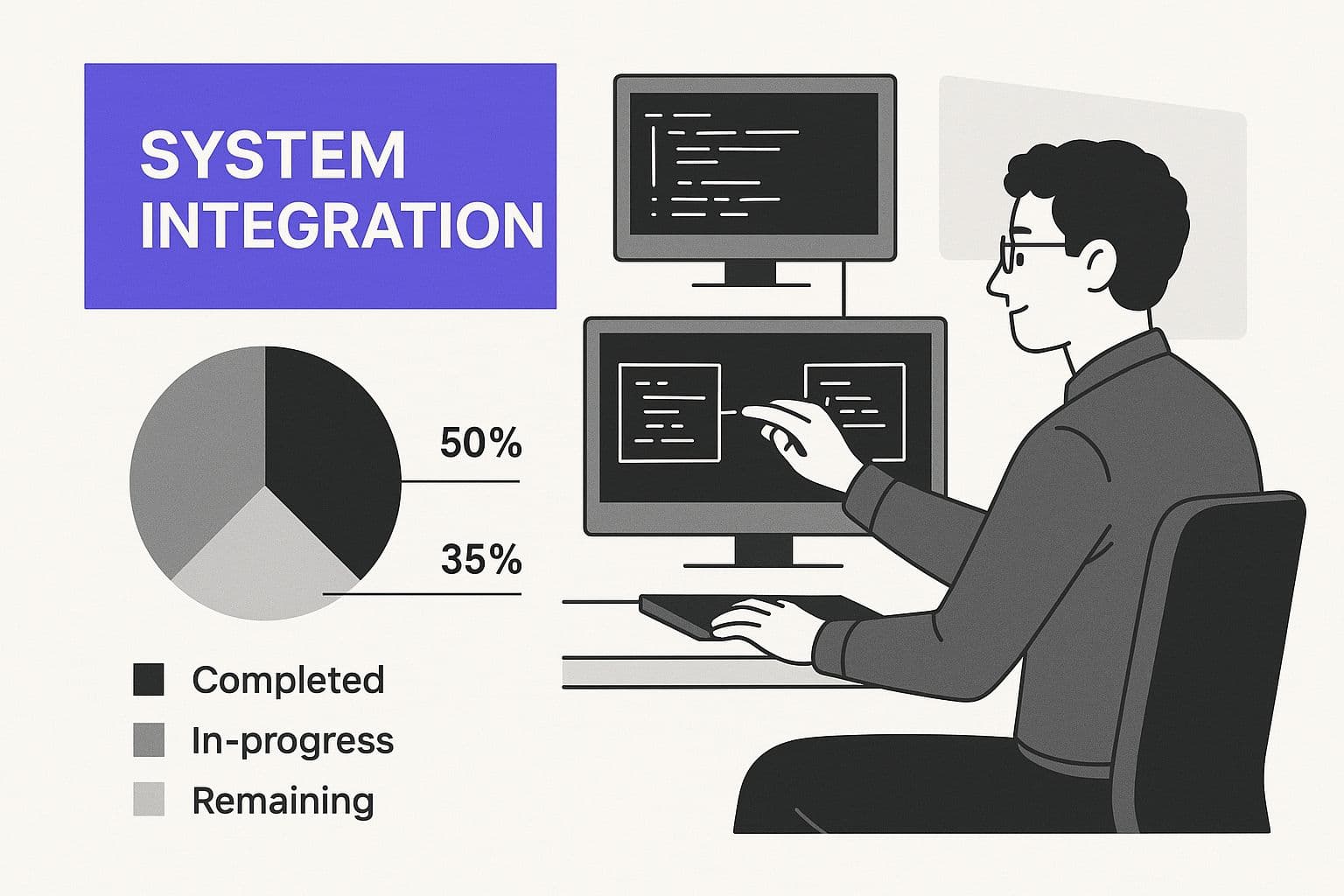
As you can see, modern software is a web of interconnected systems. Your architectural choices dictate just how smoothly these different parts can communicate and how easily you can plug in new features or third-party tools in the future.
Monolith vs. Microservices Architecture
One of the first, and biggest, forks in the road is the choice between a monolithic and a microservices architecture. Each has its place, and the right answer depends entirely on your project's scope and long-term vision.
A monolithic architecture is the traditional approach: you build the entire application as one single, unified unit. Every component, from the user interface to the database logic, is woven together. For a smaller, more straightforward application—say, an internal scheduling tool for a private clinic—this can be a perfectly fine choice. It's often simpler and faster to get off the ground.
On the other hand, a microservices architecture breaks the application into a collection of small, independent services. Each service is responsible for a single business function and can be developed, deployed, and scaled on its own. For large, complex systems, this modularity is a lifesaver.
Imagine a sprawling hospital's Electronic Health Record (EHR) system. With microservices, the team working on the patient registration service can push an update without any risk of breaking the e-prescribing or billing services. That kind of resilience is non-negotiable in a setting where system downtime simply isn't an option.
Cloud Platforms for Healthcare
Using cloud platforms like Amazon Web Services (AWS) or Microsoft Azure has become almost a given in software development today. For healthcare, their value is even more significant. These providers offer infrastructure with built-in, HIPAA-compliant configurations, which takes a massive slice of the compliance burden off your team's plate.
Here’s why leaning on a major cloud provider makes so much sense:
- Scalability on Demand: Easily manage spikes in user activity. Think about a patient portal during open enrollment season—you need to handle the load without a hitch.
- Managed Security: You get the benefit of world-class security, from physical data center protection to advanced network monitoring, that would be astronomically expensive to replicate on your own.
- Disaster Recovery: They provide robust backup and recovery solutions, ensuring that if the worst happens, you can get back online quickly and without data loss.
Selecting the Right Stack for the Job
Your application's specific purpose must be the primary driver of your technology choices. There's no magic "best" stack; the right tools depend entirely on the problem you're trying to solve.
A real-time telehealth platform that needs to deliver high-quality, low-latency video streaming has vastly different technical requirements than a data-heavy analytics platform built to crunch millions of patient records. The telehealth app might lean heavily on technologies like WebRTC for video, while the analytics tool would prioritize powerful data processing frameworks like Apache Spark.
The global healthcare Software as a Service (SaaS) market, valued at over USD 25 billion, is projected to nearly triple to almost USD 75 billion in just six years. This explosive growth, detailed in recent healthcare SaaS market trend reports, signals a clear industry shift toward these scalable, subscription-based models.
To help you navigate these options, here's a look at how different technologies fit into the healthcare ecosystem.
Technology Stack Comparison for Healthcare Applications
This table offers a snapshot of popular technology choices, showing where they shine in custom healthcare software.
| Technology Type | Example | Primary Use Case in Healthcare | Key Consideration |
|---|---|---|---|
| Frontend Framework | React, Angular | Building responsive user interfaces for patient portals or clinician dashboards. | React offers flexibility and a large community, while Angular provides a more structured, opinionated framework. |
| Backend Language | Python (Django/Flask), Node.js | Powering server-side logic, API development, and data processing. | Python is a go-to for data science and AI/ML features; Node.js excels at real-time applications like telehealth. |
| Database | PostgreSQL, MongoDB | Storing patient data, medical records, and application information. | PostgreSQL is a robust relational database ideal for structured data; MongoDB is a flexible NoSQL option for varied data types. |
| Cloud Provider | AWS, Azure | Hosting the application, managing databases, and ensuring security. | Both offer HIPAA-compliant services. The choice often comes down to existing team expertise or specific service needs. |
| Mobile Development | React Native, Swift (iOS), Kotlin (Android) | Creating mobile apps for patients or providers on the go. | React Native allows for cross-platform development, while native Swift/Kotlin offers the best performance and UX. |
Ultimately, selecting a technology stack is a strategic balancing act. You need to weigh development speed, long-term scalability, security requirements, and your team's existing skills. Making smart, informed choices at this stage ensures your customized healthcare software development project is built on a rock-solid foundation, ready to grow and adapt for years to come.
From Concept to an MVP Clinicians Will Actually Use
The journey from a great idea to a tangible piece of software can feel like a marathon. This is where the Minimum Viable Product (MVP) becomes your secret weapon. An MVP isn't a half-baked or buggy prototype. Think of it as the most distilled, essential version of your software that solves one, single, critical problem for your users.
Frankly, this approach is the best way to avoid sinking months of work and a huge chunk of your budget into features that nobody ends up using. In custom healthcare software, the MVP is how you validate your concept in a real-world clinical setting. It’s about delivering a quick win and gathering the kind of feedback that will shape the entire project.
Nailing the Core Problem and Solution
Before anyone writes a single line of code, you have to get brutally honest about priorities. What's the one feature that will solve the biggest headache for your users? If you're building a new e-prescribing tool, for instance, the core function is sending a secure, compliant prescription. That's it. Forget about importing a patient's entire medication history or integrating with insurance formularies for now—those are bells and whistles for later.
To find that core feature, you need to get out of the office and talk to the people who will live in this software every day.
- Shadow Clinicians: Seriously, spend a day following nurses, doctors, and admin staff. Watch where they get stuck. What tasks make them physically sigh?
- Conduct Focused Interviews: Ask direct, open-ended questions. "If you could wave a magic wand and fix one part of managing patient appointments, what would it be?"
- Map Their Journey: Get a whiteboard and map out the entire process you're trying to improve. Pinpoint the most painful, time-consuming, or error-prone step. That’s your target.
The sheer complexity of these workflows is a big reason why professional services hold the largest share of the healthcare IT market. It takes serious expertise to handle the integrations, security, and compliance needed. You can get a better sense of this by exploring detailed reports on the healthcare IT market.
Building for Feedback, Not Perfection
Once you've locked down the scope of your MVP, the goal is to get it into the hands of a small, dedicated pilot group as fast as possible. This isn't a splashy public launch; it's a controlled experiment. Your pilot group should be made up of the same clinicians who helped you during discovery—they are your future champions.
The real purpose of an MVP isn't to sell something; it's to learn. Every piece of feedback—good, bad, or ugly—is a precious data point that tells you what to build next. This cycle of build, measure, learn is the soul of agile development.
Their feedback is pure gold. Does the workflow actually make sense in a chaotic, high-stakes environment? Is the interface intuitive, or does it feel like it needs a 50-page manual? This early, honest input is what stops you from building a tool that looks great in a PowerPoint but falls apart in practice. For a much deeper dive into this, check out our guide on what a Minimum Viable Product truly is and why it matters.
The Iterative Path to a Finished Product
Your first MVP is just the starting line, not the finish. The feedback you collect from that pilot group creates a backlog of features and fixes. Now you have a roadmap, and you can prioritize what to tackle in the next development sprint. This iterative process is how you build a powerful, user-friendly product piece by piece.
Let's go back to that e-prescribing MVP. It launched with just the basic send function. Based on what your pilot doctors said, the next few iterations might add:
- A "Favorites" List: Let doctors save their most common prescriptions for one-click access.
- Dose Calculators: Integrate simple tools for things like weight-based pediatric dosing.
- Allergy Alerts: Add an unmissable pop-up if a new prescription conflicts with a patient's known allergies.
This step-by-step method ensures every new feature is a direct answer to a real, validated user need. It’s a smarter and far less risky way to build custom healthcare software—one that guarantees your final product actually solves problems instead of creating new ones.
Testing and QA in a High-Stakes Environment
When you're building custom healthcare software, a simple bug isn't just an inconvenience. It can be a direct risk to patient safety and a massive liability for your entire organization. We’re talking about the potential for incorrect dosages, missed diagnoses, or catastrophic data breaches. That's why your approach to testing and Quality Assurance (QA) has to be absolutely relentless.
This isn't just about clicking through screens to see if they work. This phase is where your software’s theoretical promises meet the harsh reality of a high-pressure clinical setting. Your job is to systematically and creatively try to break the application, uncovering every hidden weakness before it ever has a chance to impact a patient.
Layering Your Testing Strategy
A solid QA plan is never a single event; it's a multi-layered process where each stage builds on the last, creating a comprehensive safety net. You simply can't afford to skip steps here—each one is crucial.
- Unit Tests: This is ground zero. Your developers write these tests to confirm that the smallest, most fundamental pieces of code—the "units"—are functioning exactly as they should.
- Integration Tests: Once you know the individual pieces are solid, you have to see if they work together. Do the patient scheduling and electronic health record (EHR) modules communicate seamlessly? Integration tests are where you find out.
- System Tests: Now we're looking at the big picture. You test the entire, fully assembled application as one cohesive system to ensure all the features and workflows operate in harmony.
Think of this layered approach as your first line of defense. Catching a flaw during a unit test is infinitely cheaper and easier to fix than discovering it after the software is already in the hands of clinicians.
Performance and Security Testing Are Non-Negotiable
With the basic functions confirmed, it's time to put your software under some serious pressure. In the world of healthcare, performance and security aren't just "nice-to-have" features; they're core requirements.
Think about a hospital's central system during a major emergency or a patient portal on the first day of open enrollment. A sudden spike in traffic can’t be an excuse for a crash—that’s precisely when the system needs to perform at its best. This is what load testing is for. You simulate thousands of concurrent users to push the system to its limits. Does it slow to a crawl? Does it break? You need to know the answers long before you go live.
A vital part of this process is bringing in third-party ethical hackers for penetration testing. Their entire job is to think like a bad guy and actively try to breach your defenses. They will almost certainly find vulnerabilities you never imagined, giving you the chance to patch them before someone with malicious intent finds them first.
The Ultimate Reality Check: User Acceptance
After all the technical checks are complete, the most important test of all begins: User Acceptance Testing (UAT). This is the moment you hand your software over to the people who will actually use it day-in and day-out—the doctors, nurses, administrators, and even patients.
Their feedback is the true measure of success. They aren't looking at the code. They're asking, "Does this actually make my chaotic job easier?" Is the workflow intuitive, or does it add three frustrating clicks to a simple task? Is the critical patient data presented clearly, or is the interface a cluttered mess?
No amount of flawless code can rescue a product that real users find impractical. This human-centric validation is what separates a merely functional application from a genuinely transformative tool.
Future-Proofing Your Healthcare Application
The day your custom healthcare software goes live isn't the finish line—it's just the starting block. A successful application is never truly "done." From day one, it has to be built to evolve with new technology, shifting regulations, and the ever-changing needs of your users and organization.
Building for the future is all about thinking beyond today’s immediate problems. This foresight is what separates a long-term strategic asset from a piece of legacy software that becomes a roadblock in just a few years. It’s how you make sure your investment keeps paying off long after the initial build is complete.
Designing for Scalability and Growth
Scalability isn’t a feature you can bolt on later; it has to be baked into the design from the very beginning. Imagine your new patient portal is a massive hit. If it can't handle a sudden flood of users, it will crash right when you need it most, destroying the patient trust you worked so hard to build.
This is where cloud infrastructure from providers like AWS or Azure really shines. These platforms let your application scale dynamically, automatically giving it more power during peak hours and dialing it back when things are quiet. This elasticity means smooth performance, whether you have a hundred users or a hundred thousand.
A modular architecture is your best friend for future enhancements. When you build your software as a collection of independent, interconnected modules, you can add new features or update old ones without having to tear down and rebuild the whole thing.
Embracing True Interoperability
Your software won't exist in a bubble. It needs to talk to a whole ecosystem of other systems—labs, insurance platforms, pharmacies, and various Electronic Health Records (EHRs). This is where genuine interoperability becomes absolutely critical.
Adopting modern data exchange standards isn't optional.
- Fast Healthcare Interoperability Resources (FHIR): Think of FHIR as the common language for healthcare data. Building your application with FHIR-compliant APIs ensures it can share information with other systems seamlessly and securely.
- Health Level Seven (HL7): It might be the older standard, but HL7 is still everywhere. Your system will likely need to support it to connect with legacy hospital platforms.
This commitment to open standards is the key to breaking down the data silos that so often get in the way of great patient care.
Preparing for Future Innovations
Health tech moves incredibly fast. What sounds like science fiction today could be standard practice in five years. A future-proof application is flexible enough to integrate these innovations as they become mainstream.
Just think about what's on the horizon:
- AI-Powered Diagnostics: With a modular design, you could one day plug in an AI engine to help analyze medical images or predict patient risk scores.
- IoT Device Integration: Remote patient monitoring is exploding. Your software needs to be ready to securely handle data from smartwatches, glucose monitors, and other connected health devices.
This kind of forward-thinking approach ensures your customized healthcare software development project delivers a durable, adaptable solution. This is a core philosophy behind smart development, a concept we explore in our guide to MVP software development services. By planning for tomorrow's needs today, you build an application that grows with you.
Still Have Questions About Building Custom Medical Software?
If you're considering a custom software project for your healthcare organization, you're not alone. I've found that leaders often wrestle with a few key questions before they commit. Let's walk through them.
The big one is always: "Is building custom software really better than just buying something off the shelf?" It's a fair question. Ready-made products seem fast and easy, but they often shoehorn your team into workflows that just don't fit. A custom solution is built from the ground up to match how your organization actually works, which almost always leads to better efficiency and happier users.
Another common concern is the timeline. How long does this actually take? The honest answer is, it depends on the complexity. However, a smart approach is to focus on a Minimum Viable Product (MVP) first. We can often get a solid MVP with core features up and running in a few months. This lets you launch quickly, get the tool into the hands of real users, and gather feedback before you sink a ton of resources into more advanced features. It’s an iterative game, and it’s the best way to win.
Finding the Right Development Partner
This is probably the single most important decision you'll make in this entire process. You absolutely need a team that has real-world, hands-on experience in the healthcare space.
Don't just take their word for it. They need a deep, practical understanding of compliance—think HIPAA and GDPR—not just a footnote on their website. Ask for specific case studies and examples of their health tech projects. Dig in.
A great partner isn't just a coder; they're a strategic guide. They should be comfortable challenging your assumptions and steering you toward a solution that's not just functional, but also secure, scalable, and genuinely user-friendly. Their focus should align with your long-term goals.
Managing Budgets and Timelines
Finally, let's talk money. How do you keep the budget from spiraling out of control? The answer is transparency.
Your development partner should give you a crystal-clear breakdown of costs. To get a better handle on this, it's worth understanding how to get an accurate software development cost estimate so you can plan your finances effectively.
The key to managing both budget and timeline is a tightly defined scope for your MVP. This prevents "scope creep"—that slow addition of features that can completely derail a project. Regular check-ins and open communication are non-negotiable to ensure the project stays on track and within your financial guardrails.
Ready to turn your healthcare software idea into a reality? The team at Iglu Digital specializes in building and launching market-ready MVPs for a price agreed before a line of code is written. We transform your vision into a tangible, scalable product. Get your MVP built now.