9 Customer Onboarding Best Practices for MVP Success in 2025
Table of Contents
The journey from a promising MVP to a market-leading product is paved with successful user experiences, and it all begins with onboarding. For early-stage products, the first few interactions are critical; they determine whether a new user becomes an advocate or a churn statistic. A haphazard introduction can doom even the most innovative idea. In contrast, a thoughtful, strategic onboarding process turns initial curiosity into genuine value, setting the stage for long-term retention and growth. This is particularly crucial for MVPs where every user interaction provides vital feedback.
This guide cuts through the noise to provide nine essential customer onboarding best practices tailored for the rapid, iterative world of early-stage products. We'll explore actionable strategies that help users achieve that crucial 'aha moment' faster, ensuring your MVP doesn't just launch, but thrives. From creating structured, multi-stage journeys to leveraging data for continuous optimization, each point is designed for immediate implementation. By mastering these techniques, you can create a frictionless path to value that transforms signups into super-users and builds the foundation for sustainable success. This list provides a clear, step-by-step framework to ensure your first impression is a powerful one.
1. Create a Structured Multi-Stage Journey
One of the most effective customer onboarding best practices is to avoid overwhelming users with information. Instead, guide them through a structured, multi-stage journey that breaks the process into clear, sequential steps. This approach methodically moves customers from their initial sign-up to becoming proficient, engaged users by focusing on one core achievement at a time.
A multi-stage journey prevents cognitive overload and builds momentum. By defining specific milestones, you provide a clear path to success, which reassures users and reduces early-stage churn. For early-stage products, this structured flow is crucial for demonstrating value quickly and validating your core user activation path.
How It Works: A Step-by-Step Approach
The goal is to create a logical progression that feels natural and rewarding. Each stage should build upon the last, progressively unlocking more of the product's value. For example, Slack first ensures you set up a workspace, then prompts you to invite teammates, and only then guides you to create channels and send messages. This ensures foundational steps are completed before introducing more advanced features.
Consider these practical tips for implementation:
- Focus Each Stage: Limit each stage to 1-3 critical actions to maintain clarity and focus.
- Show Progress: Use visual cues like checklists or progress bars to motivate users and show how far they've come.
- Offer Flexibility: Allow experienced users to skip introductory stages they don't need.
The following diagram illustrates the core components of building a successful multi-stage onboarding flow.
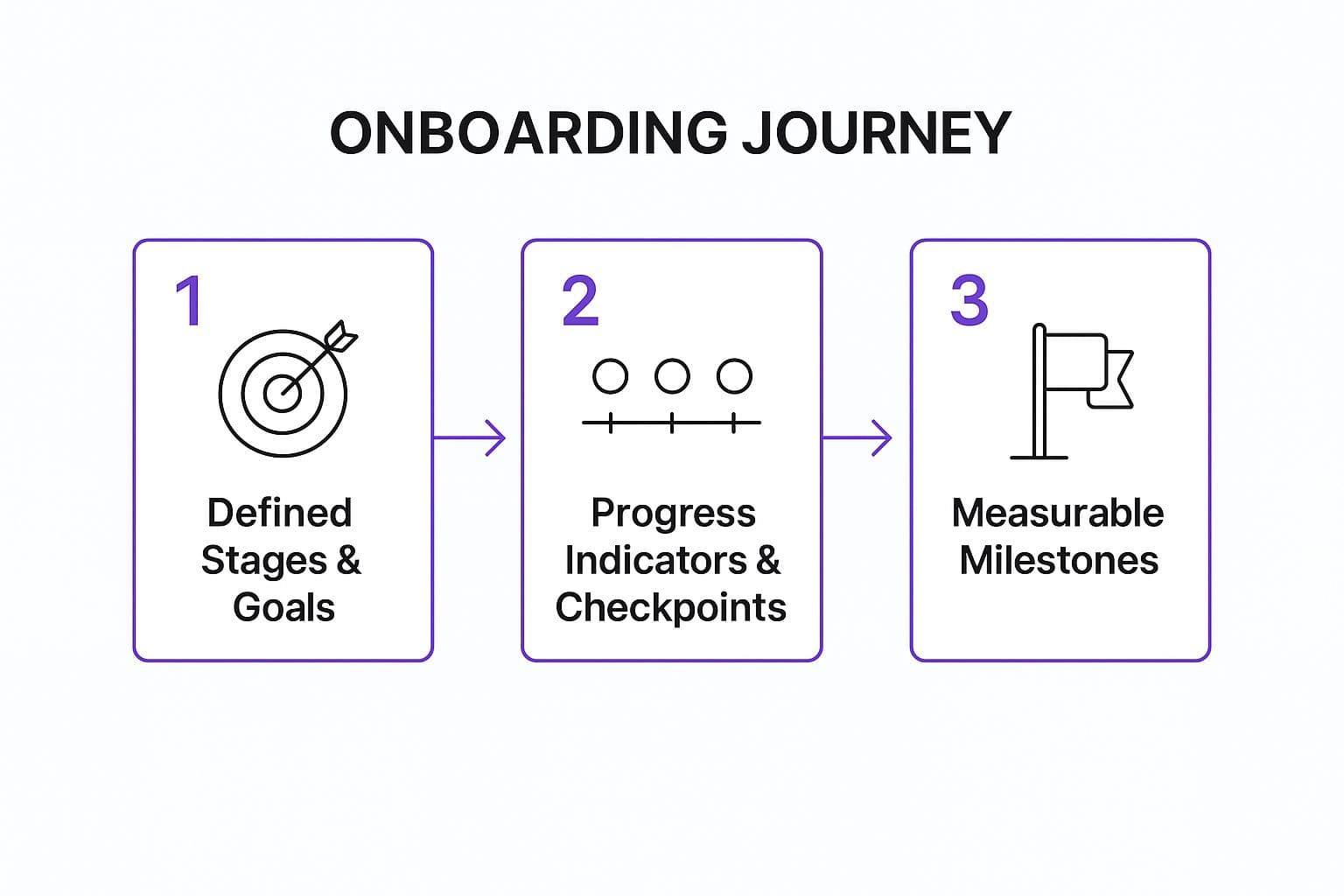
This process highlights how defining clear goals, tracking progress, and measuring success are interconnected steps that create a coherent and effective user journey. A detailed framework for this kind of rollout is essential for success; for more guidance, you can develop a comprehensive software implementation plan.
2. Personalize Based on User Segments and Goals
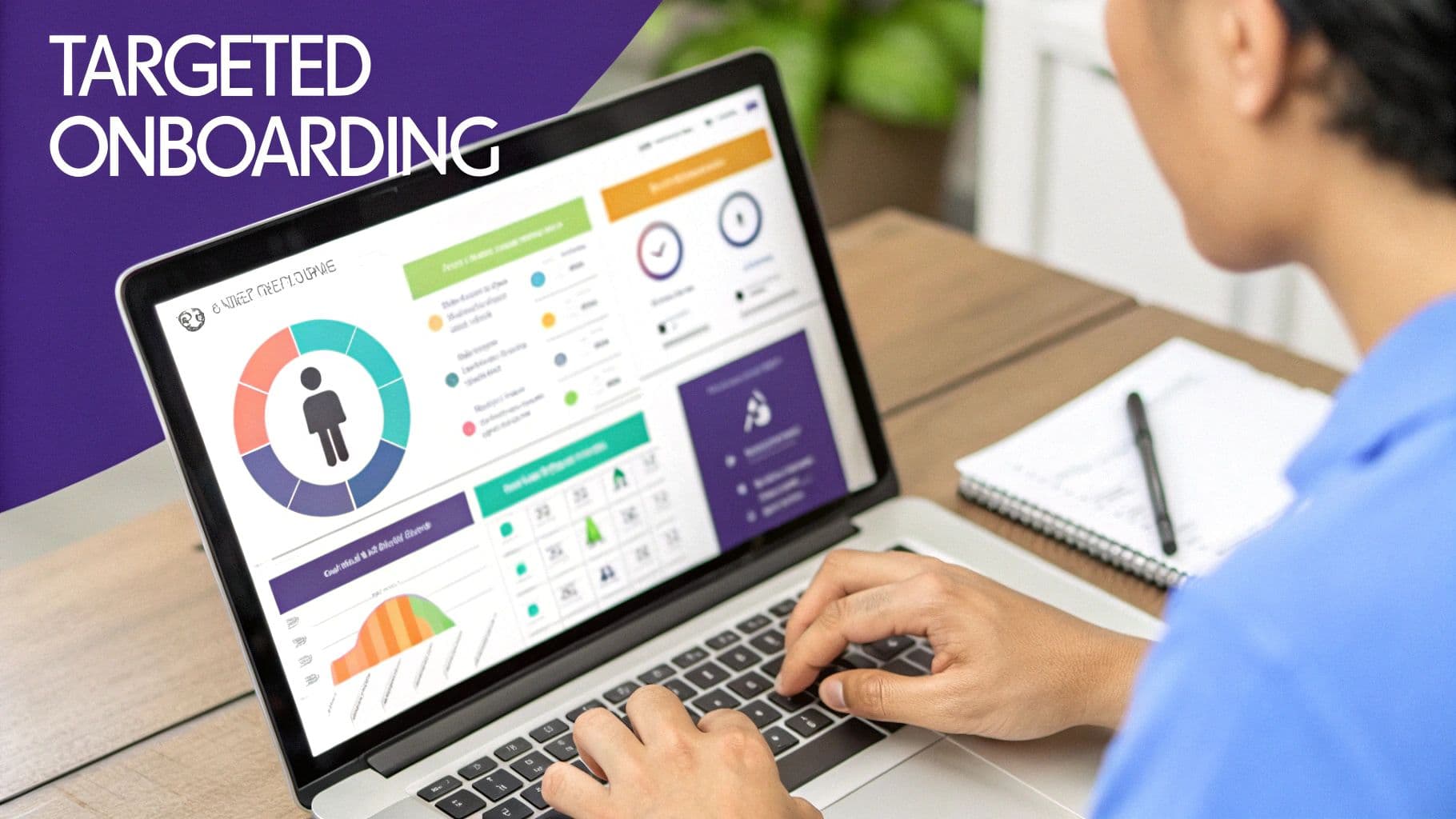
One of the most impactful customer onboarding best practices is to move beyond a one-size-fits-all approach. Instead, personalize the experience by tailoring it to different user segments, roles, or stated goals. This strategy creates targeted onboarding paths that resonate with specific user needs and use cases, demonstrating relevant value immediately.
A personalized journey significantly accelerates the user's time-to-value. By understanding who the user is and what they want to achieve, you can cut through the noise and guide them directly to the features that matter most to them. For early-stage products trying to find a product-market fit, this practice is vital for retaining diverse user personas and understanding which segments are most engaged.
How It Works: A Step-by-Step Approach
The goal is to deliver a relevant first experience that feels uniquely crafted for the user. This begins by asking a simple question during sign-up, such as "What is your role?" or "What do you want to achieve?" Based on the answer, the product can dynamically adjust the onboarding flow. For example, Canva asks if you are a teacher, student, or small business owner, then presents templates and tutorials specific to that role.
Consider these practical tips for implementation:
- Start Small: Begin by identifying 2-3 of your most critical user segments to avoid overcomplicating the initial setup.
- Use Progressive Profiling: Gather information about users gradually rather than asking everything upfront.
- Allow Path Switching: Provide users an easy way to switch their onboarding path if their initial choice wasn't right or their goals change.
This segmentation strategy ensures users feel understood and are immediately shown a clear path to solving their specific problem. This concept, championed by experts like Wes Bush of the ProductLed Institute, emphasizes that product-led growth is fueled by demonstrating value tailored to the individual user’s context and intent.
3. Focus on Quick Wins and Early Value Delivery
One of the most critical customer onboarding best practices is to show users immediate value within their first session. Instead of a comprehensive feature tour, this approach guides them to accomplish a meaningful task as quickly as possible. This builds confidence, creates momentum, and hooks the user by demonstrating your product's core value proposition right away.
Focusing on a quick win helps users experience the "aha moment" early, solidifying their decision to sign up. For early-stage products, this is paramount because it proves your solution solves a real problem efficiently. When users achieve something tangible in minutes, they are far more likely to invest time in exploring deeper functionalities later.

How It Works: A Step-by-Step Approach
The goal is to eliminate friction between sign-up and value realization. This means prioritizing one key action that delivers a tangible outcome. For example, Grammarly immediately checks a sample text for errors upon arrival, showcasing its value before a user even creates an account. Similarly, Zoom allows users to start their first meeting in minutes, proving its core utility instantly.
Consider these practical tips for implementation:
- Identify Your 'Aha Moment': Pinpoint the single action that makes users understand your product's value.
- Use Sample Data: Pre-populate the user's workspace with sample data to demonstrate functionality without requiring setup.
- Celebrate Micro-Achievements: Use visual cues like pop-ups or confetti to acknowledge the user's first successful action.
- Defer Detailed Setup: Postpone account completion or complex integrations until after the initial value has been delivered.
4. Implement Progressive Disclosure
One of the most powerful customer onboarding best practices is implementing progressive disclosure. This design principle involves showing users only the information and features they need at any given moment. By gradually revealing complexity as users become more familiar with your product, you prevent cognitive overload and create a more manageable learning curve.
Progressive disclosure is crucial for early-stage products that need to demonstrate value without overwhelming new sign-ups. Instead of presenting every feature at once, this technique focuses the user's attention on core actions, building their confidence and competence. This methodical approach ensures users master the basics before moving on to more advanced functionalities, which significantly improves long-term engagement and retention.
How It Works: A Step-by-Step Approach
The core idea is to align feature visibility with user proficiency. An initial onboarding experience should be clean and simple, with advanced tools hidden until the user is ready for them. For instance, Gmail initially guides you to compose and read emails, only later introducing features like filters, labels, and scheduled sends as you become a more active user. This ensures the initial experience is focused and successful.
Consider these practical tips for implementation:
- Map Features to Proficiency: Categorize your features into "Beginner," "Intermediate," and "Expert" levels and reveal them accordingly.
- Provide an 'Advanced Mode': Offer experienced users a toggle or setting to unlock all features immediately.
- Use Contextual Hints: Trigger tooltips or guides that suggest next-level features when a user completes a relevant basic action.
- Monitor User Behavior: Analyze how users interact with your product to optimize the timing for revealing new functionality.
This strategy ensures that your product feels both simple enough for beginners and powerful enough for experts. By hiding complexity until it's needed, you create a seamless journey that accommodates every user's pace. For more on the principles behind this, Jakob Nielsen of the Nielsen Norman Group provides foundational insights.
5. Use Interactive Tutorials and Guided Tours
One of the most impactful customer onboarding best practices is to teach by doing. Interactive tutorials move beyond passive videos or text-heavy help docs by engaging users in hands-on learning directly within your product. This method uses tooltips, guided overlays, and step-by-step instructions to help users complete real tasks, dramatically accelerating their path to proficiency.
This "learn-by-doing" approach is powerful because it builds muscle memory and context. Instead of just being told what a feature does, users experience its value firsthand. For early-stage products, this is a highly effective way to demonstrate your core value proposition quickly and convert new sign-ups into active, confident users.
How It Works: A Step-by-Step Approach
The goal of an interactive tutorial is to guide users toward their first "aha!" moment as seamlessly as possible. It should feel like a helpful expert is sitting beside them, pointing out what to do next. For example, Airtable guides new users through creating their first base with interactive prompts, ensuring they understand the core functionality before exploring more advanced features. This builds confidence and momentum.
Consider these practical tips for implementation:
- Keep Steps Short: Focus each step on a single, clear action to avoid overwhelming the user.
- Use Real Data: Populate tutorials with realistic data, not "lorem ipsum," to make the experience feel authentic and meaningful.
- Allow for Exits: Always give users an easy way to exit the tour and restart it later if they choose.
This hands-on guidance is a cornerstone of modern software adoption. To ensure your tours are effective, it is vital to adhere to strong user experience design best practices.
6. Establish Multi-Channel Communication
One of the most impactful customer onboarding best practices is to engage users where they are most active. Relying on a single channel, like email, risks your messages getting lost. Instead, establishing multi-channel communication using email, in-app notifications, SMS, and even personal calls ensures your guidance reaches users through their preferred methods, reinforcing key steps and maintaining momentum.
This approach creates a cohesive and persistent onboarding experience. By coordinating messages across various touchpoints, you increase the likelihood that users will see and act on your guidance. For early-stage products, this strategy is vital for keeping new users engaged and preventing them from dropping off due to missed information or a lack of timely support.
How It Works: A Step-by-Step Approach
The core goal is to deliver the right message at the right time through the right channel, creating a seamless support system. Each channel should play a distinct role. For example, Shopify uses email sequences for foundational business setup advice, in-app checklists for immediate platform tasks, and proactive phone support for high-value merchants who seem stuck. This ensures messaging is contextual and highly relevant.
Consider these practical tips for implementation:
- Map Messages: Align specific messages and channels to user actions and onboarding milestones. An in-app pop-up could celebrate a first achievement, while an email could provide a deeper tutorial for the next step.
- Offer Preferences: Allow users to customize their communication preferences to avoid notification fatigue and respect their boundaries.
- Ensure Consistency: Maintain a consistent brand voice, tone, and visual identity across all channels to build a trustworthy and professional image.
- Optimize with Data: Use analytics to track engagement rates for each channel and adjust your strategy based on what works best for your audience.
7. Implement Comprehensive Progress Tracking
One of the most powerful customer onboarding best practices is to give users a clear sense of accomplishment and direction. Implementing comprehensive progress tracking through elements like checklists, progress bars, and completion percentages provides users with immediate visibility into their journey, motivating them to reach the finish line. This gamifies the experience and turns onboarding from a chore into a rewarding process.
Progress tracking serves a dual purpose: it reassures users that they are on the right path while providing your business with invaluable data on user engagement and potential drop-off points. For early-stage products, this data is critical for identifying friction and refining the activation flow to ensure more users experience the core value of your platform.
How It Works: A Step-by-Step Approach
The goal is to visually represent the user's journey, making it feel manageable and encouraging completion. This works by breaking down a large, intimidating setup process into a series of smaller, achievable tasks. For instance, LinkedIn famously uses a profile completion percentage to nudge users into adding more information, while HubSpot provides a clear setup checklist that tracks progress as new users configure their accounts.
Consider these practical tips for implementation:
- Chunk Large Tasks: Break down complex setup processes into smaller, bite-sized milestones to prevent overwhelm.
- Celebrate Milestones: Use visual cues like checkmarks or congratulatory messages to celebrate the completion of major sections.
- Visualize the Path: Clearly show both completed and remaining tasks so users always know where they are and what comes next.
By making progress tangible, you create a powerful feedback loop that reduces churn and boosts user motivation. This method is essential for ensuring users complete the critical steps needed to become fully activated and engaged with your product.
8. Provide Accessible Self-Service Resources
Empowering users to find answers on their own is a cornerstone of modern customer onboarding best practices. Instead of forcing users to wait for support, provide accessible self-service resources like knowledge bases, video tutorials, and detailed FAQ sections. This approach fosters independence and allows customers to learn at their own pace, which is particularly valuable for early-stage products where support teams are lean.
Accessible self-service resources reduce the burden on your support team and build user confidence. When customers can resolve minor issues independently, they feel more in control of their experience and are more likely to explore the product further. This proactive support system is essential for scaling user growth without a proportional increase in support costs.
How It Works: A Step-by-Step Approach
The key is to make information easy to find and consume, precisely when the user needs it. These resources should be integrated directly into the user experience, not hidden away on a separate website. For example, Atlassian provides an extensive video library for Jira and Confluence, while Stripe’s interactive API documentation with code examples allows developers to solve problems in real-time.
Consider these practical tips for implementation:
- Organize Content Intuitively: Structure your knowledge base by user journey stage or product feature to make navigation logical.
- Implement Smart Search: Include a powerful search bar with filters so users can quickly find relevant articles or videos.
- Keep It Concise: Write articles that are focused, action-oriented, and use visuals like screenshots or GIFs to clarify steps.
- Update Regularly: Analyze common support tickets to identify gaps in your documentation and update your content accordingly.
9. Optimize Continuously Through Data Analysis
Effective onboarding is not a "set it and forget it" process. One of the most critical customer onboarding best practices is to continuously optimize the experience by systematically collecting, analyzing, and acting on performance data. This iterative approach transforms onboarding from a static checklist into a dynamic, data-informed system that evolves with your users and product.
Continuous optimization ensures your onboarding flow remains effective as your product grows and user expectations change. By leveraging analytics and user feedback, you can pinpoint friction points, validate hypotheses, and incrementally improve activation rates. For early-stage products, this practice is essential for discovering the most efficient path to value and building a foundation for scalable growth.
How It Works: A Step-by-Step Approach
The core idea is to create a tight feedback loop where you measure performance, identify opportunities, implement changes, and test their impact. For instance, Pinterest constantly A/B tests its signup and tutorial flows to reduce drop-offs, while Netflix analyzes viewing data to refine its initial content recommendations. This data-driven culture ensures every change is a step toward a better user experience.
Consider these practical tips for implementation:
- Define Success Metrics: Before making changes, establish clear key performance indicators (KPIs) like completion rate, time-to-value, or feature adoption.
- Test One Variable: Isolate changes by testing one variable at a time (e.g., button color, copy, or step order) to understand its specific impact.
- Combine Data Sources: Use quantitative data (analytics, heatmaps) to see what is happening and qualitative feedback (surveys, interviews) to understand why.
By implementing this data-driven cycle, you ensure that every adjustment is purposeful and contributes to a more effective onboarding journey. To get started, you can establish a set of core software development KPIs that will serve as your north star for continuous improvement.
Customer Onboarding Best Practices Comparison
| Onboarding Practice | Implementation Complexity 🔄 | Resource Requirements ⚡ | Expected Outcomes 📊 | Ideal Use Cases 💡 | Key Advantages ⭐ |
|---|---|---|---|---|---|
| Create a Structured Multi-Stage Journey | Medium to High 🔄 | Moderate (planning, checkpoints) | Consistent experiences, better completion | Products needing clear milestones and tracking | Clear success metrics, improved completion |
| Personalize Based on User Segments & Goals | High 🔄 | High (data collection, maintenance) | Higher engagement, faster time-to-value | Diverse user base with distinct roles/goals | Better adoption, improved satisfaction |
| Focus on Quick Wins and Early Value Delivery | Medium 🔄 | Low to Moderate | Reduced abandonment, early confidence | Products with clear "aha" moments | Builds momentum, positive first impressions |
| Implement Progressive Disclosure | High 🔄 | High (design & adaptive UI) | Lower cognitive load, natural skill growth | Complex products with steep learning curves | Reduces overwhelm, maintains engagement |
| Use Interactive Tutorials and Guided Tours | Medium 🔄 | Moderate (content creation, tooling) | Higher learning retention, better adoption | User onboarding requiring hands-on guidance | Immediate application, reduced support load |
| Establish Multi-Channel Communication | High 🔄 | High (marketing automation tools) | Broader reach, user re-engagement | Products needing ongoing user engagement | Multiple reinforcement, customizable preferences |
| Implement Comprehensive Progress Tracking | Medium 🔄 | Moderate (dashboards, gamification) | Increased motivation, goal visibility | Onboarding with multiple milestones | Identifies bottlenecks, encourages completion |
| Provide Accessible Self-Service Resources | Medium 🔄 | High (content creation & maintenance) | Reduced support workload, 24/7 assistance | Scaling user base requiring self-help | Accommodates learning styles, scalable support |
| Optimize Continuously Through Data Analysis | High 🔄 | High (analytics tools & expertise) | Data-driven improvements, ROI measurement | Mature products aiming for ongoing optimization | Better user insights, continuous improvement |
Launch Your Next Success Story with Expert Onboarding
Mastering the art of customer onboarding is no longer a "nice-to-have" feature; it is the critical first step in building a sustainable, high-growth product. For early-stage MVPs, where first impressions dictate survival, a well-executed onboarding process is your most powerful tool for user retention and advocacy. It’s the bridge that connects a user's initial curiosity with the long-term value your product promises, ensuring they don't just sign up, but truly succeed.
By weaving together the customer onboarding best practices we've explored, you can construct an experience that feels intuitive, supportive, and deeply valuable from the very first interaction. Each strategy plays a crucial role in this system, working together to guide users toward their "aha!" moment and beyond.
Your Actionable Onboarding Blueprint
To turn these concepts into reality, focus on these core takeaways:
- Structure is Everything: Don't leave onboarding to chance. A multi-stage journey provides a clear, predictable path for users, reducing cognitive load and building momentum.
- Personalization Drives Engagement: Move beyond one-size-fits-all. Segmenting users by their goals or roles allows you to deliver relevant guidance that speaks directly to their needs, making them feel understood and valued.
- Early Value is Non-Negotiable: Your primary goal is to help users achieve a quick win. By focusing on immediate value delivery, you provide tangible proof that your product can solve their problem, cementing their decision to stick around.
- Clarity Defeats Complexity: Avoid overwhelming new users with every feature at once. Progressive disclosure and interactive tutorials introduce complexity gradually, fostering competence and confidence instead of confusion.
Ultimately, the most effective onboarding strategies are living, breathing parts of your product. They are not set-it-and-forget-it checklists. Continuous optimization, fueled by data analysis and direct user feedback, is the engine that transforms a good onboarding experience into a great one. This iterative approach ensures your product's welcome mat is always perfectly aligned with evolving user expectations and behaviors, directly impacting key metrics like activation rates, churn reduction, and customer lifetime value. Viewing onboarding as the beginning of a relationship, rather than a mere setup process, is the foundational mindset shift that separates market leaders from forgotten MVPs.
Ready to build an MVP with a world-class onboarding experience from day one? At Iglu Digital, we specialize in transforming your vision into a market-ready product with the price fixed before we start, integrating these proven customer onboarding best practices directly into the development process. Let us help you make a first impression that not only retains users but turns them into your biggest fans.