

Decoding the Real Cost to Develop Software

Table of Contents
Trying to nail down the exact cost to develop software is a tricky business. I've seen projects run anywhere from a modest 70,000 to well over250,000. The final number isn't pulled from a hat; it’s a direct result of your project's complexity, the features you need, and the team you bring on board to make it happen.
Why Is There No Simple Answer to Software Costs

Before we start throwing numbers around, it's important to get one thing straight: there's no universal price tag for software. It helps to think of it like building a house. A cozy one-bedroom cabin and a sprawling custom mansion are both "houses," but their costs are worlds apart. The difference comes down to materials, size, and all those custom touches.
The same exact logic applies to software. You're not buying something off the shelf. You're commissioning a custom service where every decision—from the programming language to your team's location—has a domino effect on the budget. This is why one project might cost tens of thousands while another climbs into the millions.
The Core Pillars of Software Cost
To get a real handle on your budget, you need to understand the big-ticket items. I've found it's easiest to break them down into three core pillars that drive nearly all of the cost.
- Scope and Complexity: This is the "what" of your project. It covers every feature, screen, and interaction. A simple informational app with a few pages is one thing, but a platform handling real-time data with multiple third-party integrations is a completely different beast.
- Team and Location: This is the "who" and "where." The size of your team, their level of experience, and where they're located are massive cost factors. An expert senior developer in San Francisco, for example, is going to have a much higher rate than a junior developer in Southeast Asia.
- Technology Stack: This is the "how." The specific languages, frameworks, and platforms you choose will influence your costs. Some technologies have a larger pool of affordable talent, while others might require specialized—and more expensive—expertise or come with licensing fees.
Software Project Cost Estimates at a Glance
To give you a clearer picture, here’s a quick snapshot of what you might expect to pay for different types of projects. Think of this table as a starting point to frame your thinking before we dig deeper into each cost factor.
| Project Complexity | Example Features | Estimated Cost Range |
|---|---|---|
| Simple Prototype/MVP | Basic user login, core functionality, simple UI | 15,000 –50,000 |
| Medium Complexity App | API integrations, custom UI/UX, user profiles | 50,000 –150,000 |
| Complex Enterprise System | Advanced security, multiple integrations, scalability | 150,000 –500,000+ |
Getting a firm grasp on these variables is the first and most important step toward building a realistic budget. It’s all about making informed decisions from day one to set your project up for success.
How Your Team and Their Location Drive Costs
Beyond the features you choose and the tech stack you build on, the single biggest line item on your software development invoice will always be the people. Who you hire and where they live are the two most powerful forces that will shape your final cost to develop software.
Deciding who builds your product isn't just about finding skilled coders; it's a strategic choice between very different operational and financial models. Each path—in-house, freelance, local, or offshore—comes with its own set of trade-offs that go far beyond a simple hourly rate. Getting this right is the key to building a realistic and sustainable budget.
Comparing Your Hiring Options
When it comes to putting together your development dream team, you generally have four paths to choose from. Each one offers a different blend of cost, control, and convenience.
- In-House Team: Hiring full-time employees gives you the most control and ensures they are fully immersed in your company culture. It’s also, by far, the most expensive option when you factor in salaries, benefits, office space, and recruitment fees.
- Freelancers: Bringing on independent contractors can be a great way to handle specific tasks or short-term projects without long-term commitment. The challenge, however, is juggling multiple individuals, ensuring consistent quality, and keeping the project moving forward.
- Local Agency: Partnering with an agency in your city makes communication and collaboration a breeze. But that convenience comes at a premium, as their rates have to cover higher local salaries and operating costs.
- Offshore/Nearshore Team: Working with a team in a different country—often called outsourcing—unlocks access to a global talent pool at a much lower cost. The trick is to find a partner who can effectively manage time zone differences and cultural communication styles.
The infographic below gives you a sense of how different types of software vary in cost, which is heavily influenced by the teams required to build them.
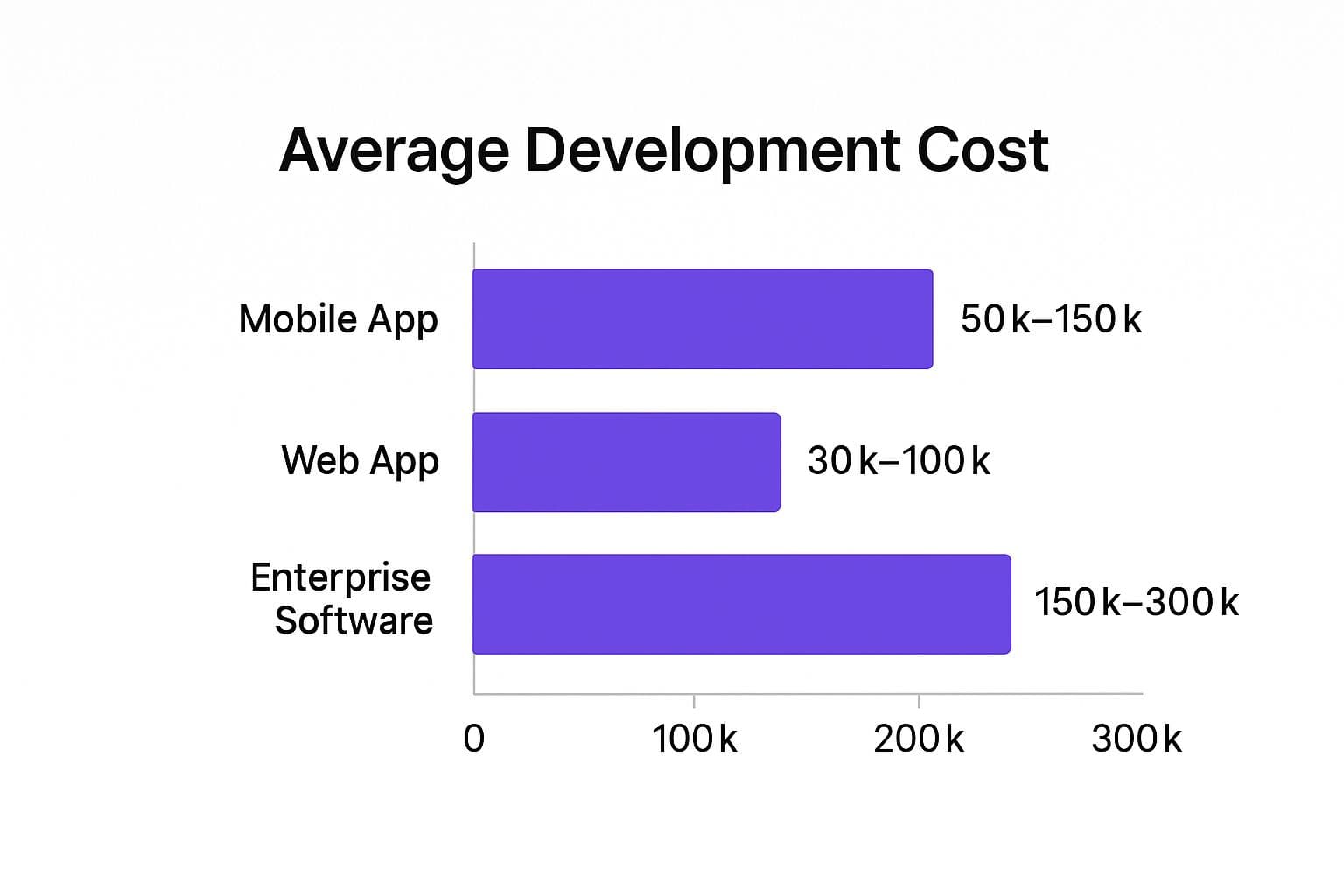
As you can see, enterprise software sits at the top end. This is usually because these projects demand larger, more specialized teams to handle their complexity.
The Geographic Cost Factor
Location is, without a doubt, the most significant variable in development rates. A developer's salary is directly tied to the cost of living in their region, which creates a massive price disparity across the globe. A senior developer in Silicon Valley could easily command five times the hourly rate of an equally talented developer in Eastern Europe or Southeast Asia.
This is exactly why outsourcing has become such a popular strategy. It allows companies to make their budgets go further without sacrificing the quality of the final product.
To put this in perspective, let's look at some numbers. Enterprise-class agencies in high-cost areas might charge upwards of 400 per hour**, while good mid-market firms often fall between 120 and 250. In stark contrast, offshore teams can offer fantastic talent for **27 to $82 per hour.
For a deeper dive into these numbers, you can explore a complete guide to software development hourly rates that breaks it all down by region and skill level.
Here’s a simplified look at how those numbers stack up across different models and regions.
Developer Hourly Rate Comparison by Location and Model
The table below offers a comparative look at how hourly rates differ across various hiring models and geographic regions.
| Development Model | Typical Hourly Rate (North America) | Typical Hourly Rate (Eastern Europe) | Typical Hourly Rate (Southeast Asia) |
|---|---|---|---|
| Freelancer | 70 -150+ | 40 -80 | 25 -60 |
| Local Agency | 120 -250+ | N/A | N/A |
| Offshore Team | N/A | 50 -100 | 27 -82 |
| In-House Employee | 60 -120 (loaded) | 35 -70 (loaded) | 20 -50 (loaded) |
As you can see, the financial difference is dramatic. Accessing talent in regions with a lower cost of living provides significant savings, allowing you to get more done with the same budget.
Finding the Right Balance for Your Project
So, which model is best? The real answer depends entirely on your priorities.
If you have a massive, secure budget and need tight, daily integration for a core, long-term product, an in-house team might be the way to go. If you just need a small, specific task done quickly, a freelancer is probably your best bet.
For most startups and businesses looking to build an MVP, however, a blended approach often hits the sweet spot. Partnering with a skilled offshore or nearshore team provides the perfect balance of cost efficiency and expert execution. It lets you tap into top-tier talent and build a high-quality product for a fraction of what it would cost to hire locally, making your investment go so much further.
How Project Features Turn Into Development Hours

Ever wondered why one app might cost 25,000** while another that looks almost identical costs **250,000? The answer is almost always hidden in the complexity behind the screen. Features are the DNA of any software, and understanding how they really translate into development time is the secret to keeping your budget in check.
Think about it like building a car. A simple user login is like installing a standard car door—a known process that’s done in a few hours. But a real-time, AI-powered recommendation engine? That’s like engineering a custom self-driving system. It demands complex algorithms, massive data processing, and ongoing machine learning, which can eat up hundreds of hours of highly specialized work.
This is exactly where project budgets get blown out of the water. A request that sounds simple on paper can hide layers of technical complexity that directly inflate the cost to develop software.
Simple Features Versus Complex Systems
Not all features are created equal. A "simple" feature usually follows a straight path and doesn't rely on much else to work. A complex feature, on the other hand, is like a spiderweb—it connects to multiple systems, has all sorts of conditional logic, and pulls in data from outside sources.
Let's look at a common example to see how the hours stack up:
- Basic Login (10-20 hours): This is your standard email and password form. It needs to validate the inputs and check them against a database. It’s a straightforward, self-contained task.
- Social Sign-On (20-40 hours): Now let's add a "Log in with Google" button. Suddenly, we're talking to a third-party API. This means setting up developer accounts, managing authentication tokens, and handling data permissions. It's another layer of work.
- Two-Factor Authentication (40-60+ hours): For extra security, you might want 2FA sent via text message. That requires integrating another service (like Twilio), generating and verifying codes, and building a user-friendly setup flow.
What started as a simple "login" has now easily tripled in scope and cost. Every new layer adds new variables and potential breaking points, all of which need careful coding and a lot of testing.
The Hidden Hours in Integrations and Compliance
It's not just the feature itself that takes time. There are a few other areas that quietly add significant hours to a project. These "hidden" costs are easy to miss in the planning phase but are absolutely essential for a working, secure app.
Third-Party API Integrations
Connecting to an external service like a payment gateway (Stripe) or a mapping tool (Google Maps) is never just "plug and play." It really involves:
- Digging through extensive documentation to understand how it works.
- Handling all the security protocols and authentication.
- Writing code to send requests and correctly process the data that comes back.
- Building solid error handling for when the other service is down or sends back something unexpected.
Custom Design and Animations
Using a standard, template-based design is fast. But if you want a fully custom, branded look with smooth animations and unique interactive elements, designers and developers have to work hand-in-hand. Every custom piece has to be built from the ground up, tested across all sorts of devices and browsers, and optimized so it doesn’t slow things down. This can add dozens, if not hundreds, of hours.
Security and Compliance Requirements
If your app handles sensitive data—think health records or financial info—you have to follow strict rules like HIPAA or PCI DSS. Getting compliant isn't a final step; it's something that has to be woven into every part of the development process. This includes:
- Encrypting data (both when it's moving and when it's stored).
- Implementing strict access controls and user permissions.
- Keeping detailed logs of all activity.
- Running regular security audits and penetration tests.
These are non-negotiable safeguards for building a product people can trust, and they add a lot of complexity and time to the project.
Prioritizing for Your MVP
Since features can make costs spiral so quickly, you have to be ruthless with prioritization, especially for an MVP. The whole point is to identify the absolute core function that solves your main user's biggest problem and push everything else to a later version.
By focusing on a lean set of high-impact features, you can control the initial cost to develop software, get your idea in front of real users, and use their feedback to guide what you build next. For more on this, check out our guide on choosing the right feature prioritization framework to help you make smarter calls.
How Your Tech Stack Becomes a Silent Cost Driver
The technology you build your software with—what developers call the "tech stack"—is way more than just a bunch of technical jargon. It's one of the biggest financial decisions you'll make, quietly dictating your initial budget, ongoing maintenance costs, and even your ability to hire. Getting this choice right is fundamental to controlling the overall cost to develop software.
Think of it like building a house. You could use standard, easy-to-find lumber, or you could insist on using a rare, imported hardwood. Both can build a solid house, but that specialized wood requires master craftspeople who are few and far between, and their rates reflect that scarcity.
The Economics of Talent Supply and Demand
That same logic applies perfectly to software development. When you pick a popular, well-supported technology like Python for the backend or React for the user interface, you're plugging into a massive global talent pool. With so many skilled developers available, hiring is competitive, which helps keep your costs reasonable.
On the other hand, if you build your product with a niche or older technology, your budget can quickly spiral. The number of developers who know that specific tech is tiny, creating a classic supply-and-demand squeeze. These specialists know their skills are rare, and they charge a premium for them.
This isn't just about the initial build, either. Imagine needing to hire a new developer a year from now. Finding someone with obscure skills can stall your project for months and cost you a fortune.
Platform Choices and Their Financial Impact
Another huge cost factor is deciding where your software will live. Will it be a web app that people use in a browser? A native app for iPhones? An Android app? Or all of the above? Each choice has a very different price tag.
- Native Development: This means building separate, dedicated apps for iOS (with languages like Swift) and Android (using Kotlin or Java). This route gives you the absolute best performance and a seamless user experience. The catch? It's the most expensive option because you’re basically paying to build two separate products from the ground up.
- Cross-Platform Development: Tools like React Native or Flutter offer a clever shortcut. They let developers write one set of code that works on both iOS and Android devices. This approach can seriously slash the initial cost to develop software, often reducing development time by up to 40% since you don't need two separate teams.
While going cross-platform is a fantastic way to save money, it isn't the right fit for every project. If your app relies on intense graphics, deep integration with phone hardware, or needs lightning-fast performance, native development is usually the better, albeit pricier, investment.
The key is to balance the immediate savings of one approach against the long-term needs of your product. Your tech stack is a foundational choice that sends ripples through your entire budget, from hiring to maintenance and beyond.
A Smarter Path to Launching Your First Product

Trying to line up all the variables—team location, feature complexity, technology stacks—can feel like you're spinning plates. If you're a startup founder with a brilliant idea but a tight budget, the thought of hourly billing and creeping project scope is enough to give you nightmares. It’s a fear that stops too many great ideas dead in their tracks.
But what if you could take all that uncertainty off the table? What if there was a path to market that gave you financial predictability and speed, letting you focus on testing your idea instead of watching a clock rack up billable hours? This is exactly where a fixed-price approach completely changes the game for getting a new product off the ground.
At Iglu, we’ve built our entire process around this idea. Every project starts with a paid scoping week that ends in a written spec and a fixed price for the build, so you get the two things every founder needs: cost certainty and a fast, strategic launch.
Predictability Over Uncertainty
The old-school agency model runs on hourly or time-and-materials contracts. It’s flexible, sure, but it also puts all the financial risk squarely on your shoulders. Every unexpected bug, small pivot, or minor tweak gets added to the final bill. Your real cost to develop software becomes a frustratingly moving target.
Our fixed-price model gets rid of that risk. Period. You know the exact cost before we write a single line of code, so you can budget with absolute confidence. No hidden fees, no surprise invoices down the road. For founders who need every dollar to count and have investors to answer to, that predictability is everything.
This approach also puts us on the same side of the table. Our incentive is to work efficiently and deliver a great product on time and on budget. After all, our success is directly tied to getting your MVP into the hands of real users as fast as possible.
What Is Included in a Fixed-Price MVP
So, what do you actually get with a strategic, fixed-price MVP? It's not a stripped-down service; it's a complete package designed to take you from a raw idea to a market-ready product without the chaos.
Here’s a clear look at what a fixed-price MVP delivers:
- Strategic Discovery Session: We don't just ask what you want to build. We dive deep into your vision, pinpoint the core problem you're solving, and map out the handful of essential features needed for a powerful launch.
- UI/UX Design: Our team creates clean, intuitive wireframes and user interface designs. The goal is to make sure your product isn't just functional but feels great to use from day one.
- Core Feature Development: We focus our firepower on building the high-impact features that deliver immediate value to your first users. It’s about creating a lean but powerful product.
- Full Deployment: We take care of all the technical heavy lifting, getting your application live on the web and ready for your first customers.
This isn’t about cutting corners; it's about cutting through the noise to build what matters most. It's the fastest and most capital-efficient way to test your business assumptions in the real world. This process also sets you up to make smarter decisions later, like whether to bring development in-house or stick with a partner. If you're weighing those options, our guide on the dilemma of whether to build vs buy software offers some great perspective.
This is about being a smarter partner, not just a cheaper one. We've designed this as a strategic partnership to de-risk your launch, give you total cost clarity, and get your product to market faster than you thought possible.
Answering Your Biggest Questions About Software Development Costs
Even after breaking down all the variables, trying to budget for a new software project can feel like you're trying to hit a moving target. To help clear things up, let's tackle the questions I hear most often from founders and product owners who are trying to get a real handle on the cost to develop software.
Why Are the Cost Estimates I’m Getting So Wildly Different?
It's a classic scenario. You send out your project brief and get three quotes back: one for 20,000**, another for **80,000, and a third that tops $200,000. It’s jarring, but this kind of range is perfectly normal in the world of software development.
The huge gap almost always comes down to the assumptions each team is making behind the scenes.
The team that quoted 20,000** is likely picturing a lean, no-frills build. They’re thinking of standard templates, basic features, and getting it done as quickly as possible. The team quoting **200,000? They’re probably envisioning a completely custom solution with intricate backend logic, complex third-party integrations, enterprise-level security, and a large, senior-level team to build it.
Neither quote is necessarily "wrong." They're just pricing two entirely different approaches to quality and depth. This is exactly why a detailed project scope is your most powerful tool—it forces everyone to bid on the same set of assumptions.
Is It Cheaper to Hire a Team of Freelancers or Go With an Agency?
At first glance, freelancers almost always look cheaper on an hourly basis. But the final project cost can tell a very different story. When you partner with an agency, that rate includes more than just a developer’s time; you’re also getting a dedicated project manager, a UI/UX designer, a QA tester, and a proven workflow that keeps everything on track.
If you hire freelancers, you instantly become the project manager. You’re the one juggling multiple people, aligning timelines, and making sure all the separate pieces of work actually fit together. That's a huge time sink, and if not managed perfectly, it can easily lead to costly mistakes and blown deadlines. An agency brings a pre-built, cohesive team to the table from day one, which often ends up being far more efficient and cost-effective.
How Much Should I Actually Budget for Ongoing Maintenance?
Getting your software launched is a huge milestone, but it's really just the beginning of the journey. The cost to develop software doesn't stop once you go live. You absolutely have to budget for ongoing maintenance to keep your app secure, fast, and working as it should.
So what does that money actually cover?
- Server Hosting: The monthly fees you pay to cloud providers like AWS or Google Cloud to run your app.
- Bug Fixes: No software is perfect. This covers fixing issues that users discover after launch.
- Security Patches: Protecting your app and user data from newly discovered vulnerabilities.
- Software Updates: Making sure your app doesn't break when a new version of iOS, Android, or a web browser is released.
- Monitoring: Proactively watching for performance issues, crashes, and downtime.
Forgetting to budget for maintenance is one of the most common—and dangerous—mistakes a new product owner can make. It's the surest way to let a great product degrade into a buggy, insecure mess.
Should I Choose a Fixed-Price or Hourly Contract?
This is a critical decision that directly shapes your budget and your ability to adapt during the project. There's a right time and place for each model.
Fixed-Price Model
- Best For: Projects where the scope and features are crystal clear from the start, like a well-defined MVP.
- Pros: It gives you complete cost certainty. You agree on a price upfront, and that’s what you pay. No financial surprises.
- Cons: It’s rigid. If you decide you need to add a major feature halfway through, it often means stopping work to draft a new scope and a new contract.
Hourly (Time & Materials) Model
- Best For: Complex, long-term projects where the requirements are likely to evolve or are just too hard to pin down at the beginning.
- Pros: It offers total flexibility. You can pivot, add features, and change direction as you learn more about what your users want.
- Cons: The final cost is unpredictable. Without tight management, scope creep can quickly cause the budget to spiral out of control.
For most founders, a fixed-price contract for the initial MVP is the smartest path forward. It forces you to be disciplined about what's truly essential, and it gives you a predictable number to work with as you test your business idea. If you want to dive deeper, our guide on time and material vs fixed-price contracts breaks it down even further.
Ready to turn your idea into a market-ready product without the financial guesswork? At Iglu, we start every project with a paid scoping week that turns your idea into a written spec and a fixed price, giving you the speed and cost certainty you need to launch with confidence. https://iglu.dev