Top Agile Methodology Types for MVP Success in 2025
Table of Contents
Navigating from a promising idea to a market-ready Minimum Viable Product (MVP) requires more than just a great concept; it demands a structured, efficient development process. For founders, CTOs, and technical leads, selecting the right operational framework is a critical early decision that directly impacts speed, cost, and product-market fit. This is where understanding the different agile methodology types becomes a strategic advantage, not just a project management preference. Agile isn’t a single, rigid system but a collection of philosophies and frameworks, each with its own unique approach to building software iteratively and responding to change.
Choosing the wrong framework can lead to misaligned teams, wasted resources, and a stalled launch. Conversely, the right agile approach acts as a powerful engine, driving your team toward rapid, validated learning and consistent delivery. This guide demystifies the most effective agile frameworks, moving beyond theory to offer a practical roundup for entrepreneurs. We will break down core methodologies like Scrum, Kanban, XP, and Lean, providing a clear comparison of their principles, pros, cons, and ideal use cases. You will gain actionable insights to determine which system best fits your team’s size, your product’s complexity, and your startup’s ambitious goals for getting an MVP to market.
1. Scrum: The Structured Sprint for Predictable Progress
Scrum is one of the most widely used agile methodology types, providing a prescriptive framework for developing and sustaining complex products. It organizes work into fixed-length iterations called sprints, typically lasting one to four weeks. This structure allows teams to ship software in regular, predictable cadences, making it ideal for MVP development where frequent feedback is crucial.
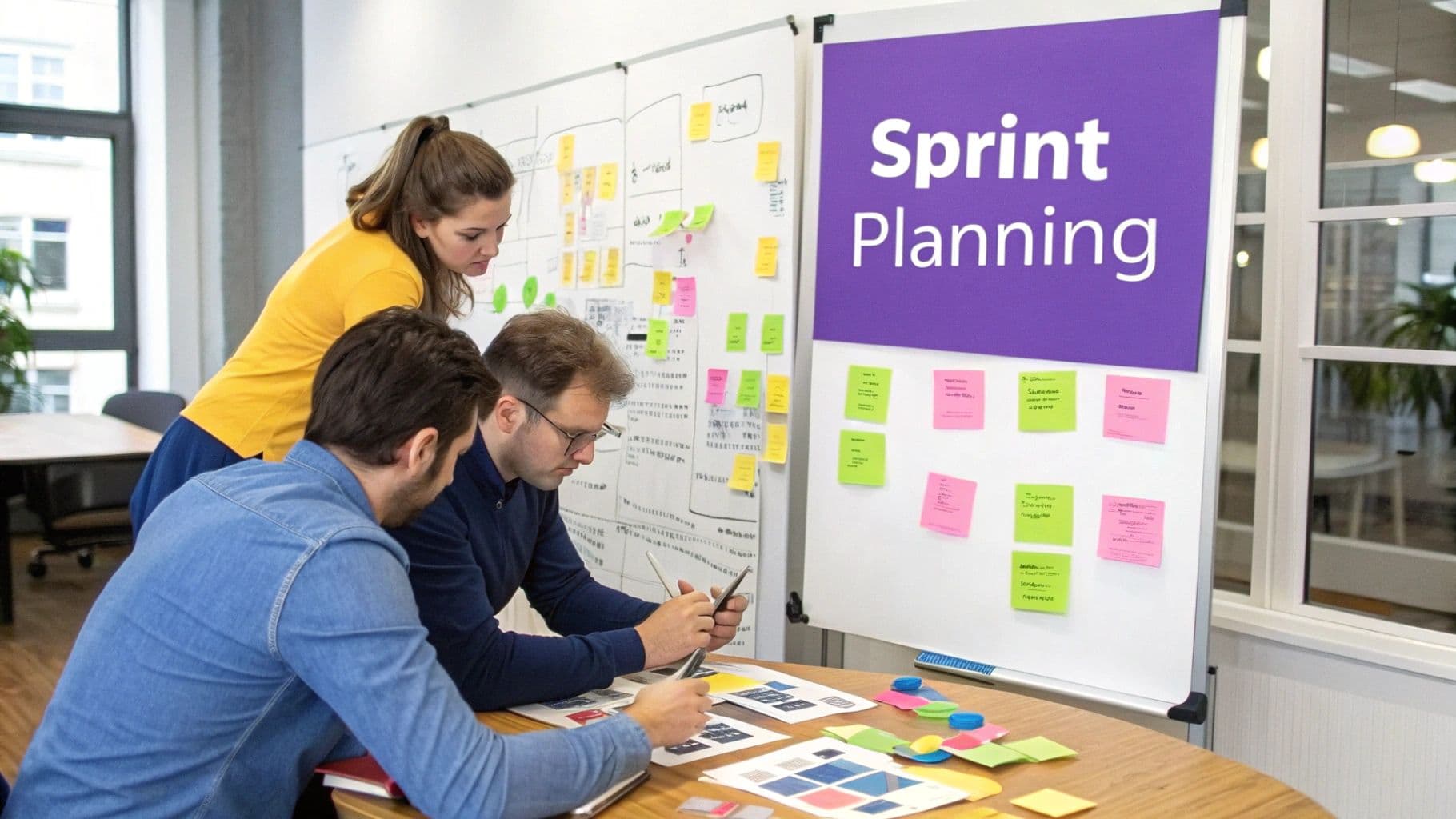
The framework is built on specific roles, events, and artifacts. Key roles include the Product Owner, who manages the product backlog; the Scrum Master, who facilitates the process; and the Development Team, which builds the product increment. Major events like the Daily Scrum, Sprint Planning, Sprint Review, and Sprint Retrospective provide a regular rhythm for inspection and adaptation.
When and Why to Use Scrum
Scrum excels in environments where requirements are likely to change or are not fully known at the outset, a common scenario for startups building an MVP. Its time-boxed sprints force teams to prioritize ruthlessly and deliver a functional piece of the product at the end of each cycle. This incremental delivery model is perfect for gathering early user feedback and iterating quickly. Companies like Microsoft and Adobe have successfully used Scrum to transition from rigid waterfall processes to a more adaptive, customer-centric development model.
Actionable Tips for Implementation
- Start with Two-Week Sprints: This duration is often long enough to build a meaningful increment but short enough to adapt to feedback quickly.
- Empower the Product Owner: Ensure this person has the authority and availability to manage the backlog and make decisive prioritization calls. For a deeper understanding of the distinct responsibilities within the framework, you can explore the key roles in agile development.
- Guard the 15-Minute Daily Scrum: Keep this meeting focused strictly on progress, plans, and impediments. It’s a synchronization meeting, not a problem-solving session.
- Prioritize the Retrospective: The Sprint Retrospective is where true continuous improvement happens. Treat it as a non-negotiable event to identify and act on process enhancements.
2. Kanban: The Visual Flow for Continuous Delivery
Kanban is a visual workflow management method that emphasizes continuous delivery and flow efficiency. Unlike the fixed iterations of Scrum, Kanban uses a board with columns and cards to represent work items and their progress through various stages. Originating from Toyota's manufacturing system, its primary goal is to identify bottlenecks and optimize the workflow for a smooth, predictable output.
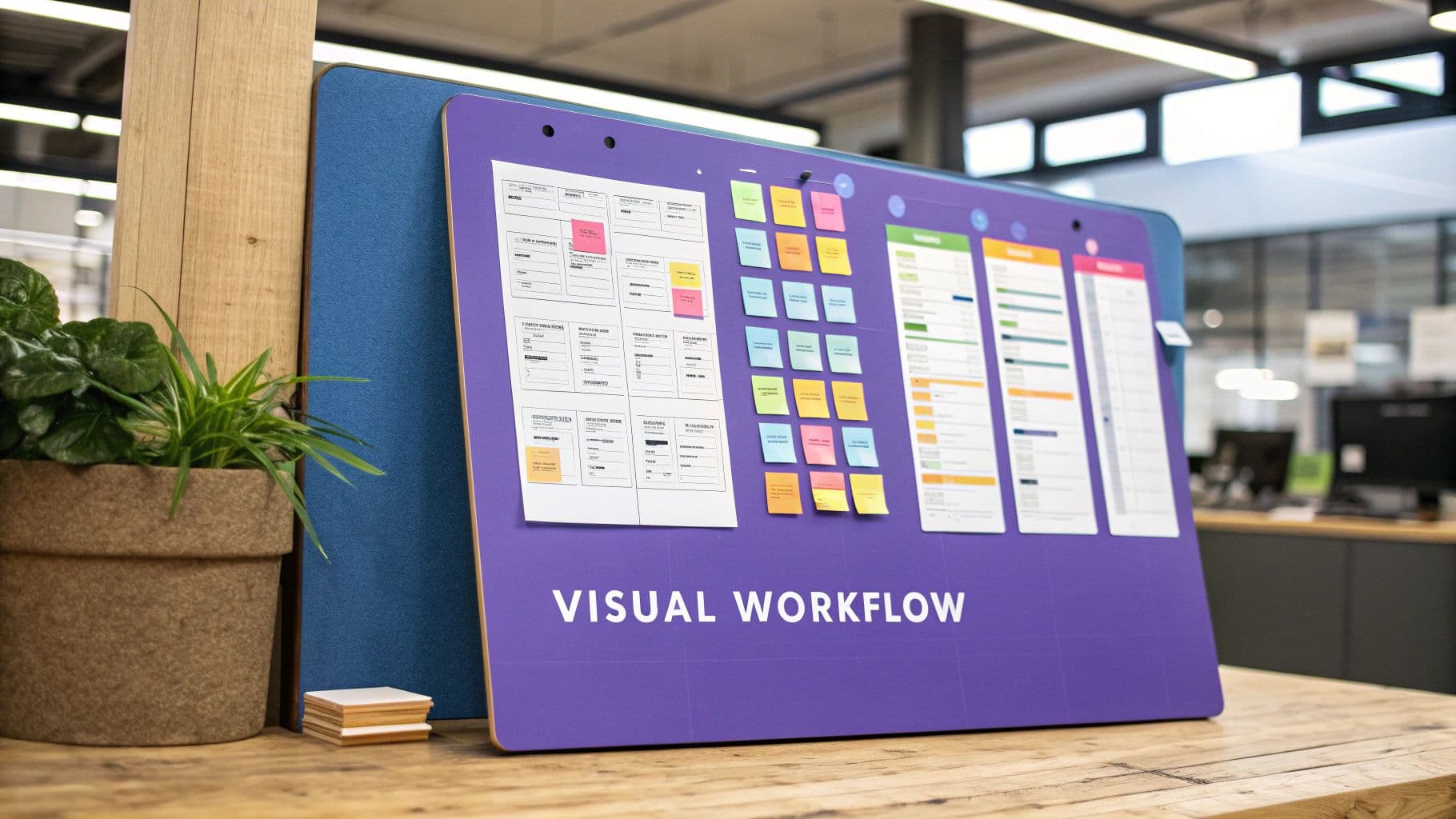
The core of this agile methodology type is limiting Work in Progress (WIP), meaning the team can only pull a set number of tasks into each stage. This simple rule prevents team members from becoming overburdened and highlights areas where work is getting stuck. This focus on flow makes it one of the most flexible agile methodology types available.
When and Why to Use Kanban
Kanban is ideal for teams that require flexibility and have a continuous flow of incoming tasks, such as maintenance, support, or content production teams. For MVP development, it's effective when priorities shift frequently and fixed-length sprints would be too restrictive. It allows teams to release features as soon as they are ready, rather than waiting for the end of a sprint. Companies like Zara and Capital One use Kanban principles to manage their fast-moving supply chains and software development processes, optimizing for speed and responsiveness.
Actionable Tips for Implementation
- Start with Your Current Process: Don't overhaul your workflow immediately. Map your existing steps onto a Kanban board and evolve gradually.
- Set Realistic WIP Limits: Base WIP limits on your team's actual capacity. The goal is to create a smooth flow, not to stop work. Adjust these limits as you gather data.
- Define "Done" for Each Stage: Clearly define what criteria must be met before a card can move to the next column. This ensures quality and reduces ambiguity. For more on this and other key concepts, you can explore common agile methodology terms.
- Visualize Everything: Use different colors or swimlanes to categorize work types (e.g., new features, bugs, technical debt) to gain clearer insights into where your effort is going.
3. Extreme Programming (XP): Engineering Discipline for High-Quality Code
Extreme Programming (XP) is a highly disciplined agile methodology focused on producing high-quality software and promoting developer welfare. It achieves this by taking proven software engineering practices to "extreme" levels. The framework is built around five core values: communication, simplicity, feedback, courage, and respect, which guide a set of specific technical practices like pair programming, test-driven development (TDD), and continuous integration.
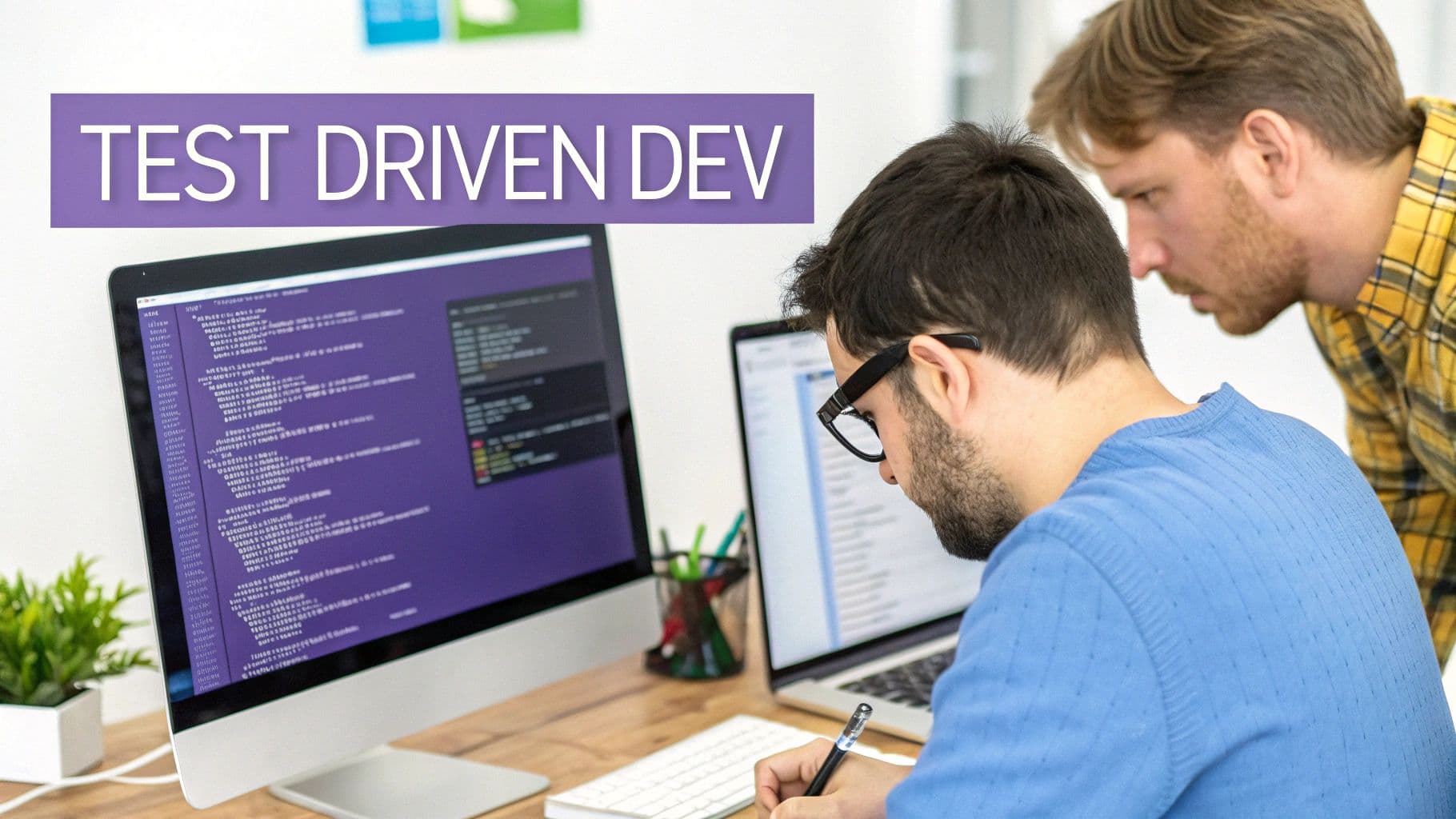
Popularized by Kent Beck, XP emphasizes frequent releases in short development cycles, fostering rapid feedback loops and adaptive planning. Unlike other agile methodology types that focus more on project management, XP’s strength lies in its concrete, engineering-focused practices designed to prevent defects and reduce the cost of change over the project's lifecycle.
When and Why to Use XP
XP is an excellent choice for startups and projects facing dynamic or unclear requirements, especially when building a technically complex MVP. Its focus on code quality and automated testing creates a robust, maintainable foundation that can scale without accumulating significant technical debt. This is critical for early-stage products that need to pivot or add features quickly. The famous Chrysler C3 payroll project was the birthplace of XP, demonstrating its power in turning around high-risk projects.
Actionable Tips for Implementation
- Adopt Practices Incrementally: Start with one or two core practices, like TDD or pair programming, before attempting a full-scale adoption. This allows the team to adapt gradually.
- Invest in Your Toolchain: XP relies heavily on automation. Ensure you have robust tools for continuous integration, automated testing, and version control from day one.
- Rotate Programming Pairs: Regularly switch partners in pair programming sessions. This practice is crucial for spreading knowledge across the team and preventing information silos.
- Prioritize a Sustainable Pace: XP advocates for a 40-hour work week to maintain high-quality output and avoid burnout, which is essential for long-term productivity and team morale.
4. Lean Software Development: Eliminating Waste for Maximum Value
Lean Software Development (LSD) adapts the principles of lean manufacturing, famously pioneered by Toyota, to the software world. Its core philosophy revolves around one central goal: eliminating waste to deliver maximum value to the customer. Waste, in this context, is anything that doesn't add value, such as unnecessary features, bureaucratic processes, or defects. It is one of the more philosophy-driven agile methodology types.
This methodology is guided by seven key principles: Eliminate Waste, Amplify Learning, Decide as Late as Possible, Deliver as Fast as Possible, Empower the Team, Build Integrity In, and See the Whole. By focusing on optimizing the entire value stream from concept to delivery, Lean helps teams build better products faster and more efficiently.
When and Why to Use Lean
Lean is exceptionally powerful for startups and established companies alike that need to operate with high efficiency and a strong customer focus. It's ideal for MVP development where the goal is to validate a core hypothesis with minimal investment. By focusing on rapid delivery and amplified learning, teams can quickly test ideas in the market and pivot based on real feedback. Companies like Amazon and Netflix embody Lean principles in their continuous deployment practices and culture of relentless optimization.
Actionable Tips for Implementation
- Map Your Value Stream: Start by visualizing your entire development process from idea to delivery. This makes it easy to identify bottlenecks, delays, and non-value-adding activities (waste).
- Focus on Flow: Optimize for a smooth, continuous flow of work rather than keeping every team member busy. A pull-based system, like Kanban, is an excellent tool for managing flow.
- Implement a Feedback Loop: Create short feedback cycles with customers to ensure you are building what they truly need. For a deeper dive into this iterative process, explore the principles of the Lean Startup methodology.
- Build Quality In: Automate testing and integrate quality checks throughout the development process. This prevents defects, a major form of waste, from slowing you down later.
5. Feature Driven Development (FDD): Model-Driven, Feature-Centric Delivery
Feature Driven Development (FDD) is a model-driven process that organizes development around client-valued features. It blends the adaptive nature of agile with the structure of a more planned approach, making it one of the more robust agile methodology types for large, complex projects. The process begins with creating a high-level domain model, which then informs a detailed feature list that guides development in short, two-week iterations.
Developed by Jeff De Luca and Peter Coad, FDD is defined by five key processes: Develop an Overall Model, Build a Features List, Plan by Feature, Design by Feature, and Build by Feature. This feature-centric organization provides tangible, measurable progress. Unlike other methods that rely on user stories, FDD’s features are small, client-valued results expressed in the format: <action> the <result> <by/for/of/to> a(n) <object>.
When and Why to Use FDD
FDD is exceptionally well-suited for large-scale enterprise projects where a clear initial understanding of the domain is possible and necessary. It provides a structured framework that scales effectively for larger teams while maintaining a focus on delivering concrete business value. Because it emphasizes design and modeling upfront, it helps mitigate risks associated with complex architectures. This approach was successfully used to build large banking systems for Singapore's Monetary Authority and United Overseas Bank, demonstrating its power in mission-critical environments.
Actionable Tips for Implementation
- Invest in the Domain Model: The initial "Develop an Overall Model" phase is critical. A comprehensive, well-understood domain object model sets the foundation for a successful project.
- Keep Feature Lists Granular: Ensure features can be completed within a two-week cycle. This keeps momentum high and provides frequent, tangible progress updates.
- Appoint Skilled Chief Programmers: This role is central to FDD, requiring individuals with strong technical and mentoring skills to guide feature teams and maintain design integrity.
- Conduct Regular Inspections: Use design and code inspections to ensure quality and adherence to the model. This is a core practice for maintaining high standards throughout the project lifecycle.
6. Dynamic Systems Development Method (DSDM): The Governed Approach to Agility
Dynamic Systems Development Method (DSDM) is a comprehensive agile framework that provides a structured, governed approach to project delivery. It's built on the philosophy that projects must deliver business value on time and on budget by fixing time, cost, and quality while allowing the scope to be variable. This makes it one of the more rigorous agile methodology types, focusing on frequent delivery and tight collaboration.
DSDM organizes the project into distinct phases: Pre-project, Feasibility, Foundations, Evolutionary Development, Deployment, and Post-project. This lifecycle ensures that a project is properly initiated and managed from conception to completion, providing a layer of governance often missing in other agile methods. Its emphasis on a "fitness for business purpose" ensures that the final product directly addresses core business needs.
When and Why to Use DSDM
DSDM is an excellent choice for organizations that need the benefits of agility but operate in environments requiring strong governance and predictability, such as the public sector or financial services. It is particularly well-suited for projects with tight deadlines and fixed budgets where adjusting scope is an acceptable trade-off. British Telecom and numerous UK government digital transformation projects have used DSDM to deliver complex systems successfully by ensuring alignment between business objectives and technical execution from the outset.
Actionable Tips for Implementation
- Ensure Strong Business Involvement: DSDM relies heavily on continuous business engagement. Secure dedicated time from business stakeholders and embed them within the project team from day one.
- Use MoSCoW Prioritization Rigorously: The "Must have, Should have, Could have, Won't have" technique is central to managing variable scope. Apply it strictly to the requirements backlog to make clear trade-off decisions.
- Invest in Proper Training: DSDM has specific roles and responsibilities. Provide formal training for team members to ensure everyone understands the framework's principles and practices. You can find resources at the Agile Business Consortium.
- Focus on Prototyping: Use iterative prototyping to explore requirements and validate solutions with users early and often. This helps ensure the final product is fit for its intended business purpose.
7. Crystal: The People-Centric, Adaptive Framework
Created by Alistair Cockburn, Crystal is not a single methodology but a family of agile methodology types tailored to different project sizes and criticalities. It operates on the core principle that people, not processes, are the most critical factor in a project's success. The framework prioritizes frequent delivery, reflective improvement, and close communication, adapting its practices to the specific context of the team.
The Crystal family is color-coded to represent different team sizes and project stakes. Crystal Clear is for small, co-located teams of 1-6 people, while other colors like Crystal Yellow, Orange, and Red provide more structure for larger, more complex projects. This adaptive nature makes it a highly flexible alternative to more rigid frameworks.
When and Why to Use Crystal
Crystal is ideal for teams that value autonomy and trust their developers to self-organize effectively. Its focus on communication and team dynamics makes it a strong choice for building an MVP where collaboration between developers and business experts is paramount. Startups can leverage Crystal Clear to maintain high development speed without getting bogged down by a heavy process overhead. Its flexibility allows the methodology to evolve with the team and the product as the startup grows.
Actionable Tips for Implementation
- Start with Crystal Clear: For most small teams and MVP projects, Crystal Clear provides a lightweight starting point that emphasizes essential agile practices.
- Prioritize Osmotic Communication: If possible, co-locate your team in the same room to facilitate the easy flow of information. If remote, invest heavily in high-bandwidth communication tools.
- Conduct Regular Reflection Workshops: Schedule frequent, informal sessions for the team to discuss what’s working and what isn’t, then adjust the process accordingly.
- Ensure Easy Access to Experts: The team must have direct and frequent access to a user or business expert to ask questions and get rapid feedback on the product.
8. Scaled Agile Framework (SAFe): The Enterprise Blueprint for Agile Alignment
The Scaled Agile Framework, or SAFe, is one of the most comprehensive agile methodology types designed to implement agile practices at an enterprise scale. It provides a structured, prescriptive blueprint for coordinating multiple agile teams working together on large, complex solutions. SAFe integrates principles from Lean, Agile, and DevOps to help large organizations align strategy with execution and deliver value more effectively.
The framework organizes teams into an Agile Release Train (ART), a long-lived, self-organizing team of agile teams that plans, commits, and executes together. This structure synchronizes alignment, collaboration, and delivery for large numbers of practitioners, ensuring that dozens or even hundreds of people are moving in the same direction.
When and Why to Use SAFe
SAFe is built for large, complex organizations that need to coordinate the efforts of many agile teams. It’s ideal when a company has multiple teams working on a single, integrated product or solution and struggles with alignment, dependencies, and consistent value delivery. Unlike simpler frameworks, SAFe provides specific roles, events, and artifacts for portfolio, large solution, and program levels. Companies like LEGO, Philips, and American Express have used SAFe to orchestrate their digital transformations and improve their product development processes across thousands of employees.
Actionable Tips for Implementation
- Start with Essential SAFe: This is the most basic configuration of the framework. Implement it first to build a solid foundation before adding more complex portfolio or solution-level elements.
- Invest Heavily in Training: SAFe introduces new roles and concepts. Ensure everyone, from leadership to individual team members, receives proper training and coaching to understand the new way of working.
- Focus on Value Streams: Organize your efforts around value streams, which represent the series of steps an organization uses to deliver value to a customer. This ensures all work is directly tied to customer outcomes.
- Secure Leadership Commitment: A SAFe transformation is a significant organizational change. It requires active and visible support from executive leadership to succeed.
9. Scaled Agile Framework (SAFe): Aligning Agile Across the Enterprise
The Scaled Agile Framework, or SAFe, is an extensive framework designed to implement agile practices at an enterprise scale. Unlike other agile methodology types that focus on a single team, SAFe provides a structured, top-down approach for aligning multiple agile teams, programs, and portfolios to achieve larger strategic business goals. It synchronizes collaboration and delivery for hundreds, or even thousands, of practitioners.
This infographic illustrates the foundational hierarchy of SAFe, showing how it organizes work across different organizational layers.
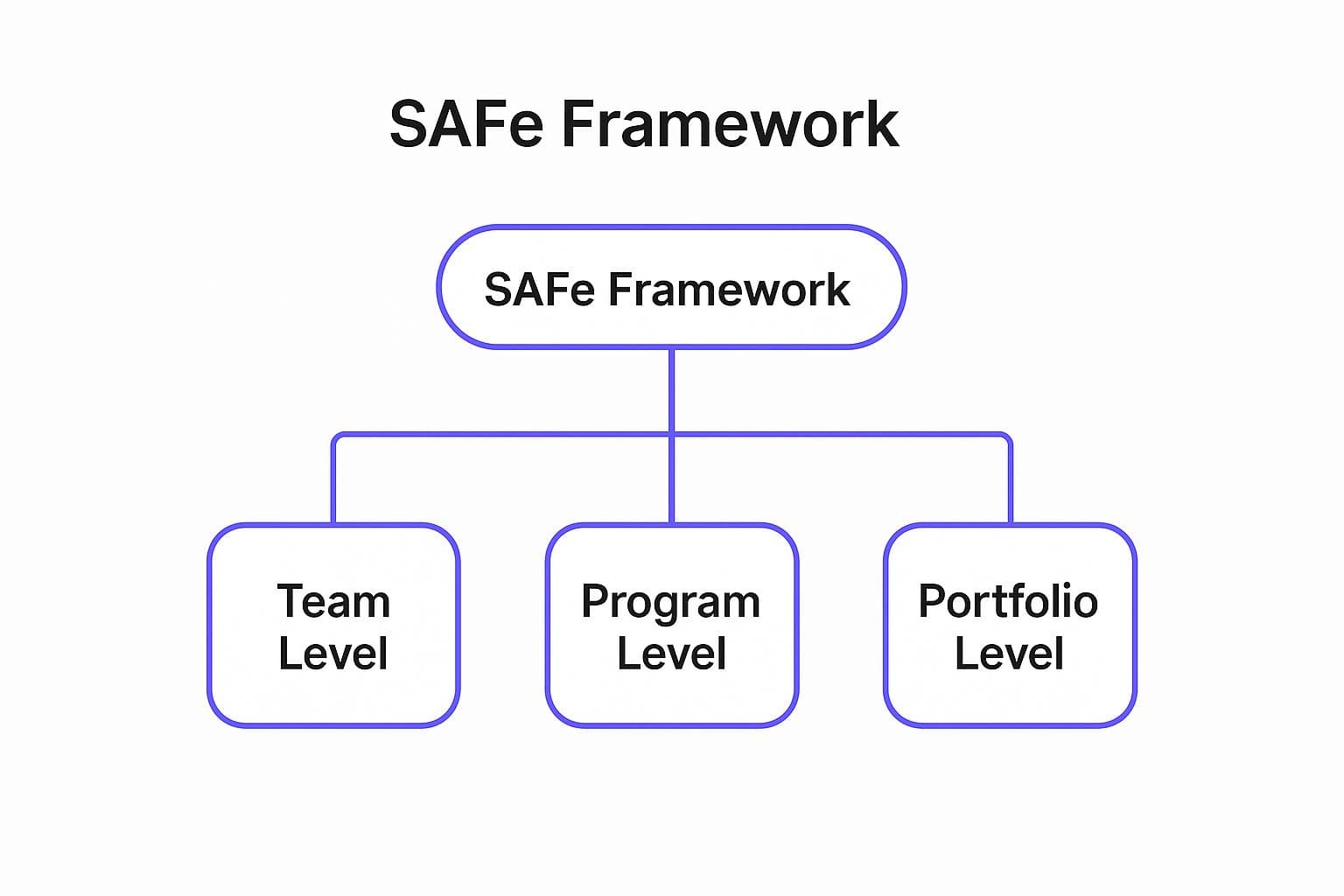
The visualization clarifies how individual agile teams connect to broader program initiatives, which in turn are driven by high-level portfolio strategies, ensuring enterprise-wide alignment.
When and Why to Use SAFe
SAFe is best suited for large, complex organizations that need to coordinate the work of many agile teams working on a single, integrated solution. While it’s often too prescriptive for an early-stage startup building an MVP, it becomes invaluable when a company grows and needs to manage dependencies across dozens of teams without losing agility. It provides a common language and process for strategy, funding, and execution, which is why companies like Intel and Cisco have adopted it to manage their large-scale product development efforts.
Actionable Tips for Implementation
- Start with the "Essential SAFe" Configuration: SAFe has multiple configurations. Begin with the most basic one, Essential SAFe, which covers the Team and Program levels, before attempting a full portfolio implementation.
- Establish Agile Release Trains (ARTs): The core of SAFe at the program level is the ART, a long-lived team of agile teams. Focus on organizing your teams into ARTs that are aligned to a common mission.
- Invest in PI Planning: Program Increment (PI) Planning is the cornerstone event in SAFe. Ensure all team members, stakeholders, and business owners are present for this multi-day planning event to align on objectives for the next 8-12 weeks.
- Appoint a Release Train Engineer (RTE): This role is like a chief Scrum Master for the ART. The RTE is a servant leader who facilitates program-level events and processes and is critical for success.
Agile Methodologies Comparison Matrix
| Methodology | Implementation Complexity 🔄 | Resource Requirements ⚡ | Expected Outcomes 📊 | Ideal Use Cases 💡 | Key Advantages ⭐ |
|---|---|---|---|---|---|
| Scrum | Moderate - defined roles and ceremonies | Requires committed, experienced teams | Regular working software increments every 1-4 weeks | Projects needing structure, collaboration, evolving requirements | Clear roles, strong team focus, transparency |
| Kanban | Low - minimal prescribed roles/cadence | Flexible, easy to adapt existing processes | Continuous flow, reduced bottlenecks, improved efficiency | Support, maintenance, continuous delivery, evolving workflows | Highly visual, flexible, quick to implement |
| Extreme Programming (XP) | High - demands rigorous engineering practices | High - pair programming, automated testing | High code quality, frequent releases, customer satisfaction | Teams prioritizing technical excellence and feedback | Rigorous code quality, knowledge sharing, customer focus |
| Lean Software Development | Moderate to High - culture and system thinking | Experienced team decision-making needed | Waste reduction, faster delivery, empowered teams | Organizations focusing on value delivery and learning | Waste elimination, continuous improvement, empowerment |
| Feature Driven Development (FDD) | Moderate - model-driven with specific roles | Experienced architects and developers | Regular, tangible feature delivery, strong design focus | Large teams, complex domains, projects needing predictability | Strong architecture, progress tracking, scalability |
| Dynamic Systems Development Method (DSDM) | High - comprehensive framework, multiple phases | Training and experienced practitioners required | Fixed budget/time projects with agile flexibility | Projects needing governance plus agility | Balanced rigor and agility, strong business involvement |
| Crystal Methodology | Low to Moderate - adaptable by team size | Depends on team maturity and communication | Frequent delivery, adaptive to team context | Teams valuing communication, small to medium projects | People-focused, flexible, scalable methodology |
| Scaled Agile Framework (SAFe) | Very High - enterprise-level complexity | Significant organizational commitment and training | Agile at scale, aligned teams, portfolio and strategic planning | Large enterprises with complex dependencies | Structured scaling, comprehensive, portfolio alignment |
From Theory to Launch: Making Your Agile Choice Actionable
We've journeyed through the diverse landscape of agile methodology types, from the structured sprints of Scrum to the continuous flow of Kanban and the engineering excellence demanded by Extreme Programming (XP). Each framework offers a distinct path toward a common destination: delivering high-value products efficiently and adaptively. The core takeaway is that "agile" is not a monolithic concept. It is a philosophy supported by a versatile toolkit, and the most successful teams are those who understand which tool to use for the job at hand.
The choice is not about finding the single "best" methodology. Instead, it is about finding the best fit for your team's unique context, your project's complexity, and your organization's culture. For a startup racing to build an MVP, the disciplined, time-boxed approach of Scrum might provide the necessary focus. A team managing continuous operational tasks and bug fixes might find Kanban's fluid, visual workflow more liberating and effective. Meanwhile, a project with high technical risk and a need for impeccable code quality could thrive under the rigorous practices of XP.
Synthesizing Your Agile Strategy
The true power of understanding these different agile methodology types lies in the ability to move beyond rigid adherence and toward intelligent adaptation. Many of the most effective development teams today practice a hybrid approach, borrowing elements that serve them best.
- Scrum + Kanban (Scrumban): Teams might use Scrum's roles and sprint structure for planning but adopt Kanban's visual board and WIP limits to manage the workflow within a sprint. This blend provides structure without sacrificing flexibility.
- XP + Scrum: A Scrum team might integrate XP's technical practices like pair programming and test-driven development to elevate their engineering standards and reduce technical debt within each sprint.
- Lean Principles as a Foundation: Regardless of the chosen framework, the Lean principles of eliminating waste and optimizing the whole value stream can serve as a guiding philosophy. Ask yourself: "Does this ceremony, task, or feature truly add value for the customer?"
Your Actionable Next Steps
To translate this knowledge into tangible results, avoid analysis paralysis. Start with a deliberate, informed choice and commit to an iterative process of refinement.
- Assess Your Context: Evaluate your team size, project goals (e.g., MVP vs. mature product), and organizational constraints. Be honest about your team's current skill set and discipline.
- Select a Starting Point: Pick the framework that most closely aligns with your assessment. Don't be afraid to start small. If you're new to agile, Kanban's low barrier to entry can be an excellent starting point.
- Run a Pilot Project: Test your chosen methodology on a single, low-risk project. This creates a safe space to learn, make mistakes, and gather real-world data on what works and what doesn't.
- Gather Feedback and Iterate: After the pilot, hold a retrospective. What were the pain points? What went smoothly? Use this feedback to tweak your process. Maybe you need shorter sprints, stricter WIP limits, or more dedicated pair programming time.
Ultimately, mastering agile is not a one-time decision but an ongoing commitment to continuous improvement. By understanding the nuances of various agile methodology types, you empower your team to build better products faster, adapt to market changes with confidence, and transform innovative ideas into impactful realities.
Navigating the complexities of agile and building a high-performing development team can be challenging. Iglu Digital specializes in connecting you with world-class tech talent and managing remote teams proficient in all major agile frameworks, helping you launch your MVP and scale effectively. Find your perfect agile-ready team today at Iglu Digital.